
All Blogs Categories, Technical SEO Audit: 10 Hidden Errors Stopping Your Kenyan Website From Ranking
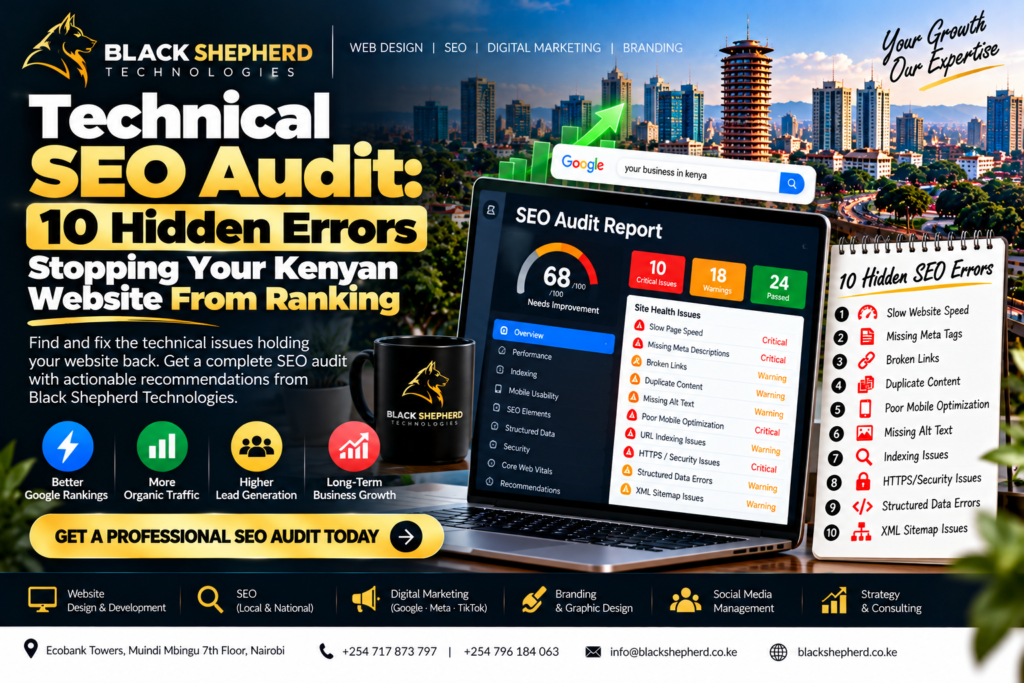
Technical SEO Audit: 10 Hidden Errors Stopping Your Kenyan Website From Ranking
Oct
The digital ecosystem across Kenya is expanding at an extraordinary velocity. From the corporate financial headquarters of Upper Hill and Westlands to the vibrant retail and tech hubs of Nairobi’s Central Business District, the coastal tourism corridors of Mombasa, the growing urban centers of Nakuru, and the bustling commercial markets of Eldoret, businesses are racing to establish a powerful online footprint.
Entrepreneurs invest heavily in professional graphic design, engaging social media content, and high-end copywriting. Yet, despite these investments, many Kenyan business owners experience a frustrating paradox: their websites sit invisible on page three or four of Google search results, traffic remains stagnant, and expected online leads fail to materialize.
When a website fails to rank despite having great content, the root cause is rarely a lack of business ambition. More often than not, the culprit lies deep within the invisible backend architecture of the site—hidden technical errors that silently block search engine crawlers from indexing, understanding, and ranking your pages.
Conducting a rigorous technical audit and resolving these hidden errors is the definitive step to unlocking organic visibility. Professional SEO Services in Kenya focus heavily on diagnosing and repairing these backend bottlenecks to ensure your enterprise captures high-intent search traffic.
1. The Anatomy of Technical SEO: Why Backend Architecture Matters
To understand why technical errors prevent a website from ranking, we must first look at how search engines like Google operate. Google dispatches automated software programs known as “crawlers” or “spiders” to scour the internet. These crawlers discover web pages by following hyperlinks, download the content, analyze its structure, and store it in a massive database known as the index.
If your website suffers from technical flaws, Google’s crawlers encounter roadblocks. They may get trapped in infinite loops, fail to render JavaScript elements properly, or get blocked entirely by misconfigured security files. If search engines cannot crawl and index your pages smoothly, your content will never appear on search engine results pages (SERPs)—no matter how well-written it is.
At Black Shepherd Technologies, our technical engineering audits are designed to uncover and eliminate these hidden roadblocks. Reviewing our successful digital implementations across diverse sectors via our comprehensive portfolio and projects archive illustrates how rigorous backend optimization unlocks explosive organic growth for local enterprises.
2. The 10 Hidden Technical Errors Stopping Your Kenyan Website From Ranking
Below are the ten most common and damaging technical SEO errors found on Kenyan business websites, along with actionable steps on how to identify and fix them.
Error #1: Misconfigured robots.txt Files Blocking Search Crawlers
The robots.txt file is a simple text document located in your website’s root directory that instructs search engine crawlers which pages they are allowed to visit and which they must ignore.
-
The Problem: It is remarkably common for developers during website staging or redesign phases to insert a line of code (
Disallow: /) to prevent Google from indexing an unfinished site. When the website launches publicly, developers frequently forget to remove that restriction. As a result, Google’s crawlers are barred from scanning the entire domain, keeping your brand completely unranked. -
The Impact: Complete invisibility on search engine result pages.
-
How to Fix It: Access your root directory via FTP or your hosting file manager, open your
robots.txtfile, and ensure that you are not accidentally blocking essential pages or your entire site from search engine crawlers.
Error #2: Broken XML Sitemaps or Orphaned Pages
An XML sitemap acts as a roadmap for search engines, listing all the vital URLs on your website that you want indexed.
-
The Problem: Many websites feature outdated sitemaps that include deleted URLs, redirected pages, or unlinked “orphaned” pages (pages that exist on your server but have no internal links pointing to them). When search engines encounter broken sitemap maps or orphaned URLs, crawling efficiency drops dramatically.
-
The Impact: Important product or service pages fail to get discovered or indexed by Google.
-
How to Fix It: Generate a clean, updated XML sitemap using an SEO plugin or automated crawler tool. Submit the fresh sitemap directly through Google Search Console to ensure rapid re-indexing of your core commercial pages.
Error #3: Severe Mobile Responsiveness and Speed Bottlenecks
Kenya is a distinctly mobile-first digital economy. Driven by widespread 4G and expanding 5G network coverage, mobile data traffic accounts for the overwhelming majority of internet sessions nationwide.
-
The Problem: Many corporate and retail websites in Kenya are designed primarily on desktop computers without proper mobile optimization. Heavy uncompressed imagery, unoptimized CSS, and bloated WordPress themes cause mobile loading times to stretch beyond 5 to 7 seconds.
-
The Impact: High bounce rates, poor Core Web Vitals scores, and direct ranking penalties from Google’s mobile-first indexing algorithms.
-
How to Fix It: Compress high-resolution images into next-gen formats like WebP, leverage browser caching, migrate to high-performance cloud hosting infrastructure, and ensure touch-friendly navigation across all mobile viewports.
Error #4: Duplicate Content and Unresolved Canonicalization Issues
Duplicate content occurs when identical or nearly identical content appears on multiple URLs across your website (e.g., HTTP vs. HTTPS versions, www vs. non-www versions, or parameter-based product sorting filters in e-commerce stores).
-
The Problem: When search engines find identical content on multiple URLs, they become confused about which version to rank, splitting your link equity and diluting your ranking power.
-
The Impact: Keyword cannibalization, suppressed rankings, and wasted crawl budget.
-
How to Fix It: Implement proper canonical tags (
rel="canonical") pointing search engines to the definitive primary version of each page, and enforce strict 301 redirects to ensure unified domain authority.
Error #5: Ignored or Missing HTTPS Security Certificates
In the modern digital landscape, security is paramount. Consumers and search engines alike demand absolute data protection.
-
The Problem: Running a website on an unsecured HTTP protocol rather than an encrypted HTTPS protocol triggers immediate security warnings in web browsers like Google Chrome (“Not Secure”).
-
The Impact: Users immediately bounce away from your site, destroying conversion rates, while Google explicitly penalizes unsecured websites in search rankings.
-
How to Fix It: Install a valid SSL/TLS certificate on your web server and configure automatic 301 redirects routing all incoming HTTP traffic to the secure HTTPS version.
Error #6: Chain and Loop 301 Redirect Failures
When you delete or move a web page, you should implement a 301 redirect to send users and search crawlers to the new, active URL.
-
The Problem: Over time, websites accumulate messy redirect chains (URL A redirects to URL B, which redirects to URL C, which redirects to URL D) or fatal redirect loops (URL A redirects to URL B, and URL B redirects back to URL A).
-
The Impact: Crawlers abandon the crawl sequence in frustration, wasting valuable server resources and causing significant page loading delays.
-
How to Fix It: Audit your website using professional crawling software to identify and flatten redirect chains, ensuring every old URL points directly to its final destination in a single hop.
Error #7: Poor Internal Linking Architecture and “Dead Ends”
Internal links connect different pages on your website together, helping users navigate and helping search crawlers understand page hierarchy.
-
The Problem: Many business websites feature siloed pages with zero internal links connecting them to core service categories or blog resources. These “dead ends” trap users and prevent link equity (ranking power) from flowing freely across your domain.
-
The Impact: Important commercial pages remain weak in authority and fail to rank for competitive keywords.
-
How to Fix It: Build a robust internal linking strategy, ensuring every new blog post or product page links contextually back to core revenue-generating service pages.
Error #8: Missing or Improperly Formatted Schema Markup
Schema markup (structured data) is a standardized code vocabulary added to your website’s backend that helps search engines understand the context of your content.
-
The Problem: Websites lacking LocalBusiness, Product, Review, or Organization schema miss out on rich snippets (such as star ratings, operating hours, and price tags directly on Google search results).
-
The Impact: Lower click-through rates (CTR) on search results pages and reduced contextual understanding by search engine crawlers.
-
How to Fix It: Implement clean JSON-LD structured data markup tailored to your exact business type—whether you operate a local retail store in Nairobi, a coastal resort in Mombasa, or an agribusiness supplier in Nakuru.
Error #9: Unoptimized URL Structures and Parameter Bloat
URLs should be clean, descriptive, and easy for both humans and search engines to read.
-
The Problem: Utilizing messy, parameter-heavy URLs full of random numbers and symbols (e.g.,
mysite.com/p?id=1048&cat=3) rather than clean semantic structures (e.g.,mysite.com/kenya/seo-services-kenya) confuses crawlers. -
The Impact: Lower keyword relevance signals and poor user trust when sharing links.
-
How to Fix It: Clean up your permalink structures, utilizing descriptive keyword slugs that clearly communicate the page topic.
Error #10: Unmonitored 404 Not Found Errors
A 404 error occurs when a user or search crawler attempts to visit a page that has been deleted, moved, or misspelled.
-
The Problem: Allowing broken links to persist without custom error handling or proper redirection creates a frustrating user experience and signals site neglect to search engines.
-
The Impact: Increased bounce rates, wasted crawl budget, and lost conversion opportunities.
-
How to Fix It: Regularly monitor Google Search Console for 404 crawl errors, and set up 301 redirects pointing broken URLs to relevant, active replacement pages.
Different commercial sectors experience unique technical demands. Exploring the specialized industries we serve demonstrates how customized technical frameworks align with sector-specific operational complexities.
3. Step-by-Step Blueprint: Conducting Your Own Technical SEO Audit
Fixing technical errors requires a structured, systematic methodology. Below is the blueprint professional digital agencies use to audit and rehabilitate enterprise websites:
Phase 1: Crawl the Entire Website
Deploy professional website crawling software (such as Screaming Frog, Semrush, or Ahrefs) to scan every URL on your domain. Configure the crawler to simulate Googlebot mobile and desktop user agents to capture authentic crawling behavior.
Phase 2: Analyze Indexation and Coverage Reports
Open Google Search Console and review your Indexing report. Check for excluded pages, server errors (5xx), client errors (404), and pages blocked by robots.txt. Ensure that your canonical tags match your intended indexation strategy.
Phase 3: Evaluate Performance and Core Web Vitals
Run field and lab data performance diagnostics to assess LCP, INP, and CLS metrics. Address image compression, script bloat, and server response latency immediately.
Phase 4: Fix and Validate
Prioritize fixes based on commercial impact—resolving site-wide crawling blocks and HTTPS issues first, followed by redirect chains, schema implementation, and internal link restructuring. Once fixed, request validation through Google Search Console.
Conclusion and Next Steps
Technical search engine optimization is the invisible foundation upon which all online success is built. You can publish exceptional content, invest in brilliant copywriting, and run aggressive marketing campaigns, but if your website suffers from hidden technical errors, your rankings will remain suppressed.
By identifying and repairing these ten technical roadblocks, you open the floodgates for search engine crawlers to index your pages, understand your offers, and rank your business prominently on Google.
Ready to uncover the hidden technical errors holding your website back and scale your digital presence across Kenya? Partner with technical specialists who understand modern web architecture. Explore our proven methodologies, review our past success stories, and discover how tailored digital solutions can elevate your enterprise. Take the first step toward sustained commercial growth by visiting Black Shepherd Technologies today.
