
Kenya
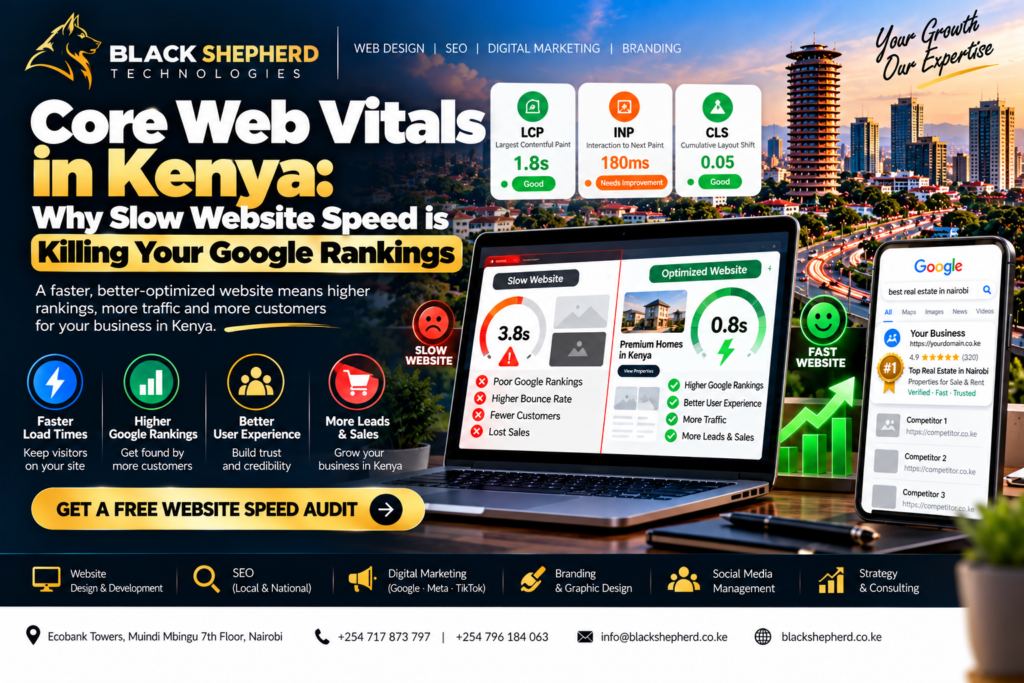
Core Web Vitals in Kenya: Why Slow Website Speed is Killing Your Google Rankings
Oct
The digital marketplace in Kenya has reached an unprecedented level of sophistication. From the bustling commercial corridors of Nairobi’s Central Business District and Westlands to the coastal tourism hubs of Mombasa, the growing urban centers of Nakuru, and the athletic and industrial dynamism of Eldoret, businesses are shifting online faster than ever before.
Entrepreneurs invest heavily in aesthetic web design, social media marketing, and content creation. Yet, despite these efforts, many Kenyan business owners find themselves staring at a frustrating reality: their websites sit buried on page two or three of Google search results, web traffic remains stagnant, and prospective customers abandon their digital checkouts before making a purchase.
The culprit behind this underperformance is rarely poor copywriting or a lack of business ambition. More often than not, it is invisible to the naked eye but devastating to search engine algorithms: slow website speed and poor Core Web Vitals performance.
If your website takes more than a few seconds to load on a smartphone, you are actively losing customers and getting heavily penalized by Google’s ranking algorithms. Understanding how technical performance dictates your digital visibility—and investing in professional SEO Services in Kenya that prioritize speed and user experience—is the single most important technical upgrade your enterprise can make this year.
1. The Mobile-First Kenyan Digital Landscape
To understand why website speed matters so much, we must first examine how internet users access information across Kenya. Kenya is a distinctly mobile-first economy. Driven by widespread 4G coverage, expanding 5G network rollouts by telecommunications providers, and affordable smartphones, mobile data traffic accounts for the overwhelming majority of internet sessions nationwide.
When a consumer or corporate buyer in Nairobi searches for office furniture, a tourist in Diani looks for a beach resort, or an engineer in Eldoret searches for heavy machinery parts, they are almost certainly using a mobile device—often while sitting in traffic along Mombasa Road, relaxing in a hotel room, or managing tasks on-the-go.
The Psychology of Mobile Impatience
Mobile users are notoriously impatient. When an internet user clicks a link on Google search results, they expect the page to render instantly.
-
If a web page takes 1 second to load, the user’s focus remains steady.
-
If load time stretches to 3 seconds, the probability of the user bouncing (leaving the site immediately) increases dramatically.
-
If a page takes 5 to 7 seconds to load—a common occurrence on bloated, unoptimized WordPress themes hosted on cheap local or international servers—the user abandons the page entirely, returning to Google and clicking on your competitor’s link.
Google measures this user behavior meticulously. When search engine crawlers notice that visitors consistently bounce away from your website within seconds, Google interprets this signal as a poor user experience. Consequently, your rankings drop, pushing your business further into digital obscurity.
2. What Are Core Web Vitals? (Google’s Speed Metrics)
For years, search engine optimization focused heavily on keyword density, meta tags, and backlink volume. While those elements remain important, Google revolutionized ranking criteria by introducing Core Web Vitals—a set of standardized, user-centric metrics that measure real-world user experience regarding loading speed, interactivity, and visual stability.
To dominate search results in Kenya, your web developers and SEO strategists must master the three core pillars of Core Web Vitals:
+-------------------------------------------------------------+
| CORE WEB VITALS METRICS OVERVIEW                            |
|                                                             |
| 1. LCP (Largest Contentful Paint) -> Loading Speed          |
|    Measures how fast main page content renders (Target: <2.5s) |
|                                                             |
| 2. FID / INP (Interactivity)       -> Responsiveness        |
|    Measures how quickly the page responds to user input     |
|                                                             |
| 3. CLS (Cumulative Layout Shift)   -> Visual Stability      |
|    Measures unexpected shifting of elements while loading   |
+-------------------------------------------------------------+
1. Largest Contentful Paint (LCP): Measuring Loading Speed
LCP measures how long it takes for the main, largest piece of content on a web page (usually a hero image, a large heading banner, or a video container) to become fully visible within the user’s viewport.
-
The Benchmark: To pass Google’s performance threshold, your LCP must occur within 2.5 seconds of the page starting to load.
-
The Kenyan Reality: Many local business websites feature massive, uncompressed product photographs, heavy sliders, and bloated plugin scripts. When loaded over mobile data networks, these elements cause LCP times to skyrocket past 6 or 7 seconds, failing Google’s core standard.
2. Interaction to Next Paint (INP) / First Input Delay (FID): Measuring Responsiveness
Interactivity metrics measure how responsive your website is when a user tries to interact with it—such as clicking a menu button, tapping an M-Pesa payment button, typing into a search bar, or opening a dropdown menu.
-
The Benchmark: Your page should respond to user inputs in under 200 milliseconds.
-
The Kenyan Reality: Websites cluttered with heavy JavaScript code, third-party analytics trackers, and complex chat widgets freeze up when users try to tap them on mobile screens, creating a frustrating, laggy experience.
3. Cumulative Layout Shift (CLS): Measuring Visual Stability
Have you ever visited a mobile website, started reading an article or looking at a product price, and suddenly an ad or an image loaded above, causing the entire text to shift downward so that you clicked the wrong button? That jarring visual instability is measured by CLS.
-
The Benchmark: Your page must maintain a CLS score of less than 0.1.
-
The Kenyan Reality: Poorly coded templates that lack explicit width and height dimensions for images and banner ads cause chaotic layout shifts as content loads asynchronously over mobile networks.
Examining successful digital transformations across diverse sectors via our comprehensive portfolio and projects archive illustrates how rigorous technical optimization and lightning-fast web architecture eliminate these performance bottlenecks, driving exceptional user engagement and top-tier search rankings.
3. Why Slow Speed Destroys Your Google Rankings and Revenue
The relationship between slow website speed and lost revenue is direct and mathematically proven. When your Core Web Vitals scores fail Google’s evaluation, multiple cascading failures occur within your digital ecosystem:
1. Direct Algorithmic Penalties
Google’s search engine algorithms use Core Web Vitals as explicit ranking factors for mobile and desktop search results. If your competitors have faster LCP and lower CLS scores than your website, Google will systematically rank them above you—even if your content or product quality is superior.
2. Plummeting Conversion Rates and M-Pesa Friction
In Kenya’s fast-moving digital economy, checkout friction kills sales. Whether your platform integrates M-Pesa STK push checkout, Pesapal, or credit card processing, a slow-loading website creates doubt in the mind of the consumer. If a customer clicks “Buy Now” or “Request Quote” and the page freezes or takes ten seconds to process, they will abandon the cart and purchase from an agile competitor.
3. Skyrocketing Bounce Rates
As discussed earlier, slow loading speeds force mobile users to hit the back button immediately. High bounce rates signal to search engines that your website does not satisfy user intent, triggering a downward spiral in your keyword rankings across major search queries in Nairobi, Mombasa, Nakuru, and Eldoret.
Different commercial sectors experience unique technical demands. Exploring the specialized industries we serve demonstrates how customized technical frameworks align with sector-specific operational complexities.
4. Step-by-Step Blueprint: Fixing Core Web Vitals and Accelerating Your Website
Optimizing your website to pass Google’s Core Web Vitals audit requires a disciplined, engineering-first approach. Below is the blueprint utilized by top-tier digital agencies to rehabilitate sluggish websites and secure page-one rankings.
Step 1: Comprehensive Performance Auditing
Before writing code, you must diagnose exactly where your website is losing speed.
-
Run your domain through performance diagnostic tools like Google PageSpeed Insights, Lighthouse, and WebPageTest.
-
Analyze mobile versus desktop performance metrics separately, focusing heavily on mobile data simulation profiles representing typical 4G/5G speeds in East Africa.
-
Identify resource-heavy bottlenecks, such as uncompressed images, render-blocking JavaScript files, and slow server response times.
Step 2: Image Optimization and Modern Formats
Images typically make up the largest percentage of page weight on commercial websites.
-
Compress and Resize: Never upload raw smartphone photos or high-resolution camera files directly to your web server. Resize images to their exact display dimensions and compress them without losing visual clarity.
-
Adopt Next-Gen Formats: Convert legacy JPEG and PNG images into modern, highly compressed formats like WebP or AVIF, which load significantly faster on mobile browsers.
-
Implement Lazy Loading: Configure your images and videos to “lazy load”—meaning they only download when the user scrolls down to view them, rather than loading all at once during initial page render.
Step 3: Server Infrastructure and Hosting Upgrade
Many Kenyan businesses host their websites on cheap, overcrowded shared hosting servers located thousands of miles away in Europe or the United States. Physical distance introduces high server latency (Time to First Byte or TTFB).
-
Migrate to High-Performance Cloud Hosting: Utilize robust cloud infrastructure with Content Delivery Network (CDN) integration (such as Cloudflare caching nodes located closer to East Africa) to slash server response times.
-
Leverage Browser Caching: Configure proper caching headers so that returning visitors load your static assets instantly from their local browser cache rather than re-downloading your entire site.
Step 4: Streamlining Code and Eliminating Bloat
Bloated themes and excessive plugins are primary killers of mobile performance.
-
Audit Plugins and Scripts: Remove unnecessary WordPress plugins, heavy page builders, and redundant tracking scripts that inject unnecessary JavaScript into your page headers.
-
Minimize and Defer JavaScript: Clean up render-blocking JavaScript files that prevent the browser from rendering visible page content until heavy scripts finish downloading.
5. Measuring Success: Tracking Speed Improvements and Ranking Gains
Technical optimization must be measured against concrete performance improvements. Once your development and SEO team implement speed fixes, you should monitor specific metrics to validate your investment.
Key Performance Indicators (KPIs) to Track:
-
PageSpeed Insights Score: Aim for a green score (90 to 100) on mobile and desktop performance audits.
-
Largest Contentful Paint (LCP): Verify that your LCP drops below the critical 2.5-second threshold.
-
Cumulative Layout Shift (CLS): Ensure your CLS score reads close to 0.0, confirming complete visual stability.
-
Organic Search Traffic and Rankings: Track the steady ascent of your core commercial keywords from page two into the top three positions on Google search results.
Conclusion and Next Steps
In the competitive digital economy of Kenya, website speed is no longer just a technical nice-to-have—it is a core determinant of commercial survival. If your website is sluggish, unoptimized, and failing Core Web Vitals benchmarks, your business is losing high-intent customers and wasting marketing capital every single day.
By partnering with technical experts who understand modern web architecture, mobile network dynamics, and search engine optimization, you can transform your digital asset into a lightning-fast, high-converting powerhouse.
Ready to eliminate speed bottlenecks, outrank your competitors, and maximize your Google rankings? Partner with specialists who understand the Kenyan digital landscape. Explore our proven methodologies, review our past success stories, and discover how tailored digital solutions can elevate your enterprise. Take the first step toward sustained commercial growth by visiting Black Shepherd Technologies today.
