Welcome to the definitive masterclass on digital supremacy, where we examine the profound convergence of Creative Direction in Tech: Merging Visual Storytelling with Powerful Code, master the operational discipline of How to Standardize Your Digital Creative Assets Across Web and Social Media, quantify The ROI of Creative Design: How Quality Visuals Directly Impact Sales in Kenya, implement Designing for Mobile-First Audiences: Best Practices for Kenyan Consumer Brands, explore How to Integrate Brand Identity with High-Ranking Local SEO Strategies in Kenya, analyze how SEO Services in Kenya: How Creative Content Dominates Search Engine Results, execute strategies to Dominate Google Kenya: The Complete Guide to Local SEO for Nairobi Enterprises, and uncover Why Technical Web Speed Optimization is Vital for Organic SEO Ranking in 2026. In today’s hyper-competitive digital economy, businesses can no longer afford to treat design, engineering, asset management, mobile optimization, search engine visibility, and site performance as isolated silos. True digital leadership requires an integrated, holistic framework that bridges creative vision with technical execution to drive sustainable commercial dominance.
Part 1: Creative Direction in Tech: Merging Visual Storytelling with Powerful Code
For decades, the technology and creative sectors existed in parallel universes. On one side stood software engineers, data scientists, and systems architects—building robust logic, optimizing backend databases, and writing clean, scalable code. On the other side stood graphic designers, brand strategists, copywriters, and art directors—crafting compelling color palettes, evocative imagery, and resonant brand stories. These two worlds rarely spoke the same language. Code was viewed as rigid, mathematical, and utilitarian; design was seen as fluid, subjective, and decorative. Today, that rigid boundary has completely dissolved.
1.1 The Anatomy of Digital Creative Direction
Digital creative direction is the overarching strategic leadership that governs how a brand’s digital product looks, feels, behaves, and communicates across every screen. It encompasses:
-
Brand Translation: Taking core brand identity pillars and translating them into dynamic digital UI/UX systems.
-
Experience Architecture: Guiding the user journey not just through wireframes, but through emotional resonance and pacing.
-
Multi-Disciplinary Alignment: Aligning UI/UX designers, motion graphic artists, copywriters, and frontend engineers toward a single unified vision.
1.2 Moving Beyond Static Aesthetics
In software development, design systems dictate how components behave. However, design tokens alone do not create a soul. Creative direction provides the narrative context that breathes life into these components. It dictates the rhythm of micro-interactions, the subtle narrative arc of an onboarding sequence, and the emotional tone conveyed through typography and motion graphics. When executed correctly, creative direction ensures that a digital platform is instantly recognizable, highly trustworthy, and deeply engaging from the very first millisecond of load time.
1.3 The Engine Room: Code as the Medium of Modern Storytelling
A brilliant creative vision trapped in a static PDF or Figma mockup is like a Hollywood screenplay left unfilmed. In the digital realm, code is the film stock. Without powerful, optimized, and inventive code, creative direction remains unfulfilled potential. Modern web and application development offers unprecedented toolsets that allow developers to act as digital artisans:
-
WebGL and Three.js: Allowing developers to render complex 3D interactive graphics, particle systems, and immersive environments directly in the browser without third-party plugins.
-
Advanced CSS and Native Animations: Modern CSS features empower engineers to build fluid, highly complex layouts that adapt seamlessly to any device.
-
Motion Libraries (Framer Motion, GSAP): Enabling physics-based animations, spring dynamics, and timeline sequencing that make UI interactions feel organic, tactile, and alive.
Part 2: How to Standardize Your Digital Creative Assets Across Web and Social Media
In the modern digital ecosystem, a brand rarely interacts with its audience through a single touchpoint. A prospective customer might discover your company via a punchy, fast-moving TikTok video, research your offerings through a LinkedIn thought-leadership post, evaluate your credibility by visiting your official website, and finally convert inside a mobile application. Across this entire customer journey, the brand’s visual identity must act as an unbroken thread.
2.1 Implementing a Centralized Single Source of Truth (DAM)
The foundation of asset standardization is the elimination of local folders and scattered desktop files.
-
Implement a Digital Asset Management (DAM) Platform: Use cloud-based repositories (such as Cloudinary, Bynder, or Figma libraries) where every approved logo variation, icon, graphic, and video file lives.
-
Establish Clear Folder Structures and Naming Conventions: Standardize file naming protocols (
BrandName_AssetType_Platform_Dimensions_Version.ext) so team members across marketing, web development, and social media can instantly find and verify approved files. -
Lock Down Master Files: Restrict editing permissions for master brand assets to core creative directors or brand managers, while allowing team members to access read-only or templated versions.
2.2 Codifying Design Tokens and Visual Guidelines
Visual consistency relies on precise parameters that translate across both code and design tools.
-
Document Design Tokens: Define core variables for your color palette, typography hierarchies, spacing scales, and iconography styles in a centralized style guide.
-
Bridge Design and Code: Ensure your web development team uses the exact same design tokens that your graphic designers use in Figma or Adobe Creative Cloud, preventing discrepancies between web UI and social graphics.
-
Define Imagery and Tone Rules: Document clear rules for photography, illustration style, aspect ratios, and filter presets to ensure a cohesive emotional tone whether a user lands on your homepage or scrolls past an Instagram post.
2.3 Developing Cross-Platform Adaptable Templates
Different platforms require different dimensions, but the core visual narrative must remain identical.
-
Master Template Frameworks: Create master templates in design software for standard social dimensions pre-populated with locked brand elements like logos, safe zones, and typography rules.
-
Modular Web Components: On the web side, use reusable UI components and design system libraries to ensure that content blocks, promotional banners, and call-to-action buttons share uniform styling.
-
Automated Resizing and Exporting: Leverage batch export tools or automated design plugins to quickly generate platform-optimized variations of promotional artwork without manual recreation.
Part 3: The ROI of Creative Design: How Quality Visuals Directly Impact Sales in Kenya
For many business owners and marketing executives in Kenya’s fast-paced digital ecosystem, creative design is often treated as an afterthought—a quick touch-up or a last-minute flyer created hours before a campaign launch. In a bustling commercial hub like Nairobi, enterprises frequently invest heavily in media spend, search optimization, and social media management while allocating minimal thought to the visual quality of their assets. This approach overlooks a fundamental economic reality: design is not just decoration; it is a direct driver of revenue.
3.1 The Psychology of First Impressions: Speed, Trust, and Perception
Human beings are intensely visual creatures. Psychological and neurological research consistently demonstrates that the human brain processes visual information significantly faster than plain text.
-
The 50-Millisecond Window: When a prospective customer in Kenya encounters your brand online—whether via a targeted Facebook ad, a sponsored LinkedIn post, or your official homepage—they form an opinion within the first 50 milliseconds.
-
Eliminating Cognitive Friction: When a design is intuitive and visually organized, it reduces cognitive load, making it easier for the customer to progress down the sales funnel.
3.2 Quantifying the Financial Impact
Studies on brand economics and visual marketing indicate that professional branding and high-tier design can boost overall revenue significantly—often driving up to a 23% increase in revenue for businesses that maintain rigorous visual consistency.
-
Lower Customer Acquisition Cost (CAC): High-converting ad creatives capture attention faster in crowded social feeds, raising Click-Through Rates (CTR) and lowering cost-per-click rates.
-
Commanding Premium Pricing: Consumers are naturally willing to pay more for products and services that look established, reliable, and premium.
-
Higher Conversion Rates: A beautifully designed website with clear call-to-action (CTA) buttons, professional product imagery, and smooth visual hierarchy converts visitors at a much higher percentage.
Part 4: Designing for Mobile-First Audiences: Best Practices for Kenyan Consumer Brands
In the contemporary Kenyan digital marketplace, mobile devices are not just one option among many—they are the absolute centre of gravity. Recent industry reports confirm that an overwhelming majority of Kenyan internet users access the web almost exclusively via smartphones.
4.1 Navigating Hardware and Data Realities
-
Handset Diversity and Mid-Range Dominance: The bulk of digital consumption occurs on mid-range and entry-to-mid-tier Android smartphones. Heavy, unoptimized animations or bloated JavaScript frameworks can cause severe lag, frustrating users and driving up bounce rates.
-
Data Consciousness: Mobile data in Kenya is a valued commodity. Fast, lightweight sites that respect data usage win consumer loyalty.
-
Network Fluctuations: Progressive web apps and resilient, fast-loading interfaces are vital to prevent connection timeouts during critical user journeys.
4.2 Ergonomic Thumb Zones and Mobile UX
-
Bottom-Anchored Navigation: Place primary Call-to-Action (CTA) buttons, navigation bars, and checkout triggers within easy reach at the bottom of the screen.
-
Generous Touch Targets: Ensure interactive elements have a minimum touch target size of 48×48 pixels to prevent mis-taps.
-
M-Pesa Integration and Conversational Commerce: Integrate prominent “Pay with M-Pesa” buttons that instantly prompt STK pushes, and embed floating WhatsApp chat widgets on product pages to allow instant customer communication.
Part 5: How to Integrate Brand Identity with High-Ranking Local SEO Strategies in Kenya
In the digital marketing landscape, business owners often treat brand identity and search engine optimization (SEO) as two entirely distinct disciplines. In Kenya’s fast-growing and fiercely competitive digital marketplace, maintaining this artificial divide is a costly mistake.
5.1 Infusing Brand Voice into Local Keyword Research
-
Locational Nuance and Cultural Resonance: Kenyan consumers search using a blend of formal terms, localized phrasing, and neighborhood-specific references (e.g., searching for services in Westlands, Kilimani, CBD Nairobi, or Upper Hill). Your keyword strategy should incorporate these regional markers without losing your brand’s signature tone.
-
Semantic Brand Integration: Weave target local keywords organically into compelling brand narratives, taglines, and value propositions that reflect your brand personality.
5.2 Optimizing Your Google Business Profile (GBP) as a Brand Anchor
Your Google Business Profile is often the very first touchpoint a customer has with your brand on Google Maps and local search results.
-
Visual Consistency: Every visual asset uploaded to your GBP must strictly adhere to your brand guidelines. High-resolution, professionally styled images signal institutional credibility.
-
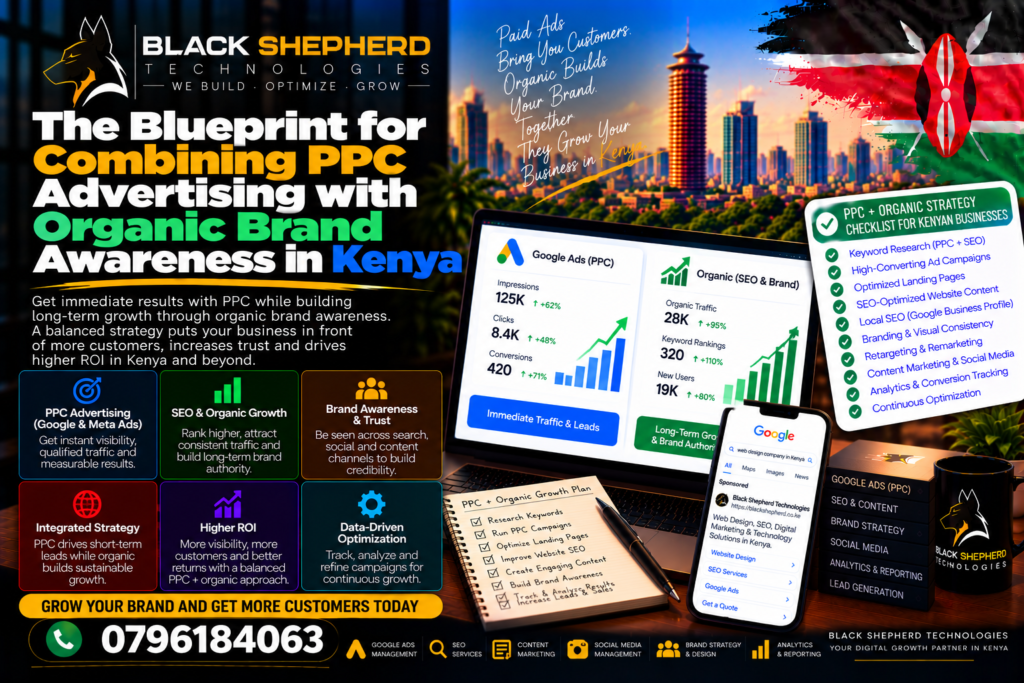
Brand Voice in Review Responses: Prompt, professional, and warmly personalized responses reinforce your brand values while signaling active engagement to search engine algorithms. For businesses looking to dominate local search packs and maximize their Google Business visibility, partnering with experts who understand both algorithmic optimization and brand aesthetics is crucial, such as leveraging expert SEO services in Kenya to ensure your local listings rank at the very top.
5.3 Bridging Technical SEO, Portfolios, and Industry Expertise
Search engine crawlers evaluate web pages based on technical markers like site speed, mobile responsiveness, semantic HTML structure, and Core Web Vitals.
-
Demonstrating Local Authority Through Proof of Work: Search engines reward E-E-A-T (Experience, Expertise, Authoritativeness, and Trustworthiness). Showcasing real, localized case studies, client success stories, and authentic project imagery builds undeniable local authority. Reviewing a comprehensive portfolio of digital projects demonstrates how technical execution and visual brand storytelling successfully intersect across various commercial ventures.
-
Tailoring Strategies Across Verticals: Understanding how specific target audiences search and interact within different commercial sectors allows brands to tailor their local landing pages and visual narratives effectively. Examining specialized industries we serve highlights how bespoke digital strategies align brand voice with targeted local search intent across multiple market verticals.
Part 6: SEO Services in Kenya: How Creative Content Dominates Search Engine Results
For years, search engine optimization (SEO) was dominated by mechanical tactics: stuffing web pages with repetitive keywords, building low-quality artificial backlinks, and treating content as a mere vehicle for search engine crawlers rather than a medium for human connection. In Nairobi, Mombasa, Kisumu, and beyond, this outdated approach no longer works. Modern search engines like Google have evolved sophisticated semantic intelligence powered by machine learning and natural language processing. Today, algorithms do not just scan for keywords; they measure user engagement, brand authority, visual polish, and emotional resonance.
6.1 The Shift Toward Semantic Search and User Intent
In the early days of search engines, ranking for a phrase like “best web designer in Nairobi” required repeating that exact phrase ten times in a 300-word blog post. Today, that tactic results in algorithmic penalties. Google’s core algorithms evaluate search intent—the underlying goal or question the user is trying to address when typing a query (Informational, Transactional, Navigational).
6.2 Demonstrating E-E-A-T Through Creative Content
Google’s Search Quality Rater Guidelines emphasize Experience, Expertise, Authoritativeness, and Trustworthiness (E-E-A-T) as critical benchmarks for ranking content. Creative content is the primary vehicle for demonstrating E-E-A-T by showcasing real-world case studies, proprietary data, localized examples, and authentic project portfolios.
Part 7: Dominate Google Kenya: The Complete Guide to Local SEO for Nairobi Enterprises
To successfully capture high-intent local search traffic across East Africa’s commercial capital, Nairobi enterprises must master local search optimization. When prospective customers search for local services, products, or professional solutions on their mobile devices, appearing in the top results on Google Maps and organic search determines market leadership.
7.1 The Three Pillars of Local Ranking
-
Relevance: How closely your business listing and website match what the user is searching for.
-
Distance: How physically close your business location is to the user conducting the search.
-
Prominence: How well-known and authoritative your business is in the real and digital world, calculated based on customer reviews, local directory citations, brand mentions, and backlink profiles.
7.2 Mastering the Google Local Pack
Securing a spot in the top-three map pack generates an exponential surge in phone calls, physical direction requests, and website visits. Rigorous optimization of your Google Business Profile, active review management, and hyper-local neighborhood landing pages (covering Westlands, Kilimani, Upper Hill, CBD, and Karen) are vital to dominating the local pack.
Part 8: Why Technical Web Speed Optimization is Vital for Organic SEO Ranking in 2026
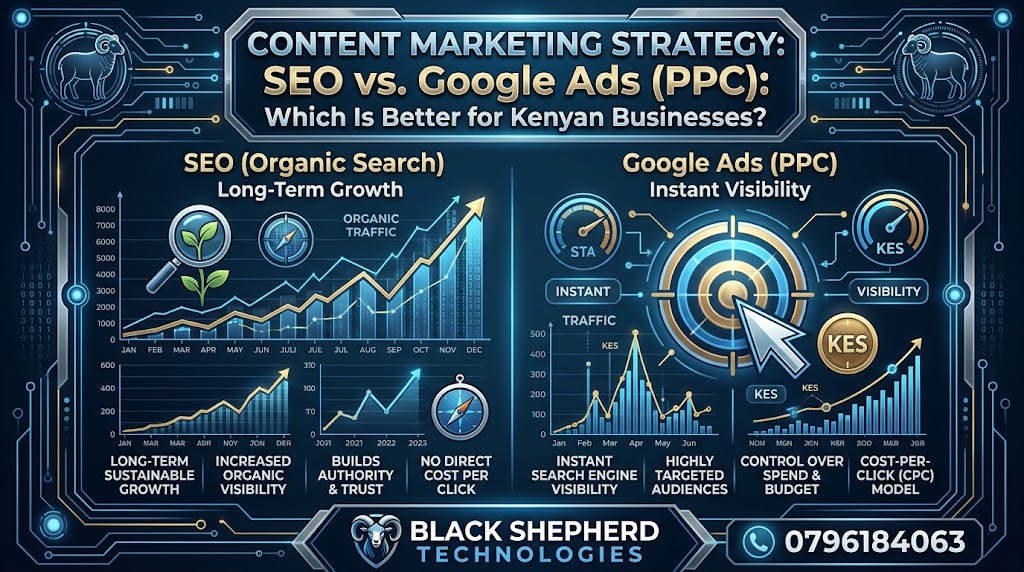
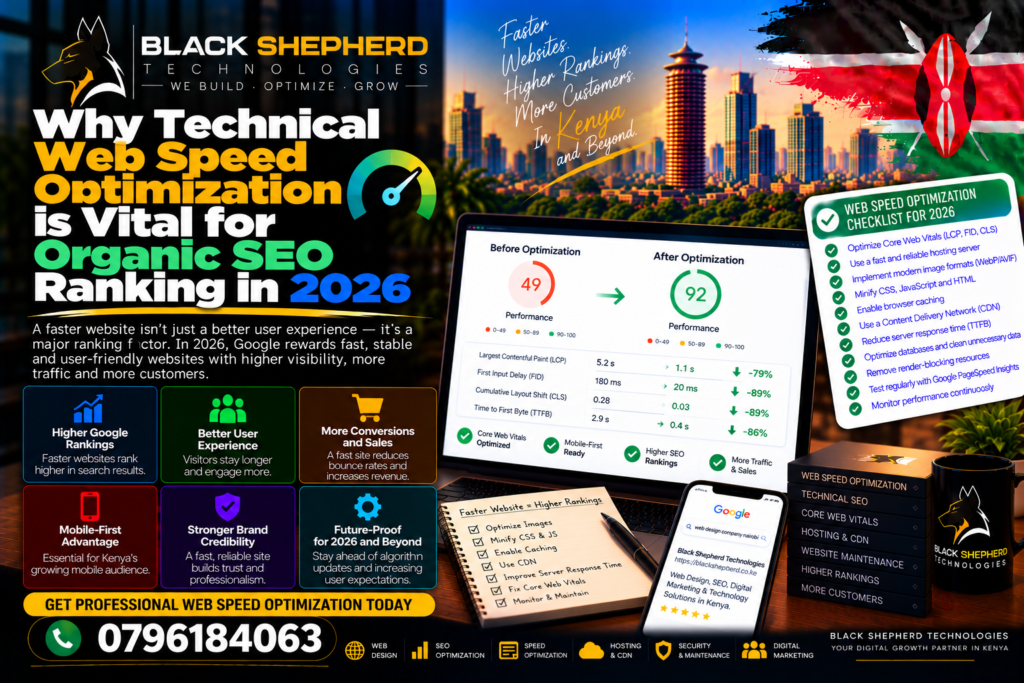
In the modern digital ecosystem, technical web speed optimization is no longer treated as a background engineering task or a minor UX enhancement. It is a direct, confirmed Google ranking factor and a primary gatekeeper for organic search visibility.
8.1 The Core Web Vitals Framework
Google assesses technical performance primarily through Core Web Vitals—a standardized set of metrics measuring real-world user experience:
-
Largest Contentful Paint (LCP): Measures perceived loading speed ($< 2.5$ seconds).
-
Interaction to Next Paint (INP): Measures overall page responsiveness across a user’s entire session ($< 200$ milliseconds).
-
Cumulative Layout Shift (CLS): Measures visual stability and unexpected layout shifts ($< 0.1$).
8.2 Real-User Field Data vs. Lab Data
Search engines evaluate performance based on field data gathered from real users via the Chrome User Experience Report (CrUX) and Google Search Console. Ensuring that at least 75% of actual visitors experience good performance across mobile and desktop devices is required to prevent algorithmic ranking penalties.
Part 9: Comprehensive Cross-Sectional Framework & Comparative Analysis
To synthesize these core pillars, examine how traditional fragmented digital methods compare against an integrated, high-performance omnichannel ecosystem:
| Strategic Dimension | Fragmented Traditional Approach | Integrated Omnichannel Ecosystem |
| Creative Direction | Static, uncoordinated design elements applied without code awareness. | Dynamic visual storytelling powered by lightweight, optimized frontend code and design tokens. |
| Asset Management | Scattered local desktop folders, lost files, and outdated logo versions. | Centralized Digital Asset Management (DAM) platform with strict naming conventions. |
| Sales & ROI Impact | High customer acquisition costs, low trust, and poor conversion rates. | Lower CAC, premium pricing power, enhanced trust, and higher conversion rates. |
| Mobile Experience | Clunky desktop-first layouts shrunk down, causing high bounce rates. | Mobile-first architecture, thumb-friendly navigation, and instant M-Pesa integration. |
| Local SEO & Branding | Robotic keyword stuffing paired with generic, disconnected brand visuals. | Semantic local keyword integration, branded Google Business Profiles, and E-E-A-T authority. |
| Technical Web Speed | Unoptimized bloated code, slow server response times, and failing Core Web Vitals. | Strict Core Web Vitals compliance (LCP, INP, CLS), WebP asset compression, and fast CDN delivery. |
Conclusion: Unifying Vision, Code, Strategy, and Speed for Lasting Success
Mastering digital growth in Kenya and beyond requires tearing down the artificial walls between creative direction, asset management, sales strategy, mobile UX, local SEO, content dominance, and technical web speed optimization. When your visual storytelling is powered by robust code, standardized across platforms through centralized DAM systems, engineered to drive sales through mobile-first M-Pesa workflows, amplified by high-ranking local SEO strategies, supported by engaging creative content, and accelerated by lightning-fast Core Web Vitals compliance, your digital presence transforms into an unstoppable, cohesive revenue engine that captures attention, builds unshakeable trust, and delivers enduring commercial dominance.