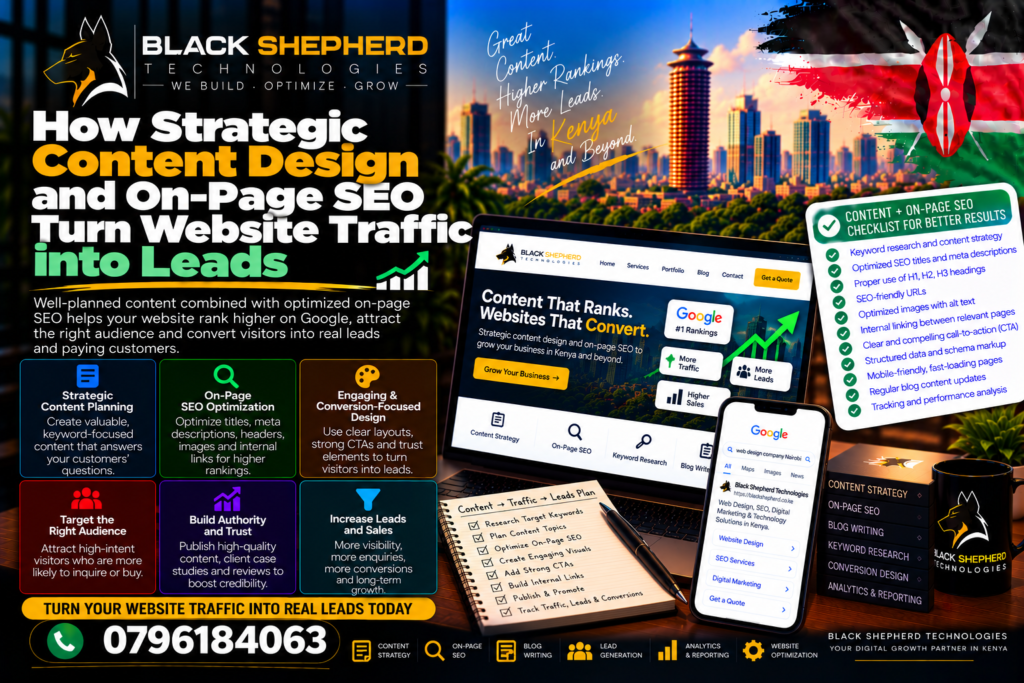
Analyzing deeply How Strategic Content Design and On-Page SEO Turn Website Traffic into Leads requires examining the exact intersection where human psychology, search engine algorithms, and conversion architecture meet. In the modern digital marketplace, driving high volumes of website traffic is only half the battle. Countless businesses invest heavily in paid advertising, social media campaigns, and basic keyword optimization, only to watch thousands of visitors arrive, browse briefly, and leave without ever filling out a contact form, making an inquiry, or converting into a qualified lead.
The missing link between raw traffic and revenue-generating leads is not more traffic—it is strategic content design paired with rigorous on-page search engine optimization (SEO). When content is structured to satisfy user intent, guided by clean visual design, and optimized for search engine crawlers, it transforms a passive blog reader or browser into an active, engaged prospect.
In this comprehensive guide, we will explore the precise frameworks, psychological triggers, on-page optimization techniques, and conversion mechanisms required to turn web traffic into a predictable pipeline of high-quality leads.
Part 1: The Traffic-to-Lead Chasm: Why Traffic Alone is Vanity
In digital marketing circles, website traffic is frequently celebrated as the primary metric of success. Business owners watch their analytics dashboards climb month over month, tracking unique visitors, page views, and session durations. However, traffic without conversion is a vanity metric that generates zero revenue.
The Anatomy of a Leaky Funnel
When visitors land on a web page, they arrive with specific expectations and intent. If they encounter a wall of dense, unformatted text, sluggish loading times, confusing navigation, or an absence of clear next steps, cognitive friction spikes.
-
High Bounce Rates: Users leave within seconds if the page fails to immediately communicate value or answer their search query.
-
Misaligned Expectations: Traffic driven by broad or misleading keywords brings visitors who are looking for something entirely different from what the page offers.
-
The Dead-End Page: A visitor reads a great article, finds the information helpful, and then encounters… nothing. No call-to-action, no lead magnet, no contact form. The user closes the tab, and the traffic is lost forever.
Bridging the Gap Through Strategic Integration
To turn traffic into leads, content design and on-page SEO must work in tandem. On-page SEO ensures that the right audience arrives at your door by aligning your pages with high-intent search queries. Strategic content design ensures that once they arrive, their journey is frictionless, engaging, and systematically guided toward conversion.
Part 2: Content Design: Sculpting User Attention and Cognitive Flow
Content design is not just about writing compelling copy or picking attractive fonts; it is the discipline of structuring information so that human beings can consume, digest, and act upon it with minimal cognitive effort.
1. The F-Shaped Reading Pattern and Scannability
Eye-tracking studies consistently show that online readers do not read web pages word-for-word; they scan them in an F-shaped pattern.
-
Headline Hierarchies: Using clear, descriptive
H1,H2, andH3tags allows scanners to grasp the core argument of a page in seconds. -
Bolding Key Insights: Strategic bolding of crucial phrases guides the reader’s eye to the most valuable takeaways.
-
Bullet Points and Numbered Lists: Breaking down complex concepts into digestible lists prevents cognitive overload and keeps users engaged.
2. Emotional Resonance and Audience Empathy
Leads are generated when a prospect feels truly understood. Content design must address the user’s pain points directly.
-
Identifying Friction Points: Start by articulating the exact frustration or challenge your target audience faces.
-
Positioning Solutions: Present your product, service, or expertise not as a corporate feature list, but as the direct, frictionless solution to their problem.
Part 3: On-Page SEO Architecture: Aligning Search Intent with Conversion Paths
On-page SEO is much more than sprinkling target keywords into paragraphs. It is the technical and semantic structuring of a web page so that search engine algorithms understand its value and serve it to users whose search intent matches your conversion offerings.
1. Mapping Content to Search Intent
Every keyword query carries a specific intent. To turn traffic into leads, your on-page SEO strategy must align content type with where the user is in the buyer’s journey:
-
Informational Queries: Users seeking knowledge (e.g., “how to choose an enterprise web design agency”). Content design here should provide deep educational value while subtly positioning your brand as the authoritative expert, guiding readers toward a downloadable resource or consultation.
-
Transactional Queries: Users ready to hire or buy (e.g., “hire professional SEO services in Nairobi”). Content design must pivot immediately to value propositions, service breakdowns, social proof, and prominent lead-capture forms.
2. Semantic Keyword Integration and Contextual Relevance
Modern search algorithms evaluate topical depth rather than isolated keyword density.
-
LSI (Latent Semantic Indexing) Keywords: Incorporate related subtopics, industry terms, and contextual phrases naturally throughout the copy.
-
Internal Linking Structures: On-page SEO requires strategic internal linking. Direct traffic from high-traffic educational blog posts to high-converting product or service landing pages using descriptive anchor text.
Part 4: The Power of Visual Hierarchy and UX in Lead Generation
Even the most well-optimized text will fail to generate leads if the visual hierarchy and user experience (UX) impede conversion. Visual design directs attention and builds subconscious trust.
1. Guiding the Eye to the Conversion Zone
Every page should have a clear, singular visual hierarchy.
-
Contrast and Prominence: Call-to-action (CTA) buttons must stand out visually from the rest of the page through intentional color choices, generous padding, and strategic placement.
-
Whitespace as a Focus Tool: Surrounding key forms and CTAs with ample whitespace removes distractions and signals importance.
2. Establishing Instant Credibility Through Design Polish
Skepticism is a major barrier to lead generation. When a visitor lands on a page, visual polish signals institutional reliability.
-
Professional Typography and Imagery: Crisp layouts, high-resolution authentic imagery, and clean vector graphics build immediate confidence.
-
Social Proof Integration: Embedding client testimonials, case study snippets, trust badges, and verified reviews directly within the content flow removes hesitation just as the user is evaluating whether to submit their contact information.
Part 5: Crafting High-Converting Call-to-Actions (CTAs) and Lead Magnets
A lead is captured the moment a visitor trades their contact information (email, phone number, company details) for something of perceived value. This transaction relies entirely on the strength of your CTAs and lead magnets.
1. Moving from Generic to Contextual CTAs
Generic CTAs like “Submit” or “Click Here” convert poorly because they offer no psychological incentive. Contextual CTAs, tailored specifically to the content the user is consuming, yield dramatically higher conversion rates.
-
Example: If a user is reading an article about mobile website optimization, a contextual CTA should offer: “Download the 10-Point Mobile-First Audit Checklist.”
2. Designing Frictionless Lead Capture Forms
Form design can make or break a conversion campaign. Every additional input field you add to a form decreases its conversion rate.
-
Minimize Required Fields: For top-of-funnel lead magnets, ask only for an email address or name. Save deeper qualification questions for later stages of the sales funnel.
-
Clear Value Exchange: Remind the user what they are getting immediately upon submission (e.g., “Get Instant Access to the Guide”).
Part 6: Technical Enablers: Speed, Mobile Responsiveness, and Core Web Vitals
All content design and on-page SEO efforts are rendered useless if technical performance causes users to abandon the page before it fully renders.
1. The Speed-to-Conversion Correlation
Studies consistently show that conversion rates drop sharply with every second of loading delay. If a user clicks your search result, arrives on your page, and stares at a blank white screen for four seconds, they will bounce back to Google and click a competitor’s link.
-
Fast Core Web Vitals: Optimizing Largest Contentful Paint (LCP), Interaction to Next Paint (INP), and Cumulative Layout Shift (CLS) ensures an instantaneous, stable user experience that keeps visitors engaged long enough to convert.
2. Mobile-First Form Factor Optimization
With the vast majority of web traffic originating on smartphones, form inputs, buttons, and lead-capture pop-ups must be engineered for touch screens. Tap targets must be easily accessible within the natural thumb zone, and mobile keyboards must trigger appropriately based on field types (e.g., numeric keyboards for phone numbers).
Part 7: Comparative Analysis: Unoptimized Traffic vs. Strategic Conversion Engines
To illustrate the stark difference between passive traffic acquisition and an optimized lead generation system, examine the structural contrast below:
Conclusion: Turning Search Visibility Into Sustainable Business Growth
Traffic is the raw material of digital marketing, but strategic content design and on-page SEO are the refinery that transforms that raw material into valuable leads. By structuring your content around human psychology and search intent, optimizing your technical and semantic on-page architecture, designing for seamless scannability, and deploying high-converting contextual CTAs, you stop wasting web traffic.
When every page on your website operates as an intentional, friction-free conversion engine, your digital presence ceases to be a digital brochure and becomes a powerful, predictable driver of business growth.