
Kenya
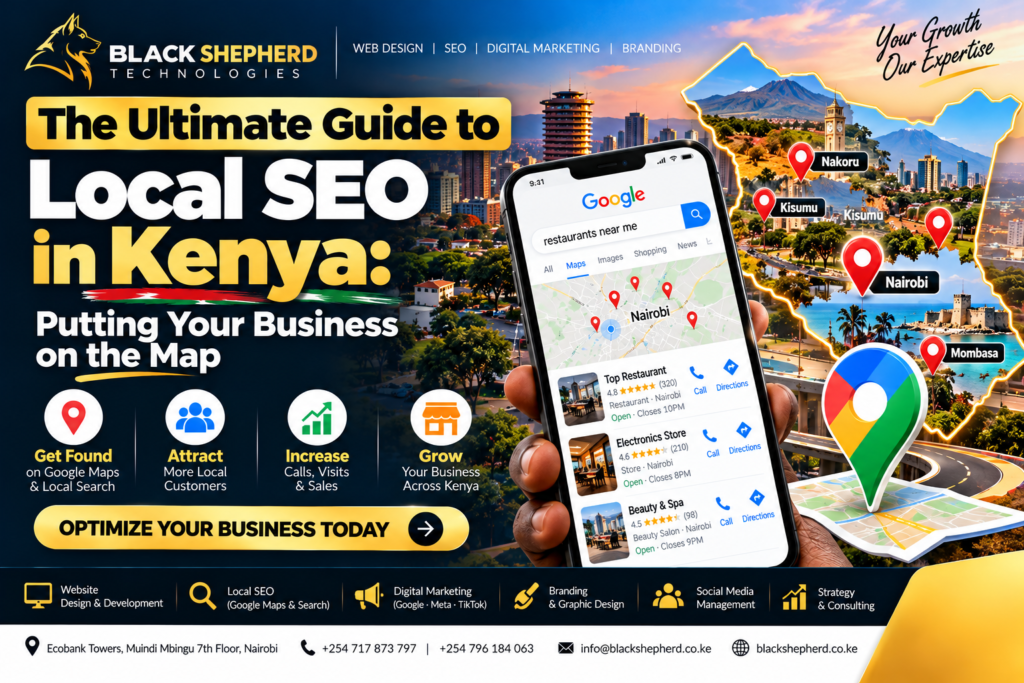
The Ultimate Guide to Local SEO in Kenya: Putting Your Business on the Map
Oct
Kenya’s commercial ecosystem is undergoing a massive digital renaissance. From the bustling corporate boardrooms and retail spaces of Nairobi’s CBD, Westlands, and Kilimani, to the vibrant coastal tourism corridors of Mombasa and Diani, the economic hubs of Nakuru, and the athletic and commercial dynamism of Eldoret, how consumers find and patronize businesses has changed forever.
When a consumer or corporate buyer needs a product or service today, they rarely flip through a physical directory or rely solely on billboard advertisements. Instead, they pull out their smartphones, open Google, and search for providers located right around the corner.
If your business maintains a physical storefront, office, or service-area footprint in Kenya, and your brand does not appear prominently when local searches occur, you are handing high-intent customers directly to your competitors. Implementing a rigorous, localized optimization strategy powered by specialized SEO Services in Kenya is the ultimate way to put your business firmly on the digital map, increase foot traffic, and scale your revenue.
1. The Modern Kenyan Consumer: Mobile-First and Hyper-Local
To understand the transformative power of local search optimization, we must examine how modern Kenyans search, behave, and purchase. Kenya boasts some of the highest mobile penetration rates and smartphone adoption figures across Sub-Saharan Africa. Mobile data usage dominates everyday life, meaning that the vast majority of commercial inquiries occur on-the-go.
When a Kenyan consumer enters a query on a mobile device, their intent is intensely local and immediate. Consider these common search patterns:
-
“Best hardware store near me in Nairobi CBD”
-
“Affordable beach resort in Nyali Mombasa”
-
“Agrochemical suppliers along Uganda Road Eldoret”
-
“Reliable plumbing services in Milimani Nakuru”
These queries contain implicit urgency. The user is usually out of the house, in transit, or sitting at a desk, ready to make a purchasing decision within hours. If your business appears prominently when these local keywords are queried, you capture a customer who is actively looking to spend money right then and there.
The Physics of Local Intent
Traditional search engine optimization focuses on broad, national keywords. While ranking for “best digital agency” across Kenya is valuable, it lacks the immediate geographical proximity required to drive physical foot traffic or local service calls. Local search engine optimization bridges the digital gap between the online query and the brick-and-mortar storefront. It tells Google precisely where your business is located, what hours you operate, what products line your shelves, and why local consumers trust your brand over competitors down the street.
2. Anatomy of Local Search: How Google Connects Kenyan Shoppers to Your Storefront
When an internet user enters a localized query, Google does not display a standard list of global web pages. Instead, it serves a specialized layout known as the Local Pack (or Map Pack), followed by localized organic search results.
+-------------------------------------------------------------+
| [Google Map Interface showing pins across Nairobi/Kenya]      |
|                                                             |
| 1. Your Business Name ⭐⭐⭐⭐⭐ (4.9) - Open · Closes 8 PM    |
|    Kimathi Street, Nairobi                                  |
|                                                             |
| 2. Competitor Enterprise ⭐⭐⭐⭐☆ (4.2) - Open · Closes 6 PM|
|    Kenyatta Avenue, Nakuru                                  |
+-------------------------------------------------------------+
Securing a spot inside this coveted Local Pack requires a specialized approach. At Black Shepherd Technologies, our comprehensive digital strategies are designed to position your brand precisely where local attention is concentrated. By reviewing our successful implementations across diverse sectors via our portfolio and projects archive, you can see how targeted geographic optimization transforms digital visibility into physical foot traffic and verified leads.
Key Components of Local Search Dominance:
-
Google Business Profile (GBP) Optimization: Formerly known as Google My Business, your GBP listing is your digital storefront. Optimizing your primary and secondary categories, uploading geotagged images of your Kenyan premises, maintaining accurate operating hours, and managing customer reviews directly influence your rank in local map results.
-
Local Citation Consistency: Your Business Name, Address, and Phone number (NAP) must remain identical across every digital directory, social media platform, and review site. Discrepancies between your physical address on Google Maps and a local directory listing confuse search engine crawlers and suppress your rankings.
-
Geo-Targeted Content Creation: Writing web pages and blog posts that address local neighborhoods (e.g., Lavington, Gigiri, Nyali, Elgon View, Milimani) signals to search engines that your business is deeply integrated into the local commercial fabric.
3. Overcoming Kenya-Specific Digital Marketing Challenges
Doing business in Kenya presents unique operational and digital dynamics. Traffic congestion along major urban arteries in Nairobi, Mombasa, Nakuru, and Eldoret means consumers value proximity above almost everything else. People want convenience. They want to know that visiting your physical location or hiring your service team will not result in wasted time or friction.
Furthermore, consumer trust in Kenya is hard-earned and easily lost. Shoppers rely heavily on peer validation, reviews, and transparent pricing structures before committing to a physical visit or financial transaction.
Integrating Trust and Local Authority
An effective optimization strategy addresses these local psychological and infrastructural factors head-on:
-
Review Generation Campaigns: Encouraging satisfied customers to leave positive reviews mentioning specific staff members or product qualities builds instant credibility. When a prospective buyer in Kenya sees dozens of 5-star reviews detailing smooth transactions at your physical store, hesitation vanishes.
-
Instant Action Integrations: Modern Kenyan shoppers expect seamless digital-to-physical transitions. Integrating direct communication channels—such as click-to-call buttons and instant WhatsApp customer support widgets—allows prospective walk-in clients to confirm stock availability or book appointments before stepping out of their offices.
Different commercial sectors face unique buyer journeys. Whether you operate in retail, industrial supply, hospitality, or professional services, exploring the specialized industries we serve reveals how customized optimization frameworks align digital visibility with sector-specific consumer expectations.
4. Step-by-Step Blueprint: Putting Your Kenyan Business on the Map
Achieving measurable growth in physical store visits and local inquiries requires a systematic execution plan. Below is the blueprint utilized by top-tier digital agencies to scale local visibility for Kenyan enterprises.
Phase 1: Comprehensive Local Audit and Competitor Gap Analysis
Before writing a single line of code or publishing content, you must understand your competitive landscape in your specific city or region.
-
Identify the top three competitors currently ranking in the local map pack for your primary commercial keywords.
-
Analyze their review volume, backlink profiles, website speed, and mobile responsiveness.
-
Pinpoint keyword gaps—phrases your competitors are ignoring that your business can easily dominate.
Phase 2: Google Business Profile (GBP) Mastery
Your Google Business Profile is the bedrock of local SEO.
-
Claim and verify your listing across all operational branches (whether in Nairobi, Mombasa, Nakuru, or Eldoret).
-
Select precise categories and populate every section with accurate details, adhering strictly to Google’s naming guidelines without keyword stuffing.
-
Regularly upload geotagged photos of your team, products, and physical premises to signal active local engagement.
Phase 3: On-Page Geographic Optimization and Schema Markup
Your website structure must explicitly communicate your service areas to search engine crawlers.
-
Embed localized schema markup (LocalBusiness structured data) into your website’s backend code. This provides search engines with machine-readable data regarding your physical coordinates, operating hours, accepted currencies, and payment methods (including M-Pesa integration details).
-
Build dedicated, hyper-targeted landing pages if you operate multiple branches across different counties or regions. Avoid generic “About Us” pages; instead, craft location-specific resource pages detailing how local clients can access your services.
Phase 4: Technical Performance and Mobile Speed Enhancement
In Kenya, where mobile browsing over 4G and expanding 5G networks is the standard, website speed is a direct conversion factor. If your website takes longer than three seconds to load on a smartphone, impatient users will bounce back to Google and click on your competitor.
-
Optimize image sizes, leverage browser caching, and deploy high-performance cloud hosting infrastructure.
-
Ensure your layout is fully responsive, featuring touch-friendly navigation elements, legible typography, and easily tappable phone numbers.
Phase 5: Localized Content Marketing & Authority Building
Search engines reward relevance and authority. By publishing high-value content centered around local challenges, you attract inbound links from other Kenyan websites, signaling to Google that your domain is a trusted local authority.
-
Publish articles addressing regional buyer guides, local industry trends, and frequently asked questions specific to the Kenyan market.
-
Earn backlinks from reputable local news outlets, business directories, and industry associations.
5. Measuring Success: Tracking ROI from Local Search Optimization
A common hesitation among business owners investing in search optimization is measuring tangible return on investment. Unlike paid advertising where every click has a direct cost, organic search traffic compounds over time, making attribution require a structured tracking approach.
Key Metrics to Monitor:
-
Map Actions: Track the number of users who click “Get Directions” to your storefront directly from your Google Business Profile.
-
Click-to-Call Volume: Monitor phone calls initiated directly from mobile search results pages.
-
Local Landing Page Traffic: Analyze organic sessions originating from users within specific neighborhoods across Kenya.
-
In-Store Redemption Tracking: Utilize unique promo codes, QR codes displayed on your website, or simple checkout surveys asking customers, “How did you hear about us today?”
When executed correctly, the compounding nature of organic search ensures that your cost per acquisition drops significantly over time, creating a steady, predictable stream of local customers month after month.
Conclusion and Next Steps
The digital marketplace in Kenya rewards businesses that make it effortless for consumers to find, trust, and visit them. Relying solely on traditional advertising or passive social media posts leaves your physical storefront vulnerable to agile competitors who dominate local search results.
By investing in specialized optimization strategies, refining your digital infrastructure, and aligning your online presence with the high-intent behaviors of Kenyan shoppers, you can turn your website into a powerful magnet for local foot traffic and inquiries.
Ready to transform your digital presence and dominate local search results across Kenya? Partner with experts who understand the nuances of the local market. Explore our proven methodologies, review our past success stories, and discover how tailored digital solutions can elevate your enterprise. Take the first step toward sustained commercial growth by visiting Black Shepherd Technologies today.
