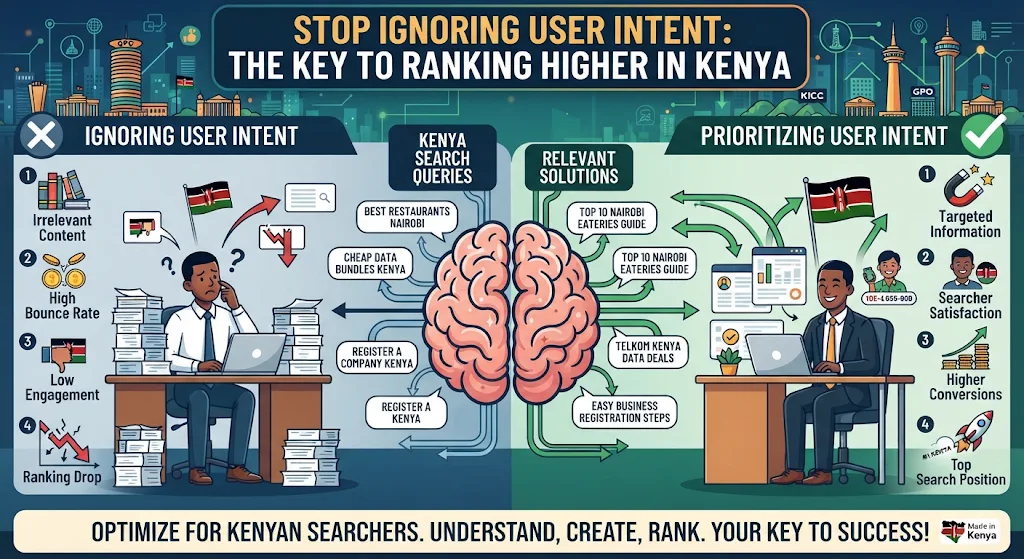
To rank higher in Kenya, stop treating user intent as a generic keyword-sorting exercise and match what Kenyan searchers actually want at the exact moment they search—including local pricing in KES, neighborhood or city context, M-Pesa and payment expectations, WhatsApp/call handoffs, and data-conscious, fast-loading pages.
Many websites targeting Kenya lose rankings not because their backlink count is zero, but because their pages miss the practical reality behind a Kenyan query. A foreigner or generic global template might write a 2,000-word article on “best laptops for students” with US dollar prices and Amazon links, while a Kenyan searcher typing “laptop prices in Nairobi CBD” or “student laptops under 40k Kenya” wants KES ranges, refurbished vs. new clarity, warranty/pickup details, and a fast way to ask availability on WhatsApp.
Why User Intent Matters More in Kenya Than Generic SEO
Search behavior in Kenya has distinct layers that change what satisfies a searcher:
-
High mobile usage alongside real device/network constraints: Smartphones dominate daily digital access across Kenya, even as desktop remains prominent in office and research contexts. Pages weighed down by heavy scripts, bloated media, or slow hosting lose impatient users quickly.
-
Price sensitivity and KES context: When someone searches for a product, service, course, loan, or software tool in Kenya, abstract global pricing rarely answers their question. Clear KES pricing—or transparent pricing tiers, delivery fees, and payment options like M-Pesa—directly matches commercial intent.
-
Hyper-local geography: Intent in Kenya often hinges on where someone is or where delivery/service happens—Nairobi (Westlands, Kilimani, CBD, Karen, Kasarani), Mombasa, Kisumu, Nakuru, Eldoret, or nationwide parcel delivery.
-
Conversation-first buying journeys: In Kenya, search discovery frequently bridges into WhatsApp, phone calls, or walk-in visits before a final purchase is made. Content that ignores how Kenyans actually inquire and transact leaves conversions—and engagement signals—on the table.
-
Multilingual and code-switched phrasing: While English is widely used in search, Kenyan queries naturally blend local terms, abbreviations, county/estate names, and conversational phrasing. Matching how people actually ask questions beats stuffing rigid keyword variations.
The Four Core User Intent Types (With Kenyan Search Examples)
| Intent Type | What the Searcher Wants | What Usually Ranks / Wins | Common Mistake That Hurts Rankings |
| Informational | Clear answers, how-to steps, eligibility rules, or local explanations without hard sales pressure. | Direct answers up front, accurate local steps/requirements, scannable checklists, and clear formatting. | Writing vague, AI-sounding fluff or outdated rules that don’t actually answer the question. |
| Commercial Investigation | Comparisons, pros/cons, prices, reviews, or “best X for Y” before choosing. | Side-by-side comparisons, KES price context, real trade-offs (e.g., new vs. UK-used, providers, locations), and honest criteria. | Pushing a single product immediately without helping the user compare options. |
| Transactional | Ready to buy, book, apply, visit, or request a quote—often looking for speed, trust, and local fulfillment. | Clear offers, KES pricing/quotes, stock/availability clarity, M-Pesa/payment info, and frictionless WhatsApp/call/order options. | Hiding prices behind slow forms or making mobile checkout/contact clunky. |
| Navigational / Local | A specific brand, portal, branch, or service near a particular area. | Accurate NAP (Name, Address, Phone/WhatsApp), hours, directions/landmarks, service areas, and fast page access. | Missing location details, outdated hours, or confusing multi-page paths to basic contact info. |
How to Diagnose & Match Intent Before You Write or Update a Page
-
Inspect the live Kenyan SERP first: Search your target query from a Kenyan location context and look closely at the top organic results. Notice what formats dominate—guides, comparison tables, category/service pages, local listings, or directories. If Google rewards service/comparison pages and you publish a generic definition post, you are fighting the intent signal.
-
Identify the primary job-to-be-done: Ask what the searcher needs to decide or do right after reading your page. A reader researching solar installation costs in Kenya needs cost drivers, system sizing examples, and installation steps—not a generic essay on global renewable energy.
-
Lead with the direct answer: Put the clearest answer, price range, eligibility summary, or key takeaway near the top so mobile readers don’t have to scroll past walls of filler to see if the page is relevant.
-
Build around real local sub-questions: Cover the practical follow-ups Kenyan searchers naturally ask next—costs in KES, timelines, required documents/steps, delivery/coverage areas, warranties or refund/cancellation terms, and how to reach a real person.
-
Match calls-to-action (CTAs) to intent stage: Don’t force a hard “Buy Now” on an early-stage informational guide, and don’t offer only a generic newsletter on a high-intent service page. Pair informational content with helpful next steps/calculators/guides, and transactional/local pages with clear quote, booking, call, or WhatsApp actions.
Common Mistakes That Keep Kenyan Sites Stuck on Page 2+
-
Writing for global searchers instead of Kenyan ones: Using foreign currency, irrelevant regulations, unavailable tools, or overseas examples makes your page feel disconnected from local reality.
-
Publishing thin “keyword pages” with zero depth: Creating separate pages for slight phrasing tweaks without distinct, genuinely helpful answers dilutes authority and fails to satisfy searchers.
-
Ignoring mobile speed and layout: If images are oversized, pop-ups cover the screen, or tables break horizontally on a phone, users bounce back to the SERP—signaling poor satisfaction.
-
Letting pages go stale: Outdated prices, old processes, or expired details erode trust fast. Refreshing key pages as local details change keeps both accuracy and intent alignment sharp.