Every week across Nairobi, Mombasa, Kisumu, Nakuru, and Eldoret, business owners and marketing managers face a familiar budget dilemma: should we put our money into Search Engine Optimization (SEO) or Paid Advertising (Google Search Ads, Meta Ads across Facebook and Instagram, TikTok Ads, or YouTube campaigns)?
With Kenya’s digital connectivity expanding rapidly—including tens of millions of mobile subscriptions, rising smartphone usage, and growing fixed broadband adoption—more Kenyan customers research, compare prices, and buy online than ever before. Yet digital ad costs in competitive categories keep rising, and global ad platforms bill in foreign currency, meaning exchange-rate shifts can quietly stretch your KES budget further or thinner.
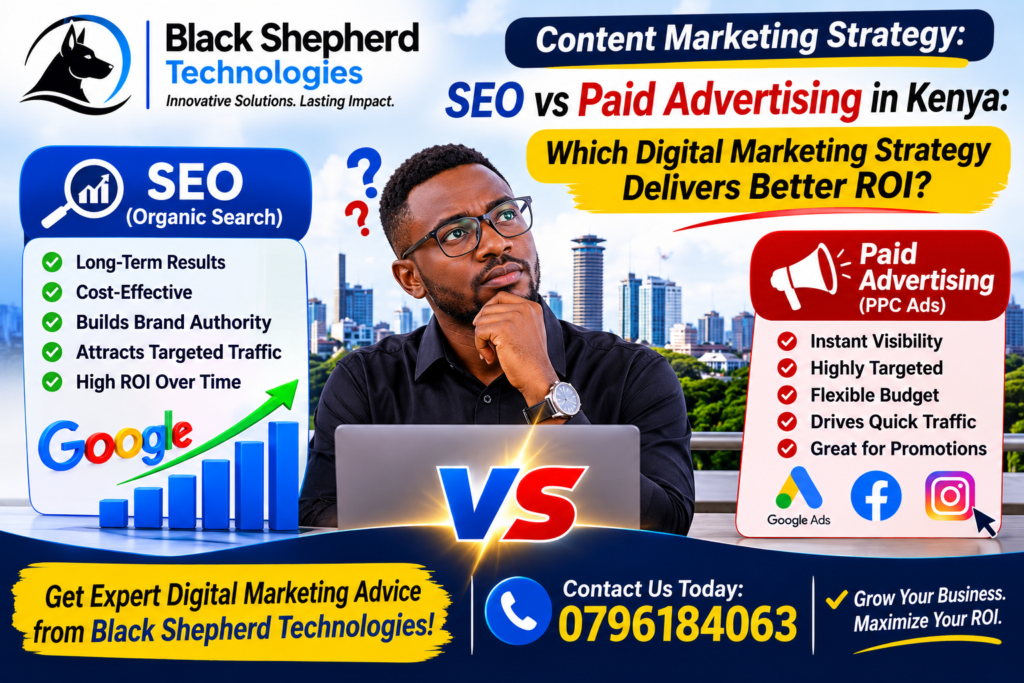
The short answer is that neither channel wins on ROI in every situation. Paid advertising buys speed and immediate visibility, while SEO builds compounding equity and lower long-term acquisition costs. Which one delivers better Return on Investment (ROI) for your business depends on your cash-flow runway, margins, sales cycle, urgency, and how well your website converts visitors once they arrive.
For organizations investing in results-driven SEO services in Kenya, the smartest goal is not blindly picking one side over the other—it is understanding how each channel behaves economically in Kenya so you allocate every shilling where it creates the strongest return.
How SEO and Paid Advertising Differ in the Kenyan Market
Before comparing ROI numbers or budget splits, it helps to look closely at what you are actually buying with each strategy.
What You Get with SEO in Kenya
Search Engine Optimization improves how your website appears in unpaid search results on google.co.ke and local map/discovery surfaces over time. It relies on:
-
Technical health and speed: Fast mobile pages, clean site structure, proper indexing, and structured data that search engines can read easily.
-
Intent-matched content and landing pages: Pages built around real Kenyan search queries, clear
KESpricing/scope context, and local relevance. -
Authority and trust signals: Credible mentions, local links, consistent business details, and authentic customer reviews.
The ROI dynamic of SEO: Upfront effort and investment happen before peak returns arrive. Once strong rankings and authority take hold, incremental clicks from organic search carry no per-click media fee, allowing cost per acquisition to drop over time as long as you maintain the asset.
What You Get with Paid Advertising in Kenya
Paid advertising places your brand in front of targeted audiences immediately through auction-based platforms—most commonly Google Search Ads, Facebook and Instagram (Meta) Ads, YouTube, or TikTok.
-
Google Search Ads capture active searchers typing commercial terms right now (such as
"emergency plumber Kilimani"or"commercial solar installation Nairobi"). -
Social & Video Ads (Meta, TikTok, YouTube) excel at visual discovery, audience interest/location targeting, product launches, remarketing, and generating WhatsApp or DM leads.
The ROI dynamic of Paid Ads: You can launch today and generate traffic or inquiries within hours or days. However, the meter never stops running—the moment you pause ad spend or run out of budget, paid traffic stops immediately. In competitive Kenyan niches like real estate, finance, legal/tax, or high-ticket retail, cost per click and lead acquisition costs can climb quickly.
Side-by-Side Comparison: SEO vs. Paid Ads in Kenya
How to Calculate True ROI (Beyond Clicks and Cost Per Click)
A common mistake in Kenyan digital marketing is judging ROI by Cost Per Click (CPC) or raw traffic volume. A KES 10 click from a social ad that never buys—or a free organic blog visitor who bounces in four seconds—delivers worse ROI than a KES 120 high-intent search click or organic visitor who turns into a KES 85,000 sale or repeat client.
To compare SEO and Paid Ads fairly in Kenya, track four practical metrics all the way to revenue:
-
Cost Per Qualified Lead (CPL): Total channel cost (media spend plus agency/team/tool costs attributed to that channel) divided by leads that actually fit your ideal customer profile, budget, and location.
-
Customer Acquisition Cost (CAC): Total channel cost divided by paying customers won from that channel over a defined period.
-
Return on Ad Spend (ROAS) / Marketing ROI: Revenue (or gross profit) generated from a channel compared against what you spent to get it. Always compare gross margin—not just top-line revenue—if your product or service has tight margins.
-
Payback Period and Customer Lifetime Value (LTV): If a customer buys once versus buying repeatedly or retaining your service for a year, a higher upfront acquisition cost may still be profitable—provided your cash flow can fund the wait.
Looking at how real digital campaigns and builds are structured across proven Kenyan web and SEO portfolio projects helps show why pairing strong search visibility with clear positioning and conversion-ready pages is essential to turning clicks into measurable business outcomes.
When SEO Delivers Better ROI in Kenya
SEO typically outperforms paid advertising on long-term ROI when your business fits one or more of these conditions:
-
You Sell Into Ongoing, Repeatable Search Demand: If Kenyans consistently search for your category year-round—such as clinics, accounting/tax services, real estate, logistics, hardware, hospitality, or e-commerce products—capturing organic rankings gives you steady demand without paying for every click.
-
Ad Clicks in Your Niche Are Expensive or Competitive: When competitors bid aggressively on commercial keywords, relying solely on paid search squeezes margins. Organic top positions help lower blended acquisition costs over time.
-
Trust and Research Matter Before Buying: Kenyan buyers frequently compare options, read reviews, check credibility, and weigh pricing before committing. Helpful guides, clear service pages, and visible proof make organic search a strong trust builder.
-
You Want Lower Long-Term Dependency on Ad Platforms: Relying 100% on paid ads leaves your lead flow vulnerable to auction spikes, ad disapprovals, account restrictions, or currency shifts.
When Paid Advertising Delivers Better ROI in Kenya
Paid advertising often wins on near-term ROI when:
-
You Need Leads or Sales This Week, Not Next Quarter: New businesses, urgent cash-flow goals, or seasonal pushes cannot wait months for organic rankings to mature.
-
You Are Launching a New Product, Offer, or Branch: Paid campaigns let you test messaging, visuals, price points, and audiences quickly and see what resonates before investing heavily in long-term content around an unproven offer.
-
You Have High Margins or Fast Order Value: If a single closed deal or order generates strong gross profit quickly, profitable paid acquisition can pay back almost immediately.
-
You Are Running Time-Bound Promotions: Limited-time offers, event registrations, flash sales, or seasonal clearances align naturally with short-burst paid media.
Different sectors in Kenya also weigh speed versus compounding equity differently depending on buying urgency and sales cycles. Reviewing how strategies are tailored across specialized Kenyan industry verticals highlights how each industry balances organic visibility and paid promotion to match real buyer behavior.
Why the Highest-ROI Kenyan Businesses Combine Both
For most growing Kenyan businesses, the real winner is not SEO versus Paid Ads—it is SEO plus Paid Ads working together:
-
Use Paid Ads for Immediate Pipeline & Fast Testing: Generate leads right away while validating which offers, headlines, and audiences convert best.
-
Use SEO to Build Lower-Cost Compounding Demand: Capture evergreen search demand, strengthen brand credibility, and gradually reduce reliance on expensive paid clicks.
-
Share Data Between Both Channels: High-converting keywords from paid search can guide which SEO pages to prioritize next, while top-performing organic pages and guides can serve as strong landing destinations or remarketing touchpoints.
-
Protect High-Intent Brand Searches: When competitors bid on your brand name, a modest exact-match branded search campaign can protect clicks while organic rankings hold steady.
The Hidden Funnel Leak That Ruins ROI for Both Channels
No matter how good your SEO rankings or ad targeting are, a weak website or slow follow-up will wreck ROI on both. Many Kenyan businesses blame Google or Meta when the real leak happens after the click:
-
Slow mobile pages: If a landing page takes too long to load on a smartphone over mobile data, impatient visitors leave before reading your offer.
-
Unclear pricing or local details: Vague copy that omits
KESbudget expectations, delivery/service areas (such as Nairobi vs. upcountry), or credibility proof causes prospects to bounce. -
Friction-heavy forms or slow WhatsApp/call replies: In Kenya, many buyers prefer reaching out quickly via WhatsApp or phone. If contact options are broken, hidden, or answered hours later, warm leads go cold.
Fix the landing page experience and lead response speed first—every improvement lifts the ROI of both SEO and paid traffic simultaneously.
How to Decide Your Budget Split in Kenya
Use this practical rule of thumb when deciding where to focus:
-
Tight budget or urgent short-term sales need: Focus on one well-targeted paid channel paired with a clear, fast landing page and fast follow-up—avoid spreading a small budget thinly across too many channels at once.
-
Steady growth with healthy runway (3–6+ months): Invest consistently in SEO foundations, high-intent pages, and helpful content while using targeted paid ads selectively for immediate leads or testing.
-
Scaling an established business: Run a coordinated mix—using paid media for immediate acquisition, remarketing, and launches while SEO expands organic market share and lowers blended acquisition cost over time.
Final Takeaway
In Kenya’s digital market, paid advertising buys speed, while SEO builds compounding ROI. Paid ads shine when you need immediate traction, want to test offers fast, or are promoting a time-sensitive campaign. SEO shines when you want sustainable, high-intent search visibility, stronger credibility, and lower long-term customer acquisition costs.
The businesses that get the best return are the ones that track real leads and sales—not vanity clicks—keep their mobile pages fast and conversion-ready, and deploy SEO and paid ads intentionally based on their stage and goals.