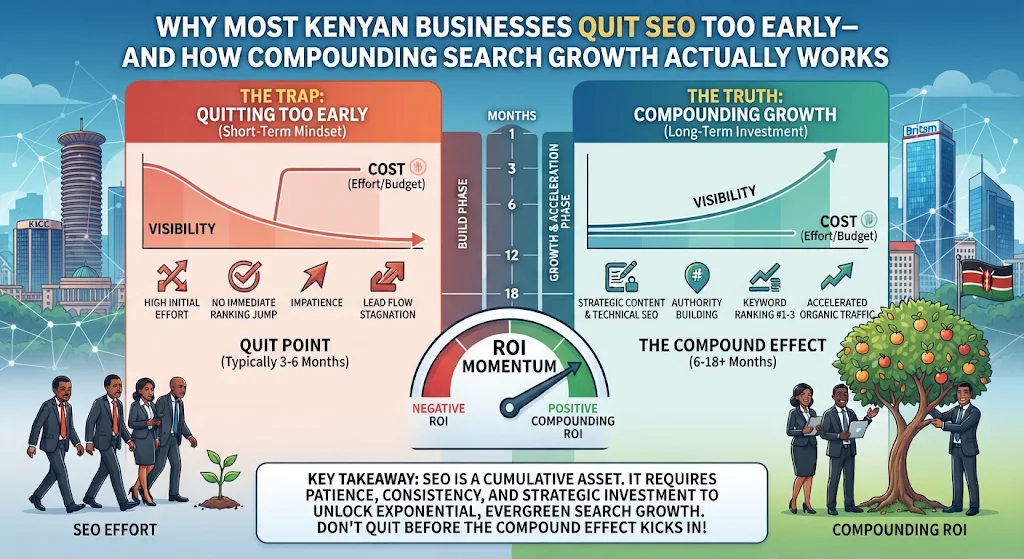
Every quarter across Nairobi, Mombasa, Kisumu, Nakuru, and Eldoret, a familiar pattern plays out in boardrooms and WhatsApp business groups. A company launches a website or signs up for search optimization with high hopes of flooding their inbox with leads and watching Lipa na M-Pesa notifications roll in by week three. Sixty or ninety days later, when rankings are still climbing through Page 2 and Page 3 or when organic traffic has only started ticking upward, patience runs out. The budget is paused, the initiative is declared “ineffective in the Kenyan market,” and the money is shifted back into short-term paid ads or impulsive social boosts.
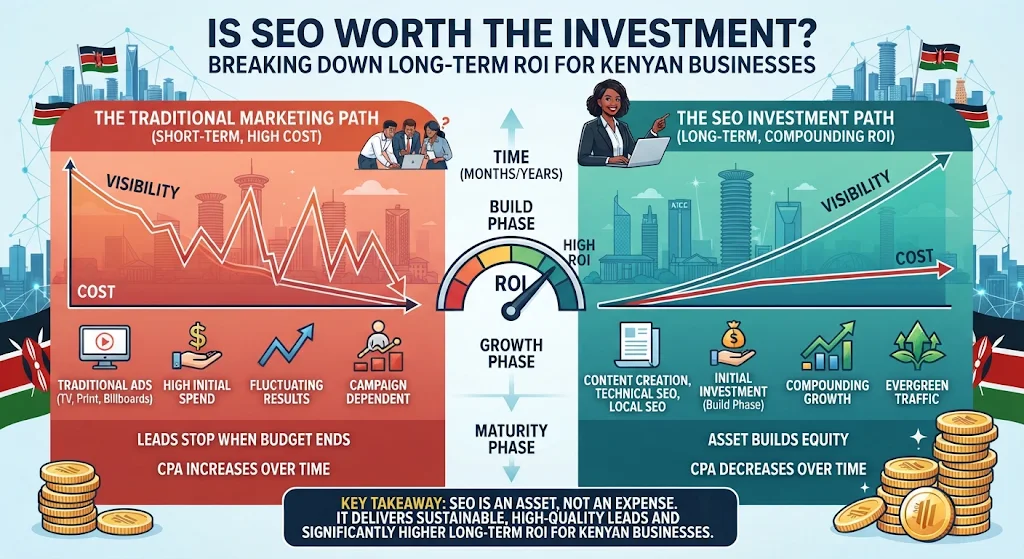
Quitting at the exact moment foundational work is beginning to gain traction is one of the costliest mistakes in Kenyan digital marketing. Search engine optimization does not behave like a light switch or a boosted social post that delivers an immediate burst of attention and stops the moment payment pauses. Instead, SEO behaves like compounding interest: early investments in technical health, search intent alignment, helpful content, local trust signals, and external authority build upon one another over time until your website captures steady, high-intent demand across google.co.ke and AI search surfaces without paying a toll on every single click.
For organizations investing in results-driven SEO services in Kenya, understanding why premature abandonment happens—and how compounding search growth actually unfolds in real Kenyan business conditions—is essential to protecting your marketing budget and building a durable competitive advantage.
This guide examines the real reasons Kenyan businesses abandon SEO too early, separates realistic timelines from misleading promises, breaks down the mechanics of compounding search growth, and outlines a disciplined system for staying the course until organic search becomes a dependable revenue engine.
The Illusion of Instant Results vs. How Search Engines Actually Evaluate Trust
To understand why so many businesses quit early, it helps to contrast how paid promotions work with how organic search trust is earned.
When you run a paid ad campaign on search or social media, you are renting immediate placement. As long as your balance is funded and your targeting works, impressions and clicks can arrive within hours. The moment you stop funding the campaign, the visibility disappears just as quickly.
Organic search works differently because search engines are trying to answer a high-stakes question on behalf of a real person in Kenya: Which website deserves to be recommended at the top for this specific need?
Before Google or an AI answer engine places a page in a top position—or cites a business in an AI Overview or recommendation—it evaluates multiple layers of evidence:
-
Crawlability and technical reliability: Can search bots fetch, render, and index the page cleanly and quickly on mobile connections without errors, blocks, or slow server responses?
-
Relevance and intent match: Does the page genuinely satisfy what a Kenyan searcher looking for that query actually needs, whether they are comparing prices in
KES, checking availability in Westlands or Mombasa, or researching a technical problem? -
Experience, expertise, and trustworthiness (E-E-A-T): Does the site show real credibility, clear ownership, practical depth, and verifiable proof rather than thin filler?
-
External validation and local signals: Do credible third parties, local listings, reviews, and relevant mentions reinforce that this business is real, active, and trusted in its market?
None of those signals flip from zero to authority overnight. A brand-new or previously neglected website starts with little historical weight in competitive categories. Earning top positions takes coordinated execution across weeks and months—and pulling the plug at month two or three usually means paying for the hardest setup phase while walking away before the compounding phase begins.
9 Reasons Kenyan Businesses Quit SEO Too Early
When an SEO initiative stalls or gets cut short in Kenya, it is rarely because search itself does not work. Usually, one or more of these nine pressures or missteps are at play:
1. Expecting Paid-Ad Speed From an Organic Asset
Many business owners compare SEO against a quick social media boost or search ad test. When organic leads do not spike in the first few weeks—especially in competitive sectors like real estate, finance, legal/tax advisory, healthcare, solar/hardware, or e-commerce—stakeholders lose confidence even when early leading indicators (indexing, impressions, and lower-competition rankings) are moving in the right direction.
2. Chasing Ultra-Competitive Keywords Without a Stepping-Stone Strategy
A business with a young domain or thin content footprint often sets its sights immediately on broad, heavily contested terms like "web design Kenya", "real estate Nairobi", or "best clinic" while ignoring specific, high-intent long-tail and geo-qualified queries. Waiting around for top spots on crowded head terms alone feels slow and discouraging, whereas winning targeted subtopics and specific local/service angles builds momentum much faster.
3. Measuring Only Final Sales While Ignoring Leading Indicators
In many Kenyan businesses, sales cycles take weeks or months—especially in B2B services, construction, real estate, corporate equipment, or high-ticket consulting. If leadership only looks at closed invoices at Day 45 and ignores Search Console impressions, keyword movement into Top 10/Top 20, organic clicks, WhatsApp inquiries, and qualified lead volume, it is easy to conclude nothing is happening when early demand is visibly building.
4. Under-Resourced or Sporadic Execution
Publishing two articles in Month 1, skipping Month 2, fixing broken pages halfway, and leaving mobile speed or local listings unaddressed will not produce compounding results. Search growth responds to consistent, well-sequenced work—not sporadic bursts followed by long silences.
5. Falling Victim to “Page 1 in 30 Days” Sales Pitches
Overpromising creates premature disappointment. Anyone guaranteeing instant Page 1 rankings across competitive Kenyan keywords in a few weeks is either targeting obscure terms nobody searches for or relying on risky shortcuts that can backfire. Realistic expectations at the start prevent frustration later.
6. Treating SEO as a Isolated Task Instead of a Full-Funnel System
Sometimes rankings do improve, yet revenue still disappoints because the landing page loads slowly on mobile, hides KES pricing or delivery details, lacks trust proof, or makes reaching out on WhatsApp or phone awkward. When traffic arrives on a leaky page, businesses sometimes blame SEO instead of fixing the conversion path.
7. Ignoring Kenyan Market Nuances and Local Context
Copy-pasted international playbooks that overlook Kenyan search phrasing, local landmarks/estates, KES budget framing, mobile data realities, and local buyer skepticism often struggle to gain traction locally. Without authentic local grounding, content feels generic and fails to connect with Kenyan buyers.
8. Cash-Flow Pressure and Short-Term Budget Reallocation
When cash flow tightens or a competitor runs an aggressive promotion, marketing budgets are often trimmed first. Because SEO’s biggest financial payoff sits further down the timeline than an immediate discount or ad push, short-term survival pressure can tempt leaders to pause organic investment right before rankings break through.
9. Lack of Clear Proof and Alignment on What Good Looks Like
Without clear milestones, transparent reporting, and visible examples of how structured digital work drives real outcomes, internal stakeholders can doubt the process. Seeing tangible examples across proven Kenyan web design and SEO portfolio projects helps set grounded expectations around how clean architecture, targeted content, and strategic optimization come together in practice.
How Compounding Search Growth Actually Works
In finance, compounding happens when the returns your money earns begin generating returns of their own. In SEO, compounding growth happens when each piece of strong work makes every subsequent piece easier to rank, more trustworthy to users, and more profitable to convert.
Here is how that compounding curve typically unfolds in practice:
Phase 1: Foundation, Cleanup & Indexing Alignment (Months 1–2)
Early work focuses on removing friction and establishing clarity:
-
Fixing crawl, indexing, redirect, canonical, and mobile speed issues so search engines can read and render your pages reliably.
-
Mapping keywords cleanly to distinct pages so you do not compete against yourself.
-
Aligning core service, location, and product pages with real Kenyan buyer intent, clear
KESscope/pricing context, and strong mobile calls to action.
What you usually see here: Technical errors drop, important pages get indexed cleanly, and impressions begin appearing in Google Search Console—even if clicks and direct sales are still modest.
Phase 2: Topical Traction & Long-Tail Momentum (Months 3–6)
As helpful guides, comparison pages, service hubs, and supporting cluster content build out your subject coverage—and as internal links connect related pages logically—search engines begin recognizing broader topical relevance:
-
Long-tail, question-based, and specific local/service queries start moving into Page 1 or higher positions.
-
Search Console impressions climb steadily as your site shows up for more relevant variations.
-
Early organic leads, WhatsApp chats, calls, or orders begin appearing from high-intent pages.
Phase 3: Authority Reinforcement & Conversion Compounding (Months 6–12+)
Over time, earlier pages accumulate history, engagement, internal links, and natural mentions or backlinks from relevant sources. Meanwhile, conversion improvements and real customer proof lift how efficiently existing traffic turns into revenue:
-
New pages on familiar topics often rank faster than they did in Month 1 because your domain already carries established topical weight.
-
High-intent commercial terms gain stronger positions, lifting both organic traffic and brand searches (
"[Brand Name]"). -
Because you are not paying a per-click toll on every organic visit, blended customer acquisition cost improves while organic search becomes a reliable pillar of pipeline growth.
Why Compounding Looks Flat Before It Curves Upward
One of the hardest psychological hurdles in SEO is what growth practitioners call the compounding lag (often nicknamed the “valley of disappointment” early on).
During the first few months, effort is high while visible revenue payoff looks small because you are building the underlying structure:
-
Fixing technical bottlenecks and mobile speed on a live site.
-
Researching and structuring pages around real buyer questions and local intent.
-
Earning trust signals, local presence, and search history.
Once enough of those elements reinforce one another, rankings that were hovering around positions 8–20 for valuable terms can cross into top slots where click-through rates jump sharply—and older pages continue pulling traffic month after month with far less ongoing effort than starting from scratch every day.
How Compounding Plays Out Across Different Kenyan Industries
While the compounding mechanism is universal, the pace and shape of search growth vary across industries depending on competition, buying cycles, and how Kenyans research in that sector. Reviewing how strategies are adapted across specialized Kenyan industry verticals shows how different businesses experience this curve:
How to Stay the Course Without Wasting Budget
Staying committed to SEO does not mean throwing money blindly at vague promises. It means pairing patience on compounding search mechanics with discipline on execution and measurement.
1. Set Realistic 6-to-12-Month Milestones Alongside 30-Day Execution Checks
Judge your team or partner every month on execution quality and leading indicators (technical fixes shipped, high-intent pages published/improved, indexing health, impression and ranking growth, and lead quality), while evaluating compounding commercial ROI over multi-month windows rather than week-to-week noise.
2. Balance Quick Wins with Long-Term Pillars
You do not have to wait a year to see useful movement. Pair long-term authority hubs with practical quick wins—such as improving titles/snippets on pages with high impressions and low clicks, tightening mobile speed and conversion paths on existing service pages, and targeting focused local/long-tail terms where you can compete right away.
3. Fix Conversion Leaks Early So Traffic Pays Back Sooner
The faster your website turns visitors into inquiries, calls, WhatsApp conversations, or orders, the sooner SEO supports its own return. Fast mobile pages, clear KES pricing or scope context, visible trust signals, and effortless contact options make even early organic traffic work harder.
4. Keep Publishing and Refreshing Consistently
Compounding stalls when momentum stops completely. Maintaining steady cadence—publishing genuinely helpful, locally grounded content and updating key pages as products, prices, or search needs evolve—keeps your site growing rather than drifting backward.
5. Track Real Business Outcomes, Not Just Vanity Numbers
Connect Google Search Console with Google Analytics 4 and your inquiry/sales tracking so you can see which pages bring qualified leads, calls, WhatsApp messages, or orders—and double down on the topics and pages that drive real business value.
Final Takeaway
Most Kenyan businesses do not fail at SEO because search marketing fails to work in Kenya; they quit during the quiet early stage when foundational authority and trust are still compounding beneath the surface.
When you focus on real buyer intent, local relevance, fast mobile user experiences, trustworthy proof, and consistent execution—while measuring both early search momentum and real commercial outcomes—SEO stops feeling like a slow gamble and becomes one of the strongest compounding growth assets in your business.