Every Kenyan business owner, marketing director, and CFO asks the exact same question before committing budget to search engine optimization: “If we invest tens of thousands of shillings every month into SEO, when will it actually pay for itself—and how does its return compare to running Google Ads, Meta Ads, or traditional media?”
The hesitation is completely understandable. Unlike paid advertising—where you deposit KES 50,000 into an ad account and see clicks within two hours—SEO requires upfront strategic investment before the compounding revenue curve kicks in. In an economy where cash flow discipline matters and every marketing shilling is scrutinized, waiting three to six months for momentum can feel uncomfortable without clear financial modeling.
Yet across Nairobi, Mombasa, Kisumu, Nakuru, and Eldoret, the most profitable, market-leading brands share a common digital foundation: they own Page 1 of Google for the exact terms their buyers search every single day. Partnering with experienced specialists in SEO services in Kenya transforms a company’s website from a passive online brochure into a self-sustaining lead generation asset whose cost per acquisition drops year after year.
This comprehensive financial and strategic breakdown examines the true cost of SEO in Kenya, models realistic 12-to-36-month ROI scenarios across different business sizes, compares organic search head-to-head against paid advertising, and shows you how to measure SEO profitability in Kenyan Shillings—not vanity metrics.
1. The Digital Reality in Kenya: Where Buying Decisions Begin
To evaluate whether SEO is worth the investment, start by looking at how Kenyan customers actually buy today. With over 23.4 million internet users in Kenya and widespread mobile broadband across urban and peri-urban hubs, search engines have become the default starting point for commercial research.
Consider how high-value transactions unfold across Kenya:
-
B2B & Corporate Procurement: A procurement officer in Industrial Area sourcing industrial packaging, a fintech startup in Kilimani searching for cybersecurity compliance auditors, or an NGO looking for fleet leasing does not rely on street flyers. They open Google, search specific commercial queries, shortlist the top three to five organic results, inspect their websites, and request proposals.
-
High-Ticket Consumer Purchases: A homeowner in Karen researching hybrid solar systems, a patient in Westlands comparing dental implant clinics, or a diaspora investor in London verifying Nairobi real estate developers spends days or weeks reading guides, checking Google reviews, and comparing local providers on search engines before making contact.
-
Urgent Local Services: A motorist stranded on Mombasa Road needing emergency towing, a facility manager needing commercial plumbing repairs, or a traveler booking a boutique hotel in Diani searches on mobile and calls one of the top three results in the Google Local Map Pack within minutes.
If your brand is invisible on Google when high-intent buyers are actively searching for what you sell, you are voluntarily handing your highest-margin customers to competitors who invested in search visibility.
2. Understanding the Financial Mechanics of SEO: Rented vs. Owned Traffic
The fundamental reason SEO delivers superior long-term ROI comes down to asset ownership versus traffic rental.
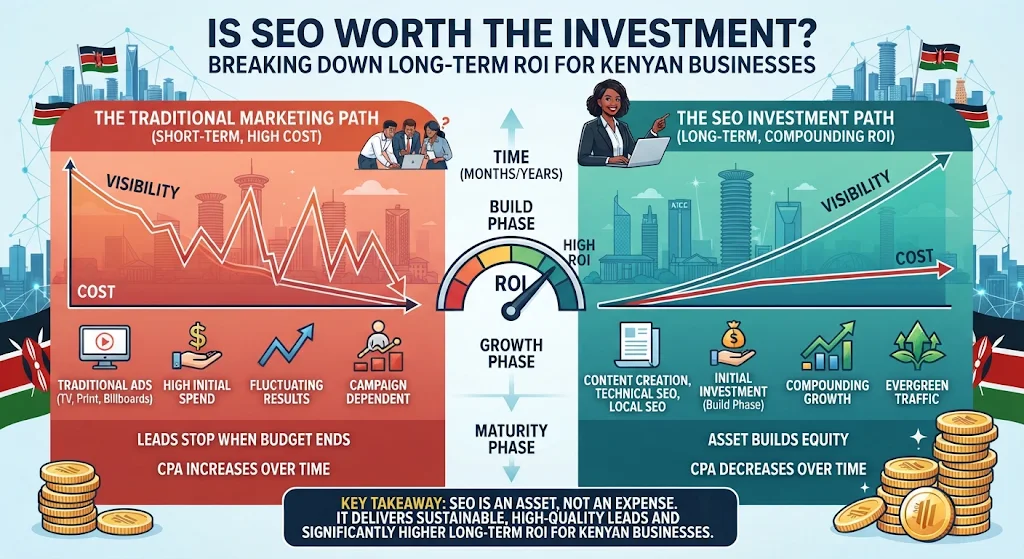
The Paid Advertising Treadmill (Renting Attention)
Paid search (Google Ads) and paid social (Meta, TikTok, LinkedIn Ads) are powerful tools for immediate testing and short-term promotions. However, economically, paid ads operate like renting office space:
-
Linear Cost Structure: Every single click costs money. If your average cost-per-click (CPC) is KES 120 and you want 2,000 monthly visitors, you pay KES 240,000 every single month—forever.
-
Inflationary Auction Pressure: As more Kenyan businesses and international entrants bid on the same keywords, auction prices steadily climb. Your customer acquisition cost (CAC) rises over time unless your conversion rates improve dramatically.
-
Zero Residual Equity: The exact second you pause your ad spend or your card declines, traffic drops to zero. Nothing remains on your balance sheet.
The SEO Compounding Curve (Building Digital Real Estate)
SEO operates like purchasing and developing commercial real estate:
-
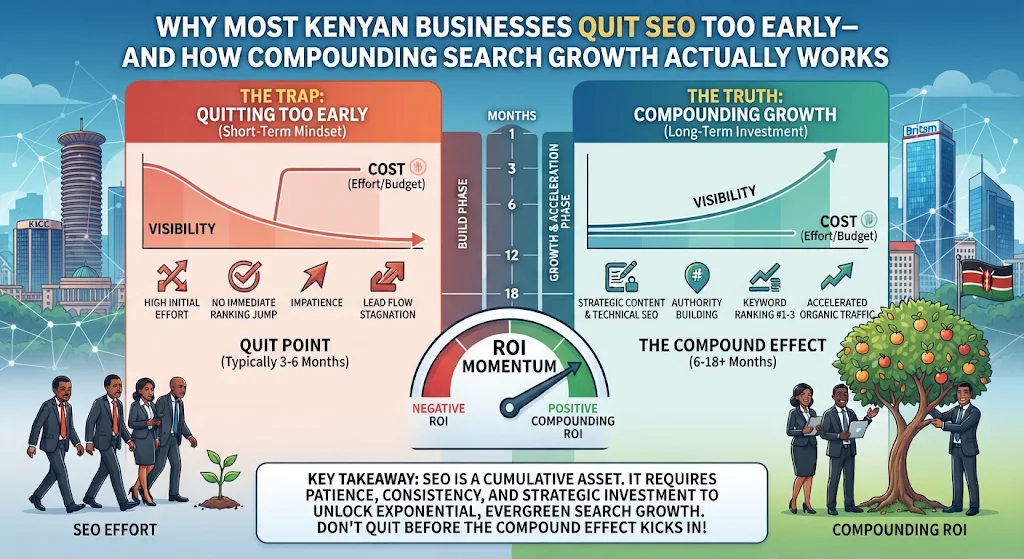
Front-Loaded Investment: During Months 1 through 4, you invest in technical site engineering, keyword architecture, authoritative content creation, and digital PR without seeing immediate peak traffic.
-
Inflection & Acceleration (Months 5–12): As search engines index your content clusters, validate your site’s E-E-A-T (Experience, Expertise, Authoritativeness, and Trustworthiness), and reward user engagement, rankings climb onto Page 1. Traffic begins growing exponentially while your monthly retainer stays fixed.
-
Compounding Margin Expansion (Year 2 and Beyond): A well-structured service page or evergreen buyer’s guide published in Month 4 continues attracting qualified prospects in Month 18, Month 24, and Month 36—at zero marginal cost per click. Your blended cost per lead drops dramatically, widening net profit margins on every sale.
3. Realistic SEO Investment Benchmarks in Kenya
Before calculating ROI, you need realistic numbers for the “I” (Investment) side of the equation. Across the Kenyan market, monthly SEO retainers vary based on competition, website size, and content velocity:
-
Local / Starter SEO (KES 25,000 – KES 45,000/month): Best for single-location local businesses (clinics, salons, restaurants, local contractors) targeting specific neighborhoods or towns. Covers technical hygiene, Google Business Profile optimization, local citations, and core service page tuning.
-
SME Growth SEO (KES 50,000 – KES 100,000/month): The sweet spot for established Kenyan SMEs competing in Nairobi, Mombasa, or national B2B/B2C sectors. Includes comprehensive technical engineering, full-funnel intent content creation (2–4+ authoritative pieces monthly), internal linking architecture, local SEO, and conversion tracking.
-
Competitive National / E-Commerce SEO (KES 100,000 – KES 250,000+/month): Designed for online retailers with hundreds of SKUs, financial institutions, real estate developers, and enterprise brands competing for high-volume national keywords. Funds high-velocity content production, digital PR link acquisition, advanced schema, and conversion rate optimization (CRO).
(Note: Retainers below KES 15,000/month rarely fund legitimate technical work or quality human writing, often leading to automated spam that damages domain authority.)
4. Breaking Down the Numbers: 3 Real-World Kenyan SEO ROI Models
Let’s move from theory to concrete Kenyan Shilling math. Below are three conservative, realistic 12-to-24-month financial models demonstrating how SEO pays for itself across distinct business models.
Model A: Nairobi B2B Professional Services Firm (Law, Accounting, IT, or Consulting)
-
Monthly SEO Investment: KES 70,000/month (12-Month Total = KES 840,000)
-
Average Client Value (First-Year Gross Profit): KES 180,000
-
Campaign Trajectory:
-
Months 1–3: Technical fixes, service page optimization, and 6 commercial-intent guides published. 1 closed client (Revenue: KES 180,000).
-
Months 4–6: Core keywords hit Positions 4–8. Organic traffic reaches 1,200 qualified visits/month. 3 closed clients (Revenue: KES 540,000).
-
Months 7–12: Top-3 rankings achieved for 15+ commercial terms. Organic traffic reaches 3,000+ visits/month. 9 closed clients (Revenue: KES 1,620,000).
-
-
Year 1 Financial Outcome:
-
Total SEO Spend: KES 840,000
-
Total Attributed Gross Profit: KES 2,340,000
-
Year 1 Net ROI: 178.6% (2.78x return in Year 1 alone—and in Year 2, maintaining rankings yields 20+ clients/year at over 400%+ ROI).
-
Model B: Private Medical / Dental Clinic or Specialist Practice in Nairobi
-
Monthly SEO Investment: KES 55,000/month (12-Month Total = KES 660,000)
-
Average Patient Lifetime Gross Margin: KES 45,000 (factoring repeat visits and high-value procedures)
-
Campaign Trajectory:
-
Months 1–3: Google Business Profile overhaul, local neighborhood landing pages, and doctor-reviewed treatment guides. 8 new patients (Gross Margin: KES 360,000).
-
Months 4–6: Top-3 Google Map Pack placement for local specialty searches. 18 new patients (Gross Margin: KES 810,000).
-
Months 7–12: Consistent flow of 12–15 booked appointments/month from organic search. 75 new patients (Gross Margin: KES 3,375,000).
-
-
Year 1 Financial Outcome:
-
Total SEO Spend: KES 660,000
-
Total Attributed Gross Margin: KES 4,545,000
-
Year 1 Net ROI: 588.6%
-
Model C: Kenyan E-Commerce Store (Home Appliances, Electronics, or Specialty Retail)
-
Monthly SEO Investment: KES 110,000/month (12-Month Total = KES 1,320,000)
-
Average Order Value (AOV): KES 14,500 | Gross Product Margin: 35% (KES 5,075 per order)
-
Campaign Trajectory:
-
Months 1–3: Category architecture cleanup, product schema markup, mobile speed tuning, and buyer comparison guides. 65 organic orders (Gross Profit: KES 329,875).
-
Months 4–6: Hundreds of long-tail product and comparison queries reach Page 1. 210 organic orders (Gross Profit: KES 1,065,750).
-
Months 7–12: Compounding category rankings drive 140+ organic orders/month. 860 organic orders (Gross Profit: KES 4,364,500).
-
-
Year 1 Financial Outcome:
-
Total SEO Spend: KES 1,320,000
-
Total Attributed Gross Profit: KES 5,760,125
-
Year 1 Net ROI: 336.4%
-
5. SEO vs. Google Ads vs. Social Media Ads: A Head-to-Head Comparison
Smart Kenyan brands rarely choose one channel in isolation—instead, they allocate budgets according to each channel’s economic strengths. Here is how SEO compares directly against paid digital channels over a 24-month horizon:
The Synergy Effect: Combining Paid Ads with SEO
The highest-performing brands use Google Ads to buy immediate data and short-term leads during Months 1–4 while their SEO foundation matures. Once organic rankings capture Positions 1–3 for high-converting commercial keywords, the brand can dial back paid spend on those exact terms and reallocate ad budget toward new product lines or remarketing—dramatically lowering overall customer acquisition costs.
6. Hidden ROI Multipliers Most Businesses Overlook
When calculating SEO ROI, spreadsheets typically count only direct organic form submissions and e-commerce checkouts. In reality, a strong SEO program generates four powerful secondary returns that amplify revenue across your entire business:
1. Higher Conversion Rates Across All Marketing Channels
Imagine a prospect sees your Instagram ad or hears about your firm at a Nairobi networking event. Before calling you, what do they do? They Google your brand name and industry. When they see your website ranking at the top of search results with authoritative guides, a 4.9-star Google Business Profile, and documented portfolios and completed projects, trust skyrockets—increasing the close rate of your social ads, email campaigns, and outbound sales team.
2. Shorter B2B Sales Cycles
When your blog and resource center thoroughly answer complex buyer questions—such as pricing structures, regulatory compliance, implementation timelines, and vendor comparisons—prospects educate themselves before booking a discovery call. Sales reps spend less time explaining basic concepts and more time closing pre-sold buyers.
3. Protection Against Competitor Encroachment
Every Page 1 spot your brand captures is a spot denied to your closest competitor. In winner-take-most local markets, dominating top organic positions builds a defensive moat that makes it far more expensive for new entrants to steal your market share.
4. Permanent Website & Technical UX Upgrades
Executing proper SEO forces your business to fix slow mobile load speeds, broken links, confusing navigation, and weak landing page copy. Those technical improvements lift conversion rates for every visitor who lands on your site—whether they arrived via Google, LinkedIn, WhatsApp, or a business card. Reviewing real-world client portfolios shows how clean web engineering and search optimization work hand in hand to drive measurable business outcomes.
7. Why Some Kenyan Businesses Fail to See SEO ROI (And How to Avoid It)
If SEO delivers such compelling returns, why do some Kenyan companies complain that “we tried SEO for six months and got nothing”? Almost every failed campaign traces back to one of five avoidable mistakes:
-
Chasing High-Volume Vanity Keywords Instead of Buyer Intent: Ranking #1 for a broad informational term that attracts students or overseas browsers generates impressive traffic charts and zero sales. ROI comes from targeting commercial and transactional queries tied to your highest-margin offerings.
-
Quitting at Month 3 Right Before the Inflection Point: Pulling the plug 90 days into an SEO campaign is like planting maize, fertilizing the soil, and abandoning the farm two weeks before harvest. Give your strategy a realistic 6-to-12-month window to compound.
-
Ignoring Website Conversion Design: Sending 5,000 qualified searchers to an outdated, slow-loading website with broken forms or unclear messaging wastes every shilling spent on rankings. Traffic acquisition and conversion rate optimization must operate together.
-
Generic, Unlocalized Content: Publishing surface-level articles written without Kenyan market context—ignoring KES pricing, local regulations, regional logistics, or sector-specific pain points—fails to persuade discerning local buyers. Tailoring strategies specifically for the diverse industries a brand serves is essential for turning clicks into clients.
-
Hiring Bargain-Basement Vendors Using Risky Shortcuts: Paying KES 10,000/month for automated link blasts or copied content routinely triggers algorithmic suppression that can take a year to clean up.
8. How to Track and Prove SEO ROI in Your Business
To hold your internal team or agency accountable to real financial returns, set up a simple four-step ROI tracking framework from Day 1:
Step 1: Configure Conversion Tracking in Google Analytics 4 (GA4)
Never rely on raw pageviews or keyword rank trackers alone. Configure GA4 to track concrete commercial actions:
-
Quote and consultation form submissions
-
Click-to-call phone taps on mobile devices
-
Click-to-WhatsApp button interactions
-
E-commerce checkouts and order values
-
Downloadable brochure or pricing guide requests
Step 2: Connect Organic Leads to Your CRM or Sales Ledger
Add a hidden UTM / Source field to your website forms and train your front-desk or sales team to log “Google Search” inquiries in your CRM or sales spreadsheet. Track those leads all the way to closed-won invoices so you know exact revenue generated—not just lead counts.
Step 3: Monitor Assisted Conversions
Many high-ticket customers discover your brand via an educational blog post on Monday, compare your case studies and projects on Thursday, and submit a quote request directly on the following Tuesday. Check GA4’s Attribution / Conversion Paths report so early-funnel SEO content receives proper credit for initiating the sale.
Step 4: Apply the Simple Net SEO ROI Formula
Every quarter, calculate your cumulative return using this straightforward formula:
Tracking Gross Profit (rather than top-line revenue) ensures your CFO and leadership team view SEO through a rigorous, financially conservative lens.
9. When SEO Is Not the Right First Move
Honest strategic advice requires acknowledging when SEO should wait:
-
You Need Cash Flow in the Next 14 Days: If your business needs immediate sales next week to cover payroll, deploy targeted Google Search Ads or direct outbound sales first, then reinvest early profits into SEO.
-
You Are Testing an Unvalidated Offer: If you haven’t confirmed whether customers will buy a brand-new product or pricing model, run small paid ad tests for 30 days to validate messaging before building a 6-month SEO content moat around it.
-
You Have Zero Budget for Quality Execution: Attempting SEO on a shoestring budget that cannot cover basic technical fixes and authentic writing will only lead to frustration.
For every other established or growth-stage Kenyan business with a proven product or service, delaying SEO simply makes entering your market more expensive next year.
Turning Marketing Spend into a Compounding Balance-Sheet Asset
So, is SEO worth the investment for Kenyan businesses? When approached as a disciplined, commercial-intent growth engine rather than a checklist of technical tricks, SEO delivers one of the highest long-term returns on investment available in modern business.
While competitors remain trapped on the treadmill of rising ad costs—paying more every quarter just to maintain yesterday’s lead volume—brands that invest in search visibility build an enduring digital moat. Every technical improvement, authoritative guide, and Page 1 ranking works around the clock to attract high-intent buyers, lower customer acquisition costs, and compound revenue year after year.
Whether you operate across healthcare, real estate, finance, logistics, e-commerce, or B2B services—and understand the value of tailored strategies across specialized industry sectors—now is the ideal time to build an organic acquisition engine that pays dividends long into the future. Explore how data-driven SEO services in Kenya can turn your website into your company’s most profitable growth asset.