Launching a brand-new website—or migrating an existing Kenyan business onto a fresh domain—is an exciting milestone. Yet for many founders, marketing managers, and directors across Nairobi, Mombasa, Kisumu, Nakuru, and Eldoret, the first ninety days after going live feel strangely quiet. You publish clean service pages, share the link on WhatsApp and LinkedIn, maybe run a small boost, and then open google.co.ke expecting to see your brand appear for high-intent customer searches—only to find your pages barely indexed or buried far behind established competitors.
A new website in Kenya does not start with instant search authority. Search engines must first discover every URL, verify that mobile pages render quickly over local 4G/5G and fiber connections, interpret your topical focus and local relevance, evaluate trust and early engagement signals, and gradually move your pages from initial indexing into competitive positions—including AI Overviews, Local Map Packs, and organic results.
For organizations investing in results-driven SEO services in Kenya, the first 90 days are about building a rock-solid foundation, aligning every page with real Kenyan buyer intent, establishing local trust signals, and creating early search and lead momentum rather than chasing overnight gimmicks. When those first three months are sequenced properly, every subsequent month builds on cleaner architecture and stronger search signals.
This comprehensive roadmap breaks down what actually happens across Month 1, Month 2, and Month 3 for a new Kenyan website—complete with practical checklists, local market considerations, conversion safeguards, and realistic expectations so your team knows what to prioritize and how to measure early progress.
Setting Realistic Expectations for Days 1 to 90
Before walking through each month, it helps to ground the first 90 days in reality so leadership teams make smart decisions rather than judging a young site by unrealistic yardsticks:
-
What 90 days can achieve: Clean indexing of core pages, fast mobile performance on Kenyan networks, accurate local business and structured data setup, keyword-to-page alignment without internal cannibalization, initial rankings on long-tail and local queries, early Search Console impressions and clicks, and initial leads or inquiries when conversion paths are properly set up.
-
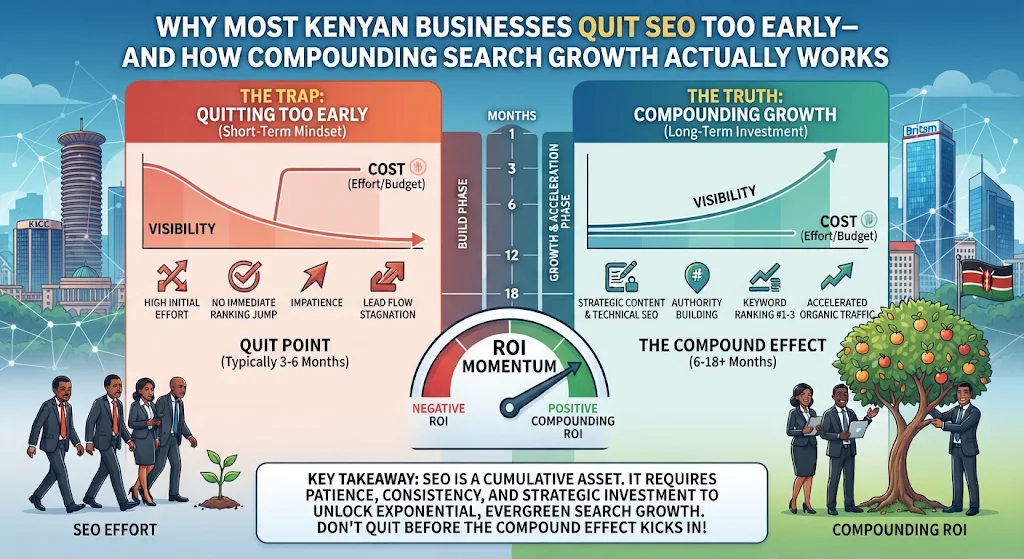
What usually takes longer than 90 days: Dominating ultra-competitive head terms in crowded sectors (such as broad real estate, finance, legal, or major retail categories) against sites with years of backlinks, brand searches, and deep content hubs. In Kenya, search growth compounds over 6 to 12+ months of consistent execution.
-
Why sequencing matters: Doing content writing before fixing
noindextags or slow mobile templates wastes effort; building backlinks before your core service pages and trust signals are ready wastes referral and ranking potential. A structured 90-day sequence puts the right work in the right order.
Month 1 (Days 1–30): Technical Foundations, Indexing & Local Market Alignment
Month 1 is all about visibility, speed, clarity, and structure. A search engine cannot rank a page it cannot crawl or understand—and a Kenyan mobile visitor will not convert on a slow, confusing page.
Week 1: Access, Baseline Audit & Technical Hygiene
-
Verify Core Measurement & Search Tools: Set up and verify Google Search Console (ideally a Domain property), Google Analytics 4 (GA4), and any tag/event tracking for key actions (form submissions, WhatsApp clicks, phone call taps, bookings, or checkouts).
-
Eliminate Indexing Blockers: Check that core pages do not carry accidental
noindextags left over from staging, confirmrobots.txtallows crawling of important sections without exposing private admin/cart clutter, verify HTTPS/SSL across the site with clean redirects, and submit a clean XML sitemap in Search Console. -
Fix Broken Links and Redirects: Scan for
404errors, redirect loops or long redirect chains, and duplicate URL variations (wwwvs. non-www, trailing slash inconsistencies).
Week 2: Mobile Speed & Core Web Vitals for Kenyan Networks
With smartphone browsing accounting for the vast majority of web usage in Kenya, mobile speed is a day-one priority—not an afterthought:
-
Compress and Modernize Media: Convert heavy images to lightweight WebP or AVIF formats, size images appropriately for mobile and desktop viewports, and avoid oversized unoptimized hero media that delays first paint.
-
Optimize Caching and Delivery: Enable browser/page caching, compression, and CDN/edge delivery so assets load swiftly across Nairobi and regional towns even on fluctuating mobile data connections.
-
Trim Script Bloat: Remove unused plugins, heavy unoptimized sliders, and excessive third-party scripts that slow interaction or cause layout shifts (
CLS) on mobile screens.
Week 3: Keyword Mapping & Site Architecture
Rather than guessing topics at random, build a clean Keyword-to-Page Map tailored to Kenyan search habits:
-
Identify Core Commercial & Local Terms: Group keywords by real search intent—transactional service/product queries, comparison and
KEScost/budget queries, local/location queries (such as Nairobi neighborhoods or major Kenyan towns you genuinely serve), and helpful customer questions. -
Prevent Cannibalization Early: Assign each primary keyword cluster to one clear target page so your homepage, service pages, location pages, and blog posts reinforce one another instead of competing for the same term.
-
Refine Navigation and Internal Links: Ensure important service, category, and portfolio pages are easy to reach in a few clicks and linked naturally from related pages using descriptive anchor text.
Week 4: Core Money Pages, Trust Signals & Conversion Readiness
Even before traffic ramps up, make sure every core page is ready to persuade a first-time Kenyan visitor:
-
Clarify Value, Scope &
KESContext: Write clear headlines, concise scannable copy, and realistic pricing ranges, starting points, or scope factors inKES(where appropriate to your business model) so visitors immediately understand what you offer and who it is for. -
Build Local Trust Proof: Display verifiable Kenyan business details—physical location/service coverage, local contact numbers, clear policies, authentic testimonials or credentials, and real work examples. Reviewing how real builds are presented across proven Kenyan web design and SEO portfolio projects helps benchmark how concrete project evidence strengthens credibility.
-
Set Up Friction-Free Contact & Conversion Paths: Test forms on mobile phones, verify click-to-call (
tel:) and WhatsApp links, and ensure checkout or inquiry steps work smoothly without unnecessary roadblocks.
Month 2 (Days 31–60): Content Clusters, Local SEO & Structured Data
Once technical health and core pages are in place, Month 2 focuses on expanding topical depth, strengthening local presence across Kenya, and helping search engines and AI systems parse your brand accurately.
Week 5: Launching High-Intent Supporting Content & Topic Clusters
-
Build Around Real Buyer Questions: Instead of publishing disconnected generic posts, create helpful articles, buying guides, cost breakdowns, and comparison pages that answer specific questions Kenyan customers ask before hiring or buying—and link them logically to your core commercial pages.
-
Write for Both Human Readers and AI Synthesis: Structure sections with clear
H2/H3headings, concise direct answers upfront, scannable lists or comparison tables where helpful, and practical local context rather than thin filler.
Week 6: Google Business Profile & Local SEO Alignment
For businesses serving walk-in customers, local appointments, or regional markets in Kenya, local search alignment in Month 2 is critical:
-
Complete and Align Your Google Business Profile: Claim and verify your listing, use your real business name cleanly, select accurate primary and secondary categories, add up-to-date hours and phone/website details, upload clear photos, and keep Name, Address, and Phone (NAP) consistent with your website.
-
Avoid Thin “Doorway” City Pages: Only create dedicated city or area pages for locations you genuinely serve well, and give each one unique, locally relevant details rather than copy-pasted text with only the town name swapped.
Week 7: Structured Data (Schema.org JSON-LD) Implementation
-
Add Relevant JSON-LD Markup: Implement accurate structured data matching visible page content—such as
OrganizationorLocalBusiness,BreadcrumbList,Article,Product(with accurateKESpricing and availability where applicable), andFAQPagewhere genuine Q&As appear on the page. -
Validate Everything: Test pages using structured data/rich result validation tools and monitor enhancements in Search Console to catch syntax or field mismatches early.
Week 8: First-Month Search Console & Behavior Check
At the end of Month 2, review early signals from the first ~60 days:
-
Check Indexing > Pages and URL Inspection to confirm key pages are indexed and spot any newly discovered crawl or canonical issues.
-
Look at Performance filtered to Kenya to see which queries are starting to generate impressions and where early long-tail rankings are appearing.
-
Inspect mobile engagement and form/WhatsApp/checkout events in GA4 to catch any UX friction before scaling content further.
Month 3 (Days 61–90): Authority Building, Optimization Loops & Scaling What Works
Month 3 shifts from pure setup into external authority signals, targeted refinements based on real data, and scaling high-potential pages.
Week 9: Strategic Link Earning & Kenyan Ecosystem Visibility
-
Earn Relevant Local Links and Mentions: Look for genuine opportunities to earn backlinks or credible citations from relevant Kenyan publications, industry associations, business partners, suppliers, or helpful local resources—prioritizing relevance and real readership over bulk low-quality link schemes.
-
Reclaim Mentions and Build Assets: When your brand, product, or project is mentioned online without a link, reach out politely where appropriate, and keep creating practical guides or resources that others naturally reference.
Week 10: Optimizing Early Impressions, Striking-Distance Terms & CTR
By Month 3, Search Console data begins revealing real user behavior:
-
Spot “Striking-Distance” Opportunities: Look for queries where your pages are already gaining impressions and sitting in reachable positions (such as lower Page 1 or top of Page 2), then strengthen those pages with clearer intent alignment, richer answers, better local context, and strong internal links.
-
Fix Early CTR Leaks: Where a page or query earns solid impressions but low click-through rates, refine the title tag and meta description so the snippet clearly communicates relevance, local fit, and value without misleading clickbait.
Week 11: Tailoring Messaging Across Kenyan Verticals & Offers
Different industries and buyer segments in Kenya respond to different proof points, timelines, and decision triggers. Examining how strategies are tailored across specialized Kenyan industry verticals helps refine your landing pages and content angles so each audience sees solutions tailored to their exact operational reality.
Week 12: 90-Day Review & Q2 Growth Plan
Wrap up Month 3 with a structured review comparing baseline versus Day-90 performance:
-
Track Leading & Commercial Metrics: Review indexed page health, mobile Core Web Vitals, non-branded impressions and clicks in Kenya, top-performing pages, micro-conversions (calls, WhatsApp clicks, quote/form starts), and qualified leads or sales attributed to organic search.
-
Prioritize the Next 90 Days: Double down on topic clusters, service/product pages, and local angles showing real traction, prune or consolidate underperforming/overlapping URLs, and keep steady momentum going into Months 4–6 where compounding gains typically accelerate.
Summary Table: 90-Day SEO Roadmap at a Glance
Common 90-Day Pitfalls to Avoid on a New Kenyan Website
Even well-intentioned teams lose momentum during the first three months when they fall into predictable traps:
-
Judging SEO Only on Week-3 Sales: Early weeks build crawlability, indexing, relevance, and trust; evaluate both early search momentum and conversion readiness alongside pipeline growth.
-
Publishing Thin Pages Just to Hit a Number: Five thorough, genuinely helpful pages aligned with real Kenyan buyer intent beat twenty generic posts written without care or local insight.
-
Ignoring Mobile UX Until Later: Most Kenyan visitors arrive on smartphones; slow mobile pages or clunky forms waste traffic from day one.
-
Stopping at Day 90: Think of Day 90 as laying the foundation and lighting the pilot flame—the biggest compounding returns come when you maintain steady, disciplined execution beyond the first quarter.
Final Takeaway
A strong 90-day SEO roadmap for a new Kenyan website replaces guesswork and impatience with a clear, methodical sequence: get the technical and mobile foundation right in Month 1, build helpful topic clusters, local signals, and structured data in Month 2, and earn authority while refining pages from real data in Month 3.
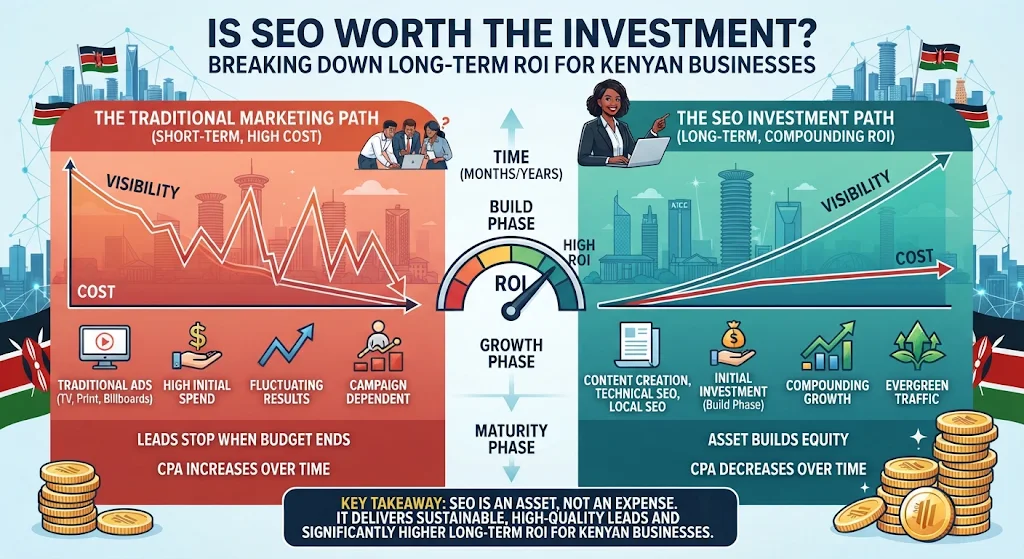
When you treat the first 90 days as the launchpad for a long-term organic growth system—backed by fast mobile pages, authentic Kenyan context, and clear paths to action—your new website builds durable search equity that pays off well beyond its first quarter.