When a Kenyan entrepreneur needs to structure a cross-border commercial contract, or when a parent in Kilimani searches late at night for a pediatric specialist, they are not browsing casually for entertainment. They are making decisions that directly impact their legal liberty, financial security, physical health, or life savings.
Google classifies legal and medical websites under its strictest algorithmic evaluation tier: Your Money or Your Life (YMYL). Unlike an e-commerce store selling sneakers or a travel blog reviewing Diani beach resorts, a poorly researched legal guide or an unverified medical clinic webpage can cause severe real-world harm. Consequently, Google’s 2026 search ranking algorithms—alongside generative AI platforms like Google Gemini, AI Overviews, and ChatGPT Search—apply heightened scrutiny to legal and healthcare domains before awarding top visibility.
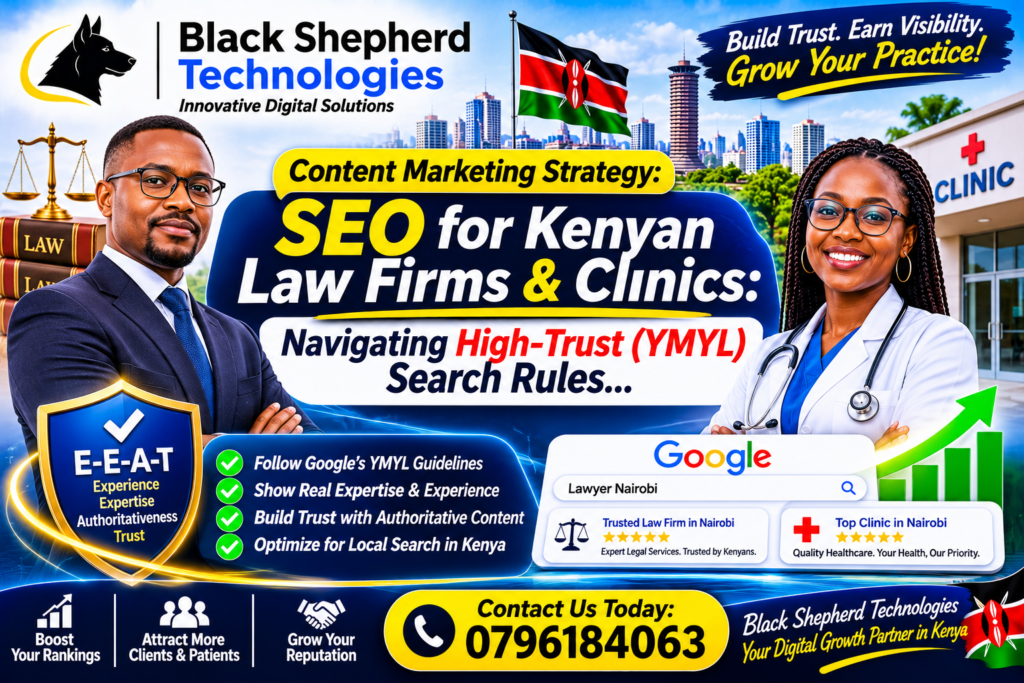
For Kenyan advocates and medical practitioners, ranking #1 is not merely a technical SEO challenge; it is a dual-compliance mandate. You must simultaneously satisfy Google’s rigorous E-E-A-T (Experience, Expertise, Authoritativeness, and Trustworthiness) standards while strictly obeying Kenyan statutory advertising and data protection regulations—specifically the Law Society of Kenya (LSK) Advocates (Marketing and Advertising) Rules, the Kenya Medical Practitioners and Dentists Council (KMPDC) Advertising Rules, and the Kenya Data Protection Act (ODPC).
Using aggressive, hyperbole-driven marketing tactics—such as claiming “Kenya’s #1 Best Law Firm” or guaranteeing “100% Cure Rates”—will not only trigger algorithmic suppression by Google’s YMYL filters, it can also expose partners and practitioners to formal professional misconduct complaints before the LSK or KMPDC. Partnering with specialized SEO services in Kenya ensures your law firm or medical practice builds undeniable search authority while staying 100% compliant with Kenyan professional ethics.
Understanding YMYL & E-E-A-T in the Kenyan Legal and Medical Context
In Google’s Search Quality Rater Guidelines, YMYL encompasses topics that could significantly impact a person’s health, financial stability, safety, or legal rights. Legal representation in Kenya (conveyancing, employment disputes, corporate litigation, family law, tax law) and medical care (outpatient clinics, dental practices, fertility centers, diagnostics, specialist consultations) sit at the very center of YMYL.
To rank a YMYL website in 2026, Google and AI search engines evaluate four core dimensions of E-E-A-T:
-
Experience: Does the content reflect real-world Kenyan legal practice or clinical patient care rather than generic, theoretical definitions? (e.g., explaining actual Milimani Commercial Court filing workflows or Nairobi hospital insurance pre-authorization steps).
-
Expertise: Is the webpage authored or formally reviewed by a verifiable Advocate of the High Court of Kenya or a KMPDC-licensed Medical/Dental Practitioner?
-
Authoritativeness: Is the firm or clinic recognized by independent Kenyan institutions, legal/medical directories, courts, academic journals, or reputable national news outlets?
-
Trustworthiness: Is the website technically secure (
HTTPS), transparent about physical Kenyan office locations, compliant with ODPC patient/client data privacy laws, and completely free of misleading superlatives or guaranteed outcome promises?
Regulatory Guardrails: What Kenyan Law and Medical Rules Permit vs. Prohibit Online
Before writing a single title tag or meta description, your digital team must understand the exact statutory boundaries governing Kenyan advocates and healthcare institutions. Crossing these lines can result in disciplinary inquiry.
1. Law Society of Kenya (LSK) Marketing & Advertising Rules
Under the Advocates (Marketing and Advertising) Rules, 2014, advertisements—explicitly including websites and digital platforms—must be objective, true, and dignified, must respect professional ethics, and must never denigrate another advocate or unfairly solicit business.
-
What IS Permitted on Your Law Firm Website:
-
Identity of the advocate and the law firm.
-
Date of admission to the Roll of Advocates.
-
Physical office address (e.g., Upper Hill, Westlands, Nairobi CBD, Mombasa, Kisumu), contact information, and business hours.
-
Academic qualifications, legal directories, and branches of law practiced (in accordance with LSK specialist classifications).
-
Objective, educational legal articles explaining Kenyan statutes, court procedures, and regulatory compliance.
-
-
What IS Prohibited:
-
Naming or identifying clients of the advocate or firm in advertisements.
-
Using intermediaries (“touts”) or paying commissions to solicit instructions.
-
Making false, misleading, or self-laudatory claims that unfairly attract professional business.
-
2. Kenya Medical Practitioners and Dentists Council (KMPDC) Advertising Rules
Under the Medical Practitioners and Dentists (Practitioners and Health Facilities) (Advertising) Rules, healthcare marketing draws a strict line between accurate factual education and canvassing/touting for patients.
-
What IS Permitted on Your Clinic Website:
-
Practitioner and facility names, Board-recognized specializations, and KMPDC registration numbers/years.
-
Physical clinic address, operating hours, languages spoken, and accepted insurance/SHA accreditation (when currently contracted).
-
Objective, evidence-based patient education articles explaining medical conditions, diagnostic procedures, and preventive care.
-
Academic publications, research contributions, and hospital affiliations.
-
-
What IS Prohibited:
-
Using superlatives or superiority claims such as “Best Clinic in Nairobi,” “No. 1 Dentist,” or “Leading Hospital”.
-
Publishing patient names, identifiable photos, or unconsented before-and-after images.
-
Promising guaranteed outcomes, recovery timelines, or “no result, no fee” offers.
-
Advertising prescription-only medicines directly to the public (restricted under the Pharmacy and Poisons Act).
-
Offering discounts or gifts in exchange for patient reviews or paying referral commissions.
-
Compliance Comparison Matrix for Kenyan SEO Copywriting
Pillar 1: Building Unassailable E-E-A-T Architecture on Your Website
In 2026, Google’s algorithms—and AI answer engines like Gemini and ChatGPT—refuse to rank anonymous legal or medical content. If your blog posts are published under “Admin” or “Marketing Team,” your YMYL rankings will remain permanently capped.
1. Create Comprehensive Advocate & Practitioner Bio Pages
Every partner, associate advocate, consulting doctor, or specialist at your practice must have a dedicated, indexable profile page (yourdomain.co.ke/team/dr-jane-mwangi/ or yourdomain.co.ke/advocates/john-kamau-ll-m/) featuring:
-
Full name, official academic degrees (LL.B, LL.M, MBChB, MMed), and Kenya School of Law or medical university credentials.
-
Year of admission to the Roll of Advocates or KMPDC registration number and recognized specialization.
-
Active memberships in professional bodies (LSK, East Africa Law Society, Chartered Institute of Arbitrators, Kenya Medical Association, etc.).
-
Links to published legal journals, peer-reviewed medical research, speaking engagements at conferences, and verified LinkedIn profiles.
2. Implement Authorship & “Medically/Legally Reviewed By” Attributions
On every practice-area guide or health education article:
-
Display a visible byline at the top of the page: Written by [Name, Title & Credentials] and Reviewed by [Senior Partner / Specialist Consultant].
-
Include a “Last Updated / Reviewed Date” stamp—YMYL content citing outdated Kenyan statutes (such as repealed tax clauses or superseded health regulations) loses E-E-A-T trust rapidly.
-
Cite primary authoritative sources directly in your text: Kenya Law (National Council for Law Reporting), Acts of Parliament, Ministry of Health Kenya guidelines, World Health Organization (WHO) protocols, and peer-reviewed medical journals.
3. Deploy Specialized YMYL JSON-LD Schema Markup
Use structured data to connect your articles, practitioners, and physical offices directly inside Google’s Knowledge Graph:
-
LegalServiceorAttorneySchema: Define practice areas, bar admission credentials, physical Nairobi/Mombasa/Kisumu office coordinates, andareaServedcounties. -
MedicalClinic,Physician, orMedicalWebPageSchema: SpecifymedicalSpecialty,reviewedBypointing to the practitioner’sPersonentity URL, accepted health insurance, and clinic opening hours.
Pillar 2: High-Intent Keyword Strategy for Kenyan Law Firms & Clinics
Potential legal clients and patients rarely search using technical Latin jargon. They search around urgent life events, Kenyan statutory procedures, symptoms, and neighborhood proximity.
High-Converting Legal Search Clusters in Kenya
-
Practice Area + Location Modifiers:
-
“Conveyancing and property lawyers in Nairobi”
-
“Corporate and commercial law firms in Upper Hill”
-
“Employment and labour law advocates in Mombasa”
-
“Intellectual property and data protection lawyers Kenya”
-
-
Procedural & Statutory Question Queries (Top-to-Mid Funnel):
-
“How to conduct a land search on Ardhisasa in Kenya”
-
“Process of registering a company and CR12 in Kenya”
-
“Succession and probate process in Kenyan courts”
-
“Employee termination notice and severance pay under Employment Act Kenya”
-
High-Converting Medical & Clinic Search Clusters in Kenya
-
Specialty + Neighborhood / City Modifiers:
-
“Pediatric clinic in Kilimani Nairobi”
-
“Dental clinic open on Saturday in Westlands”
-
“Obstetrician and gynecologist in Karen Nairobi”
-
“Diagnostic laboratory and ultrasound center in Kisumu”
-
-
Condition, Screening & Insurance Queries:
-
“Full body health checkup packages and cost in Nairobi”
-
“Outpatient clinics accepting SHA and Jubilee insurance in Nairobi”
-
“Root canal treatment procedure and recovery timeline”
-
(Compliance Tip: Always keep medical fee disclosures strictly aligned with KMPDC Professional Fees Rules—never advertise discounted clinical procedures or promotional price cuts).
Pillar 3: Local SEO & Winning the Nairobi, Mombasa & Kisumu Map Pack
For clinics and law firms, local proximity and verified reputation drive immediate consultations. When someone searches “family lawyer near me” or “urgent care clinic in Westlands,” appearing in the Google Local 3-Pack captures the majority of phone calls.
Optimizing Google Business Profile Within Professional Ethics
-
Accurate Primary Categories: Select precise categories such as Law Firm, Real Estate Attorney, Family Law Attorney, Medical Clinic, Dental Clinic, or Pediatrician.
-
Factual, Dignified Profile Copy: Use your exact registered firm or clinic name (no keyword stuffing). List exact physical landmarks (e.g., “4th Floor, Britam Tower, Hospital Road, Upper Hill, Nairobi”), consultation hours, wheelchair accessibility, and parking availability.
-
Ethical Review Management: Both LSK and KMPDC rules forbid paying for testimonials or using patient/client identities in promotional ads. However, patients and clients routinely leave voluntary public reviews on Google Maps. Respond professionally to every review within 48 hours—and never confirm confidential case details or medical diagnoses in your public reply (e.g., reply neutrally: “Thank you for sharing your feedback regarding your visit to our Kilimani clinic. We appreciate your trust in our team.”).
Pillar 4: ODPC Data Protection & Technical Security Compliance
In Kenya, trust is inseparable from statutory data privacy. Under the Kenya Data Protection Act, 2019 and Office of the Data Protection Commissioner (ODPC) regulations, health data and legal client records are classified as sensitive personal data.
Notably, the small-business registration exemption does not apply to healthcare administration or legal/professional services handling sensitive client data—meaning clinics and law firms must register with the ODPC regardless of size.
Technical & Privacy Signals That Boost Both Compliance and SEO Trust
-
Display Your ODPC Data Controller/Processor Registration Number in your website privacy notice.
-
Publish a Clear, Accessible Privacy Notice: Explain clearly before any visitor submits an appointment or consultation form why you collect their name, phone number, and inquiry summary, how long it is stored, and how confidentiality is protected.
-
Minimize Form Data Collection: Never ask patients to type sensitive medical histories or confidential litigation evidence into an unencrypted website contact form. Keep intake forms limited to Name, Phone/WhatsApp, Preferred Location, and General Department, moving detailed intake to secure, encrypted channels.
-
Enforce Strict
HTTPS, HSTS & Fast Mobile Load Speeds: Ensure valid SSL certificates, zero mixed-content warnings, and sub-2.5-second mobile load speeds on Kenyan 4G networks.
Pillar 5: Demonstrating Authority Across Regulated Industry Verticals
In YMYL sectors, prospective clients vet your digital presence thoroughly before trusting you with sensitive legal or medical matters. Working with a digital partner experienced in specialized industries we serve ensures your site architecture reflects the gravitas, clarity, and regulatory precision expected in high-trust Kenyan professions.
While law firms and clinics cannot publish confidential client names or identifiable patient stories, you can still showcase authoritative capability by:
-
Publishing Anonymized Legal & Clinical Insights: Discuss published High Court or Court of Appeal jurisprudence handled by your advocates (public court records) or anonymized clinical research methodologies and community health outreach initiatives.
-
Highlighting Institutional & Infrastructure Standards: Showcase your diagnostic laboratory accreditations, ISO quality certifications, hospital affiliations, and digital infrastructure—drawing inspiration from how structured client portfolios and projects communicate technical competence and execution rigor cleanly.
-
Earning Authoritative Kenyan Citations: Contribute objective legal commentary or public health education articles to Business Daily, Nation, The Standard, Kenya Law Review, and recognized professional association journals. Editorial citations from Tier-1 Kenyan institutions dramatically elevate both Google organic rankings and AI Overview recommendations.
90-Day YMYL SEO Execution Roadmap for Kenyan Practices
In Kenya’s legal and healthcare sectors, sustainable digital growth never comes from loud advertising gimmicks—it comes from dignified, verifiable substance. When your website combines strict LSK, KMPDC, and ODPC compliance with credentialed Kenyan authorship, structured YMYL schema, and clear, objective guidance, Google and AI answer engines recognize your practice as the safest, most authoritative choice for clients and patients across the country.