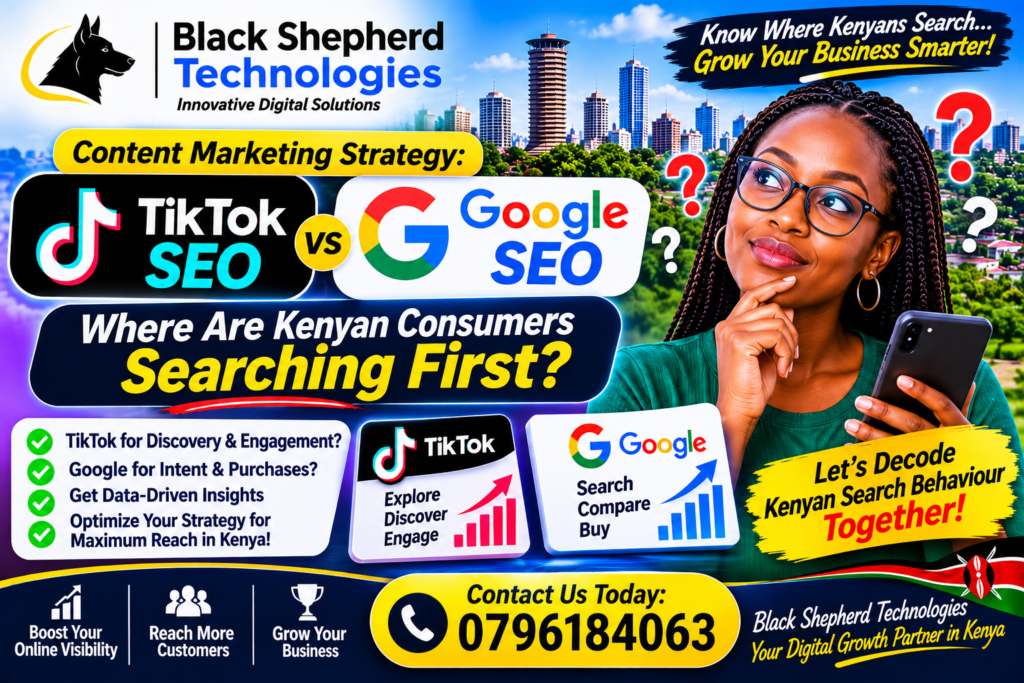
Ask a marketing director in Westlands where Kenyan customers search before buying, and you will likely hear two completely opposite answers depending on who is in the room. The traditional growth lead will point to Google—noting that over 99% of traditional web search traffic in Kenya flows through Google Search and Maps. Meanwhile, the social media manager will pull up TikTok, pointing out that young professionals in Nairobi, Mombasa, and Kisumu now type “best brunch spots in Kilimani,” “affordable skincare products in Kenya,” or “2 bedroom apartments to let in Ruiru” directly into TikTok’s search bar before ever opening Chrome or Safari.
Both are right—and both are missing half the picture if they treat TikTok SEO and Google SEO as an either/or choice.
According to late-2026 digital adoption benchmarks from DataReportal, Kenya’s internet user base has reached 23.9 million people, with TikTok’s adult advertising reach alone hitting 23.9 million users aged 18 and above (an increase of 5.55 million users, or +30.2%, over the previous twelve months). Even more telling, recent Kenyan consumer research shows that 69.1% of Kenyan internet users now use social networks for online brand research, ahead of traditional search engines at 48.4%. Yet when those exact same consumers move from casual discovery to serious due diligence, price comparison, B2B procurement, or local map navigation, they immediately pivot to Google Search, Google Business Profile, and AI Overviews to verify legitimacy before paying via M-Pesa.
Understanding where Kenyan consumers search first—by demographic, industry, and purchase intent—is the key to building an acquisition engine that captures buyers at every stage of their journey. Partnering with specialists in SEO services in Kenya enables businesses to unify social video discovery with high-converting Google search authority, ensuring you never lose a customer between inspiration and checkout.
The 2026 Kenyan Search Landscape: Two Engines, Two Distinct Mindsets
To allocate your marketing budget intelligently, you must recognize that TikTok and Google are not competing to solve the exact same user mindset. They serve two fundamentally different cognitive modes: Visual Experience Discovery versus High-Intent Verification and Action.
How Kenyan Consumers Use TikTok Search
Kenyan users open TikTok when they want unfiltered visual proof, cultural context, and peer validation in under 30 seconds. A polished corporate brochure or stock-photo website cannot show what a restaurant’s actual portion sizes look like, how a foundation shade blends on dark skin under Nairobi sunlight, or what the road access to a gated estate in Kitengela truly looks like during rainy season.
On TikTok, Kenyan searchers look for:
-
Unedited Visual Reality: Real videos filmed on smartphones by real customers, creators, or business owners showing products in use.
-
Peer Consensus in the Comments: In Kenya, the TikTok comment section functions as an instant, crowdsourced Consumer Protection Bureau. Buyers immediately scroll the comments to see if past customers praise delivery speed or warn about hidden charges.
-
Local Context & Code-Switching: Queries naturally blend English, Kiswahili, and Sheng (e.g., “bei ya iPhone 15 Nairobi CBD,” “nyumba za kupanga Syokimau,” or “best nyama choma joints Nairobi”).
How Kenyan Consumers Use Google Search
Kenyan users open Google when they want comprehensive answers, official credentials, geographic proximity, and transactional certainty. When a decision carries high financial cost, regulatory risk, or B2B accountability, a 30-second video is never enough.
On Google, Kenyan searchers look for:
-
Official Verification & E-E-A-T: Is the company registered with KRA, NCA, ICPAK, LSK, or ODPC? Do they have a verifiable physical office in Upper Hill, Westlands, or Mombasa CBD?
-
Deep Comparison & Technical Specs: Detailed pricing tables in KES, downloadable floor plans, bills of quantities, software feature matrices, and side-by-side comparisons.
-
Immediate Geographic Action (“Near Me”): Google Maps directions, verified Google reviews, opening hours, and one-tap phone or WhatsApp buttons when standing on the street needing immediate service.
Where Kenyan Consumers Search First by Industry
Rather than guessing which platform matters more, look at how search behavior splits across major Kenyan commercial sectors:
1. Hospitality, Restaurants, Travel & Lifestyle (TikTok First -> Google Maps Second)
If you run a café in Kilimani, a boutique hotel in Diani, a safari tour operator, or a fitness studio in Lavington, TikTok is the #1 discovery search engine. Consumers search “aesthetic restaurants in Nairobi for birthdays” or “affordable Diani weekend packages” on TikTok to see the ambiance, plating, and crowd vibe. Once they pick a spot, they switch to Google Maps to check the exact location, parking availability, and driving directions.
2. Fashion, Beauty, Skincare & Consumer Electronics (TikTok First -> WhatsApp / E-Commerce Checkout)
For retail products sold across Kenya, buyers search TikTok for unboxing videos, thrift (“mtumba”) store tours in Gikomba or Toi Market, skincare routines, and phone camera tests. High-converting Kenyan retailers capture the search on TikTok and close the sale via an M-Pesa-integrated e-commerce checkout or WhatsApp catalog.
3. Real Estate & Residential Property (Hybrid: TikTok for Tours -> Google for Due Diligence)
Real estate has undergone a dramatic shift in Kenya. Homebuyers and diaspora Kenyans increasingly search TikTok for walkthrough video tours of apartments in Kileleshwa, townhouses in Ruiru, and plots in Joska or Kitengela. However, because land and off-plan fraud remain major concerns, no serious buyer wires a deposit from a TikTok video alone. They immediately search the developer’s name on Google to verify title deed processes, check Google Business Profile reviews, read Ardhisasa due-diligence guides, and inspect completed project portfolios.
4. B2B Services, Legal, Accounting, Healthcare & Construction (Google First)
When a CFO searches for “KRA tax audit consultants in Nairobi,” a hospital administrator looks up “laboratory equipment suppliers in Kenya,” or a landowner searches “NCA 1 commercial building contractors,” Google commands 90%+ of initial discovery. Decision-makers in B2B and high-trust sectors rely on Google Search, AI Overviews, and detailed website case studies—similar to exploring documented client portfolios and projects—to vet institutional capability before scheduling a boardroom meeting.
How TikTok’s Search Algorithm Works in 2026 (And How to Rank #1)
Many Kenyan businesses still post videos on TikTok using only trending Afrobeats or Amapiano sounds and vague captions like “Check out our new arrivals! 🔥🇰🇪 #fyp #kenya.” While that might occasionally earn random entertainment views, it generates zero search traffic when a buyer actively types a commercial query into TikTok.
In 2026, TikTok’s search engine indexes content across four distinct signal layers—meaning you can deliberately engineer your videos to rank #1 for Kenyan buyer searches:
1. Spoken Keywords (Automatic Speech Recognition)
TikTok transcribes every single word spoken aloud in your video. If you want to rank for “best solar backup system for homes in Nairobi,” you must say those exact words aloud within the first 3 to 5 seconds of the video. Opening with “Here is how much a 5kVA solar backup system costs for a 4-bedroom home in Nairobi in 2026” immediately locks your video onto that search query.
2. On-Screen Text Overlays (OCR Indexing)
TikTok’s Optical Character Recognition (OCR) scans the native text boxes placed on your video screen. Place a clean, high-contrast title hook at the top of the frame during the first 3 seconds containing your primary Kenyan search phrase (e.g., “3 Bedroom Apartment Tour in Kilimani – KES 14.5M”). Keep text out of the bottom 20% and right edge where captions and engagement icons sit.
3. Keyword-Rich Captions & Long-Tail Descriptions
TikTok expanded video descriptions to 4,000 characters specifically to compete with Google as a text-indexed search engine. Write clear, descriptive 2-to-3-sentence mini-blog captions that naturally incorporate:
-
Your core product or service keyword.
-
Specific Kenyan locations (Nairobi, Westlands, Mombasa, Kisumu, Nakuru, Eldoret).
-
Pricing ranges in KES, delivery timelines, and clear next steps.
4. Strategic Hashtag Tiering (3 to 5 Tags Max)
Stuffing 25 generic hashtags (#viral #fyp #kenyantiktok) dilutes algorithmic classification. Use a disciplined 3-tier formula:
-
1–2 Broad Industry Tags:
#NairobiRealEstate,#KenyaSkincare -
1–2 Specific Long-Tail Search Tags:
#KilimaniApartmentsForSale,#SolarInstallationKenya -
1 Location/Brand Tag:
#NairobiKenya,#YourBrandName
5. Search-Triggered Engagement Metrics
When a user searches a phrase on TikTok and taps your video, TikTok measures Search Completion Rate (did they watch at least 70% of the video?), Saves/Bookmarks (the strongest signal that the video provided useful reference value), and Profile Clicks. Videos that earn high save rates stay pinned at the top of TikTok search results for months.
Why Google SEO Remains the Non-Negotiable Revenue Anchor in Kenya
While TikTok excels at capturing attention and visual curiosity, Google SEO remains the bedrock of sustainable, high-margin revenue for Kenyan businesses—for four structural reasons:
-
Higher Purchase Intent & Larger Ticket Sizes: Searchers on Google are actively solving an immediate commercial problem rather than passively scrolling an entertainment feed. Conversion rates on high-intent Google search landing pages consistently outperform social traffic by 3x to 5x, particularly for B2B contracts, real estate, healthcare, financial services, and high-ticket retail.
-
Ownership of Your Digital Asset: Social media algorithms change overnight, accounts get restricted, and organic reach fluctuates wildly. A well-structured website with high domain authority, fast mobile speed on Kenyan 4G networks, and top-ranking service pages is an asset you own 100%.
-
Domination of the Local Map Pack & “Near Me” Searches: TikTok does not have a real-time GPS navigation ecosystem comparable to Google Maps. When a customer needs a clinic, lawyer, hardware supplier, or garage right now, winning the Google Local 3-Pack captures the phone call immediately.
-
Fueling AI Recommendations (ChatGPT, Gemini & AI Overviews): Generative AI engines pull their facts, vendor shortlists, and citations from indexed web pages, structured schema data, and Google Business Profile reviews—not from private TikTok feeds.
The “Search Everywhere” Flywheel: Combining TikTok SEO and Google SEO
The smartest Kenyan brands in 2026 do not choose between TikTok and Google—they connect both into a single Search Everywhere Flywheel where each channel amplifies the other:
[1. TikTok Search Discovery]
   User searches "cost of drilling a borehole in Kitengela" -> Watches your 45-sec engineer breakdown
          │
          ▼
[2. Branded Google Search & Verification]
   User searches "[Your Brand Name] Kenya" on Google -> Reads your 4.9-star GBP reviews & NCA credentials
          │
          ▼
[3. Website Conversion & Retargeting]
   User lands on your Kitengela Borehole Cost Guide -> Uses KES calculator -> Books site survey via WhatsApp
          │
          ▼
[4. Algorithmic Feedback Loop]
   Rising branded Google searches boost your Google domain authority -> Higher Google rankings -> More leads
How to Execute the Cross-Platform Flywheel
-
Repurpose One Core Research Asset Across Both Engines: Every time your team publishes a comprehensive, data-backed guide on your website—for example, “2026 Website Design & SEO Pricing in Kenya” or “How to Register a Company and KRA PIN in Kenya”—record two 45-second vertical TikTok videos summarizing the top three takeaways using the exact same target keywords spoken aloud and in captions.
-
Embed TikTok Videos Into Your Google Blog Posts & Service Pages: Embedding your relevant TikTok walkthroughs directly inside your Google-indexed landing pages increases on-page dwell time (a positive engagement signal for Google) while giving website visitors instant visual proof without leaving your site.
-
Use TikTok Comments to Mine New Google SEO Keywords: Read the questions Kenyan viewers ask in your TikTok comments (“Do you deliver to Eldoret?”, “What is the minimum deposit?”, “Does it work without KPLC power?”). Turn those exact verbatim questions into H2 subheadings and
FAQPageschema sections on your website—capturing both Google AI Overviews and traditional organic traffic. -
Align Both Channels Around Specialized Industry Verticals: Whether buyers find you first via a visual case study on TikTok or a technical search on Google, presenting tailored expertise across specialized industries we serve—such as healthcare, real estate, fintech, hospitality, and manufacturing—reinforces instant trust across every touchpoint.
TikTok SEO vs. Google SEO Action Checklist for Kenyan Brands
90-Day Omnichannel Search Rollout Plan
-
Days 1–30 (Audit & Keyword Mapping): Identify your top 20 commercial buyer questions in Kenya. Separate them into visual-discovery queries (for TikTok) and high-intent verification/local queries (for Google). Optimize your Google Business Profile and TikTok business bio with consistent brand naming and WhatsApp links.
-
Days 31–60 (Dual-Engine Content Production): Publish 4 deep, structured commercial hubs or cost guides on your website with JSON-LD schema. Simultaneously film and publish 12 search-optimized TikTok videos (3 per week) answering those exact customer questions using spoken hooks, on-screen keyword text, and location tags.
-
Days 61–90 (Cross-Linking, Reviews & Attribution): Embed your highest-performing TikTok videos into your website landing pages, launch a WhatsApp review workflow for your Google Business Profile, and track branded Google search lift alongside direct WhatsApp and form conversions.
Kenyan consumers no longer follow a straight line from a single search bar to a cash register. They discover visually on TikTok, verify deeply on Google, ask AI assistants for shortlists, and close transactions on WhatsApp. By mastering both TikTok SEO to spark initial discovery and Google SEO to lock down trust and high-intent conversions, your brand owns the entire customer journey—wherever Kenyans search first.