For nearly two decades, digital visibility in Kenya followed a predictable playbook. If your website ranked in the top three blue links on Google Search for terms like “best web designers in Nairobi,” “solar installation Kenya,” or “corporate lawyers in Upper Hill,” you captured the lion’s share of qualified buyer inquiries.
In late 2026, that playbook is no longer complete.
Today, how Kenyan consumers, procurement managers, and diaspora investors discover, evaluate, and shortlist brands has undergone its largest shift since the smartphone boom. Instead of typing fragmented two-word keywords into a search bar and clicking through ten browser tabs, buyers are asking full, conversational questions directly to generative AI engines:
-
“Compare the top commercial solar installers in Nairobi with proven industrial warehouse case studies.”
-
“Which accounting firms in Kenya specialize in KRA eTIMS compliance and NGO audits?”
-
“Find a reliable real estate developer in Syokimau or Ruiru with verified sectional title handovers.”
Whether the user types that prompt into ChatGPT Search, asks Google Gemini on their Android phone, or reads the synthesized Google AI Overview pinned above traditional search results, the interface no longer hands them a list of links to research themselves. It hands them a direct, curated answer—naming two or three recommended brands and explaining why they should be trusted.
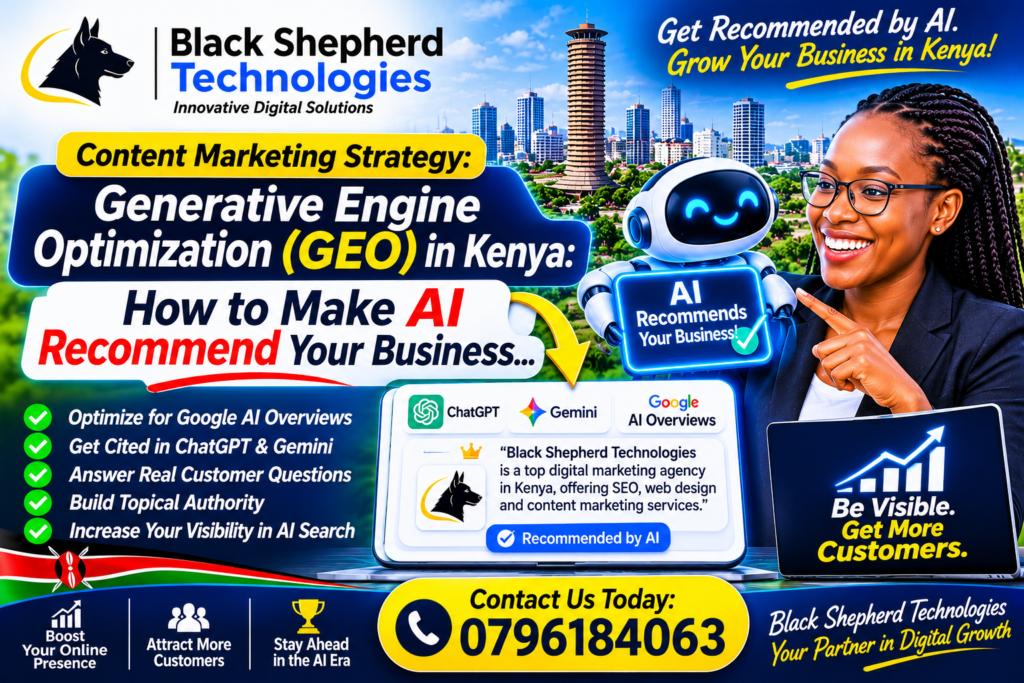
If your Kenyan brand is not cited inside those AI-generated answers, you are invisible during the critical consideration phase—even if your website still holds a decent traditional keyword ranking. Transitioning from legacy keyword optimization to Generative Engine Optimization (GEO) and Answer Engine Optimization (AEO) is now essential for market leadership. Partnering with forward-looking specialists in SEO services in Kenya equips your brand with the entity architecture, structured data, and authoritative citations required to become the default recommendation across every major AI platform.
Understanding the New Search Ecosystem in Kenya: SEO vs. AEO vs. GEO
To future-proof your digital acquisition strategy, you must understand how traditional search engines and Large Language Models (LLMs) retrieve, verify, and synthesize information differently.
1. Traditional Search Engine Optimization (SEO)
-
How it works: Crawls web pages, indexes keywords, evaluates backlink authority, and ranks URLs in a list of 10 blue links or a 3-pack local map.
-
User behavior: The user clicks multiple links, reads pages manually, and compares vendors themselves.
-
Primary metric: Keyword rankings, organic impressions, and click-through rate (CTR).
2. Answer Engine Optimization (AEO)
-
How it works: Structures content into concise, authoritative, machine-readable answers designed to be extracted directly into Google AI Overviews, Featured Snippets, and voice assistant responses.
-
User behavior: The user gets an immediate synthesized summary at the top of the SERP and clicks only the cited source links to verify pricing, portfolios, or contact details.
-
Primary metric: Citation frequency inside AI Overviews and high-intent referral conversions.
3. Generative Engine Optimization (GEO)
-
How it works: Optimizes your brand’s broader digital footprint—entity definitions, third-party press mentions, structured schema, review sentiment, and proprietary data—so standalone AI assistants like ChatGPT, Gemini, Perplexity, and Claude recognize your brand as a trusted entity and recommend you by name.
-
User behavior: Multi-turn conversational research (“Give me three options in Nairobi” -> “Which one has the best reviews for healthcare clients?” -> “Share their website and contact details”).
-
Primary metric: Brand Share of Voice (SoV) across AI prompts, sentiment accuracy, and direct/branded search lift.
Crucially, GEO does not replace traditional SEO—it builds on top of it. Both Google Gemini and ChatGPT’s live web retrieval engines rely heavily on top-ranking search indexes, high-authority domains, and structured web data to ground their answers in real-time facts.
How ChatGPT, Gemini, and Google AI Overviews Choose Which Kenyan Brands to Recommend
Generative AI models do not “guess” which Nairobi or Mombasa company is best; they rely on Retrieval-Augmented Generation (RAG) and Entity Knowledge Graphs. When a user asks an AI engine for vendor recommendations in Kenya, the model executes four rapid steps behind the scenes:
-
Query Fan-Out: The AI breaks one complex user prompt into 4 to 8 sub-queries (e.g., “best interior fit-out contractors Nairobi,” “Nairobi office fit-out reviews,” “NCA registered interior contractors Kenya,” “commercial fit-out portfolio Nairobi”).
-
Real-Time Index Retrieval: It pulls top-ranking pages, Kenyan business directories, news articles, and Google Business Profile data across those sub-queries.
-
Entity Corroboration & Consensus Scoring: The model checks whether the same brand name appears consistently across multiple independent, credible sources—your own website, verified Google reviews, industry association directories, and Kenyan media outlets.
-
Fact Extraction & Citation Synthesis: The AI extracts verifiable facts (years in operation, physical location, regulatory licenses, pricing benchmarks, client case studies) and constructs a balanced answer citing the brands with the strongest evidence.
If your website consists solely of vague marketing slogans like “We deliver innovative, world-class solutions tailored to your business needs” without concrete numbers, verifiable Kenyan credentials, or third-party mentions, AI models have nothing factual to extract—and will skip your brand entirely.
Pillar 1: Establishing Unambiguous Brand Entity Signals
In legacy SEO, you optimized for strings (exact keyword phrases). In AI search, you optimize for entities (distinct, verifiable real-world concepts—your company, your founders, your services, your physical offices in Nairobi or Mombasa, and your regulatory accreditations—and how they connect to one another).
1. Write Clear, Definitional “Entity Anchor” Copy
Every core page on your website—especially your Homepage, About Us page, and primary Service pages—should open with a crystal-clear, factual definition that an LLM can parse effortlessly in the first 100 words.
-
Weak Marketing Fluff:
"At Apex Solutions, we are passionate pioneers transforming the digital landscape through synergy and cutting-edge excellence." -
AI-Ready Entity Statement:
"Apex Digital Solutions is a Nairobi-based enterprise software and cloud infrastructure firm founded in 2016. Headquartered in Westlands, Nairobi, the company serves banks, SACCOs, NGOs, and logistics firms across Kenya, Uganda, and Tanzania with ISO 27001-certified ERP systems and custom API integrations."
Notice how the second statement immediately anchors Who (Apex Digital Solutions), What (enterprise software and cloud infrastructure), Where (Westlands, Nairobi; Kenya, Uganda, Tanzania), For Whom (banks, SACCOs, NGOs, logistics firms), and Proof (founded in 2016, ISO 27001-certified).
2. Deploy Comprehensive JSON-LD Schema Markup (Organization, LocalBusiness, FAQPage)
Structured data is the native language of AI crawlers. While human visitors read your formatted web design, Google’s Gemini crawlers and AI indexing bots read your JSON-LD schema to verify entity relationships without hallucination.
Ensure your website implements clean, interconnected JSON-LD schema containing:
-
Organization/ProfessionalServiceSchema: Define your exact legalname,alternateName,foundingDate,url,logo, physicaladdressin Kenya,+254telephone,areaServed(specific Kenyan counties and cities), andknowsAbout(listing your core technical competencies). -
sameAsEntity Linking: Connect your website explicitly to your verified LinkedIn company page, Google Business Profile, Crunchbase profile, Wikidata entry (if applicable), and official Kenyan association listings so AI models merge all mentions into one unified brand profile. -
PersonSchema for Leadership & Authors: Link every blog post, whitepaper, and case study to a named Kenyan subject-matter expert with verifiable credentials, LinkedIn profiles, and industry experience—reinforcing Google’s E-E-A-T (Experience, Expertise, Authoritativeness, Trustworthiness) framework.
Pillar 2: Structuring Content for AI Extraction (The Answer-First Framework)
AI Overviews and conversational engines are trained to extract modular, self-contained blocks of information that directly answer specific user questions. Long walls of unstructured prose buried beneath meandering introductions rarely get cited.
How to Format Pages So AI Engines Quote You Directly
-
Use Question-Based H2 and H3 Headings: Frame subheadings around the exact natural-language prompts Kenyan buyers type into ChatGPT and Google (e.g., “How Much Does Commercial Solar Installation Cost in Nairobi in 2026?” or “What Documents Are Required for KRA eTIMS Integration?”).
-
Follow the “40-to-60-Word Direct Answer” Rule: Immediately beneath each question heading, write a concise, objective 2-to-3-sentence paragraph that directly answers the question with specific figures in KES, timelines, or regulatory steps—before expanding into deeper nuance below. AI models routinely lift these crisp opening blocks word-for-word into AI Overviews.
-
Use Structured Markdown/HTML Comparison Tables: LLMs excel at parsing HTML
<table>elements. Whenever comparing service tiers, pricing ranges, software features, or regional logistics options (Nairobi vs. Mombasa vs. Kisumu), present the data in a clean comparison table rather than burying numbers inside paragraphs. -
Build Dedicated, High-Intent FAQ Sections: End every core service page and location hub with 5 to 8 genuine buyer FAQs marked up with
FAQPageschema. Focus on real pre-purchase objections: pricing transparency, SLAs, payment milestones, regulatory compliance, and post-project support.
Pillar 3: Building Co-Citations & Consensus Across the Kenyan Digital Ecosystem
One of the biggest revelations in Generative Engine Optimization is that what other credible websites say about your brand matters even more than what you say about yourself.
When ChatGPT or Gemini evaluates which Kenyan companies to recommend, it looks for co-occurrence—seeing your brand name mentioned repeatedly alongside your industry category across independent, trustworthy sources. Even unlinked brand mentions (where a Kenyan news site, trade journal, or forum discusses your firm without adding a clickable hyperlink) feed directly into LLM training and retrieval weights.
High-Impact Co-Citation Channels in Kenya
How to Engineer Multi-Channel Brand Consensus
-
Publish Original Kenyan Benchmark Reports: AI models crave proprietary statistics that do not exist elsewhere. If you run a logistics firm, publish an annual “Kenya Freight & Last-Mile Delivery Cost Index.” If you run a digital agency, publish “2026 Kenyan E-Commerce Conversion & M-Pesa Checkout Benchmarks.” Pitch these findings to Kenyan journalists and industry bloggers—when media outlets cite your data, your brand becomes the primary cited authority in AI answers.
-
Audit Your “Best [Service] in Nairobi/Kenya” Presence: Prompt ChatGPT and Gemini today with “What are the best [your industry] companies in Kenya?” Inspect every third-party listicle or directory that the AI cites as its source. Reach out to those publishers to ensure your firm is accurately profiled, reviewed, and included.
-
Turn Case Studies Into Verifiable Proof: AI engines look for concrete evidence of execution before recommending B2B partners. Documenting measurable client outcomes—much like showcasing detailed client portfolios and projects—gives both human buyers and AI retrieval bots verifiable proof of industries served, technical scope, and delivered ROI.
Pillar 4: Optimizing Your Google Business Profile for Gemini & Local AI Recommendations
Because Google Gemini is deeply integrated into Android smartphones, Google Maps, Chrome, and Google Search across Kenya, your Google Business Profile (GBP) is the primary data feed for local AI queries.
When a user in Kilimani asks Gemini “Find me a top-rated pediatric clinic near me that is open right now and accepts SHA/private insurance,” Gemini pulls directly from GBP attributes, opening hours, Q&A entries, and customer review text.
Making Your GBP AI-Readable
-
Detailed Service Descriptions: Do not just list service titles inside your GBP dashboard. Fill out the 300-character description field for every individual service, including specific Kenyan terminology, target client types, and transparent starting prices in KES.
-
Attribute Completeness: Complete every applicable attribute—wheelchair accessibility, parking availability, online appointments, women-owned/led indicators, and accepted payment methods.
-
Review Sentiment & Specificity: As AI models summarize review sentiment (“Reviewers praise their fast turnaround in Westlands and transparent pricing”), encourage happy clients via WhatsApp to mention the exact service delivered and their Nairobi/Mombasa/Kisumu neighborhood in their Google reviews.
-
Industry-Vertical Alignment: Clearly articulating your domain focus across specialized industries we serve—whether healthcare, real estate, fintech, manufacturing, or NGOs—helps AI engines match your brand to nuanced vertical-specific prompts rather than treating you as a generic generalist.
Pillar 5: Technical Readiness for AI Crawlers (llms.txt, Bot Access & Page Speed)
Many Kenyan websites inadvertently block AI search engines from reading their content due to outdated security configurations or heavy JavaScript rendering.
1. Check Your robots.txt for AI Search Bots
While some publishers block AI model training scrapers, blocking AI search retrieval bots prevents your brand from appearing in live ChatGPT Search, Perplexity, and Google AI Overview citations. Review your robots.txt file to ensure you are not unintentionally blocking:
-
OAI-SearchBot(OpenAI’s live search retrieval crawler for ChatGPT) -
ChatGPT-User(Real-time user browsing agent) -
GooglebotandGoogle-Extended(Google Search and Gemini grounding) -
PerplexityBot(Perplexity AI answer engine)
2. Implement an /llms.txt File on Your Root Domain
Emerging as a widely adopted technical standard in 2026, llms.txt is a clean, lightweight Markdown file placed at yourdomain.co.ke/llms.txt that acts as a curated executive summary for AI crawlers. Instead of forcing an AI bot to wade through complex navigation menus, popups, and footer scripts, llms.txt gives LLMs a structured map of:
-
Who your Kenyan company is and your core value proposition.
-
Direct links and concise summaries of your primary service pillars, industry verticals, pricing guides, and flagship case studies.
-
Official contact details, physical office locations, and regulatory certifications.
3. Server-Side Rendering (SSR) & Clean HTML
Many AI retrieval crawlers do not execute heavy client-side JavaScript frameworks cleanly. If your website relies entirely on client-side rendering to display service descriptions, pricing tables, or portfolio items, AI bots may see a blank page. Ensure all critical text, headings, tables, and schema markup are rendered directly in clean, semantic HTML (<h1>, <h2>, <p>, <table>, <ul>) with fast mobile server response times.
Measuring What Matters: Tracking Your AI Visibility in 2026
Traditional rank trackers alone cannot tell you how your brand performs inside conversational AI engines. Update your monthly reporting dashboard with four modern GEO KPIs:
-
AI Share of Voice (Prompt Testing): Build a standardized list of 20 to 30 high-intent buyer prompts relevant to your Kenyan market (e.g., “best [service] in Nairobi,” “top [industry] companies in Kenya,” “compare [Your Brand] vs [Competitor]”). Run these prompts monthly across ChatGPT, Google Gemini, and Google Search (tracking AI Overviews) to score how often your brand appears, in what position, and with what sentiment.
-
AI Referral Traffic in GA4: Configure a custom channel group in Google Analytics 4 (GA4) tracking referral traffic from
chatgpt.com,chat.openai.com,gemini.google.com,perplexity.ai, andcopilot.microsoft.com. While AI referral volume is smaller than traditional search volume, visitors clicking through from an AI recommendation convert at 2x to 4x higher rates because the AI has already pre-qualified your brand. -
Branded Search Volume Lift: Often, a Kenyan buyer asks ChatGPT for vendor recommendations on mobile, sees your company recommended, and then opens Google or LinkedIn to search your brand name directly. Rising branded search impressions in Google Search Console is one of the clearest indicators of growing AI visibility.
-
Citation Accuracy Audits: Periodically ask ChatGPT and Gemini to summarize your company’s services, pricing, and locations. If an AI model repeats outdated pricing or misses a new branch in Mombasa or Kisumu, update your website’s entity copy,
llms.txt, and structured schema to correct the source record.
90-Day Roadmap: Preparing Your Kenyan Brand for AI Search Dominance
The shift from ten blue links to AI-synthesized answers does not mean the end of SEO—it means the end of lazy, superficial marketing. In 2026, ChatGPT, Gemini, and Google AI Overviews reward Kenyan brands that demonstrate real-world expertise, transparent pricing, verifiable regulatory standing, and consistent third-party trust. By building a clean entity foundation and structuring your knowledge for both human decision-makers and AI retrieval engines, your brand will remain the first name recommended—no matter how your customers search.