
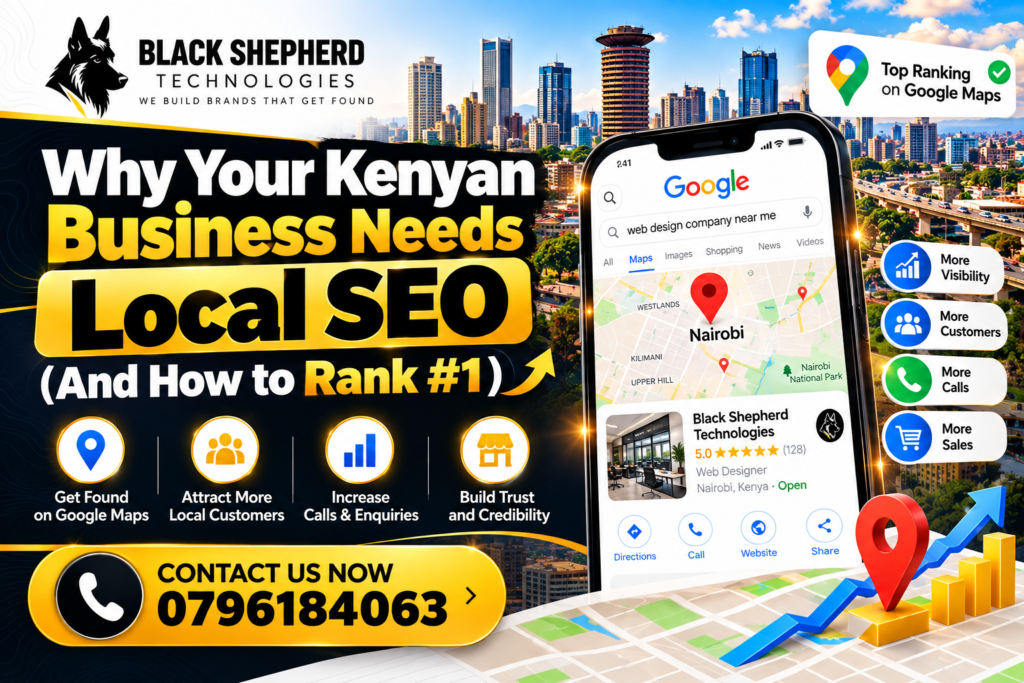
Imagine this: A resident in Westlands, Nairobi, is craving authentic coastal biryani or needs an emergency plumber in Nyali, Mombasa. What do they do? They don’t flip through a physical phone directory or ask a passing stranger. They pull out their smartphone, type “best restaurant near me” or “plumber in Mombasa” into Google, and tap on one of the top three results.
If your Kenyan business isn’t showing up at that exact moment, you are invisible to the customers who are ready to buy right now.
In Kenya’s rapidly digitalizing economy, having a standard website is no longer enough. With over 22 million internet subscriptions and smartphone penetration skyrocketing across Nairobi, Mombasa, Kisumu, Nakuru, and Eldoret, consumers have shifted their shopping habits online. They look for local solutions to local problems.
This comprehensive guide explores why Local SEO is the ultimate growth engine for Kenyan businesses, how it differs from traditional SEO, and the step-by-step framework you can use to dominate search engine results and rank #1.
What is Local SEO, and Why is it Different in Kenya?
Understanding Local Search Engine Optimization
Local SEO is the practice of optimizing your online presence to attract more business from relevant local searches. These searches take place on Google Search, Google Maps, and other directories where consumers look for products and services within a specific geographic radius.
When a user searches for “digital marketing agency Nairobi” or “hardware store near me” while located in Kilimani, Google triggers a specific algorithm. Instead of just showing the most popular global websites, Google displays the Local Pack (the map with three local business listings) followed by localized organic search results.
The Kenyan Digital Landscape
Kenya’s internet ecosystem has unique characteristics that make Local SEO mandatory:
-
Mobile-First Realities: The vast majority of internet traffic in Kenya originates from mobile devices (Android and iOS smartphones). Mobile searches are inherently local; users want answers while on the move, commuting along Thika Road, or sitting in a café in Karen.
-
“Near Me” Culture: Urban Kenyans rely heavily on location-based intent. Whether looking for a boutique hotel in Naivasha, a dentist in Upper Hill, or a logistics firm in Industrial Area, queries are hyper-targeted.
-
Trust Deficit and Proximity: Kenyan consumers prefer transacting with businesses they can physically visit or verify locally. A well-optimized local profile builds immediate trust, showing verified physical addresses, working hours, and genuine customer reviews.
If you are a business owner looking to scale your local footprint, partnering with an expert team that understands the nuances of the local market is crucial. You can explore professional solutions tailored for the local market by checking out Black Shepherd’s SEO Services in Kenya.
Why Your Kenyan Business Desperately Needs Local SEO
Traditional SEO focuses on ranking nationally or globally for broad keywords (e.g., “best shoes”). While valuable for e-commerce giants, a local bakery in Lang’ata doesn’t care about a customer in Kisumu who cannot visit their storefront. Here is why Local SEO should be your top marketing priority:
1. High Conversion Intent
Local searches have the highest purchase intent on the internet. Someone searching for “roofing contractor in Eldoret” isn’t browsing for fun—they have a leaking roof and need it fixed today. Studies show that nearly 76% of people who search for something local on their smartphone visit a related business within 24 hours, and 28% of those searches result in a purchase.
2. Cost-Effective Marketing Compared to Traditional Ads
Radio ads, billboards along Mombasa Road, and print flyers are expensive, short-lived, and difficult to measure. Once your ad budget runs out, the visibility stops. In contrast, Local SEO is an asset-building strategy. Once you rank #1 on Google Maps and organic search, you receive a continuous stream of free, high-intent traffic 24/7 without paying for every single click.
3. Beating Larger Competitors
You don’t need a multi-million-shilling advertising budget to outrank multinational or national chains locally. Google’s local algorithm prioritizes relevance, distance, and prominence. If your local optimization is sharper, your Google Business Profile is more active, and your reviews are better, a small boutique agency in Kilimani can easily outrank a massive corporation for local searches.
4. Direct Integration with Google Maps and Mobile Navigation
In cities like Nairobi and Mombasa, physical navigation is integrated directly into daily life. When your business appears prominently on Google Maps, customers don’t just see your website—they get instant driving directions, tap-to-call phone numbers, and operational status.
To see how specialized web architecture and localized design can merge to drive explosive growth across different sectors, review the diverse Black Shepherd Portfolios and Projects.
Anatomy of a Local SEO Strategy: How Google Decides Who Ranks #1
Before diving into execution, you must understand how Google’s local ranking algorithm works. Google evaluates local businesses based on three primary pillars:
-
Relevance: How well your local profile matches what someone is searching for. If someone searches for “cybersecurity audit Nairobi,” a generic IT repair shop won’t rank unless its profile explicitly details cybersecurity services.
-
Distance: How far each potential search result is from the location term used in the search (or the user’s actual physical location if they use “near me”).
-
Prominence: How well-known a business is. This is calculated using traditional SEO factors (backlinks, domain authority, directory citations, article mentions) as well as offline presence, review volume, and sentiment.
Step-by-Step Blueprint to Rank #1 on Local Search in Kenya
Step 1: Claim, Verify, and Optimize Your Google Business Profile (GBP)
Your Google Business Profile (formerly Google My Business) is the single most important tool for Local SEO. If you don’t have one optimized, you are losing out to competitors immediately.
-
Claim Your Listing: Go to Google Business Profile and claim your business name. If it already exists, request ownership.
-
Accurate Name, Address, and Phone Number (NAP): Ensure your business name matches your legal trading name. Avoid keyword stuffing your business name (e.g., changing “Nairobi Coffee House” to “Nairobi Coffee House Best Coffee Shop Nairobi”), as this violates Google’s guidelines and can lead to suspension.
-
Choose the Right Primary Category: This is a heavy ranking factor. If you are a digital agency, select “Digital Marketing Agency” rather than just “Marketing Agency” or “Consultant.”
-
Write a Compelling Business Description: Incorporate local keywords naturally. Mention cities, estates, and landmarks (e.g., “Located along Ngong Road, opposite Nairobi Garage, we provide…”).
-
Add High-Quality Visuals: Upload clear photos of your storefront, office interior, products, and team. Kenyan consumers engage significantly more with listings that feature real, high-resolution imagery.
-
Operating Hours and Attributes: Keep your hours updated, especially during Kenyan public holidays (Madaraka Day, Mashujaa Day, Jamhuri Day, Christmas, etc.).
Step 2: Master Local Keyword Research for the Kenyan Market
Keyword research for Kenya requires understanding local colloquialisms, spelling variations, and search behaviors.
-
Geo-Modifiers: Always pair your core service with Kenyan geographic terms. Instead of targeting “best accountant,” target “best tax accountant in Westlands Nairobi” or “certified public accountants in Nakuru.”
-
Understand Search Intent: Analyze what Kenyans type. Do they search in English, Swahili, or Sheng? While corporate services are primarily searched in English, retail and consumer services often blend languages. Test keywords using tools like Google Keyword Planner with your location set to Kenya.
Step 3: Optimize Your Website for Local Search (On-Page SEO)
Your website must signal to Google precisely where you operate and whom you serve.
-
Local Landing Pages: If you serve multiple regions (e.g., Nairobi, Mombasa, and Kisumu), create dedicated landing pages for each city or major neighborhood.
-
Title Tags and Meta Descriptions: Include your primary keyword and location.
-
Example:
<title>Top Web Design Agency in Nairobi, Kenya | Black Shepherd</title>
-
-
Local Business Schema Markup (JSON-LD): Implement schema markup on your website. This is a snippet of code that tells search engines your exact physical address, telephone number, geocoordinates, business hours, and social profiles.
-
Mobile Optimization: Ensure your site loads in under 3 seconds on Safaricom and Airtel mobile networks. Compress images, minimize heavy scripts, and use responsive design.
Step 4: Build Local Citations and NAP Consistency
Citations are mentions of your business name, address, and phone number on other websites, directories, and social platforms.
-
List on Kenyan Business Directories: Get listed on authoritative local directories such as Yalafrica Kenya, BrighterMonday (for employer branding), Yellow Pages Kenya, and VibeDeal.
-
Ensure NAP Consistency: Your business name, address, and phone number must be identical across your website, Google Business Profile, Facebook page, Instagram, and every directory. Discrepancies confuse Google’s crawler and dilute your ranking power.
Step 5: Cultivate and Manage Customer Reviews
Online reviews act as social proof for humans and a major ranking signal for Google.
-
Ask at the Right Time: Train your team to request reviews immediately after delivering an exceptional service or product. A simple WhatsApp message with a direct link to your Google review page works wonders in Kenya.
-
Respond to All Reviews: Reply professionally to every single review—positive or negative. When responding to positive reviews, subtly mention keywords (e.g., “Thank you for trusting us with your office networking needs in Westlands!”).
-
Handle Negative Feedback Gracefully: If you receive a negative review, address it calmly, apologize if necessary, and take the conversation offline to resolve the customer’s issue. Prospective clients respect how you handle adversity.
Step 6: Create Localized Content and Build Local Backlinks
Content marketing establishes your authority, while backlinks act as “votes of confidence” from other websites.
-
Write About Local Topics: Publish blog posts addressing specific local challenges or events. For example, “How the Finance Act Affects SME Taxation in Kenya” or “Top Real Estate Trends in Kilimani for 2026.”
-
Earn Local Backlinks: Partner with local news outlets, industry blogs, and business associations. Sponsor local tech meetups, charity events, or university entrepreneurship clubs to earn high-authority .ke or local contextual backlinks.
Tailoring Local SEO Across Different Kenyan Industries
Local SEO isn’t a one-size-fits-all strategy. Different sectors require distinct approaches to capture their target audience effectively. Whether you operate in professional services, hospitality, manufacturing, or retail, specialized optimization strategies drive results.
To explore how tailored digital strategies apply to your specific sector, you can examine the specialized approaches detailed under Black Shepherd’s Industry-Specific Solutions.
1. Hospitality and Tourism
Hotels, restaurants, tour operators, and resorts in Maasai Mara, Diani, Naivasha, and Nairobi rely heavily on travelers looking for immediate accommodations or dining experiences. Local SEO captures international tourists searching before arrival as well as domestic weekend-getaway seekers.
2. Professional Services (Legal, Accounting, Consulting)
Law firms in Milimani, tax consultants in Upper Hill, and digital agencies in Westlands benefit from high-ticket local search queries. Because professional services require immense trust, glowing Google reviews and detailed case studies on local service pages are paramount.
3. Medical and Healthcare Clinics
Patients looking for pediatricians, dentists, or specialized clinics near them prioritize proximity and emergency availability. Optimizing for “24-hour pharmacy near me” or “best pediatrician in Karen” ensures patients find your clinic during moments of urgent need.
4. Retail, Hardware, and E-Commerce with Physical Stores
Hardware stores along Enterprise Road, fashion boutiques on Moi Avenue, or supermarkets across residential estates win when they capture local shoppers comparing stock availability and store proximity before making the trip.
Common Local SEO Mistakes Kenyan Businesses Make
As you implement your strategy, avoid these frequent pitfalls that stall rankings:
-
Ignoring Google Business Profile Updates: Leaving your profile stagnant with outdated phone numbers or old operating hours destroys trust and causes Google to lower your ranking.
-
Keyword Stuffing Business Names: Adding terms like “ABC Logistics – Best Cheap Cargo Shipping Nairobi Kenya” to your business name often results in instant account suspension by Google.
-
Neglecting Mobile Speed: Designing desktop-heavy websites that load sluggishly on mobile data networks alienates the majority of Kenyan users.
-
Buying Fake Reviews: Purchasing fake 5-star reviews from shady offshore sellers is easily detected by Google’s spam filters and will result in penalties or complete deletion of your listing.
-
Failing to Track Results: Not using Google Analytics and Google Search Console to monitor traffic, click-through rates, and phone call conversions from local search queries.
Measuring Your Local SEO Success
How do you know your Local SEO campaign is working? Track these key performance indicators (KPIs):
-
Google Business Profile Insights: Monitor how many people found your listing via Discovery searches (searching for a category rather than your brand name), how many clicked your website link, requested directions, or tapped-to-call.
-
Local Organic Traffic: Use Google Analytics to track visitors landing on your local landing pages from specific geographic locations (e.g., Nairobi vs. Mombasa).
-
Rank Tracking: Monitor your position for high-value geo-targeted keywords using professional SEO tracking tools.
-
Lead Generation and Conversions: Measure form submissions, WhatsApp chat initiations, phone calls, and direct store foot traffic attributed to organic search.
Conclusion: Claim Your Territory Online Today
The Kenyan business landscape is more competitive than ever. Consumers are online, searching for local solutions, and deciding which businesses to support with a quick tap of their screens. If you ignore Local SEO, you are willingly handing over paying customers to your competitors who occupy those coveted top spots on Google Maps and search results.
Dominating local search requires consistency, technical precision, and a deep understanding of the local market dynamics. You don’t have to navigate this journey alone.
Ready to outrank your competition, flood your business with high-intent local leads, and secure the #1 spot on Google? Take action today. Explore professional strategies and kickstart your growth by partnering with experts at Black Shepherd’s SEO Services in Kenya, browsing proven past performance via Black Shepherd Portfolios and Projects, or discovering sector-specific strategies at Black Shepherd’s Industry Solutions.
Optimizing your local presence today ensures your business thrives tomorrow. Claim your digital real estate and watch your Kenyan business grow.
