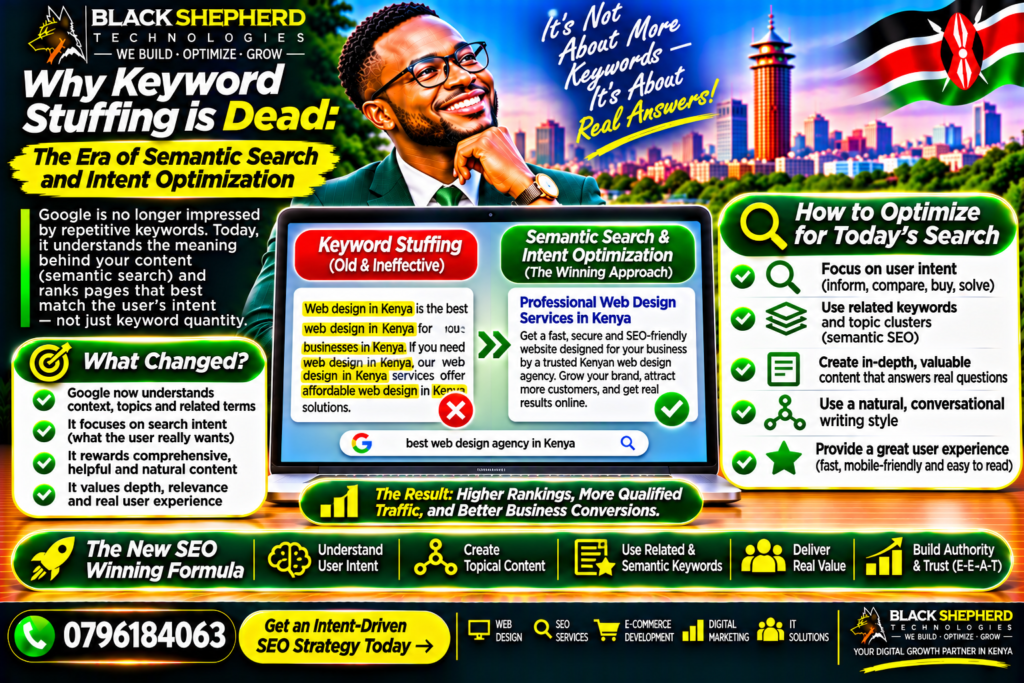
If you look back at digital marketing strategies from a decade ago, search engine optimization (SEO) often felt like a mechanical puzzle. To rank for a term like “best web designer Nairobi,” marketers would repeat the exact phrase ten, twenty, or even fifty times across a single webpage, stuff it into meta tags, and hide blocks of matching text in website footers.
In today’s digital landscape, that playbook is not only completely ineffective—it is actively toxic. Websites that attempt to manipulate search engines using outdated keyword stuffing tactics are quickly penalized or filtered out by Google’s advanced algorithms.
Search engines have evolved from rigid keyword-matching directories into intelligent, conversational answer engines. Powered by artificial intelligence, natural language processing (NLP), and machine learning models, modern algorithms care very little about how many times you repeat a specific phrase. Instead, they evaluate semantic depth, topical context, and human intent.
At Black Shepherd Technologies, we help businesses transition away from obsolete tactics and embrace modern, intent-driven optimization. In this comprehensive guide, we explore why keyword stuffing died, how semantic search works, and how optimizing for user intent can catapult your brand to the top of Google search results.
1. The Anatomy of Keyword Stuffing (And Why It Failed)
Keyword stuffing is the practice of overloading a web page with exact-match keywords or numbers in an attempt to manipulate a site’s ranking in search engine results.
Why Keyword Stuffing Destroyed User Experience:
-
Unreadable Content: Paragraphs read like robotic loops (“Looking for the best web designer Nairobi? Our web designer Nairobi team provides web designer Nairobi services…”), driving human readers away in seconds.
-
High Bounce Rates: Frustrated users who land on a keyword-stuffed page immediately hit the back button, sending strong negative user-engagement signals to Google.
-
Algorithmic Crackdowns: Updates like Google’s Panda and SpamBrain were specifically engineered to detect and penalize unnatural keyword density, demoting spammy sites instantly.
Key Takeaway: Search engines exist to serve human users, not algorithms. When you write for machines instead of people, you lose both your audience and your rankings.
2. Enter Semantic Search: How Google Understands Meaning
To understand why keyword stuffing is dead, you must understand semantic search.
In the past, Google’s crawlers looked for exact string matches. Today, semantic search algorithms analyze the relationship between words, concepts, entities, and intent. When a user in Kenya enters a search query, Google’s AI models analyze:
-
Entities and Context: Recognizing that terms like “M-Pesa,” “Safaricom,” “Nairobi,” and “e-commerce checkout” belong to a specific regional financial and commercial ecosystem.
-
Latent Semantic Indexing (LSI): Understanding that a page about “SEO services” should naturally discuss related concepts like “Core Web Vitals, backlink profiles, technical audits, and organic traffic” without needing a single keyword repeated fifty times.
-
Synonyms and Variations: Knowing that a search for “cheap smartphones Kenya” is semantically related to “affordable mobile phones in Nairobi” or “budget-friendly handsets.”
3. The Pivot to Intent Optimization: Satisfying the Searcher
In the era of AI-driven search, your primary optimization target is no longer a keyword string; it is user intent. Search intent represents the underlying goal or question a user has when typing a query into Google.
Search intent generally falls into four core categories:
-
Informational Intent: The user wants to learn something (“What are Core Web Vitals?”).
-
Navigational Intent: The user wants to find a specific website or brand (“Black Shepherd Technologies login”).
-
Commercial Intent: The user is researching products or services before making a purchase decision (“Compare top web design agencies in Kenya”).
-
Transactional Intent: The user is ready to buy or hire right now (“Hire an expert SEO agency in Nairobi”).
How to Optimize for Intent:
-
Match the Content Format: If search results for a query show listicles or comparison tables, your content must be structured similarly to satisfy what users expect.
-
Answer Comprehensive Follow-Up Questions: Anticipate what the user will need to know next. When writing across the industries we serve, provide deep, thorough explanations that solve the user’s problem completely on the first visit.
4. Five Best Practices for Modern Semantic SEO
Replacing keyword stuffing with semantic optimization requires a shift in how you plan, write, and structure your website content.
A. Focus on Topics and Entities, Not Keywords
Instead of asking, “How do I squeeze this keyword into every paragraph?” ask, “What subtopics, questions, and related concepts must I cover to make this the most comprehensive guide on the internet?”
-
Implementation: Use content research tools to map out semantic entities and related subtopics before drafting.
B. Write Naturally and Conversational
Write the way you speak to a client sitting across from you in a Nairobi office. Use natural language, varied phrasing, and engaging storytelling.
-
Implementation: Read your drafts out loud. If a sentence sounds robotic or repetitive, rewrite it for smooth human readability.
C. Structure Content with Clear Semantic HTML
Search engines rely on clean code structure to understand hierarchy and context.
-
Implementation: Use proper heading tags (
H2,H3) to break content into logical thematic sections. Implement bulleted lists and HTML tables (<table>) to organize data clearly for both human readers and AI crawlers.
D. Optimize for Featured Snippets and AI Overviews
Semantic search powers Google’s AI Overviews and Featured Snippets. By providing direct, concise answers to specific questions, you position your content to be featured prominently at the top of search results.
-
Implementation: Add FAQ sections to your service pages, providing clear 40-to-50-word definitions beneath distinct question headings.
E. Leverage Proof and E-E-A-T
Modern search algorithms reward authentic expertise and real-world experience.
-
Implementation: Include original case studies, data insights, and transparent proof of your work. Explore our own track record in our portfolio and projects showcase to see how authentic expertise drives sustainable search success.
5. Partnering with Experts: Why Black Shepherd Technologies Leads the Way
Adapting to semantic search and intent optimization requires a sophisticated blend of technical mastery, content strategy, and deep understanding of the East African digital landscape. Trying to navigate modern algorithms with outdated, keyword-stuffed approaches will stall your growth.
At Black Shepherd Technologies, we help businesses across the industries we serve transition to modern, semantic-first SEO strategies. Whether you want to overhaul your content engine or scale your organic visibility, our team delivers measurable, high-converting results.
Conclusion
Keyword stuffing belongs in the history books. In the era of semantic search and AI-driven engines, success belongs to brands that prioritize human intent, topical depth, and genuine value. By writing naturally, satisfying user intent, and structuring your content for semantic clarity, you build a resilient digital presence that withstands algorithmic shifts.
Ready to transform your SEO strategy and outrank competitors with modern semantic optimization? Reach out to the experts at Black Shepherd Technologies today for a comprehensive content and SEO strategy tailored to the Kenyan market.