
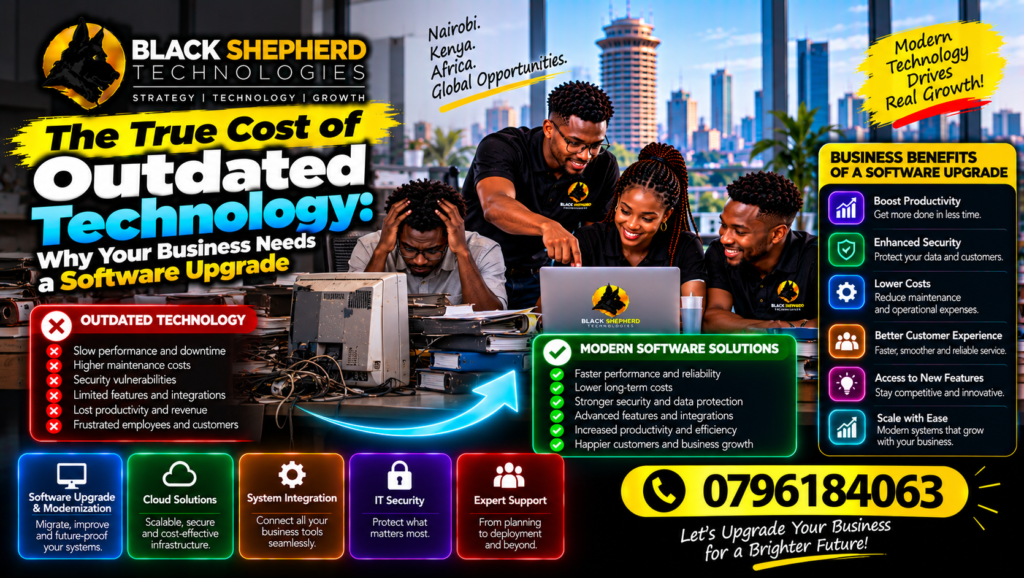
In the fast-accelerating corporate ecosystem of Kenya, businesses across Nairobi, Mombasa, Kisumu, Nakuru, and regional commercial hubs are operating in an era defined by rapid digital transformation. From bustling retail chains in the central business district and logistics fleets moving cargo along the Northern Corridor to financial institutions in Upper Hill and agricultural supply networks in the Rift Valley, software has become the absolute central pillar of operational survival.
Yet, despite the undeniable importance of digital agility, many established enterprises continue to run their daily operations on legacy software, aging desktop applications, unmaintained content management systems, and cluttered spreadsheets. Executives and business owners often justify keeping legacy technology with a simple phrase: “If it isn’t completely broken, why spend money to fix it?”
This mindset is a dangerous financial trap.
While sticking with legacy software might feel like a cost-saving measure on paper because there is no immediate software purchase invoice, the hidden costs of legacy systems quietly erode your profitability every single day. Outdated technology drains employee productivity, creates severe cybersecurity vulnerabilities, causes lost sales through sluggish customer experiences, and prevents seamless integration with modern financial infrastructure like Safaricom’s M-Pesa.
At Black Shepherd Technologies, we engineer high-performance software, custom web applications, and modern cloud architectures tailored specifically for the East African economic ecosystem. If you are assessing your enterprise digital infrastructure or looking to modernize legacy systems, explore our professional engineering portfolio and projects to see how we build market-leading technology solutions.
In this exhaustive, 3,000-word business guide, we will break down the true hidden costs of outdated technology, examine the severe operational risks of running legacy software in Kenya, explore the tangible financial benefits of modernizing your software stack, and outline a step-by-step digital upgrade strategy for your business.
-
The Hidden Iceberg: Defining Outdated and Legacy Software
To understand the financial damage caused by outdated technology, business leaders must first recognize what constitutes a legacy system in today’s digital economy.
What Makes Software “Outdated”?
Legacy software is not defined strictly by its age. A system becomes outdated the moment it can no longer support your growing business requirements efficiently, securely, or flexibly. Legacy technology typically exhibits these key warning signs:
-
Monolithic, Non-API Architecture: The software operates in an isolated silo and cannot connect natively to modern APIs, cloud services, or third-party platforms.
-
Lack of Mobile Responsiveness & Accessibility: The software only runs on old desktop operating systems and cannot be accessed securely on smartphones or tablets by remote workers or field staff.
-
Unsupported Technology Stacks: The programming languages, frameworks, or database engines powering the system (e.g., PHP 5.x, Python 2.7, old ASP.NET, or unpatched WordPress builds) are no longer maintained or supported with security patches by their creators.
-
Heavy Reliance on Manual Workarounds: Employees must constantly export CSV files, copy-paste data between separate tools, or maintain side spreadsheets to complete routine daily tasks.
-
Sluggish Performance & High Downtime: Pages take several seconds to load, database queries freeze under peak traffic, and the system experiences frequent unexpected crashes.
Whether you operate in retail, manufacturing, logistics, healthcare, or financial services, running your core operations on obsolete digital foundations introduces massive operational risk. Explore our specialized industries we serve page to see how we build modern, custom software solutions tailored to diverse commercial sectors.
-
The 5 Heavy Hidden Costs of Outdated Software
When business leaders calculate the cost of upgrading software, they look at the explicit price tag of development and deployment. However, they rarely calculate the implicit, continuous drain that outdated technology exerts on their balance sheet.
Cost #1: The Productivity Drain and Lost Employee Hours
The most immediate, invisible tax paid by companies running outdated software is lost labor productivity.
Consider a typical mid-sized Kenyan enterprise employing fifty administrative, sales, and logistics staff. If legacy systems cause each employee to lose just 30 minutes a day due to slow page loads, system freezes, manual data re-entry, and application crashes:
-
30 minutes x 50 employees = 25 hours of lost labor per day.
-
Over a standard 22-day working month, that equals 550 hours of wasted productivity.
You are effectively paying full-time salaries for hundreds of hours of employee frustration and unproductive idle time. Modern, fast software automates repetitive data entry, loads interfaces instantly, and unifies workflows, allowing your team to accomplish significantly more work in fewer hours.
Cost #2: Cybersecurity Vulnerabilities & Compliance Penalties
Outdated software is the single primary entry point for cyberattacks, ransomware, and data breaches globally.
When software creators stop releasing security patches for legacy frameworks or plugins, hackers actively scan the internet looking for businesses running those unpatched systems. In Kenya, cybersecurity risks carry severe legal and financial consequences:
-
The Data Protection Act: Under Kenya’s data privacy laws, enterprises are legally mandated to implement robust technical measures to protect customer data. A data breach caused by unpatched, outdated software can result in massive regulatory fines from the Office of the Data Protection Commissioner (ODPC).
-
Ransomware & Business Interruption: Ransomware attacks encrypt corporate databases, holding operations hostage for days or weeks. For an e-commerce store or logistics provider, several days of complete operational blackout can destroy brand reputation and result in millions of shillings in lost revenue.
Cost #3: Integration Failure with Local Payment & Banking Systems
The modern Kenyan business ecosystem runs on instant, digital connectivity. If your customer-facing web platform or internal enterprise resource planning (ERP) system cannot integrate natively with local financial rails, you suffer massive friction at checkout.
Modern consumers and B2B buyers expect frictionless digital payment options:
-
Safaricom M-Pesa Integration: Automated STK push prompts, instant C2B validation, B2C automated disbursements, and real-time webhook payment notifications.
-
Card Processing & Multi-Currency Aggregators: Smooth processing for local and international Visa, Mastercard, and mobile wallets.
Outdated legacy platforms often lack secure API endpoints, making it impossible to set up automated M-Pesa reconciliation. As a result, businesses are forced to hire finance staff to manually cross-reference M-Pesa receipts against open invoices—a slow, error-prone process that delays order dispatch and frustrates paying customers.
Cost #4: Cart Abandonment and Lost Sales Opportunities
In digital commerce and online lead generation, speed is directly tied to revenue. Consumer attention spans are shorter than ever.
If your website or e-commerce web application takes more than three seconds to load on a mobile phone running on a local cellular network:
-
Over 50% of mobile visitors will abandon the page immediately.
-
Potential buyers will abandon their shopping carts if the checkout process involves multiple confusing steps, unoptimized forms, or failed mobile money prompts.
Outdated software drives prospective customers directly into the arms of your more technologically agile competitors.
Cost #5: High Maintenance Costs and Technical Debt
Maintaining legacy software is exponentially more expensive than maintaining a modern codebase.
As systems age, finding software engineers who specialize in obsolete programming languages or legacy frameworks becomes extremely difficult and expensive. Developers must spend hours writing complex “band-aid” code scripts just to keep an old database running or force it to communicate with a new tool. This accumulated technical debt creates a fragile system where modifying one small feature causes three other components to break.
-
The Strategic Advantages of Modernizing Your Software Stack
Upgrading from legacy software to modern, custom-engineered digital solutions transforms your IT department from a costly overhead expense into a powerful, revenue-generating engine.
                  THE PATH TO SOFTWARE MODERNIZATION

  [ LEGACY SYSTEM ]                     [ MODERN SOFTWARE STACK ]
  - Slow, manual tasks                   - Automated, instant workflows
  - Siloed data & spreadsheets   --->    - Cloud-native, unified database
  - Security vulnerabilities             - Enterprise encryption & compliance
  - Unreliable M-Pesa links              - Seamless M-Pesa & API connectivity
  - High customer drop-off               - High-converting, fast UX
1. Unmatched Speed and Scalability
Modern software architectures (built with high-performance frameworks, clean REST/GraphQL APIs, and cloud-native databases) load instantly and scale effortlessly. Whether your system handles 100 concurrent users or 100,000 peak festival shoppers, modern cloud infrastructure expands automatically to handle transaction spikes without crashing.
2. Seamless Mobility and Remote Access
Modern web applications and custom software are built with a “mobile-first” mindset. Executive leadership, field sales representatives, warehouse managers, and delivery teams can log into secure, role-based dashboards from any device (laptop, tablet, or smartphone) anywhere in the world, making real-time decisions based on live operational data.
3. Intelligent Automation & Reduced Human Error
Upgrading your software allows you to automate repetitive administrative tasks:
-
Automated invoice generation and instant M-Pesa payment matching.
-
Real-time inventory tracking that alerts procurement teams before stock runs out.
-
Automated WhatsApp and SMS customer order updates.
-
Instant financial reporting and data analytics dashboards.
Eliminating manual data entry drastically cuts operational error rates and frees your talent to focus on core strategic business expansion.
-
Step-by-Step Guide: How to Upgrade Your Business Software
Modernizing legacy enterprise technology does not require shutting down your daily business operations or throwing away your historical data. A successful software upgrade follows a structured, phased modernization roadmap.
Phase 1: Conducting a Comprehensive Software & Process Audit
Before writing new code, conduct a thorough audit of your existing technology stack and business processes:
-
Identify every software tool, spreadsheet, and database currently used across departments.
-
Pinpoint exact operational bottlenecks, slow manual processes, and security vulnerabilities.
-
Map out all necessary third-party integrations (M-Pesa, KRA eTIMS, accounting tools, CRM, logistics APIs).
Phase 2: Defining Clear Business Requirements & Architecture
Work alongside experienced software architects to define the technical specifications for your modern platform:
-
Establish user roles, permissions, and security protocols.
-
Choose the optimal technology stack (e.g., modern Node.js, Python, React, cloud database architecture).
-
Design clean, intuitive UI/UX wireframes optimized for fast, thumb-friendly mobile navigation.
Phase 3: Agile Development & Milestone Delivery
Build the new system incrementally using agile software development sprints:
-
Focus first on core, high-value functionality (e.g., core database, checkout, and payment processing).
-
Conduct rigorous Quality Assurance (QA) testing, security vulnerability scans, and performance stress tests at every sprint milestone.
Phase 4: Secure Data Migration & Integration
Migrating historical customer records, sales transactions, and inventory data from legacy databases to your modern architecture must be executed with zero data loss:
-
Write custom data cleaning and migration scripts to reformat old data into the modern database structure.
-
Test third-party API integrations (Safaricom Daraja, payment gateways, messaging APIs) in live sandbox environments.
Phase 5: Staff Training & Phased Deployment
Ensure smooth user adoption across your organization:
-
Conduct structured training sessions for administrative and operational staff.
-
Run the new software system alongside the legacy platform during a brief testing phase to verify data accuracy before completing the final cutover.
-
Driving Sustainable Growth with Enterprise SEO
Modernizing your internal software platforms and customer-facing web applications guarantees that when clients interact with your brand, they experience exceptional speed, reliability, and security. However, having state-of-the-art software is only half the equation; you must also ensure high-intent customers can find your business online.
If prospective corporate clients or consumers searching for your products and services on search engines cannot find your web application or platform, your competitors will capture that market share. Implementing technical SEO, structured schema markup, fast page speed optimization, and targeted local content strategies is essential for dominating search results. Partnering with professionals providing expert SEO services in Kenya is the most sustainable way to drive high-value organic traffic directly to your digital storefront.
Conclusion: Stop Paying the Legacy Technology Tax
Running a business on outdated technology is a continuous, hidden tax on your growth, security, and profitability. Every slow page load, manual spreadsheet reconciliation, abandoned shopping cart, and security risk quietly erodes your competitive advantage in Kenya’s fast-moving economy.
Upgrading your software stack is not an operational luxury; it is a vital strategic investment that pays immediate dividends through saved labor hours, heightened cybersecurity, frictionless M-Pesa payment collection, and superior customer retention.
At Black Shepherd Technologies, we empower enterprises across East Africa with elite software engineering, custom application architecture, and high-performance digital platforms. Get in touch with our engineering team today to audit your current technology stack, eliminate technical debt, and build a modern software foundation engineered for sustainable business growth.
