Imagine launching an innovative tech startup in Nairobi, developing a revolutionary mobile app or B2B SaaS platform, and investing heavily in social media marketing. While platforms like LinkedIn or Instagram are fantastic for brand awareness, they capture customers who are casually scrolling. What happens when potential clients actively search for your exact solution on Google with high commercial intent?
If your website isn’t optimized to appear on the first page, your startup is losing out to competitors who have mastered on-page SEO.
For startups operating in Kenya’s dynamic business ecosystem—from FinTech in Westlands and AgriTech in Nakuru to logistics and e-commerce across East Africa—organic search traffic is the most cost-effective, scalable engine for long-term customer acquisition.
In this beginner-friendly guide, we will demystify on-page SEO, break down its core elements, and provide a step-by-step framework to optimize your startup’s website for maximum visibility and conversion.
What is On-Page SEO?
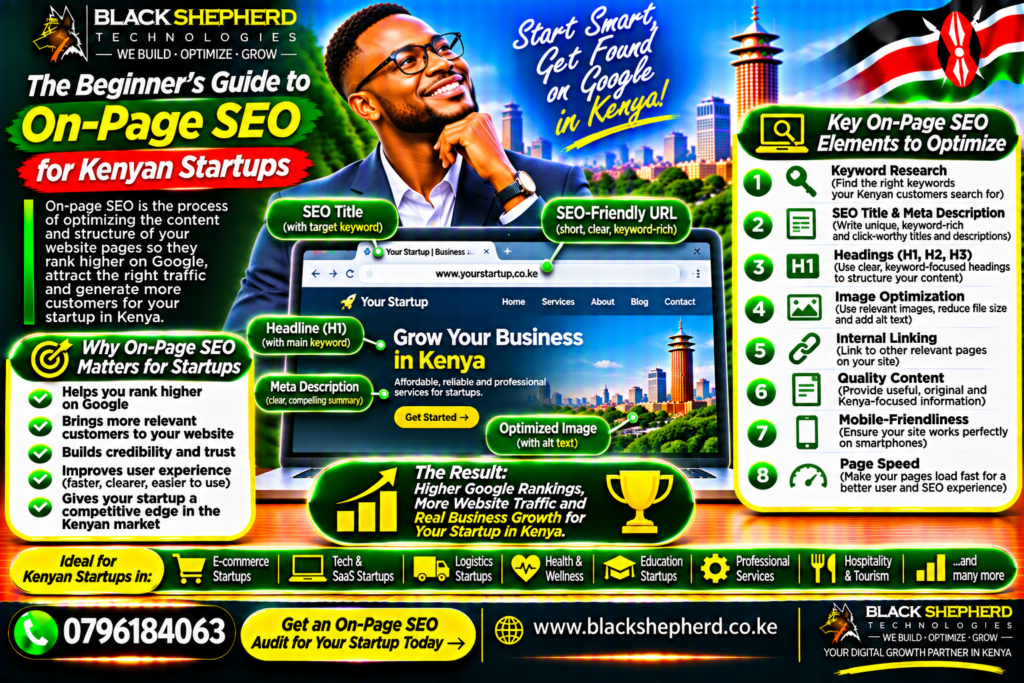
On-page SEO (sometimes called on-site SEO) is the practice of optimizing individual web pages in order to rank higher and earn more relevant traffic from search engines like Google.
Unlike off-page SEO (which focuses on external signals like backlinks and digital PR) or technical SEO (which deals with server speeds and site architecture), on-page SEO is entirely within your control. It involves optimizing both the visible content (text, images, headings) and the behind-the-scenes HTML source code (title tags, meta descriptions, and structured data) of every single page on your site.
+-------------------------------------------------------------+
|                 THE THREE PILLARS OF SEO                    |
+-------------------------------------------------------------+
|  • Technical SEO: How well search bots crawl & load your site|
|  • Off-Page SEO:  Your brand's authority and backlink profile|
|  • On-Page SEO:   The relevance, quality, and structure of   |
|                   your content and HTML code                |
+-------------------------------------------------------------+
Why On-Page SEO is Critical for Kenyan Startups
Startups often operate on lean marketing budgets. Pouring money into paid ads (Google Ads or Meta Ads) yields immediate traffic, but the moment you stop spending, your leads dry up instantly.
On-page SEO builds compounding digital equity:
-
Targeted High-Intent Traffic: Attract users who are typing specific queries into Google because they actively need your product or service right now.
-
Higher Conversion Rates: When your pages directly match user search intent, visitors stay longer, read deeper, and convert into paying clients or trial users.
-
Cost-Effective Scalability: Once a well-optimized page ranks in the top 3, it drives organic traffic 24/7 without requiring a continuous ad spend.
Essential Elements of On-Page SEO
Mastering on-page SEO requires fine-tuning several key components across every web page and blog post.
+-------------------------------------------------------------+
|               ON-PAGE SEO OPTIMIZATION CHECKLIST            |
+-------------------------------------------------------------+
|  1. Strategic Keyword Placement & Search Intent             |
|  2. Compelling Title Tags & Meta Descriptions               |
|  3. Clean Heading Hierarchies (H1, H2, H3)                  |
|  4. High-Value, Comprehensive Content                       |
|  5. Strategic Internal Linking & UX                         |
+-------------------------------------------------------------+
1. Strategic Keyword Placement and Search Intent
Keywords are the bridge between what your target audience types into Google and the content on your website.
-
Find What People Search For: Use keyword research tools to identify what terms prospective clients use in Kenya (e.g., “payroll software for small businesses in Kenya” vs. “automated HR tools”).
-
Align with Search Intent: Understand why the user is searching. Are they looking to buy a product (commercial intent), learn how something works (informational intent), or find a local service provider (local transactional intent)? Your page content must match that exact goal.
2. Compelling Title Tags and Meta Descriptions
Your title tag and meta description are your startup’s billboard on Search Engine Results Pages (SERPs).
-
Title Tag: Keep it under 60 characters, include your primary target keyword, and make it compelling. (e.g., Best Inventory Management Software in Kenya | BrandName).
-
Meta Description: Keep it under 160 characters. Think of it as a mini-ad summarizing the page, complete with a clear call-to-action to encourage click-throughs.
3. Clean Heading Hierarchies (H1, H2, H3)
Search engine crawlers read your page structure from top to bottom just like a human reader scans a textbook.
-
Every page must feature one and only one H1 tag (your main page title) containing your primary keyword.
-
Use H2 and H3 tags logically to break up subtopics, making the content easy to scan and digest.
4. High-Value, Comprehensive Content
Google’s algorithms reward content that demonstrates E-E-A-T (Experience, Expertise, Authoritativeness, and Trustworthiness). Avoid thin, generic 300-word blog posts. Write in-depth, original articles that thoroughly answer your audience’s questions, integrate local case studies, and provide actionable insights.
To ensure your startup’s core offerings and commercial service lines remain structured and easy for search bots to index, map them out cleanly alongside your core portfolio items and portifolios projects.
5. Strategic Internal Linking
Internal links connect your web pages together. When writing new content, link naturally to related product pages, feature overviews, or other blog posts on your site. This helps search bots discover new pages, distributes link authority across your domain, and keeps visitors engaged longer.
For startups offering specialized commercial solutions across various industries we serve, smart internal linking guides prospective clients smoothly from educational blog posts straight to your conversion funnels.
Step-by-Step Action Plan for Startup Founders
-
Audit Existing Pages: Review your startup’s current landing pages and blog posts. Do they have unique title tags? Are your primary keywords present in the H1 headers?
-
Conduct Keyword Mapping: Create a spreadsheet mapping every page on your site to a specific primary keyword and user intent to avoid accidental keyword cannibalization.
-
Optimize Media Assets: Compress images, adopt next-gen formats like WebP, and add descriptive alt text so your visuals load instantly on mobile devices.
-
Track Performance: Connect Google Search Console and Google Analytics 4 to monitor your keyword impressions, click-through rates, and organic traffic growth over time.
Conclusion: Build a Sustainable Growth Engine
On-page SEO is the bedrock of digital visibility for modern startups. By aligning your content with search intent, optimizing your HTML tags, structuring your headings, and maintaining clean internal linking, you transform your website into a powerful customer acquisition machine.
Implementing technical and on-page optimization requires precision, consistency, and ongoing refinement. If you want to fast-track your startup’s growth, optimize your site architecture, and scale your organic visibility, partnering with experienced specialists who provide comprehensive seo services kenya can help your business secure long-term market dominance.