When business owners and marketers in Kenya think about SEO, their minds usually gravitate toward content creation, keyword research, and acquiring backlinks. While these on-page and off-page elements are vital, they represent only the tip of the iceberg. Beneath the surface lies Technical SEO—the underlying architecture of your website.
Even if you have the most engaging blog posts, stunning visuals, and world-class products, hidden technical errors can completely sabotage your Google rankings. Search engine crawlers like Googlebot operate like automated quality inspectors; if they encounter broken pathways, slow rendering speeds, or confusing site structures, they will simply abandon your site in favor of a smoother competitor experience.
At Black Shepherd Technologies, our technical audits routinely uncover invisible roadblocks draining traffic and revenue from Kenyan businesses. In this guide, we explore the most damaging hidden technical SEO errors, how to identify them, and how fixing them can catapult your website to the top of the search engine results pages (SERPs).
1. The Anatomy of a Technical SEO Audit: What Are We Looking For?
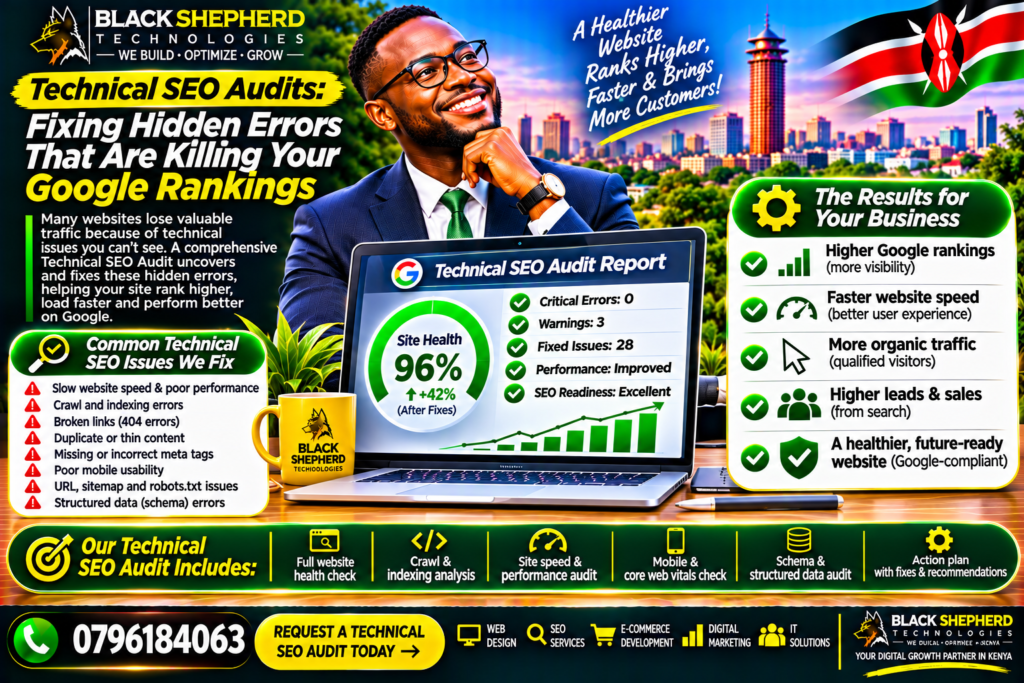
A technical SEO audit is a comprehensive diagnostic evaluation of your website’s backend infrastructure. Its primary goal is to ensure that search engine bots can easily crawl, render, and index your web pages without encountering friction.
When running audits across diverse platforms—whether scaling e-commerce stores or corporate portals featured in our portfolio and projects showcase—we examine several core layers:
-
Crawlability: Can search bots access your important pages?
-
Indexability: Are the right pages entering Google’s index while duplicate or private pages are blocked?
-
Performance & Speed: How fast does your site load on standard Kenyan mobile networks (4G/5G)?
-
Architecture & URL Structure: Is your site logically organized into clear topical silos?
2. Five Hidden Technical Errors Killing Your Rankings
Let’s examine the most common, insidious technical errors that drag down search visibility and how they impact performance across the industries we serve.
Error 1: Crawl Budget Waste and Orphaned Pages
Google assigns every website a “crawl budget”—the number of pages Googlebot is willing and able to crawl on your site during a given visit. If your site has thousands of low-value URLs (such as sorting parameters, pagination loops, or old tag archives), Google wastes its precious budget crawling junk instead of your high-converting product or service pages.
-
The Killer Impact: New content or critical updates take weeks or months to get indexed because search bots are trapped sorting through redundant URLs.
-
The Fix: Implement clean
robots.txtrules, use canonical tags correctly, and eliminate “orphaned pages” (pages that exist on your server but have no internal links pointing to them).
Error 2: Core Web Vitals Failures on Mobile Devices
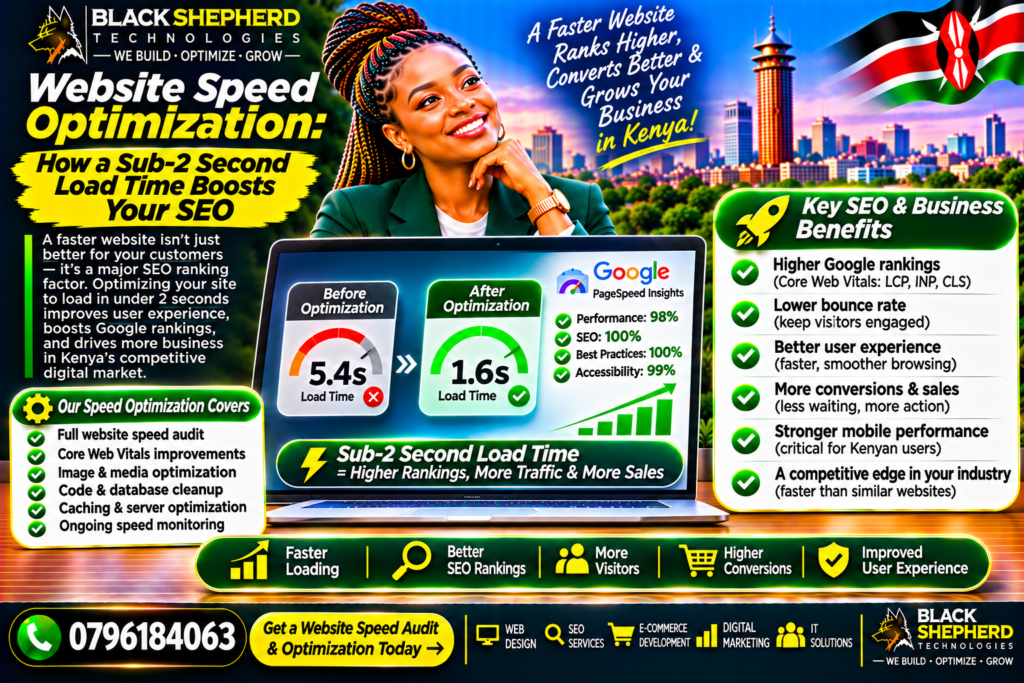
In Kenya, over 80% of web traffic originates from mobile smartphones. Google’s Core Web Vitals—measuring Largest Contentful Paint (LCP), Interaction to Next Paint (INP), and Cumulative Layout Shift (CLS)—evaluate real-world user experience.
-
The Killer Impact: If your high-resolution hero images take 6 seconds to load or your text jumps around while a banner loads on a mobile browser, Google’s AI algorithms downgrade your user experience score, penalizing your rankings.
-
The Fix: Compress images to modern formats (like WebP), leverage browser caching, minimize heavy JavaScript execution, and invest in high-performance web hosting tailored for East African audiences.
Error 3: Misconfigured Canonical Tags and Duplicate Content
If your website is accessible via multiple versions (http://, https://, www.yoursite.co.ke, and yoursite.co.ke/index.php), search engines may view each variation as a completely separate website with identical content.
-
The Killer Impact: Keyword cannibalization occurs, where your own pages compete against each other for rankings, diluting your overall domain authority.
-
The Fix: Establish a definitive preferred domain, enforce strict 301 redirects, and deploy self-referencing canonical tags across all primary pages.
Error 4: Broken Redirect Chains and 404 Loops
Over time, as websites evolve, URLs change. If an old URL points to a new URL, which in turn redirects to a third URL (a redirect chain), search engine bots waste time traversing the chain. If a link leads to a dead end (404 Not Found), users bounce back to Google, sending a negative user-signal.
-
The Killer Impact: Slow crawl efficiency and frustrated users who abandon your site before conversion.
-
The Fix: Audit your site regularly using tools like Screaming Frog or Google Search Console to identify and collapse redirect chains into direct 1-to-1 301 redirects.
Error 5: Missing or Inaccurate Schema Markup
Search engines rely on structured data (JSON-LD schema) to understand context. Without schema, Google has to guess whether a string of numbers is a product price, a phone number, or a zip code.
-
The Killer Impact: You miss out on rich snippets (star ratings, event dates, pricing tables) in search results that dramatically increase click-through rates (CTR).
-
The Fix: Implement robust Local Business, Organization, Product, and Article schema across your templates.
3. How to Conduct a Basic Technical Audit in 5 Steps
While enterprise-level audits require specialized engineering insights, you can begin identifying issues today using freely available tools:
-
Claim and Inspect Google Search Console (GSC): Check the Indexing report. Look for pages flagged with errors such as “Indexed, though blocked by robots.txt,” “Server error (5xx),” or “Soft 404.”
-
Test Mobile Speed: Run your key landing pages through Google PageSpeed Insights. Pay close attention to mobile performance metrics, not just desktop scores.
-
Check Your HTTPS and Security Certificates: Ensure all internal links point to secure
https://versions to avoid mixed-content warnings. -
Review XML Sitemaps: Ensure your XML sitemap is clean, updated automatically when new content is published, and submitted directly to Google Search Console.
-
Inspect Internal Linking Paths: Ensure important service pages are no more than 3 clicks away from your homepage.
4. Why Technical SEO Requires Expert Engineering
Technical SEO is not a one-time checklist; it is an ongoing engineering discipline. A single misplaced line of code in your .htaccess file, an accidental plugin conflict, or a faulty server response header can de-index your entire website overnight.
At Black Shepherd Technologies, we combine advanced technical diagnostics with high-performance web architecture. Whether you are troubleshooting a complex server migration, cleaning up legacy code, or building a brand-new digital ecosystem tailored for the industries we serve, our technical audits ensure your website is engineered to rank.
Explore our past engineering successes in our portfolio and projects showcase to see how robust technical foundations drive measurable business growth.
Conclusion
Hidden technical errors act like drag on an aircraft—no matter how powerful your engine (content) or how sleek your design (UI/UX), you will never reach cruising altitude if your backend architecture is compromised. Identifying and fixing these invisible roadblocks is the fastest, most reliable way to unlock your website’s true organic ranking potential.
Ready to uncover what’s holding your website back? Reach out to the experts at Black Shepherd Technologies today for a comprehensive technical SEO audit and let’s optimize your digital presence for peak performance.