
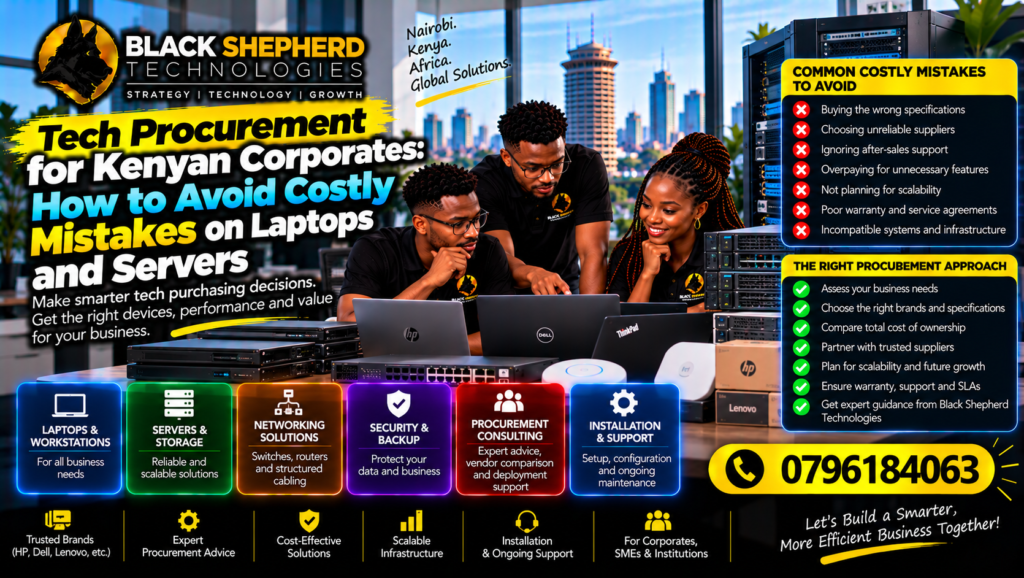
In the fast-evolving corporate environment across Kenya, technology procurement has quietly shifted from a routine administrative function into a core driver of operational risk and financial efficiency. Whether equipping a multinational headquarters in Westlands, modernizing a commercial bank in the Nairobi Central Business District, provisioning a fleet for a logistics hub in Mombasa, or expanding processing facilities in Industrial Area, hardware investments dictate daily productivity, data security, and long-term capital efficiency.
Yet, technology procurement in East Africa remains fraught with operational traps. Corporate procurement departments routinely lose millions of shillings annually through misaligned hardware specifications, gray-market imports lacking valid manufacturer warranties, counterfeit server components, unbudgeted software licensing fees, and vendor lock-in.
In a volatile economic climate marked by fluctuating exchange rates, shifting import duties, and stringent regulatory requirements under the Data Protection Act, buying enterprise laptops and rack servers requires far more than comparing quotation line items. It demands a structured, strategic engineering framework that aligns hardware lifecycles with enterprise software requirements and corporate growth targets.
At Black Shepherd Technologies, we engineer high-performance custom software, enterprise platforms, and digital solutions tailored specifically for the East African corporate ecosystem. If you are auditing your enterprise digital infrastructure or planning your next technology investment, explore our professional engineering portfolio and projects to see how we bring market-leading technology solutions to life.
In this exhaustive, 3,000-word enterprise procurement guide, we will analyze the hidden costs of hardware acquisition in Kenya, break down technical evaluation frameworks for laptops and servers, outline vendor risk mitigation strategies, and explore lifecycle asset management for modern corporate IT.
-
The High Stakes of IT Procurement in Kenya
Corporate IT procurement in East Africa operates in a uniquely challenging environment. Unlike mature Western markets where hardware supply chains are streamlined and direct-from-manufacturer delivery is standard, technology acquisition in Kenya involves multi-tiered distribution channels, regional customs frameworks, and varying levels of vendor capability.
The True Cost of “Cheap” Hardware
When procurement committees prioritize the lowest upfront purchase price over total cost of ownership (TCO), the organization ultimately pays a steep financial price.
Consider a corporate enterprise purchasing 100 entry-level consumer laptops for its finance and operations personnel to save 20% on the initial purchase invoice:
-
The Reality: Consumer-grade laptops feature plastic chassis, fragile display hinges, non-expandable RAM, single-channel cooling fans, and non-encrypted consumer operating systems.
-
The Impact: Within 18 months, failure rates spike. Broken hinges, thermal throttling, battery degradation, and motherboard failures cause continuous employee downtime. The IT helpdesk spends hundreds of hours managing individual repair tickets, and the business is forced to execute an early refresh cycle—effectively paying double for the same endpoint fleet.
The Regulatory and Security Mandate
In Kenya, hardware procurement is deeply intertwined with legal compliance. Server infrastructure housing customer records, employee data, or financial transactions must adhere strictly to the Data Protection Act. Deploying consumer-grade hardware or legacy unpatched server infrastructure that lacks Hardware Root of Trust, Trusted Platform Module (TPM 2.0) chips, or self-encrypting drives (SED) exposes the enterprise to severe legal liabilities and regulatory fines from the Office of the Data Protection Commissioner (ODPC).
Whether your enterprise operates in financial services, logistics, retail, manufacturing, or healthcare, aligning your hardware infrastructure with your operational requirements is critical. Explore our specialized industries we serve page to see how we build digital architectures tailored to diverse commercial sectors.
-
Procurement Mistake #1: Buying Consumer Laptops for Corporate Workflows
One of the most frequent and costly mistakes in Kenyan corporate procurement is failing to enforce a strict boundary between consumer-grade and enterprise-grade mobile workstations.
                      ENTERPRISE VS. CONSUMER LAPTOP ARCHITECTURE

  FEATURE                    CONSUMER LAPTOPS                  ENTERPRISE WORKSTATIONS
  -------------------------  --------------------------------  ------------------------------------
  Chassis & Durability       Plastic / Lightweight Composite   Magnesium Alloy / MIL-STD-810H
  Processor & Thermal        Standard Cooling / Throttling     Dual-Fan Heat Pipes / Sustained Load
  Security Hardware          Basic Software TPM                TPM 2.0 / vPro / SmartCard / Biometric
  OS & Management            Windows Home Edition              Windows Pro / Enterprise / vPro Remote
  Spare Parts Availability   12 to 18 Months                   5 to 7 Years Guaranteed
  Warranty Coverage          Standard Carry-In                 Next Business Day On-Site (3-5 Yrs)
The Enterprise Architecture Standard
When issuing Tenders or Requests for Quotations (RFQs) for corporate laptops (HP EliteBook, Dell Latitude, Lenovo ThinkPad, or Apple MacBook Pro), procurement officers must mandate enterprise-level specifications:
-
MIL-STD-810H Certification: Guarantees that laptop chassis endure physical shocks, drops, dust, and temperature variations common during field operations and business travel across Kenya.
-
Hardware Security Chips (TPM 2.0): Essential for BitLocker full-disk encryption. If a laptop is lost or stolen during an executive trip, sensitive corporate data remains mathematically inaccessible to unauthorized parties.
-
Intel vPro or AMD Pro Management: Enables corporate IT administrators to remotely manage, update, diagnose, and wipe laptop endpoints across offices in Nairobi, Mombasa, and regional branches—even if the laptop operating system is powered off or corrupted.
-
Standardized Docking and Port Architecture: Mandating Thunderbolt 4 or USB-C DisplayPort Alt-Mode docking ensures that hot-desking setups in corporate offices function seamlessly with single-cable power delivery and multi-monitor output.
-
Procurement Mistake #2: Server Misconfigurations and Over-Provisioning
Buying server hardware (Dell PowerEdge, HPE ProLiant, or Lenovo ThinkSystem) presents a completely different set of technical pitfalls. Corporate IT departments often commit two equal and opposite mistakes: buying under-spec’d entry-level servers that bottleneck under database loads, or grossly over-provisioning expensive enterprise hardware that runs at 5% utilization.
Server Sizing: Matching Workloads to Silicon
Before drafting server procurement specifications, enterprise architects must categorize the primary workload:
-
Database & Transaction Servers (Core Banking, ERP, M-Pesa Gateways): Require high clock-speed per core (GHz) over sheer core count, paired with enterprise SAS or NVMe Solid State Drives (SSDs) operating in RAID 10 configurations for maximum IOPS (Input/Output Operations Per Second) and write redundancy.
-
Virtualization & Hypervisor Hosts (VMware ESXi, Proxmox, Hyper-V): Require maximum physical core counts (e.g., dual-socket AMD EPYC or Intel Xeon Scalable processors), massive High-Density DDR5 Registered RAM (RDIMM), and redundant 10GbE / 25GbE SFP+ network interfaces.
-
Storage and Backup Arrays: Prioritize storage density, controller cache, and hot-swappable enterprise SATA/SAS drives paired with hardware RAID controllers (with flash-backed write cache) to prevent data corruption during sudden power drops.
                        SERVER WORKLOAD SIZING ARCHITECTURE

  WORKLOAD TYPE          PROCESSOR FOCUS        MEMORY CONFIG           STORAGE LAYOUT
  ---------------------  ---------------------  ----------------------  ------------------------
  Database / ERP         High GHz per Core      DDR5 RDIMM (ECC)        RAID 10 NVMe / SAS SSDs
  Virtualization Host    High Core Count        Max Capacity RDIMM      SAN / Dual 10GbE SFP+
  Backup / Storage       Balanced Clock         Standard ECC            RAID 6 High-Capacity SAS
The Uninterruptible Power Supply (UPS) and Environmental Factor
Deploying high-density rack servers into corporate server rooms in Kenya without factoring in power conditioning and environmental cooling is a recipe for catastrophic hardware destruction.
-
Online Double-Conversion UPS Systems: Standard offline or line-interactive UPS units do not clean raw utility power fast enough. Server rooms require Online Double-Conversion UPS systems that continuously convert AC to DC and back to AC, delivering clean, pure sine-wave power isolated from grid spikes, sags, and frequency fluctuations.
-
Precision Air Conditioning (PAC): Standard comfort air conditioners cool room air intermittently. Server closets housing enterprise racks require dedicated precision cooling that runs 24/7/365, controlling both temperature (18°C–21°C) and relative humidity to prevent internal hardware condensation or thermal shutdown.
-
Procurement Mistake #3: Falling Victim to Gray-Market Imports and Fake Components
The gray market represents one of the largest financial drains on technology procurement in East Africa. Gray-market products are genuine goods imported through unauthorized distribution channels that bypass official manufacturer support frameworks, localized customs declarations, and regional warranty obligations.
The Dangers of Gray-Market Laptops and Servers
When a vendor submits a quotation that is 30% lower than authorized distributor pricing, procurement committees must investigate immediately:
-
Voided Warranties: Major hardware manufacturers (HP, Dell, Lenovo, Cisco) tie warranty service coverage to specific geographic regions. A server or laptop originally intended for sale in North America or Eastern Europe will not be covered under local Next Business Day (NBD) on-site warranty service in Kenya. If a motherboard fails, local authorized service centers will reject the claim.
-
Refurbished Sold as New: Gray-market vendors routinely repackage factory-refurbished or lease-return laptops and servers in generic boxes, selling them to unsuspecting corporate buyers as brand-new units.
-
Counterfeit Server Memory and Drives: Unscrupulous suppliers frequently buy base-model servers and populate them with cheap consumer-grade SSDs or non-ECC desktop RAM sticks modified with fake manufacturer stickers. Under heavy enterprise database write loads, non-ECC RAM causes silent data corruption, system kernel panics, and unexpected database downtime.
How to Verify Authenticity in Procurement
To insulate your enterprise from gray-market risks, incorporate mandatory verification steps into your procurement policy:
-
Manufacturer Authorization Letter (MAF): Mandate that every vendor bidding on hardware tenders must submit an official, verifiable Manufacturer Authorization Form (MAF) or Channel Partner Certificate issued directly by the vendor’s regional office in Kenya.
-
Service Tag / Serial Number Pre-Validation: Before accepting final delivery and signing commissioning certificates, IT personnel must run the serial numbers or service tags of every laptop and server through the official manufacturer portal to verify manufacture date, regional warranty destination, and internal component bills of materials.
-
Procurement Mistake #4: Ignoring Software Licensing and OS Compatibility
A hardware procurement contract is incomplete if it fails to address the operating system, virtualization hypervisor, and management software licensing frameworks required to run the equipment.
The OEM vs. Volume Licensing Trap
-
Laptops: Buying enterprise laptops pre-installed with Windows Home or FreeDOS to save costs forces your IT department to buy expensive standalone Windows Pro or Enterprise upgrade licenses later to join the machines to Active Directory / Microsoft Entra ID. Always procure laptops with factory-preinstalled Windows Pro OEM licensing.
-
Servers: Server hardware pricing does not automatically include Microsoft Windows Server or Red Hat Enterprise Linux (RHEL) licenses. For Windows Server, licensing is calculated based on physical CPU cores (requiring a minimum of 16-core licenses per physical processor), plus Client Access Licenses (CALs) for every user or device connecting to the server. Failing to calculate core licensing during server procurement results in massive unbudgeted software compliance audit liabilities.
-
The Total Cost of Ownership (TCO) Procurement Checklist
To ensure your corporate procurement team avoids costly mistakes, run every laptop and server procurement evaluation through this 10-point enterprise checklist:
-
Enterprise Product Line Verification: Are the requested units classified under official enterprise lines (e.g., HP EliteBook/ProLiant, Dell Latitude/PowerEdge, Lenovo ThinkPad/ThinkSystem)?
-
Manufacturer Authorization: Has the vendor provided a valid, verifiable Manufacturer Authorization Form (MAF) for the Kenyan jurisdiction?
-
Warranty Scope & On-Site SLA: Does the warranty explicitly guarantee 3-to-5-year Next Business Day (NBD) on-site service coverage within Kenya, including local spare parts availability?
-
Hardware-Level Security: Do laptops include dedicated TPM 2.0 chips, smartcard readers, and hardware-level management (Intel vPro / AMD Pro)?
-
Component Authenticity: Are server drives, RAID controllers, power supplies, and RAM certified original parts listed on the manufacturer’s Hardware Compatibility List (HCL)?
-
Thermal & Power Environmental Match: Does the server room feature Online Double-Conversion UPS backup, dedicated precision cooling, and proper PDU power distribution?
-
Complete Software & CAL Licensing: Are operating system licenses, processor core licenses, and user CALs fully accounted for in the quotation?
-
Scalability & Upgrade Paths: Do laptops feature user-accessible RAM and M.2 NVMe slots for future expansion? Do servers feature unpopulated DIMM slots and PCIe expansion risers?
-
Delivery Timelines & IncoTerms: Is the vendor offering Delivered Duty Paid (DDP) pricing with clear, contractually bound delivery schedules?
-
Lifecycle Asset Disposal (E-Waste): Does the vendor or procurement framework include certified e-waste disposal and secure disk sanitization policies compliant with data protection laws?
-
Driving Enterprise Growth with Advanced Digital Solutions
Procuring world-class enterprise laptops and servers establishes a robust, highly reliable hardware foundation for your organization. However, hardware is simply the physical stage upon which your corporate software applications, databases, customer portals, and internal workflows execute.
If your enterprise runs high-performance hardware but relies on sluggish, legacy software platforms, your operational productivity will remain bottlenecked. Furthermore, if prospective corporate clients or consumers searching for your digital services online cannot discover your web applications on search engines, your market share will shrink.
Implementing technical SEO, structured schema markup, fast page speed optimization, and targeted local content strategies is essential for dominating search engine results pages. Partnering with professionals providing expert SEO services in Kenya is the most sustainable way to drive high-value organic traffic directly to your digital storefront.
Conclusion: Strategic Procurement as a Competitive Advantage
Technology procurement for Kenyan corporates is not a clerical task of selecting the lowest bidder; it is a strategic engineering discipline. By eliminating consumer-grade hardware from corporate fleets, sizing server workloads accurately, insisting on official manufacturer warranty channels, and accounting for total cost of ownership, corporate leaders transform IT procurement from a financial drain into a powerful competitive advantage.
When your enterprise equips its workforce with durable, secure, enterprise-grade hardware backed by solid infrastructure, employee productivity soars, downtime vanishes, and data assets remain ironclad.
At Black Shepherd Technologies, we partner with corporate enterprises, financial institutions, logistics networks, and growing organizations across East Africa to engineer custom software, optimize enterprise architectures, and build market-leading digital platforms. Get in touch with our engineering team today to audit your technology roadmap, modernize your digital systems, and drive sustainable corporate growth.
