In today’s hyper-competitive digital landscape, building a corporate brand in Kenya requires far more than an eye-catching logo or a memorable tagline. The East African market—and Nairobi in particular—has evolved into a sophisticated, tech-driven commercial hub. Consumer expectations are at an all-time high, digital touchpoints have multiplied, and search engines reward only the most authoritative, performance-optimized, and well-architected platforms.
Whether you operate an established enterprise in Nairobi’s Central Business District, lead a fast-scaling tech venture in Westlands, or manage a regional distribution network across East Africa, a well-defined corporate brand strategy is the single most valuable asset for sustainable revenue growth, market authority, and long-term customer retention.
This comprehensive guide explores every layer of modern corporate brand strategy, demonstrating how to fuse brand positioning, visual systems, high-speed web architecture, and aggressive local visibility to build a dominant presence in 2026.
1. What is Corporate Brand Strategy in the Modern Kenyan Context?
Corporate brand strategy is the overarching blueprint that defines how a company presents itself to customers, investors, employees, partners, and search engine algorithms. Unlike consumer product branding—which often focuses on individual items or short-term promotions—corporate branding positions your entire organization as a trusted, scalable, and authoritative entity.
In Kenya’s current economic climate, corporate brand strategy sits at the intersection of three fundamental pillars:
-
Brand Positioning & Value Proposition: Clarifying who you serve, what unique value you bring to the market, and why enterprise buyers should select your firm over regional alternatives.
-
Visual & Structural Identity Systems: Establishing a flexible visual system, consistent brand tone, intuitive user experience (UX), and cohesive design language across all physical and digital touchpoints.
-
Digital Execution & Search Dominance: Fusing your visual identity with high-performance engineering—including specialized SEO services in Kenya and lightning-fast web infrastructure—to ensure target decision-makers effortlessly discover, trust, and engage with your enterprise online.
2. The Core Pillars of an Unshakeable Corporate Brand
+---------------------------------------------------------------------------------+
|                        CORPORATE BRAND STRATEGY MATRIX                          |
+---------------------------------------------------------------------------------+
|  PILLAR 1: BRAND POSITIONING   | Target personas, market gap, value proposition |
|  PILLAR 2: VISUAL SYSTEMS      | Logos, typography, design systems, UI/UX kits   |
|  PILLAR 3: WEB ARCHITECTURE    | Fast static code, edge caching, mobile UX       |
|  PILLAR 4: LOCAL SEARCH (SEO)  | Schema markup, local keywords, topical authority|
+---------------------------------------------------------------------------------+
Pillar 1: Market Positioning & Audience Architecture
A strong corporate brand never attempts to be everything to everyone. Winning in Kenya’s corporate ecosystem requires sharp specialization, clear audience profiling, and precise market segmentation:
-
Target Buyer Persona Mapping: Identify whether your brand primary targets procurement heads, institutional investors, direct consumer segments, or tech-first founders.
-
Sector-Specific Tailoring: Customizing messaging, proof points, and value propositions to solve the precise compliance, security, and operational bottlenecks across the diverse industries we serve.
-
Differentiated Value Proposition: Articulating your operational edge—whether that is superior speed, local cultural intelligence, or enterprise-grade reliability.
Pillar 2: Visual Identity Systems & Governance
Consistency builds institutional trust. Disjointed typography, conflicting color palettes, and inconsistent logo usages erode credibility among corporate clients.
-
Responsive Logo Systems: Engineering primary marks, secondary lockups, and dynamic app icons built for high-resolution displays, print media, and small mobile viewports.
-
Color Psychology & Palette Standards: Selecting color schemes that communicate stability, technology, or prestige within East Africa, documented with precise HEX, RGB, and CMYK parameters.
-
Design Systems & Brand Books: Standardizing visual assets into a centralized Brand Book to ensure marketing teams, agency partners, and internal staff maintain 100% visual fidelity.
Pillar 3: High-Speed Web Architecture & User Experience
In 2026, web speed and user interface design serve as direct indicators of technical competence. A slow, bloated website instantly undermines an otherwise polished brand promise.
-
Lightweight Static Generation: Transitioning from heavy, database-dependent Content Management Systems (CMS) to clean, static HTML setups generated locally via scripts.
-
Mobile-First UX Design: With over 80% of digital interactions in Kenya occurring via smartphone screens, navigation, tap targets, and layout structures must be engineered for mobile devices first.
-
Edge Caching & Security: Utilizing global Content Delivery Networks (CDNs) and edge security protocols (like Cloudflare) to deliver sub-second page loads to users across Nairobi, Mombasa, and international markets.
Pillar 4: Localized SEO & Search Engine Authority
Your brand architecture must be readable to both human users and search engine bots. Integrating search engine optimization into the core of brand strategy ensures that market authority translates into organic traffic and high-ticket sales leads.
3. Merging Brand Strategy with High-Performance Local SEO
Branding and Search Engine Optimization are mutually reinforcing. Powerful corporate branding drives direct searches, brand recognition, and high click-through rates. Conversely, technical local SEO positions your brand directly in front of active buyers at the exact moment they search for commercial solutions.
       +-------------------------------------------------------+
       |             Corporate Brand Blueprint                 |
       +-------------------------------------------------------+
                                   |
         +-------------------------+-------------------------+
         |                                                   |
         v                                                   v
+------------------+                               +-------------------+
|  Brand Strategy  |                               |    SEO & Local    |
|   & Identity     |                               |    Visibility     |
+------------------+                               +-------------------+
         |                                                   |
         |---> Visual Identity & UX                          |---> Technical Page Speed
         |---> Messaging & Position                          |---> On-Page Optimization
         |---> Institutional Trust                           |---> Local Keyword Ranks
         |                                                   |
         +-------------------------+-------------------------+
                                   |
                                   v
       +-------------------------------------------------------+
       |   High-Converting, Search-Dominant Digital Engine     |
       +-------------------------------------------------------+
The Search Engine as a First-Impression Engine
When a potential investor, procurement manager, or enterprise client searches for service providers in Nairobi, your search engine presence acts as your digital front door:
-
Brand Visibility: Ranking at the top of search engine results pages (SERPs) for high-intent keywords immediately signals market leadership.
-
Schema & Knowledge Graphs: Structured organization schema enables search engines to display rich corporate snippets, physical addresses, review ratings, and official contact channels.
-
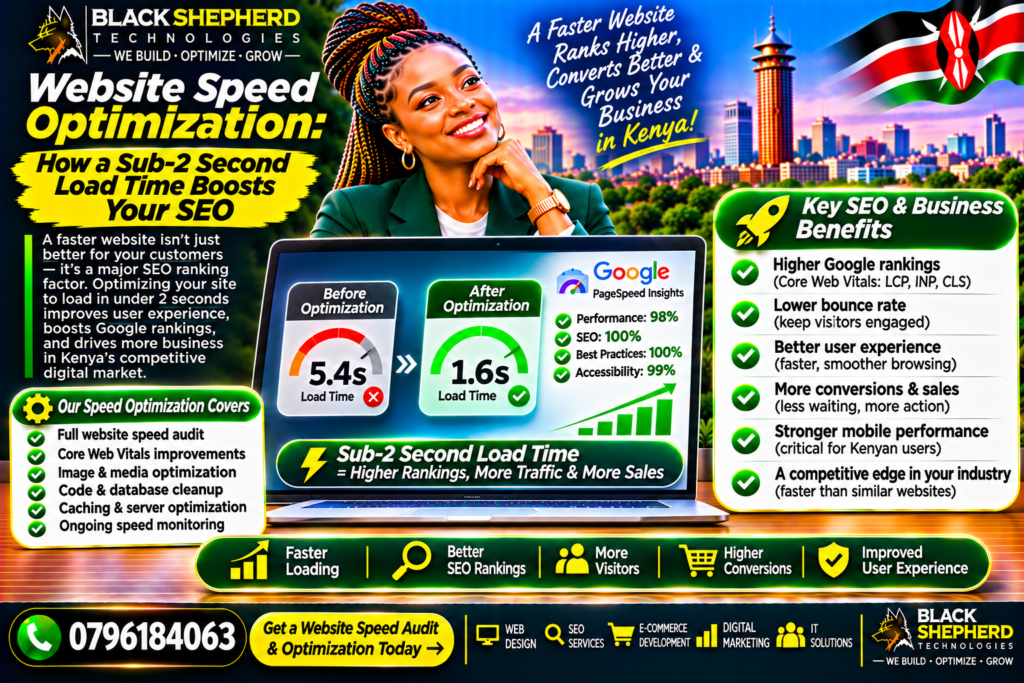
Core Web Vitals & Google Trust: Google’s ranking algorithms directly favor sites that offer rapid load speeds, low cumulative layout shifts, and mobile responsiveness—mirroring the exact requirements of modern brand UX.
To discover how localized search strategies drive commercial growth for enterprises, explore our dedicated SEO services in Kenya.
4. Sector-Specific Branding Strategies Across Key Kenyan Industries
A rigid, one-size-fits-all approach to corporate branding fails in a market as diverse as East Africa. Brand architecture must adjust to match the purchasing habits, compliance standards, and decision-making cycles across different sectors.
To examine how tailored corporate brand solutions are engineered across various commercial sectors, review the comprehensive list of industries we serve.
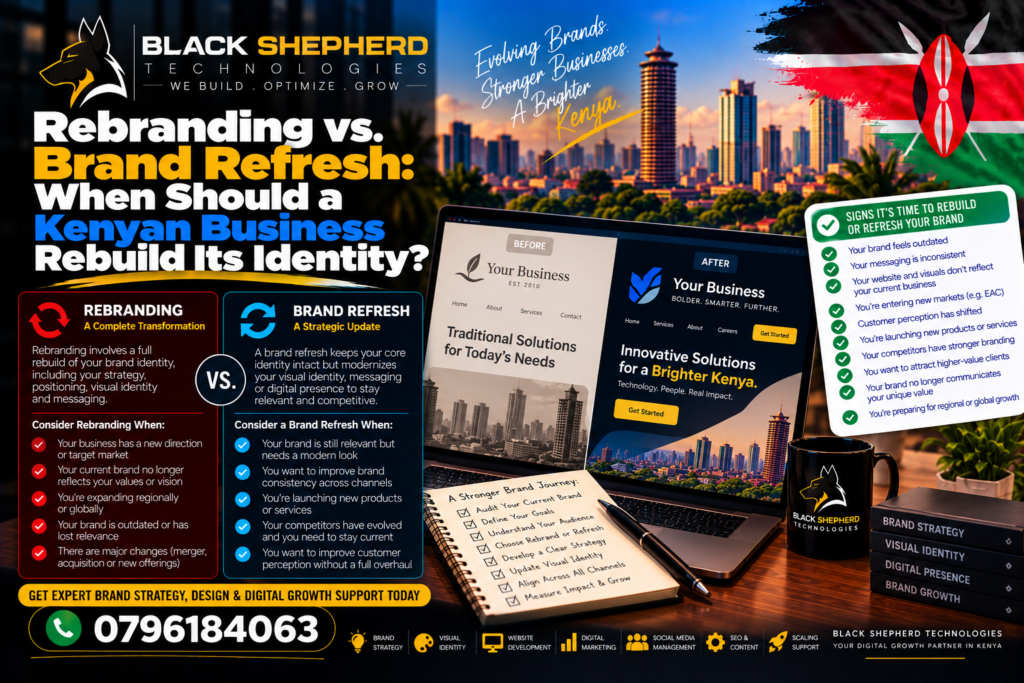
5. Rebranding vs. Brand Refresh: Making the Right Strategic Move
As corporate entities evolve, leadership teams must decide whether to execute a subtle visual update or undertake a structural brand overhaul.
The Brand Refresh (The Visual & Performance Upgrade)
A Brand Refresh modernizes an existing brand’s visual presentation and technical performance without changing its underlying business model, core audience, or brand name.
-
When to Choose a Refresh:
-
Your current logo and corporate collateral look dated or visually inconsistent across channels.
-
Your website suffers from slow page load speeds, poor mobile responsiveness, or outdated UI elements.
-
You are expanding onto new digital platforms and require a unified, scalable design system.
-
The Rebrand (The Structural & Strategic Pivot)
A Rebrand is a total transformation that redefines your corporate name, positioning, brand messaging, target audience, and digital footprint.
-
When to Choose a Rebrand:
-
Your organization is executing a fundamental shift in its core business model or target market.
-
Mergers, acquisitions, or corporate restructuring demand a unified brand entity.
-
Your current name restricts geographical expansion beyond Nairobi or local borders.
-
6. Real-World Execution: Portfolios & Engineering Proof
In digital brand development, creative concepts must be backed by real-world technical execution. Evaluating past project deployments provides actionable insight into how brand messaging, user interface design, static web performance, and search engine optimization come together in production environments.
When choosing a strategic design and digital agency partner, inspect their track record across three critical metrics:
-
Visual Quality & System Consistency: Do their project builds feature cohesive visual languages, refined typography, and responsive design execution?
-
Technical Speed Performance: Do their web platforms achieve high Google PageSpeed Insights scores and sub-second load times on mobile networks?
-
Search Engine Ranking Power: Does their web engineering translate into organic search dominance for client platforms?
To inspect live client builds, design systems, and fast web implementations built for high-growth firms, browse our complete collection of portfolios & projects.
7. Step-by-Step Roadmap to Build a Market-Dominating Corporate Brand
Building an authoritative corporate brand in Kenya requires an organized, multi-phase rollout plan. Below is an actionable 6-step blueprint designed for leadership teams, founders, and marketing heads in 2026:
+-----------------------------------------------------------------------------------+
|                        CORPORATE BRAND BUILDING ROADMAP                           |
+-----------------------------------------------------------------------------------+
| STEP 1: AUDIT           | Uncover design, technical SEO, & performance bottlenecks|
| STEP 2: POSITIONING     | Lock in target buyer personas & unique value propositions |
| STEP 3: DESIGN SYSTEM   | Build scalable brand books, logo suites, & UI/UX kits     |
| STEP 4: ENGINEERING     | Deploy static HTML pages, mobile optimization & edge CDN  |
| STEP 5: LOCAL SEO       | Drive rankings with targeted keywords & Schema markup     |
| STEP 6: LEAD ROUTING    | Integrate direct WhatsApp, CRM, & automated conversions   |
+-----------------------------------------------------------------------------------+
Step 1: Comprehensive Brand & Technical Audit
Begin by conducting a thorough review of all active brand assets and digital touchpoints:
-
Evaluate visual consistency across pitch decks, corporate stationery, social media, and physical signage.
-
Run speed diagnostics on your current website via Google PageSpeed Insights and GTmetrix.
-
Audit your current search engine rankings, domain backlink profile, and local citation accuracy.
Step 2: Refine Positioning & Messaging Frameworks
Clarify your core strategic narrative before designing a single pixel:
-
Define your primary, secondary, and tertiary customer buyer profiles.
-
Draft a clear brand statement that articulates what your firm does, how it excels, and why it matters in East Africa.
-
Formulate tone-of-voice guidelines that dictate how your brand communicates across corporate, sales, and customer service touchpoints.
Step 3: Develop a Scalable Visual Identity System
Translate strategic positioning into a cohesive design language:
-
Design a flexible logo system featuring primary marks, horizontal variants, and responsive icons.
-
Establish a corporate color palette complete with primary, supporting, and functional color tokens.
-
Define typographic hierarchies for headings, body text, data visualizations, and digital interfaces.
-
Publish a central Brand Guideline Book to enforce visual compliance across all business units.
Step 4: Engineer a Fast, Mobile-First Digital Platform
Rebuild your digital presence using ultra-fast, modern web architecture:
-
Utilize static HTML code generation or lightweight headless setups to eliminate server-side database bottlenecks.
-
Compress image files into modern WebP/AVIF formats and eliminate unnecessary JavaScript libraries.
-
Implement mobile-first layouts, tap-friendly action buttons, and accessible contrast ratios.
Step 5: Execute Localized Search Engine Optimization
Deploy an aggressive, content-led search engine campaign to capture high-intent commercial traffic:
-
Target localized, long-tail search phrases mapped to buyer intent across Nairobi, Mombasa, and regional markets.
-
Implement structured Organization, Service, and LocalBusiness Schema markup to dominate Google Knowledge Panels.
-
Align your platform with proven search growth strategies by leveraging specialized SEO services in Kenya.
Step 6: Integrate Frictionless Lead Capture & Conversion Routes
Turn incoming search traffic and brand engagement into direct sales opportunities:
-
Embed direct-to-WhatsApp order triggers with pre-filled inquiry templates for immediate mobile lead response.
-
Design clean lead-capture forms integrated with your corporate CRM and automated email response systems.
-
Ensure call-to-action (CTA) triggers are strategically placed across landing pages and service breakdowns.
8. Common Corporate Branding Pitfalls in East Africa (And How to Avoid Them)
Even established businesses frequently fall into strategic traps during brand creation or site redesign efforts. Understanding these common mistakes saves capital, preserves search equity, and prevents visual fragmentation.
+-----------------------------------------------------------------------------------+
|                        BRANDING PITFALLS vs. STRATEGIC FIXES                      |
+-----------------------------------------------------------------------------------+
| PITFALL: Treating Branding as "Just a Logo"                                       |
| FIX: Build a full strategy-backed identity system with complete brand governance. |
|                                                                                   |
| PITFALL: Ignoring Mobile & Web Load Speed                                         |
| FIX: Deploy fast static architecture and optimized digital assets.                |
|                                                                                   |
| PITFALL: Separating Brand Strategy from SEO                                       |
| FIX: Integrate search keywords, Schema markup, and topical authority upfront.     |
|                                                                                   |
| PITFALL: Inconsistent Channel Execution                                           |
| FIX: Standardize asset kits across print, social, web, and sales presentations.   |
+-----------------------------------------------------------------------------------+
Pitfall 1: Treating a Logo as a Complete Brand
A logo is merely an identifier; it is not a brand strategy. A visual mark without market positioning, cohesive color standards, defined brand messaging, and digital execution fails to drive trust or sales conversions.
-
The Fix: Demand a strategy-first approach that uncovers market gaps, audience motivations, and visual system governance before approving final creative concepts.
Pitfall 2: Prioritizing Aesthetics Over Web Performance
Designing heavy, visually elaborate websites that take 5 to 10 seconds to load on mobile networks frustrates users and destroys conversion rates.
-
The Fix: Pair design direction with performance engineering. Ensure your digital agency utilizes clean, lightweight static code, efficient image delivery, and edge caching.
Pitfall 3: Separating Brand Creation from Search Engine Strategy
Launching a sleek new visual identity on a website that lacks search engine optimization guarantees low traffic volume and missed market share.
-
The Fix: Ensure that on-page SEO, local search keywords, site structure, and technical Schema markup are built directly into the web platform during the initial design phase.
Pitfall 4: Channel Disconnection and Brand Drift
When corporate pitch decks, web pages, social media profiles, and office collateral use varying fonts, mismatched logos, and inconsistent messaging, customer trust declines rapidly.
-
The Fix: Establish a centralized digital brand asset library and enforce rigid brand guidelines across all departments and external vendors.
Conclusion: Build a Future-Proof Corporate Brand Today
In 2026, corporate brand strategy is a multidisciplinary practice combining positioning, visual storytelling, performance engineering, and local search engine dominance. Kenyan businesses that pair high-converting brand identity with fast web architecture and localized SEO consistently win client trust, secure enterprise contracts, and outpace market competition.
Whether you are launching a new enterprise, expanding regionally across East Africa, or re-engineering an established brand for performance, Black Shepherd Technologies delivers the strategic foresight, visual mastery, and technical engineering needed to dominate your industry.
-
Inspect real-world brand systems, UI builds, and static platforms across our portfolios & projects.
-
Discover how custom digital frameworks are tailored across the specialized industries we serve.
-
Elevate your brand visibility and dominate local search rankings with proven SEO services in Kenya.