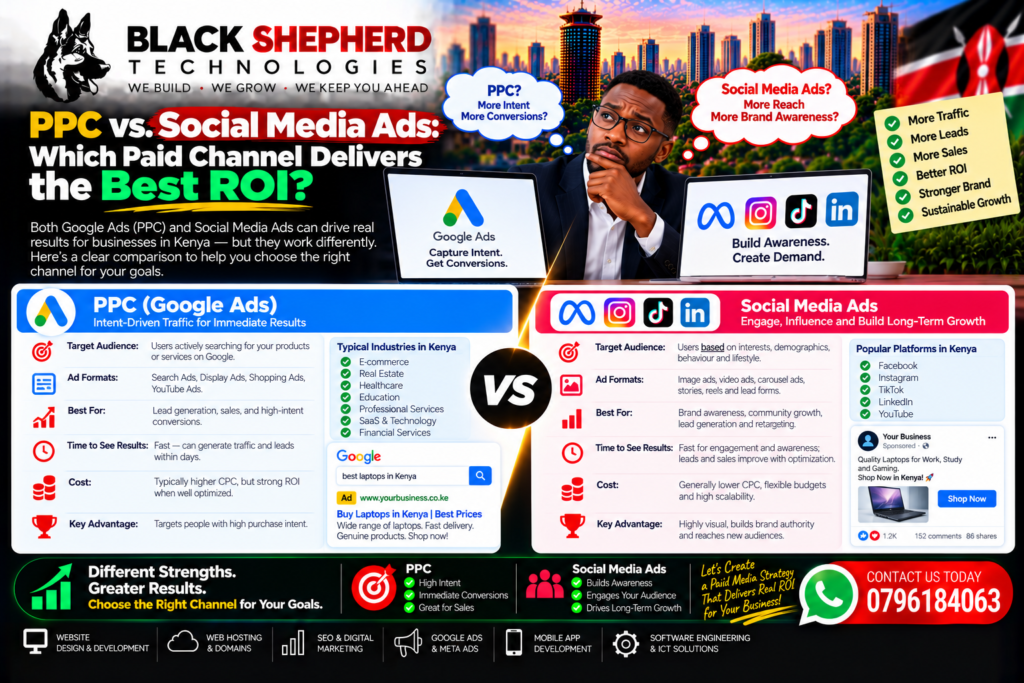
When allocating marketing budgets, business owners and growth leaders frequently face a classic dilemma: Should we invest our budget in Search Engine PPC (Google Ads, Bing) or Paid Social Media Ads (Meta, TikTok, LinkedIn)?
The short answer is that neither channel is universally superior. Paid Search (PPC) and Paid Social operate across entirely different stages of the customer journey. Evaluating which channel delivers the best Return on Investment (ROI) depends entirely on your business model, customer intent, average order value (AOV), and where your buyers sit within the purchasing funnel.
1. Understanding the Fundamental Difference: Intent vs. Attention
The core distinction between PPC and Social Media ads lies in psychological user intent versus visual interruption.
+------------------------------------------------------------------------+
|                      CHANNEL ARCHITECTURE COMPARISON                   |
+----------------------------------+-------------------------------------+
|         PPC (GOOGLE ADS)         |        PAID SOCIAL (META/TIKTOK)    |
+----------------------------------+-------------------------------------+
| • **Core Dynamic:** Pull (Intent)| • **Core Dynamic:** Push (Interruption)|
| • **User Mindset:** Active Buyer | • **User Mindset:** Casual Browser  |
| • **Trigger:** Specific Keyword  | • **Trigger:** Visual Hook / Story  |
| • **Best For:** Immediate Sales  | • **Best For:** Demand Generation   |
+----------------------------------+-------------------------------------+
-
Paid Search (PPC): Users on Google are actively searching for a solution to an immediate problem (e.g., “emergency plumber in Nairobi” or “best CRM software for B2B”). They exhibit high commercial intent, making PPC a high-intent capture channel.
-
Paid Social: Users on Meta, Instagram, or TikTok are scrolling casually to connect with friends, consume entertainment, or pass time. They are not actively looking to buy. Paid social acts as a demand generation channel, interrupting their feed with compelling visual creatives to manufacture desire.
2. Deep Dive: PPC (Google Search Ads)
Google Ads captures users who are ready to make a purchasing decision right now.
Advantages of PPC
-
High Purchase Intent: Because users type specific commercial keywords, conversion rates on well-optimized search campaigns are typically much higher than cold social traffic.
-
Shorter Conversion Cycles: Users searching for a service or product often convert within minutes or hours of clicking the ad.
-
Precise Geospatial & Keyword Control: You can target users down to specific city radii searching for exact phrases related to your core offerings.
Disadvantages of PPC
-
High Cost-Per-Click (CPC): In competitive verticals (e.g., legal, finance, SaaS, enterprise tech), bidding on high-intent keywords can drive CPCs up significantly.
-
Zero Demand Creation: If no one is actively searching for your innovative product or newly launched category, search volume will be zero. PPC captures existing demand; it cannot create new markets from scratch.
-
Vulnerable to Click Fraud & Waste: Without strict negative keyword management, broad match keywords can exhaust budgets on irrelevant search queries.
3. Deep Dive: Paid Social Ads (Meta, TikTok, LinkedIn)
Paid social advertising leverages rich demographic data, behavioral profiling, and immersive visual storytelling to put your brand in front of ideal buyers before they search for you.
Advantages of Paid Social
-
Targeting Depth: Beyond basic demographics, platforms like Meta and LinkedIn allow you to target users based on detailed job titles, industry verticals, interests, past engagement, and custom lookalike profiles.
-
Visual Storytelling & Brand Building: Formats like high-converting UGC (User Generated Experience) videos, carousels, and instant experience canvas ads allow you to demonstrate product value emotionally.
-
Lower Cost-Per-Mille (CPM): Reaching a thousand people on social media is often significantly cheaper than capturing a competitive search click on Google.
Disadvantages of Paid Social
-
Lower Initial Intent: Because you are interrupting a casual browsing experience, conversion rates from cold social traffic are lower, requiring sophisticated retargeting funnels.
-
Creative Fatigue: Social ad algorithms rely heavily on fresh creative assets. Ad fatigue sets in rapidly, requiring constant iteration of new hooks, videos, and angles every 2 to 4 weeks.
-
Attribution Complexity: Users rarely buy on the first social impression; they see an ad, research the brand later, and convert via direct search, making multi-touch attribution essential.
4. Financial Comparison: Which Delivers Better ROI?
Evaluating ROAS (Return on Ad Spend) requires analyzing how each channel fits into your unit economics and sales cycle.
+-----------------------------------------------------------------------------------+
|                        CHANNEL FINANCIAL PERFORMANCE MATRIX                       |
+-------------------------+----------------------------+----------------------------+
| METRIC / FACTOR         | PPC (GOOGLE SEARCH)        | PAID SOCIAL (META/TIKTOK)  |
+-------------------------+----------------------------+----------------------------+
| Average Conversion Rate | Higher (2% – 8%+)          | Lower (0.5% – 2.5%)        |
| Customer Acquisition    | Moderate to High (Driven   | Scalable, but requires     |
| Cost (CAC)              | by CPC auction inflation)  | stronger backend funnels   |
| Time to First Sale      | Immediate (Days 1–7)       | Moderate (Requires warmup  |
|                         |                            | & retargeting sequences)   |
| Best Suited For         | Emergency services, local  | E-commerce, visual goods,  |
|                         | B2B services, high-intent  | new brand discovery, SaaS, |
|                         | transactional queries      | and impulse purchases      |
+-------------------------+----------------------------+----------------------------+
-
When PPC Wins on ROI: If you sell a high-urgency product or service (e.g., emergency repairs, professional legal help, high-ticket B2B software), Google Ads delivers immediate ROI because you intercept buyers at the exact moment of need.
-
When Paid Social Wins on ROI: If you run an e-commerce brand, sell visually engaging consumer products, or offer a disruptive service that requires education, Paid Social delivers superior scale and lower customer acquisition costs over time.
5. The Omnichannel Growth Reality: Why Choosing One is a Mistake
Viewing PPC and Social Media as competing alternatives is a strategic error. High-growth businesses do not choose between them—they integrate both into a cohesive multi-touch funnel.
+-----------------------------------------------------------------------------------+
|                        THE INTEGRATED ACQUISITION FUNNEL                          |
+-----------------------------------------------------------------------------------+
| 1. DEMAND GENERATION (Top of Funnel): Paid Social (Meta / TikTok / LinkedIn)      |
|    • Introduces brand to cold audiences using engaging video and visual hooks.      |
+-----------------------------------------------------------------------------------+
                                          |
                                          v
+-----------------------------------------------------------------------------------+
| 2. INTENT CAPTURE (Bottom of Funnel): PPC (Google Search Ads)                     |
|    • Captures users who researched your brand on social and search for it later.   |
+-----------------------------------------------------------------------------------+
                                          |
                                          v
+-----------------------------------------------------------------------------------+
| 3. RETARGETING ENGINE (Multi-Channel Loop): Dynamic Social & Display Retargeting  |
|    • Re-engages non-converting visitors with reviews, case studies, and offers.     |
+-----------------------------------------------------------------------------------+
-
Top-of-Funnel Demand Generation: Use Meta or TikTok ads to build brand awareness, introduce your products, and capture attention among target demographic profiles.
-
Bottom-of-Funnel Intent Capture: As users become familiar with your brand through social touchpoints, search query volume for your brand name and core product categories increases on Google. PPC captures that surge in high-intent search traffic.
-
Cross-Channel Retargeting: Deploy cross-platform retargeting pools that serve video testimonials on social media to users who visited your website via Google Ads but didn’t convert immediately.
Summary Checklist: Which Channel Should You Start With?
-
Start with PPC (Google Ads) if:
-
You have limited initial budget and need immediate, high-intent leads or sales.
-
Your product/service solves an urgent, problem-driven need with active search volume.
-
-
Start with Paid Social if:
-
You sell visual e-commerce products, fashion, beauty, or consumer goods.
-
You are launching an innovative product category where search volume does not yet exist.
-
You have robust creative production capabilities (UGC videos, professional imagery) to fuel iterative ad testing.
-
Need Help Optimizing Your Paid Channels?
At Black Shepherd Technologies, we architect unified paid acquisition strategies across Google Search and Paid Social platforms, backed by advanced tracking setups and dedicated landing page funnels.
Explore how we can maximize your return on ad spend at blackshepherd.co.ke.