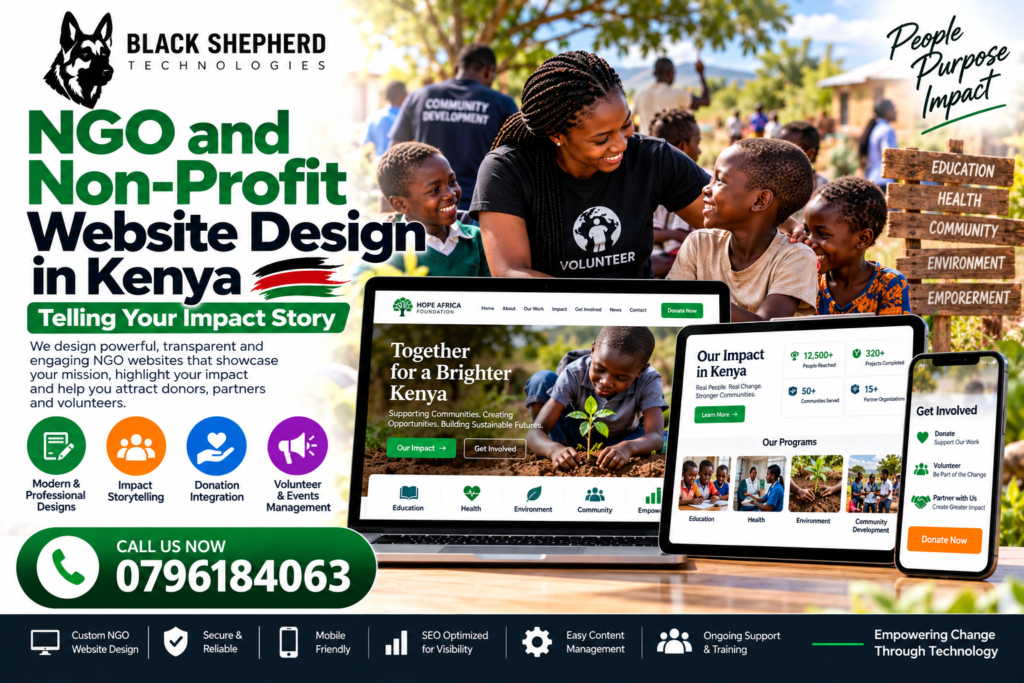
NGO and Non-Profit Website Design in Kenya: Telling Your Impact Story
In the heart of East Africa, Kenya stands as a vibrant hub for social impact, innovation, and community development. From the bustling tech hubs of Nairobi to grassroots initiatives in Kisumu, Mombasa, and rural Turkana, non-governmental organizations (NGOs), community-based organizations (CBOs), and international non-profits work tirelessly to address critical challenges. They fight for environmental conservation, champion healthcare access, empower women, drive educational reforms, and provide humanitarian relief.
Yet, in today’s digital-first world, doing phenomenal work on the ground is only half the battle. To secure funding, attract international donors, retain volunteers, and influence policy, non-profits must be able to tell their impact story effectively online.
For many Kenyan NGOs, however, their digital storefront—their website—often fails to capture the magnitude of their mission. Outdated designs, sluggish load times, confusing navigation, and poor mobile responsiveness create a digital barrier between organizations and the audiences they need to reach.
This comprehensive guide explores the art and science of NGO and non-profit website design in Kenya, detailing how purpose-driven organizations can transform their online presence into powerful storytelling and fundraising engines.
1. The Unique Digital Landscape of Non-Profits in Kenya
Kenya’s digital ecosystem is unlike almost anywhere else in the world. With high mobile penetration, a dominant mobile money culture (led by M-Pesa), and a young, tech-savvy population, digital engagement is deeply ingrained in daily Kenyan life. At the same time, Kenyan NGOs operate in a complex ecosystem characterized by:
-
Diverse Stakeholder Groups: Your website must speak simultaneously to international donor agencies (e.g., USAID, EU, Ford Foundation), local corporate partners, government regulators (such as the NGO Coordination Board), volunteers, beneficiaries, and the general public.
-
Trust and Transparency Demands: Donors want accountability. They want to see where their money goes, how programs are evaluated, and what impact is being generated in real-time.
-
Resource Constraints: Non-profits often operate on lean budgets, making every shilling spent on digital infrastructure a high-stakes investment.
Because of these dynamics, an NGO website cannot be treated as a static online brochure. It must be an active, dynamic ecosystem designed to build trust, inspire empathy, and drive action.
2. Why Traditional Web Design Fails NGOs
Many non-profits make the mistake of hiring general web designers who treat an NGO website like a corporate e-commerce site or a standard portfolio. This leads to several critical pitfalls:
A. The “Wall of Text” Syndrome
NGOs are rich in data, reports, and mission statements. Unskilled designers often dump 50-page PDF strategic plans and dense paragraphs directly onto web pages, overwhelming visitors and burying the human element of the work.
B. Ignoring the Mobile-First Reality
While desktop computers are used in office settings, the vast majority of local stakeholders, youth volunteers, and mobile-first donors in Kenya access the internet via smartphones. Websites that are not optimized for mobile devices lose audience engagement within seconds.
C. Disconnected Donation and Engagement Funnels
If a donor feels inspired by a story on your homepage, but it takes five confusing clicks, an unoptimized form, or a broken payment gateway to make a contribution, you will lose them.
D. Poor Search Visibility
Even the most beautifully designed non-profit website is useless if no one can find it. Without strategic SEO services in Kenya, your organization remains invisible to grant-makers, researchers, and partners searching for solutions on Google.
3. Core Pillars of a High-Impact NGO Website Design
To build a website that tells your story and drives results, your web design and development strategy must incorporate several foundational pillars:
I. Human-Centric Storytelling and Visual Identity
Numbers and statistics matter, but human beings connect with stories. When a donor visits your site, they should instantly see the faces, names, and communities behind your mission.
-
High-Quality Imagery: Avoid generic, overly polished stock photos of children or landscapes. Use authentic, high-resolution photography and videography from your field projects in Kenya.
-
The Hero Section: Your homepage’s above-the-fold section must answer three questions in under five seconds: Who are you? What problem are you solving? How can the visitor help?
II. Seamless User Experience (UX) and Information Architecture
Your website structure should cater to different user intents. A donor has a different goal than a researcher or a beneficiary.
-
Clear Navigation: Keep top-level menus simple (e.g., About Us, What We Do, Where We Work, Impact, Get Involved, Contact).
-
Fast Load Times: In areas with fluctuating internet connectivity, lightweight code, compressed imagery, and optimized hosting ensure your site loads instantly.
III. Radical Transparency and Credibility Markers
Trust is the currency of the non-profit sector. Your website must immediately establish legitimacy by featuring:
-
Annual reports, financial audits, and governance details.
-
Certifications and regulatory registration numbers (e.g., NGO Coordination Board registration).
-
Testimonials from community leaders, partner organizations, and beneficiaries.
4. Crafting the Essential Pages of a Non-Profit Website
Every page on your NGO website serves a specific psychological and strategic purpose. Let’s break down how to design the key sections:
A. The Homepage: Your Digital Front Door
Your homepage is your elevator pitch. It should feature:
-
An emotional, compelling headline.
-
A clear Call-to-Action (CTA) button (e.g., “Donate Now,” “Partner With Us,” “Read Our Impact Report”).
-
A brief overview of key impact metrics (e.g., 10,000+ children educated, 45 communities reached, 5 counties transformed).
B. The “About Us” Page: Your Origin Story and Values
Donors don’t just give to causes; they give to organizations they trust. Use this page to share your history, your founders’ vision, your leadership team, and the core values guiding your work across Kenya.
C. Programs / “What We Do” Pages
Break down your initiatives clearly. If you work in environmental conservation in the Mau Forest and maternal healthcare in Turkana, each program should have its own dedicated landing page detailing:
-
The specific problem being addressed.
-
Your methodology and intervention strategy.
-
Measurable outcomes and success stories.
D. The Impact / Stories Page: Proof of Work
This is where your storytelling shines. Incorporate blog posts, video documentaries, case studies, and photo galleries showcasing real transformations. When organizations showcase their verifiable results through well-documented portfolios and project showcases, donor confidence skyrockets.
E. The “Get Involved” / Donation Hub
Make participation effortless. Provide multiple avenues for engagement:
-
Financial contributions integrated with local payment rails (M-Pesa, Airtel Money) and international gateways (Credit Cards, PayPal, Stripe).
-
Volunteer sign-up forms.
-
Corporate partnership and CSR inquiries.
5. Tailoring Web Design for Diverse NGO Sectors in Kenya
Different non-profit niches require distinct digital strategies and user journeys. Understanding sector-specific requirements ensures your website resonates with your exact target audience:
-
Environmental & Conservation NGOs: Focus heavily on immersive visual storytelling, interactive maps of conservation areas, field reports, and scientific data visualization.
-
Health & Humanitarian Organizations: Prioritize urgent call-to-actions, emergency response updates, transparency in supply chains, and impact metrics regarding patient care and community outreach.
-
Education & Youth Empowerment NGOs: Highlight success stories of scholarship recipients, student portals, mentorship sign-ups, and curriculum development resources.
-
Human Rights & Advocacy Groups: Focus on secure communication channels, resource libraries, press rooms for media advocacy, and legal documentation.
Professional agencies that specialize in tailored web design solutions across various industries we serve understand these nuances and build custom digital architectures tailored to your specific sector’s unique demands.
6. The Role of SEO and Digital Marketing in Non-Profit Growth
Building a stunning website is only the beginning. If your target donors, international grant officers, and volunteers cannot find you on search engines like Google, your impact remains stifled.
Why Non-Profits Need SEO
Search Engine Optimization (SEO) ensures that when someone searches for terms like “child education NGO in Kenya,” “climate change non-profit Nairobi,” or “humanitarian grants East Africa,” your organization appears at the top of the search results.
Investing in robust SEO services in Kenya helps non-profits:
-
Attract Organic Grant Opportunities: International foundations often conduct preliminary research via Google before issuing Requests for Proposals (RFPs).
-
Build Global Awareness: Position your Kenyan-led initiative on the global stage, attracting international donors and diaspora support.
-
Educate the Public: Publish keyword-optimized blog posts and resource articles that answer critical questions regarding social issues in your domain.
7. Technical Considerations for Kenyan Non-Profit Websites
When designing a website for the Kenyan market, technical infrastructure can make or break your digital presence. Keep these technical best practices in mind:
-
Mobile Responsiveness & Speed: With mobile traffic dominating internet usage in Kenya, test your site relentlessly across various mobile devices and screen resolutions. Compress images to ensure fast loading even on 3G or constrained 4G networks.
-
Local Payment Gateway Integration: For local fundraising campaigns, integrating secure M-Pesa STK push API integration is essential. Donors should be able to contribute 500 KES or 5,000 KES in less than 10 seconds directly from their mobile phones.
-
Security (SSL Certificates & Data Privacy): Non-profits handle sensitive donor financial information and beneficiary data. Ensure strict adherence to Kenya’s Data Protection Act (DPA) and implement robust SSL encryption to prevent cyber threats.
-
Content Management System (CMS): Choose a user-friendly CMS like WordPress or Webflow that allows your internal communications or programs team to update blog posts, add photos, and publish reports without needing advanced coding knowledge.
8. Step-by-Step Roadmap: Building Your NGO Website
Embarking on a website redesign or building your first digital platform can feel daunting. Here is a step-by-step roadmap to guide your organization through the process:
Step 1: Define Your Objectives and Audience
Gather your core team, board members, and program leads. Ask yourselves:
-
What is the primary goal of this website? (e.g., Fundraising, volunteer mobilization, donor reporting, policy advocacy?)
-
Who are our primary website visitors?
Step 2: Conduct an Audit of Existing Assets
Review your current website (if you have one), your brand guidelines, logo, photography library, annual reports, and impact data. Identify what works and what needs to be discarded.
Step 3: Partner with the Right Digital Agency
Choose a web design and digital marketing partner who understands the Kenyan non-profit sector, respects your budget constraints, and demonstrates a proven track record. Review past portfolios and project showcases to evaluate their creative and technical capabilities.
Step 4: Map Out Wireframes and Content Strategy
Before writing a single line of code, design wireframes (blueprints) of your key pages. Ensure your content copy is clear, compelling, and free of bureaucratic jargon.
Step 5: Development, Testing, and Optimization
Once the design is approved, development begins. Rigorously test the website for mobile responsiveness, speed, donation gateway functionality, and form submissions. Ensure basic SEO architecture is baked into the code from day one.
Step 6: Launch, Monitor, and Iterate
Launch your new website with an announcement campaign across your social media channels, newsletters, and stakeholder networks. Use tools like Google Analytics to monitor user behavior, track donation conversion rates, and continuously refine your digital strategy.
Conclusion: Let Your Mission Shine Online
In Kenya’s competitive philanthropic and development landscape, your NGO’s story is your most powerful asset. You are changing lives, transforming communities, and building a better future—your website should reflect that excellence.
By moving away from cluttered, outdated designs and embracing human-centric storytelling, seamless mobile experiences, transparent reporting, and strategic optimization, your non-profit can unlock unprecedented levels of engagement, funding, and impact.
Ready to elevate your non-profit’s digital presence and tell your impact story to the world? Partner with experts who understand your mission and know how to bring it to life online. Explore our specialized industries we serve and discover how we help purpose-driven organizations thrive.
Transform your vision into digital impact. Visit Black Shepherd Kenya today to start your digital transformation journey.