
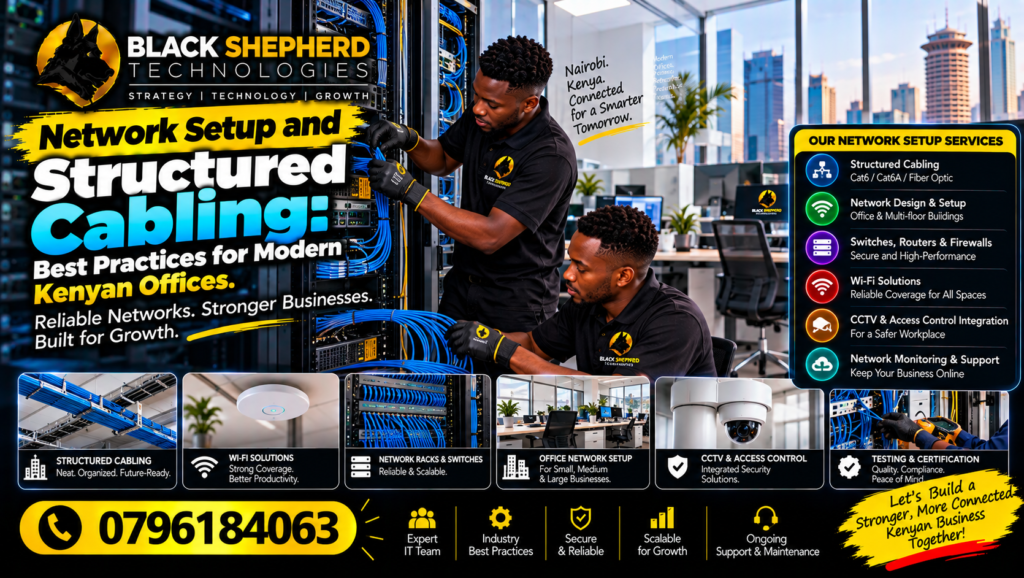
The commercial real estate landscape across Nairobi—spanning prime corporate towers in Westlands, Upper Hill, and Kilimani, as well as bustling business parks along Mombasa Road and industrial zones—is evolving at a staggering pace. Modern businesses rely entirely on seamless digital connectivity. Whether your enterprise is a fast-growing fintech startup, a multi-branch retail headquarters, a logistics nerve center, or a professional legal and financial consultancy, your day-to-day operations depend on lightning-fast data flow.
Yet, a common operational paradox plagues many offices: companies invest heavily in high-performance cloud applications, enterprise software, and expensive workstations, yet their local office network constantly lets them down. Employees experience frustrating Wi-Fi dropouts, video conference calls freeze mid-sentence, file transfers crawl during peak hours, and network downtime brings business to a standstill.
In almost every case, the root cause is not the internet service provider (ISP) or the computers themselves; it is faulty, disorganized network setup and unstructured cabling.
Achieving a resilient, future-proof office network requires adhering to rigorous engineering standards. This comprehensive guide explores the best practices for network setup and structured cabling tailored specifically for modern Kenyan offices. We will examine copper and fiber standards, rack organization, dual-ISP redundancy, Wi-Fi mesh engineering, and how pairing physical infrastructure excellence with world-class digital visibility through professional SEO services in Kenya ensures your enterprise dominates across the diverse industries we serve, drawing inspiration from proven engineering blueprints featured in our portfolios and projects.
1. The Real Cost of Poor Network Infrastructure in Nairobi
Before examining technical best practices, it is essential to understand why network architecture matters so much in the local business environment.
A. The Hidden Price of “Ad-Hoc” Cabling
When offices are set up quickly, contractors often run loose extension cords, tangled Ethernet cables across floors, and unlabelled wires plugged into consumer-grade multi-switches. While this cheap, ad-hoc approach works temporarily, it creates severe long-term liabilities:
-
Signal Degradation and Interference: Unshielded data cables running parallel to high-voltage electrical lines suffer from electromagnetic interference (EMI), causing packet loss and slow network speeds.
-
Troubleshooting Nightmares: When a network port fails in a messy bundle of 200 tangled cables, finding the correct line requires hours of manual tracing, causing prolonged office downtime.
-
Physical Safety and Fire Hazards: Exposed cables create tripping hazards for staff and pose electrical fire risks that violate standard occupational safety regulations.
B. The Demand for High-Concurrency Workspaces
Modern offices are hybrid ecosystems. Employees simultaneously stream cloud-based ERP software (like Odoo or ERPNext), execute video conferences on Zoom or Microsoft Teams, process real-time M-Pesa merchant transactions, and upload massive design or data files. A weak or bottlenecked local area network (LAN) will choke these workflows, regardless of how fast your external internet connection is.
2. Structured Cabling Standards: Copper, Fiber, and Pathways
Structured cabling is the systematic organization of telecommunications cabling infrastructure that integrates voice, data, video, and management systems into a standardized, predictable medium.
A. Choosing the Right Copper Media: CAT6 vs. CAT7
For horizontal cable runs connecting wall outlets to patch panels and switches, selecting the appropriate copper category is foundational:
-
CAT6 (Category 6): Supports gigabit Ethernet (1 Gbps) speeds up to 100 meters and frequencies up to 250 MHz. It is the cost-effective baseline for standard office workstations.
-
CAT6A (Augmented CAT6): Supports 10-Gigabit Ethernet (10 Gbps) up to 100 meters and operates up to 500 MHz, featuring superior shielding against alien crosstalk. It is highly recommended for modern offices expecting intensive data demands.
-
CAT7 (Category 7): Provides performance up to 600 MHz and features individual shielding for each wire pair, making it ideal for data centers and environments with heavy electromagnetic interference.
B. Fiber-Optic Backbone Cabling
For multi-story office buildings or sprawling commercial compounds in Nairobi, copper cables have a physical distance limitation of 100 meters.
-
Single-Mode and Multi-Mode Fiber: Deploying fiber-optic backbone cables between distribution frames and server racks ensures lightning-fast data transmission across long distances, immune to electrical interference and lightning surges common during rainy seasons.
C. Cable Pathways, Trunking, and Separation
-
Dedicated Trunking: Always run data cables in separate PVC trunking channels or metal conduits distinct from electrical power lines, maintaining a minimum physical separation distance of at least 30 centimeters to prevent EMI noise.
-
Bend Radius Compliance: Never bend data cables beyond their manufacturer-specified minimum bend radius. Sharp kinks or tight squeezes crush internal copper pairs and permanently ruin data transmission capabilities.
3. Server Rack Architecture and Cable Management
The server rack or network closet is the heart of your office IT infrastructure. A professionally engineered rack is clean, cool, and easily maintainable.
[Main Distribution Frame / Server Rack]
                   │
                   ├──► [Online UPS & Power Distribution Units (PDUs)]
                   ├──► [Next-Gen Core Hardware Firewall & Multi-WAN Routers]
                   ├──► [Gigabit PoE Managed Network Switches]
                   └──► [Patch Panels & Vertical/Horizontal Cable Managers]
A. Rack Layout and Thermal Management
-
Logical Elevation: Mount heavy equipment (such as uninterruptible power supply battery units) at the bottom of the rack to maintain a low center of gravity. Place patch panels near the top or middle, adjacent to switches, to minimize jumper cable lengths.
-
Proper Ventilation: Ensure server cabinets feature vented or glass doors paired with exhaust fan trays. Overheating network switches experience thermal throttling, packet drops, and premature hardware failure.
B. Patch Panels and Color-Coding
-
Terminate Properly: Never plug raw cable drops directly into network switches. All horizontal cables must terminate cleanly onto 24-port or 48-port RJ45 patch panels.
-
Color-Coded Patch Cords: Use color-coded patch cables to distinguish traffic types instantly at a glance: Blue for standard workstations, Yellow for IP security cameras, Red for critical servers and firewalls, and Green for VoIP telephone systems.
4. Enterprise Networking: Redundancy, Routing, and Wi-Fi Mesh Engineering
A great physical cabling layout must be supported by intelligent network electronics and routing configurations.
A. Dual-ISP Redundancy and Automatic Failover
Relying on a single internet service provider in Nairobi is a major business risk. Fiber cuts caused by road construction, utility pole maintenance, or regional backbone outages can sever your connection without warning.
-
Multi-WAN Enterprise Routers: Install an enterprise-grade router or firewall (such as Fortinet, Sophos, or Cisco) featuring multiple WAN ports.
-
Seamless Failover: Configure your primary high-speed dedicated fiber link from ISP A alongside a redundant backup link from ISP B. If ISP A drops, the router automatically fails over to ISP B within milliseconds, ensuring zero disruption to live calls, POS terminals, or cloud operations.
B. Enterprise Wi-Fi Architecture
Consumer-grade wireless routers purchased from retail shops cannot handle the device density and security demands of a modern office.
-
Ceiling-Mounted PoE Access Points: Deploy enterprise-grade, power-over-ethernet (PoE) access points (such as Ubiquiti UniFi, Aruba, or Cisco Meraki) strategically across the office ceiling to ensure strong, seamless roaming signal coverage with zero dead zones.
-
VLAN Segmentation: Isolate your wireless networks into secure segments:
-
Corporate VLAN: Encrypted access strictly for employee workstations and internal systems.
-
Guest VLAN: Isolated Wi-Fi portal for office visitors, featuring bandwidth caps and terms-of-service acceptance pages to prevent network abuse and protect internal servers.
-
5. Power Protection and Surge Mitigation
Electrical stability in commercial offices across Nairobi requires dedicated protective infrastructure. Voltage spikes, lightning storms during rainy seasons, and sudden grid power cuts can fry expensive network switches, firewalls, and server equipment.
-
Online Double-Conversion UPS: Protect all core network racks with an online UPS system. Unlike offline backup units that switch to battery power after a delay, online UPS units continuously convert incoming AC power to DC and back to clean AC, providing zero transfer time and complete isolation from voltage surges.
-
Dedicated Grounding: Ensure your server rack and electrical circuits feature a certified, low-resistance copper grounding rod and earth pit. Improper grounding invites electrical feedback, hardware burnout, and severe safety hazards.
6. Security, Access Control, and Physical Surveillance
Network infrastructure security encompasses both cybersecurity defenses and physical asset protection.
-
Next-Gen Hardware Firewalls: Implement a hardware firewall at the network perimeter to inspect all incoming and outgoing traffic, block malicious botnets, and enforce deep packet inspection.
-
Physical Server Room Security: Restrict access to the network closet or server room using biometric fingerprint scanners or digital RFID card locks. Install high-definition IP security cameras covering the rack and entryways, connected to a secure network video recorder (NVR).
7. Scaling Beyond Physical Infrastructure: Digital Visibility and Marketing
Building a robust, high-performance office network and structured cabling system ensures that your internal operations run with absolute efficiency, zero downtime, and maximum productivity. However, internal technical excellence must be paired with aggressive outward market visibility to drive business growth.
Whether you operate in retail, fintech, logistics, manufacturing, or professional services across the diverse industries we serve, your digital presence determines your market reach and client acquisition velocity. Partnering with digital marketing experts to execute targeted SEO services in Kenya ensures that your enterprise web portals, e-commerce stores, and digital campaigns rank prominently on search engines, capturing high-intent organic traffic from across Kenya and the wider East African region.
To review practical examples of robust technical architectures, custom software integrations, and responsive web solutions, explore our comprehensive portfolios and projects. Witnessing successful deployments offers clear benchmarks for what your enterprise can achieve.
Conclusion
Network setup and structured cabling form the invisible nervous system of every modern Kenyan office. Investing in certified CAT6/6A copper runs, fiber backbones, pristine server rack organization, dual-ISP internet redundancy, enterprise Wi-Fi mesh engineering, and robust power protection eliminates costly technical friction.
Backed by expert technical execution, rigorous planning, and strategic digital growth initiatives like SEO services in Kenya, your physical workspace and digital assets will work in seamless harmony to secure long-term market leadership.
