
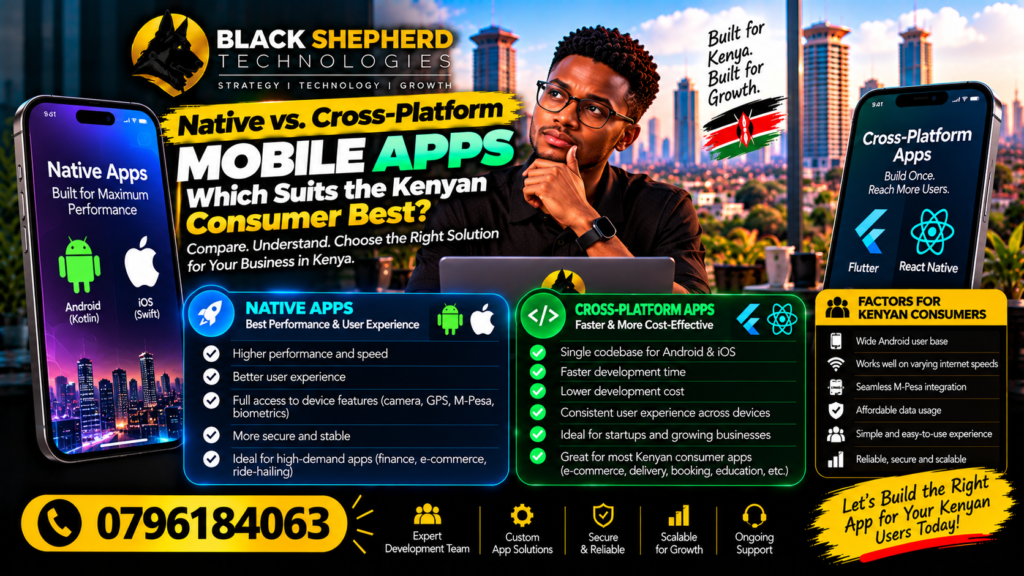
When businesses, corporate executives, and startup founders in Kenya’s vibrant tech hub—affectionately known as the Silicon Savannah—decide to build a mobile application, they face a foundational architectural question right at the outset: Should we build a Native app or a Cross-Platform app?
This decision is far more than a simple technical preference for software engineers. It dictates your initial development budget, your time-to-market speed, your ability to integrate seamlessly with local payment gateways like M-Pesa, how smoothly your app runs on budget versus flagship devices, and how easily you can scale your product as your user base expands across Kenya and East Africa.
In a market defined by fast-paced digital adoption, budget-conscious consumers, device fragmentation, and intermittent network coverage, making the wrong choice can lead to bloated budgets, sluggish performance, and high user churn.
Which development approach is genuinely best suited for the Kenyan consumer? Let us dive deep into a comprehensive analysis of Native versus Cross-Platform development through the lens of local market realities.
Part 1: Defining the Contenders
To evaluate which approach serves the Kenyan consumer best, we must first clearly define what Native and Cross-Platform development mean.
1. Native Mobile Applications
Native apps are built specifically for a single mobile operating system using the platform’s native programming languages and development tools.
- iOS Native: Written in Swift or Objective-C using Apple’s Xcode IDE. Designed exclusively for iPhones and iPads.
- Android Native: Written in Kotlin or Java using Android Studio. Designed exclusively for Android devices (Samsung, Google Pixel, Tecno, Infinix, Oppo, Xiaomi, etc.).
- The Core Advantage: Native apps have direct, unhindered access to the device’s underlying hardware, operating system APIs, and native UI components. They deliver the absolute highest level of performance, fluid animations, and deep hardware integration (such as complex Bluetooth peripherals, advanced camera APIs, or biometric security modules).
- The Core Disadvantage: You must build and maintain two entirely separate codebases. If you want your app on both the Google Play Store and the Apple App Store, you need two distinct development teams (or developers skilled in both Swift and Kotlin), doubling your initial development cost and ongoing maintenance overhead.
2. Cross-Platform Mobile Applications
Cross-platform apps are built using a single unified codebase that can be compiled and deployed to run on both Android and iOS devices.
- Popular Frameworks: Flutter (backed by Google, using the Dart language) and React Native (backed by Meta, using JavaScript/TypeScript).
- The Core Advantage: Developers write code once and deploy it across both mobile operating systems. This typically slashes initial development time and engineering costs by 30% to 50%, allowing startups and enterprises to get to market faster.
- The Core Disadvantage: Historically, cross-platform apps relied on performance bridges or interpreted code, which could introduce slight UI overhead or lag on low-end hardware. However, modern frameworks like Flutter (with direct compilation and its high-performance rendering engine) have dramatically closed this gap.
Part 2: Evaluating the Kenyan Consumer Landscape
To determine which approach suits the Kenyan market best, we must evaluate how real people in Nairobi, Mombasa, Kisumu, Nakuru, and rural counties actually use mobile apps.
1. Device Fragmentation: The Hardware Reality Check
In mature Western or Asian tech markets, flagship devices (such as the latest iPhone or high-end Samsung Galaxy S-series) represent a massive portion of active users.
In Kenya, while high-end iPhones have a strong, premium urban footprint, the vast majority of mobile consumers rely on a diverse spectrum of Android devices. These range from mid-range Samsung models to hugely popular, budget-friendly smartphones manufactured by Tecno, Infinix, Oppo, and Xiaomi. These devices often feature modest processors (RAM ranging from 2GB to 6GB) and limited onboard storage.
- Native Implication: Building a separate Android app in Kotlin allows you to optimize memory management and CPU utilization specifically for Android architecture. However, maintaining that alongside a separate iOS app stretches budgets for many growing businesses.
- Cross-Platform Implication: Modern cross-platform frameworks—particularly Flutter, which renders pixels directly via its own engine—deliver surprisingly fluid, high-frame-rate performance even on modest Android hardware, making them exceptionally attractive for reaching mass-market Kenyan consumers.
2. Network Constraints and Data Cost Consciousness
While fiber optic and 5G networks are expanding rapidly across major urban centers in Kenya, mobile network reliability and data costs fluctuate significantly. Commuters in Nairobi traffic, residents in concrete multi-story buildings, or individuals traveling across county lines frequently encounter dropped connections or slow 3G speeds. Furthermore, mobile data bundles represent a conscious monthly expense for everyday consumers.
- The Consumer Reaction: Kenyan consumers have very little patience for heavy, sluggish apps. An app that takes 15 seconds to load or consumes excessive background data will be uninstalled immediately.
- Architectural Demand: Whether Native or Cross-Platform, an app targeting Kenya must be built with an offline-first mindset, efficient local caching (using Room, SQLite, or Hive), and compressed asset payloads. Both development approaches can achieve this, but cross-platform frameworks often make it easier to maintain unified state management and synchronization logic across both operating systems simultaneously.
3. Payment Infrastructure: The M-Pesa Imperative
No mobile app in Kenya can succeed without frictionless payment integration. Safaricom’s M-Pesa (via the Daraja API), alongside alternative mobile money wallets and digital payment gateways (like Paystack and Flutterwave), forms the economic backbone of local digital commerce.
- Integration Complexity: Integrating an M-Pesa STK push workflow requires handling secure API requests, callback URLs, session timeouts, and biometric confirmation prompts.
- Framework Comparison: Both Native and Cross-Platform frameworks handle API requests and local storage effortlessly. However, because cross-platform ecosystems like Flutter (
pub.dev) and React Native (npm) boast massive open-source package libraries, developers can quickly implement secure network requests and encryption modules without reinventing the wheel.
Part 3: Deep-Dive Comparison Metrics for Kenyan Businesses
When deciding between Native and Cross-Platform development for your Kenyan project, weigh these five critical metrics:
| Metric | Native (Swift / Kotlin) | Cross-Platform (Flutter / React Native) | Winner for Kenya |
| Initial Budget & Cost | High (Requires two separate development teams/codebases) | Moderate (Single unified codebase shared across iOS and Android) | Cross-Platform |
| Time-to-Market | Slower (Building and testing two apps in parallel takes longer) | Faster (Launch simultaneously on Google Play and App Store) | Cross-Platform |
| Performance on Budget Devices | Absolute peak performance optimized per OS | High performance (Flutter/React Native handle budget hardware well) | Native (Slight edge, though negligible for standard apps) |
| Local Talent Availability in Nairobi | Mixed (Finding senior Kotlin & Swift devs can be competitive) | High (Vibrant local community of JavaScript/React and Flutter devs) | Cross-Platform |
| Deep Hardware / Complex Graphics | Unmatched (Best for heavy 3D gaming, complex Bluetooth, or OS-level customization) | Excellent for 95% of business, fintech, and e-commerce apps | Native (For niche hardware-heavy apps) |
Part 4: When Should You Choose Native Development in Kenya?
While cross-platform development wins on budget and speed for most use cases, there are specific scenarios where Native development (Swift for iOS and Kotlin for Android) is the superior choice:
- Hardware-Intensive Enterprise Solutions: If your mobile app relies heavily on continuous background hardware processing—such as real-time IoT device pairing, complex industrial Bluetooth peripherals, augmented reality (AR), or high-end 3D graphics rendering—Native development provides unhindered access to OS-level APIs.
- Well-Funded Enterprises with Strict OS Paradigms: Large banks, multinational corporations, or telcos with substantial technology budgets often prefer native codebases to ensure absolute, uncompromising control over every micro-interaction and native UI guideline on both iOS and Android.
- Maximum Longevity for Core OS Upgrades: Native apps are ready to adopt new iOS and Android features the exact day Apple and Google release their annual operating system updates, without waiting for third-party cross-platform framework maintainers to patch their bridges.
Part 5: When Should You Choose Cross-Platform Development in Kenya?
For the vast majority of startups, SMEs, e-commerce platforms, logistics apps, and fintech solutions built in Nairobi, Cross-Platform development (Flutter or React Native) is the most strategic and pragmatic choice:
- Optimizing Limited Capital: Startups and growing businesses rarely have unlimited venture capital. Choosing cross-platform development cuts your initial engineering budget in half, preserving precious capital for digital marketing, user acquisition, and local SEO campaigns.
- Capturing Both Android and iOS Simultaneously: In Kenya, Android commands the overwhelming majority of the mobile market share, while iOS holds a smaller, highly lucrative urban and corporate niche. Launching on both platforms at the exact same time ensures you do not alienate either segment of your target audience.
- Rapid MVP (Minimum Viable Product) Validation: In a fast-moving market like Kenya, speed to market is everything. Cross-platform frameworks allow you to iterate rapidly, push weekly updates, test product-market fit, and pivot based on user feedback without maintaining two separate engineering teams.
Conclusion: Which Suits the Kenyan Consumer Best?
So, which development approach ultimately suits the Kenyan consumer best?
For 95% of consumer-facing applications, fintech solutions, e-commerce platforms, and service-booking apps in Kenya, Cross-Platform development (specifically Flutter or React Native) is the clear winner. It delivers the speed, cost-efficiency, and cross-device consistency required to launch quickly, scale smoothly, and perform reliably across the diverse spectrum of Android and iOS devices used across Nairobi and beyond.
However, technology is only a tool. Whether you choose Native or Cross-Platform, the ultimate success of your mobile app depends on partnering with a seasoned digital agency and software development team that understands local infrastructure, M-Pesa payment workflows, network constraints, and user behavior.
Are you planning to build, scale, or optimize a mobile application in Kenya? Connect with industry-leading digital agencies and mobile app experts in Nairobi to choose the right architecture and turn your vision into a high-performing reality.
