For many CEOs and managing directors across Kenya, digital marketing has historically been treated as a mysterious “black box.” Agencies talk about keyword rankings, domain authority, and indexation rates—metrics that sound important on paper but often fail to answer the singular question that keeps every executive awake at night: “How does this directly impact our bottom line?”
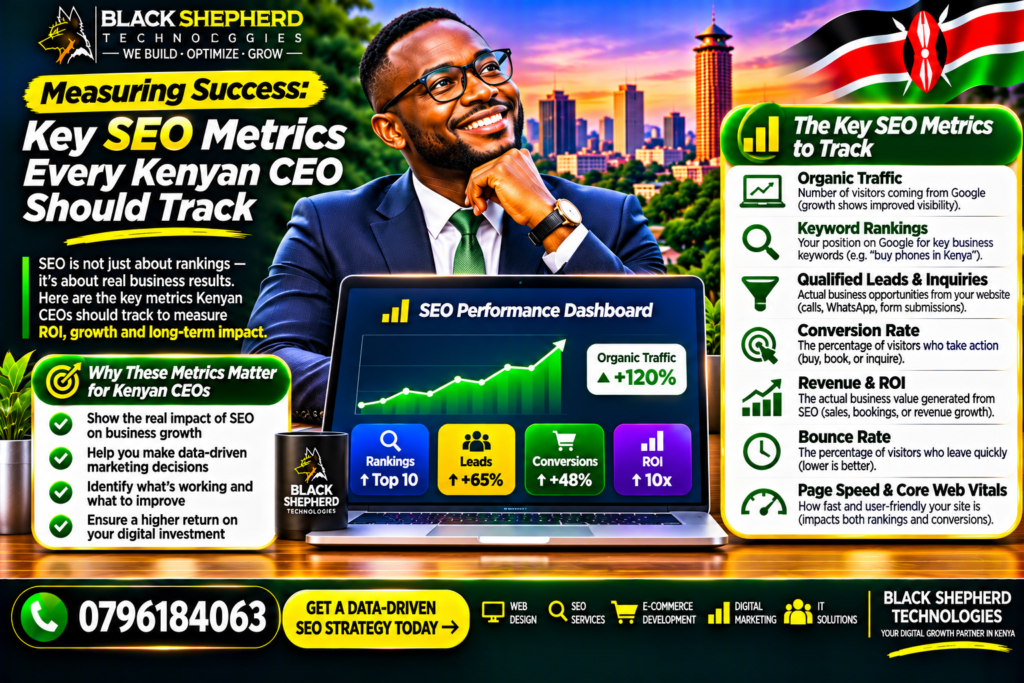
If you are investing company capital into Search Engine Optimization (SEO), you shouldn’t need a degree in data science to know if it’s working. While marketing teams track dozens of granular technical indicators, a CEO needs a clean, high-level dashboard focused purely on business growth, revenue generation, and asset appreciation.
This guide outlines the essential SEO metrics every Kenyan CEO should track to measure true return on investment and hold digital partners accountable.
1. Organic Revenue & Pipeline Contribution (The Ultimate Metric)
Too many businesses measure SEO success solely by raw traffic volume or keyword rankings. However, traffic doesn’t pay salaries—revenue does.
As a CEO, your primary focus should be on how many qualified leads, inquiries, and direct sales originate from organic search traffic.
-
What to Track: Total revenue generated from organic search channels versus paid and social channels, tracked via Google Analytics 4 (GA4) attribution models.
-
Why It Matters: If your organic traffic is doubling but your sales remain flat, your keyword strategy is attracting the wrong audience (window shoppers or students instead of B2B decision-makers and high-intent buyers). True SEO success aligns directly with pipeline growth.
2. Organic Cost Per Acquisition (CPA) vs. Paid Ads
In Kenya’s competitive digital landscape, paid advertising costs on Meta and Google PPC are rising steadily. Every click costs money, squeezing profit margins.
SEO, by contrast, operates on an appreciating asset model. Once your pages rank at the top of Google, the marginal cost of acquiring a new customer drops dramatically.
-
What to Track: The blended cost of acquiring a paying customer through organic search compared to paid media campaigns.
-
Why It Matters: Calculating Organic CPA helps you visualize long-term financial efficiency. As your organic authority compounds over 6 to 12 months, your overall Customer Acquisition Cost should decrease significantly, freeing up capital to scale other areas of your business.
3. Commercial Keyword Rankings (Focusing on Bottom-of-Funnel)
Ranking #1 for a broad, vague vanity term like “software Kenya” or “best office Nairobi” might look impressive in a slide deck, but it rarely converts into business. A CEO should care about commercial, high-intent keywords that capture buyers at the final stage of the decision-making process.
-
What to Track: Movement and visibility of specific bottom-of-funnel (BoFu) keywords tied directly to your core revenue-generating services or products (e.g., “automated payroll and KRA tax software” or “enterprise cloud migration services Nairobi”).
-
Why It Matters: Tracking high-intent keyword positions tells you whether your brand is winning market share against key competitors in your specific industry.
4. Organic Conversion Rate (CRO)
Traffic without conversion is a vanity metric. If 10,000 people visit your website every month from Google but none of them fill out a contact form, call your sales team, or complete an online purchase, your digital architecture is leaking potential revenue.
-
What to Track: The percentage of organic search visitors who complete a high-value action (form submission, newsletter signup, WhatsApp click-to-chat, or direct checkout).
-
Why It Matters: A healthy SEO campaign doesn’t just drive traffic; it collaborates with your website’s user experience (UX) and conversion design to turn searchers into paying clients. Monitoring this metric ensures your site is actively working for you 24/7.
5. Non-Brand Organic Traffic Growth
When analyzing traffic reports, it is vital to separate Brand Traffic (people searching for your company name directly, like “Black Shepherd SEO” because they already know you) from Non-Brand Traffic (people searching for your products or solutions without knowing your brand yet).
-
What to Track: Month-over-month growth in unique visitors arriving via unbranded search queries.
-
Why It Matters: Growth in non-brand organic traffic is the truest indicator that your SEO strategy is successfully capturing new markets, expanding your footprint, and reaching prospective clients who would have otherwise found your competitors.
Executive Summary Dashboard for Kenyan CEOs
To keep things actionable during quarterly board reviews, your digital marketing team should present a concise executive summary built around these four core questions:
+------------------------------------------------------------+
|             THE CEO'S SEO SCORECARD                        |
+------------------------------------------------------------+
|  1. Revenue Growth: How much revenue did organic search    |
|     drive this quarter compared to last quarter?           |
|  2. Acquisition Efficiency: Is our organic Customer        |
|     Acquisition Cost (CPA) dropping relative to paid ads?  |
|  3. Market Share: Are we ranking for our top 10 core       |
|     commercial, high-intent keywords?                      |
|  4. Conversion Health: Are organic visitors turning into   |
|     qualified leads and paying customers?                  |
+------------------------------------------------------------+
When tracked correctly, SEO transforms from an unpredictable marketing expense into a predictable, high-yielding revenue engine that drives sustainable long-term growth across Kenya and the wider East African market.