
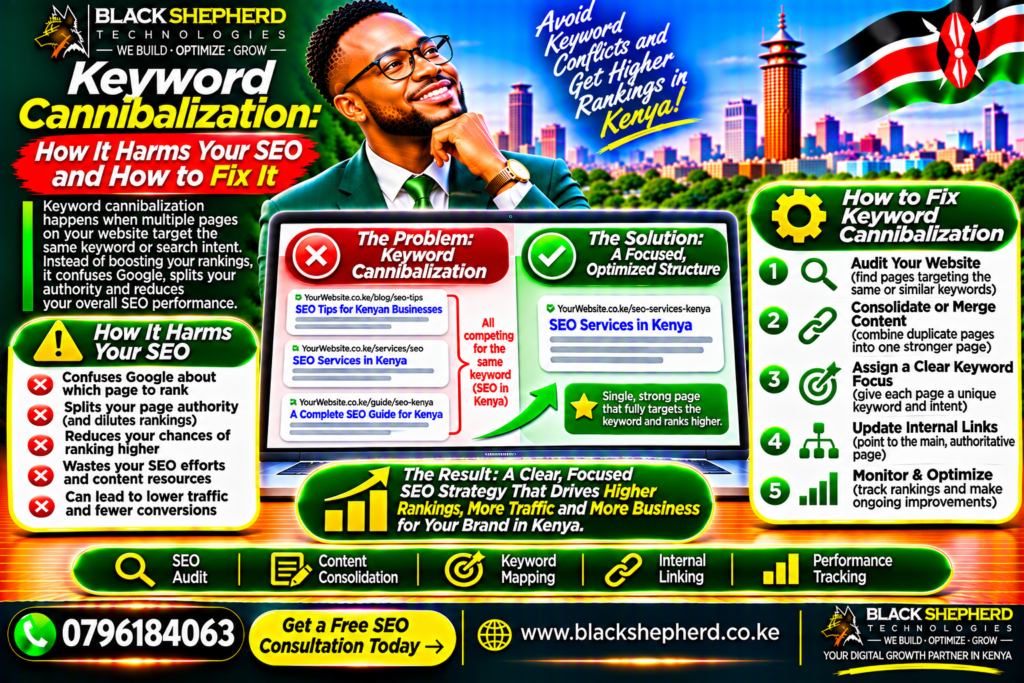
Imagine walking into a massive, multi-story retail store where three different sales representatives run up to you, shouting contradictory advice about the exact same product. One tells you to buy version A, another pushes version B, and a third claims neither is good and points you toward a shelf across the room. Confused and overwhelmed, you walk out without buying anything.
This exact scenario happens on websites every single day through a silent, insidious SEO killer known as keyword cannibalization.
For business owners, digital marketers, and content creators scaling their online presence, building a library of content feels like an achievement. More pages should mean more traffic, right? Not always. When your own pages start competing against each other for the exact same search engine real estate, you aren’t expanding your reach—you are splitting your strength.
In this comprehensive guide, we will unpack what keyword cannibalization is, why it occurs, how it sabotages your search visibility, and the step-by-step strategies you can use to fix it permanently. Along the way, we will also explore how working with professionals who offer specialized seo services kenya can help you streamline your architecture and dominate search engine results pages (SERPs).
What is Keyword Cannibalization?
Keyword cannibalization occurs when multiple pages on the same website target the exact same core keyword or variations with identical search intent, causing them to compete against each other in search engine results.
Instead of Google selecting your strongest page and ranking it at the top, the search engine gets confused. It bounces back and forth between your URLs, splits your link equity, divides your click-through rate (CTR), and ultimately drags down the rankings of all competing pages.
An Example from the Real World
Suppose you run a digital agency and publish two blog posts over a year:
-
“How to Choose the Best Web Designer & SEO Services in Nairobi” (Published in 2024)
-
“Top Web Design and SEO Services Nairobi Guide” (Published in 2025)
Both articles target the primary keyword: “SEO services in Nairobi”.
Because both pieces cover overlapping topics and use similar headings, Google crawls them and thinks: “Which of these pages is the ultimate authority for this user query?” Instead of ranking either page in the top 3, Google fluctuates them between positions 12 and 25, frequently swapping them out week by week. Users land on fragmented content, and your conversion rates plummet.
Why Keyword Cannibalization Happens (The Root Causes)
Keyword cannibalization is rarely intentional. It doesn’t stem from malicious optimization; rather, it is a byproduct of organic growth, scaling content pipelines, and organizational blind spots.
+-------------------------------------------------------------+
|               COMMON CAUSES OF CANNIBALIZATION              |
+-------------------------------------------------------------+
|  • Rapid, unmapped content creation                         |
|  • Evolving product and service taxonomies                  |
|  • Seasonal content duplication ("...-2024" vs "...-2025")   |
|  • Inconsistent internal linking & anchor text distribution |
|  • Blog posts competing directly with commercial pages       |
+-------------------------------------------------------------+
1. Rapid, Unmapped Content Creation
When a marketing team writes articles for months or years without maintaining a centralized content map or keyword matrix, writers naturally circle back to core topics. If a writer doesn’t check what the site has already published, they will write a new post covering the same ground.
2. Evolving Product and Service Structures
Businesses often create new landing pages as they expand their offerings without retiring or redirecting old ones. If an e-commerce platform or service agency lists similar offerings across multiple sub-folders or legacy portfolio items, those pages inevitably collide. Reviewing active case studies via a dedicated portifolios projects page helps ensure your project showcases remain distinct from your core informational or transactional service hubs.
3. Seasonal or Year-Based Content Duplication
A common trap for publishers is updating yearly posts by creating brand-new URLs instead of refreshing the original page. Creating /best-seo-services-2024/ and then publishing /best-seo-services-2025/ forces two nearly identical URLs to fight for the same term.
4. Poor Internal Linking Practices
If you link to different pages across your website using the exact same anchor text (e.g., pointing ten different articles to ten different service sub-pages using the phrase “SEO services”), you send mixed signals to search engine crawlers about which page deserves to rank.
5. Blog Posts Competing with Core Service Pages
Informational blog posts frequently outrank commercial landing pages if the blog is deeper or richer in content. Unfortunately, a blog post answering “What are SEO services?” rarely converts as well as a dedicated commercial landing page built to close clients across various industries we serve.
How Keyword Cannibalization Harms Your SEO Performance
Many site owners ask: “If two of my pages are in the top 20, isn’t that twice the real estate?”
In short: No. Google’s algorithms are designed to diversify search results. With rare exceptions for massive authority domains, Google generally limits the number of results from a single domain per search query. Here is how cannibalization actively harms your performance:
1. Dilution of Backlinks and Authority (PageRank)
Backlinks are the currency of the web. If you earn 10 powerful backlinks to Page A and 10 to Page B, but both pages target the exact same keyword, you split your site’s authority. If those 20 links pointed to a single URL, that unified page would likely possess enough authority to break into the top 3.
2. Wasted Crawl Budget
Search engine bots allocate a finite amount of “crawl budget” to explore your website. If bots waste time crawling multiple redundant, cannibalizing pages, they spend less time discovering newly published or updated content.
3. Destruction of Conversion Rates and User Experience (UX)
When a user clicks a search result and lands on a shallow or repetitive page, they bounce back to the search results to find a better answer. High bounce rates, low dwell times, and poor click-through rates (CTRs) send negative behavioral signals to search engines.
4. Ranking Volatility (The “Rank Swapping” Phenomenon)
If you track your rankings, you might notice a frustrating pattern: your primary page ranks #11 one week, drops to #30 the next, while a secondary page jumps up to #14. This volatility occurs because Google’s algorithm cannot decide which URL satisfies the search intent, leading to erratic ranking behavior.
How to Detect Keyword Cannibalization on Your Website
Finding cannibalization issues requires auditing your index footprint and performance metrics. You can uncover these issues using three primary methods:
Method 1: The Quick Google Site Search
You can perform a manual query directly in Google to see every page on your domain targeting a specific phrase:
site:yourdomain.com "target keyword"
If Google returns multiple pages where the titles and meta descriptions look like they are answering the exact same user intent, you have likely found a cannibalization cluster.
Method 2: Google Search Console (GSC) Performance Audit
Google Search Console is your most powerful free diagnostic tool:
-
Navigate to Performance > Search Results.
-
Click + New and filter by Query. Type in your target keyword.
-
Once the query filter is applied, click over to the Pages tab.
-
Look at the list of URLs receiving impressions and clicks for that single query. If you see two or more URLs accumulating impressions for the exact same query, those pages are competing against each other.
Method 3: Automated SEO Auditing Tools
Enterprise suites like Semrush, SE Ranking, or Ahrefs offer dedicated cannibalization reports. These tools scan your keyword tracking data and flag instances where multiple URLs from your domain rank for the same keyword simultaneously, saving you dozens of hours of manual spreadsheet work.
5 Proven Strategies to Fix Keyword Cannibalization
Once you identify competing pages, you must resolve the conflict. The principle behind every fix is simple: Choose one primary (“winning”) URL for the target keyword, and clarify its dominance to search engines.
+-------------------------------------------------------------+
|                 CANNIBALIZATION FIX MATRIX                  |
+-------------------------------------------------------------+
|  1. Content Consolidation & Merging  (Best for overlap)     |
|  2. 301 Redirects                    (Best for duplicates)  |
|  3. Canonical Tags                   (Best for parity)      |
|  4. Intent Differentiation / Retargeting (Best for angles)  |
|  5. Internal Link Restructuring      (Best for anchor flow) |
+-------------------------------------------------------------+
1. Content Consolidation (The Merge)
If you have two or more articles or landing pages that cover roughly the same topic with mediocre performance, merge them:
-
Identify the URL with the strongest backlink profile, traffic history, and ranking position.
-
Take any unique, valuable insights, statistics, or sections from the weaker page and integrate them into the primary page.
-
Publish the comprehensive, upgraded master page.
2. Implement Permanent 301 Redirects
After consolidating content (or if you have a duplicate page that serves no unique purpose), delete the weaker URL and set up a 301 redirect pointing from the old URL to your primary winning page. This passes link equity (link juice) to the master page and ensures users and crawlers land in the right spot automatically.
3. Use Canonical Tags
If you need to keep both pages accessible for user experience reasons (such as a primary service page and a specialized landing page that share similar boilerplate text or offerings), use a canonical tag (rel="canonical"). This tells search engines: “Both pages are valid, but please credit all ranking power and index preference to this specific master URL”.
4. Intent Differentiation and Retargeting
If both pages are valuable and you don’t want to delete either, you must differentiate their search intent:
-
Shift the focus of the secondary page toward a distinct subtopic, long-tail variation, or different stage of the marketing funnel.
-
Rewrite title tags, H1 headers, and introductory text to clearly target a different angle. For example, shift a broad article toward a niche breakdown tailored specifically for a distinct audience segment or vertical.
5. Restructure Your Internal Linking
Audit the internal links pointing to your competing pages. Ensure that all contextual links across your site point exclusively to your designated primary page, using consistent, descriptive anchor text. Stop linking to the secondary, weaker pages for that core keyword phrase.
Preventing Future Cannibalization: Best Practices
Fixing existing issues is only half the battle. To ensure keyword cannibalization doesn’t creep back into your digital ecosystem, follow these preventive frameworks:
-
Maintain a Living Keyword Map: Keep an up-to-date master spreadsheet or SEO software database. Every single page, blog post, and landing page on your domain must be mapped to one primary keyword and a unique search intent.
-
Mandatory Pre-Publishing Checks: Before writing a new piece of content, run a quick site search (
site:yourdomain.com "topic keyword") to verify whether you have already addressed the topic. -
Audit Content Regularly: Schedule quarterly or bi-annual content audits to catch minor keyword overlaps before they spiral into ranking drops.
Conclusion
Keyword cannibalization is an invisible brake holding back your website’s true organic potential. When your pages compete against each other, you waste valuable link equity, confuse search engines, and frustrate prospective clients.
By auditing your content, consolidating overlapping pages, implementing clean redirects, and enforcing strict keyword mapping, you clear the path for your best pages to rise to the top of search results.
Whether you are managing a growing content library or scaling a commercial web presence, maintaining a clean site architecture is essential for long-term growth. If you want expert assistance structuring your architecture, optimizing your organic visibility, or building robust technical campaigns, consider partnering with professionals who specialize in scaling digital visibility.