
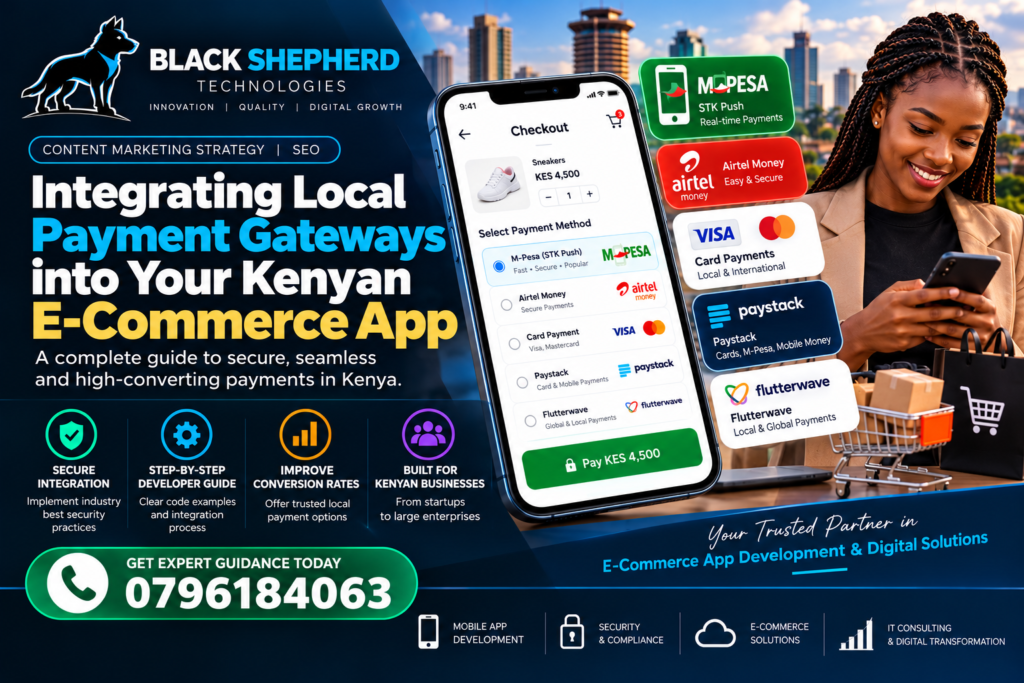
Integrating Local Payment Gateways into Your Kenyan E-Commerce App: The Ultimate Technical and Strategic Guide
In the dynamic and fast-evolving landscape of digital commerce across East Africa, the checkout page is the ultimate moment of truth. You can spend months crafting a breathtaking user interface, optimizing your mobile responsiveness, and driving thousands of targeted visitors to your digital storefront through rigorous search engine optimization. However, if your customer reaches the final checkout step and encounters a sluggish payment gateway, a confusing currency conversion, or an unfamiliar transaction prompt, they will abandon their cart instantly. In e-commerce, cart abandonment is the silent killer of revenue.
For online retail platforms, multi-vendor marketplaces, and direct-to-consumer digital brands operating in Kenya, payment integration is not merely a technical checkbox—it is the core heartbeat of your entire business model. Unlike Western markets where credit and debit cards dominate, the East African digital economy runs on mobile money. Safaricom’s M-Pesa commands an overwhelming majority of the market share, complemented by card processing rails, alternative mobile wallets like Airtel Money, and aggregator platforms such as Pesapal, IntaSend, and JamboPay.
Building a high-converting e-commerce application requires deep technical expertise, robust API integration architecture, flawless security protocols, and an intimate understanding of local consumer trust dynamics. At Black Shepherd Technologies, we engineer high-performance e-commerce platforms, web applications, and mobile solutions optimized specifically for the Kenyan economic ecosystem. If you are scaling your digital infrastructure or require enterprise-grade engineering, explore our professional engineering portfolio and projects (https://blackshepherd.co.ke/portifolios-projects/) to see our work in action.
In this exhaustive, 3,000-word developer and strategist guide, we will break down the end-to-end process of integrating local payment gateways into your Kenyan e-commerce application, covering architecture, security, M-Pesa Daraja APIs, card aggregators, error handling, and conversion rate optimization.
-
The Kenyan E-Commerce Payment Ecosystem: Why Localization Matters
To understand why generic, out-of-the-box international checkout plugins (such as default US-centric PayPal or Stripe integrations) often fail in Kenya, you must first examine how Kenyan consumers buy goods online.
The Death of Friction: Mobile Money Supremacy
In Kenya, mobile money is deeply woven into the fabric of daily life. Consumers pay for matatu fares, utility bills, supermarket groceries, and school fees using their mobile phones. When shopping online, a Kenyan shopper expects a seamless, familiar experience:
-
They select a product and proceed to checkout.
-
They enter their mobile phone number (formatted as 07XXXXXXXX or 01XXXXXXXX).
-
An instant USSD push prompt appears on their screen asking them to authorize payment with their M-Pesa PIN.
-
Within five seconds, the transaction is confirmed, and the e-commerce backend instantly updates the order status to Paid and dispatches a fulfillment notification.
Any payment flow that forces the user to log into an external web wallet, enter a 16-digit credit card number, pass 3D Secure verification codes, or wait for delayed email confirmations introduces massive friction. High friction equals high cart abandonment.
The Hybrid Reality: Cards, Mobile Money, and Diaspora Buyers
While mobile money reigns supreme for domestic retail, modern Kenyan e-commerce platforms must cater to a diverse buyer demographic:
-
Local Retail Shoppers: Rely exclusively on M-Pesa STK Push and mobile wallet transfers.
-
Corporate and B2B Buyers: Often prefer direct Bank EFT/RTGS transfers or corporate credit cards.
-
Diaspora Shoppers: Kenyans living abroad purchasing gifts, real estate, or retail goods for family back home frequently rely on international Visa and Mastercard debit/credit cards.
Therefore, a successful e-commerce app cannot rely on a single payment method. It requires a unified, multi-gateway architecture that intelligently routes payment requests based on user preference and transaction type.
Whether you operate in retail, fashion, electronics, B2B wholesale, or specialized service sectors, tailoring your digital checkout infrastructure to your target audience is paramount. Explore our specialized industries we serve (https://blackshepherd.co.ke/best-web-designer-seo-services-in-nairobi-kenya/industries-we-serve/) page to see how we build bespoke checkout workflows tailored to diverse commercial sectors.
-
Core Payment Integration Options in Kenya
When architecting your e-commerce application, you must choose between integrating direct carrier/bank APIs or utilizing unified payment aggregators. Each approach comes with distinct architectural trade-offs.
A. Direct Integration: Safaricom Daraja API (Lipa Na M-Pesa Online / STK Push)
Integrating directly with Safaricom’s Daraja API gives you absolute control over the payment experience without paying middleman aggregator commissions.
-
Pros: Lower transaction overhead costs, direct relationship with Safaricom, highly customizable backend webhook logic.
-
Cons: Requires rigorous development effort to set up OAuth authentication tokens, timestamp generation, password encryption, C2B validation/confirmation URLs, and B2C payout automation.
B. Payment Aggregators: Pesapal, IntaSend, DPO Group, and Flutterwave
Payment aggregators act as master-merchant bridges that bundle multiple payment channels—including M-Pesa, Airtel Money, Visa, Mastercard, and American Express—into a single, unified SDK and API suite.
-
Pros: Rapid integration (often taking hours instead of weeks), single dashboard for reconciling mobile money and card transactions, built-in fraud detection, and pre-built checkout UI components for WordPress/WooCommerce, Shopify, and custom Node.js/PHP stacks.
-
Cons: Slightly higher transaction fees per checkout compared to direct shortcode implementations.
For growing e-commerce startups, aggregators offer the fastest time-to-market. For enterprise-grade platforms processing massive transaction volumes, hybrid models combining direct M-Pesa shortcodes with aggregator card fallbacks are often optimal.
-
Step-by-Step Technical Implementation: M-Pesa STK Push Integration
Let us examine the technical workflow for integrating Lipa Na M-Pesa Online (STK Push) into a custom e-commerce backend architecture.
Architecture Overview
-
Frontend Checkout Form: Collects the user’s phone number, shipping address, and cart total, then sends an HTTP request to your e-commerce backend server.
-
Backend Authentication: Your server requests a Bearer token from Safaricom’s OAuth endpoint using your Consumer Key and Secret.
-
Password Generation: Your server dynamically generates a timestamp and encodes your Shortcode, Passkey, and Timestamp into a Base64 string.
-
STK Push Request: Your server forwards the payment payload to Safaricom’s process request endpoint.
-
Asynchronous Webhook Callback: Safaricom sends a JSON payload to your server’s callback URL once the user enters their PIN or cancels the prompt. Your backend updates the order database in real-time.
-
Handling Webhooks and Instant Order Reconciliation
One of the most critical engineering failures in poorly built e-commerce stores is relying on synchronous frontend responses to confirm payments. Because mobile network latency and USSD session timeouts can occur, your application must rely on asynchronous backend webhooks.
The Webhook Listener Endpoint
When a customer authorizes an M-Pesa payment, Safaricom’s servers post the transaction result to your registered CallBackURL. Your backend must validate this payload, extract the unique M-Pesa receipt number, and update your database instantly.
-
Integrating Card and Multi-Currency Aggregators (Pesapal / IntaSend)
While M-Pesa handles domestic transactions effortlessly, capturing international sales or catering to local corporate clients requires robust card processing. Here is how to integrate an aggregator like Pesapal or IntaSend into your e-commerce checkout flow.
Step-by-Step Aggregator Flow
-
Order Initialization: When the user clicks Checkout with Card or M-Pesa, your backend sends an API request to the aggregator containing the order amount, currency, customer email, phone number, and callback URLs.
-
Redirect or Iframe Generation: The aggregator returns a secure payment URL or iframe token, redirecting the user to a secure hosted checkout page.
-
Multi-Channel Payment: The customer chooses whether to pay via Visa card, Mastercard, M-Pesa, Airtel Money, or PayPal on the aggregator’s secure interface.
-
IPN (Instant Payment Notification): Once payment settles, the aggregator fires an IPN to your server, confirming the transaction and passing encrypted parameter signatures to prevent tampering.
-
Overcoming Common E-Commerce Checkout Pitfalls in Kenya
Even with a fully integrated payment gateway, subtle user experience or architectural flaws can wreck your conversion rates. Avoid these frequent mistakes:
-
Inadequate Mobile ResponsivenessOver 85% of e-commerce traffic in Kenya originates from mobile devices running Android and iOS. If your checkout form requires pinching, zooming, or awkward horizontal scrolling, users will abandon your store within seconds. Ensure your checkout UI features large, thumb-friendly buttons, numeric keypads for phone number inputs, and clean spacing.
-
Missing Offline State and Error RecoveryIf a user’s internet drops momentarily while initiating an STK push, your app must not crash. Implement polite loading states with clear instructions instructing them to check their phone for the prompt, accompanied by a manual Check Payment Status button for quick recovery.
-
Lack of Transparent Pricing and Hidden FeesSurprising customers with unexpected delivery fees or transaction surcharges at the very last step of checkout is the number one cause of cart abandonment. Disclose all shipping costs and taxes upfront on the product page or cart summary.
-
Scaling Your E-Commerce Store with Enterprise SEO
Integrating a world-class payment gateway ensures that when visitors arrive ready to buy, they convert seamlessly. However, filling your sales funnel requires steady, high-intent organic traffic.
If potential customers searching for your products online cannot find your e-commerce store on Google, your competitors will capture that market share. Implementing rigorous technical SEO, structured product schema markup, local keyword targeting, and high-performance site architecture is essential. Partnering with professionals providing expert SEO services in Kenya (https://blackshepherd.co.ke/kenya/seo-services-kenya) is the most sustainable way to drive high-value shoppers directly to your digital storefront.
Conclusion: Building the Future of Kenyan Digital Commerce
Integrating local payment gateways into your Kenyan e-commerce application is the decisive factor separating struggling online stores from dominant market leaders. By combining frictionless M-Pesa STK push workflows, robust backend webhook reconciliation, secure card aggregators, and lightning-fast mobile UX, you create a frictionless shopping experience that builds instant consumer trust.
At Black Shepherd Technologies, we empower businesses across East Africa with custom software engineering, bulletproof payment integrations, and high-performance digital platforms. Get in touch with our engineering team today, and let’s build an e-commerce platform engineered for explosive growth and seamless transactions.
