For many businesses, a website is still viewed as a static digital brochure—an online business card containing a company history, a list of generic services, and a basic contact form. In today’s competitive digital economy, this passive approach results in wasted traffic, high bounce rates, and stagnant growth. A modern website should not just exist; it must actively work as a relentless, 24/7 revenue engine.
Top-tier web agencies approach digital architecture entirely differently. They do not build websites based purely on subjective aesthetics. Instead, they engineer high-performance platforms rooted in user psychology, rigorous technical speed, semantic on-page SEO, and seamless conversion architecture.
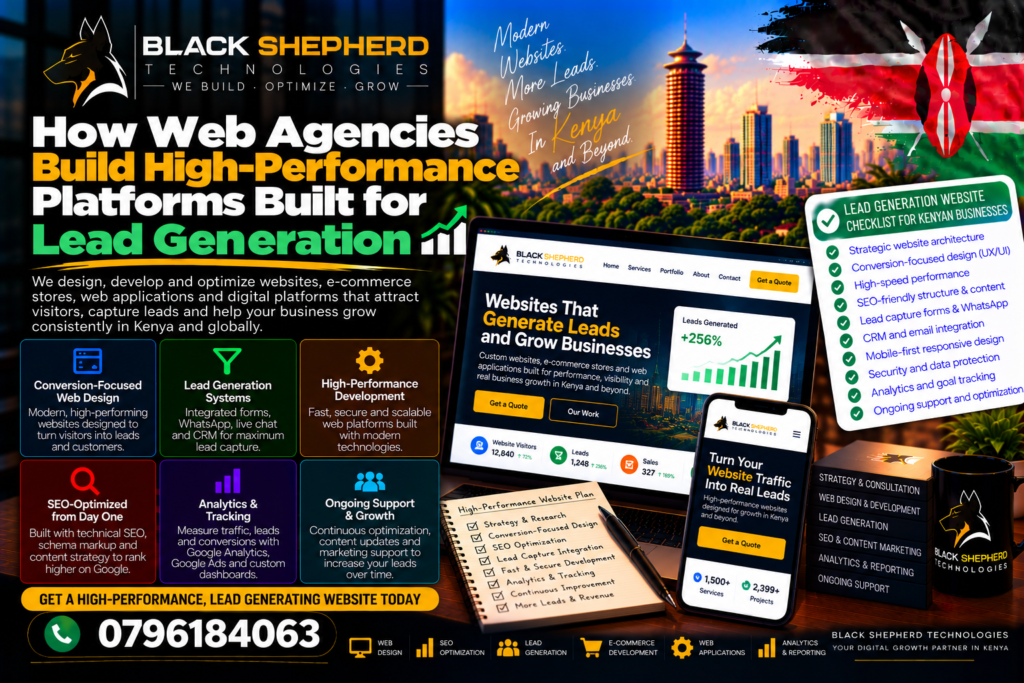
In this comprehensive guide, we will explore the precise frameworks, technical protocols, and strategic workflows web agencies use to build high-performance platforms built specifically for lead generation.
1. Strategic Discovery and User Journey Mapping
Before a single line of code is written or a design layout is sketched in Figma, top agencies conduct deep discovery phases. Building a lead generation platform requires understanding exactly who the target audience is and what psychological barriers prevent them from converting.
-
Defining the Ideal Customer Profile (ICP): Agencies map out precise user personas, identifying their specific pain points, objections, search behaviors, and preferred communication channels.
-
Funnel Architecture and Pathing: Every page on the platform is assigned a specific role within the sales funnel—whether it is capturing top-of-funnel awareness via educational content, nurturing mid-funnel consideration through case studies, or closing bottom-of-funnel transactions with high-contrast conversion forms.
-
Reducing Friction Points: Agencies map out the shortest, most intuitive path from initial landing to final form submission, eliminating unnecessary clicks and cognitive roadblocks.
2. Mobile-First Engineering and Technical Speed
A stunning design and persuasive copy are useless if a prospective lead abandons your site before it finishes loading. Elite web agencies prioritize technical performance and mobile optimization from day one.
-
Mobile-First UX Architecture: With the vast majority of web traffic originating on mobile devices, agencies design for thumb-driven navigation. Primary calls-to-action (CTAs) are anchored within natural thumb zones, and touch targets meet strict accessibility standards (minimum 48×48 pixels).
-
Core Web Vitals Compliance: Agencies optimize codebases to pass Google’s Core Web Vitals thresholds effortlessly:
-
Largest Contentful Paint (LCP): Ensuring main visual elements load under 2.5 seconds.
-
Interaction to Next Paint (INP): Guaranteeing instant responsiveness to clicks and taps under 200 milliseconds.
-
Cumulative Layout Shift (CLS): Locking layout dimensions to prevent jarring visual shifts during asset loading.
-
-
Lightweight Asset Pipelines: Utilizing next-generation image formats (WebP and AVIF), server-side compression, and high-performance Content Delivery Networks (CDNs) to ensure lightning-fast load times even on fluctuating mobile data connections.
3. Conversion-Centric UI/UX Design and Visual Hierarchy
Design in a lead generation platform is an intentional tool for guiding human attention and building immediate trust.
-
Ruthless Visual Hierarchy: Using typography scales, contrasting color palettes, and strategic whitespace to guide the user’s eye from the headline hook down to supporting proof and squarely onto a high-contrast CTA button.
-
Establishing Instant Credibility: Integrating social proof elements—such as verified client testimonials, case study metrics, industry trust badges, and partner logos—directly into the primary user flow to eliminate buyer skepticism.
-
Contextual CTAs: Replacing generic, low-converting buttons like “Submit” or “Click Here” with action-oriented, value-driven micro-copy (e.g., “Get Your Free Growth Audit” or “Book a Strategy Session”).
4. Seamless Integrations: CRM, Analytics, and Local Workflows
A lead generation platform cannot operate as an isolated island. It must integrate smoothly with an enterprise’s broader operational technology stack.
-
CRM and Marketing Automation Sync: Agencies integrate platforms directly with Customer Relationship Management systems (such as HubSpot, Salesforce, or ActiveCampaign). When a user submits a form, lead data flows instantly into sales pipelines, triggering automated welcome emails and internal notifications.
-
Advanced Event Tracking and Analytics: Implementing robust tracking via Google Analytics 4 (GA4) and tag managers to monitor micro-conversions, scroll depth, form interaction rates, and button clicks.
-
Localized Payment and Communication Tools: For regional markets—such as integrating mobile-money checkout triggers (like M-Pesa STK push widgets) or embedding instant messaging tools like WhatsApp Business chat widgets to facilitate conversational commerce.
5. Technical SEO and Semantic Content Architecture
A high-performance platform must attract qualified traffic before it can convert it. Web agencies build SEO into the foundational architecture of the site.
-
Semantic HTML Markup: Using clean, structured HTML tags (
<article>,<section>,<h1>to<h6>) so search engine crawlers can easily parse topical authority and index pages correctly. -
Optimized Information Architecture: Structuring URL hierarchies, category taxonomies, and internal linking paths so that link equity flows smoothly from high-traffic educational pages to high-converting service landing pages.
-
Schema Markup Integration: Embedding structured data (Organization, LocalBusiness, Service, and Review schemas) to help search engines display rich snippets, enhancing click-through rates on search results pages.
Comparative Analysis: Basic Website vs. High-Performance Lead Generation Platform
Conclusion: Engineering Predictable Growth
Building a platform built for lead generation is a meticulous discipline that leaves nothing to chance. By uniting strategic discovery, mobile-first technical speed, conversion-centric UI/UX design, robust CRM integrations, and semantic on-page SEO, professional web agencies transform websites from passive digital brochures into predictable, high-performing revenue engines.