
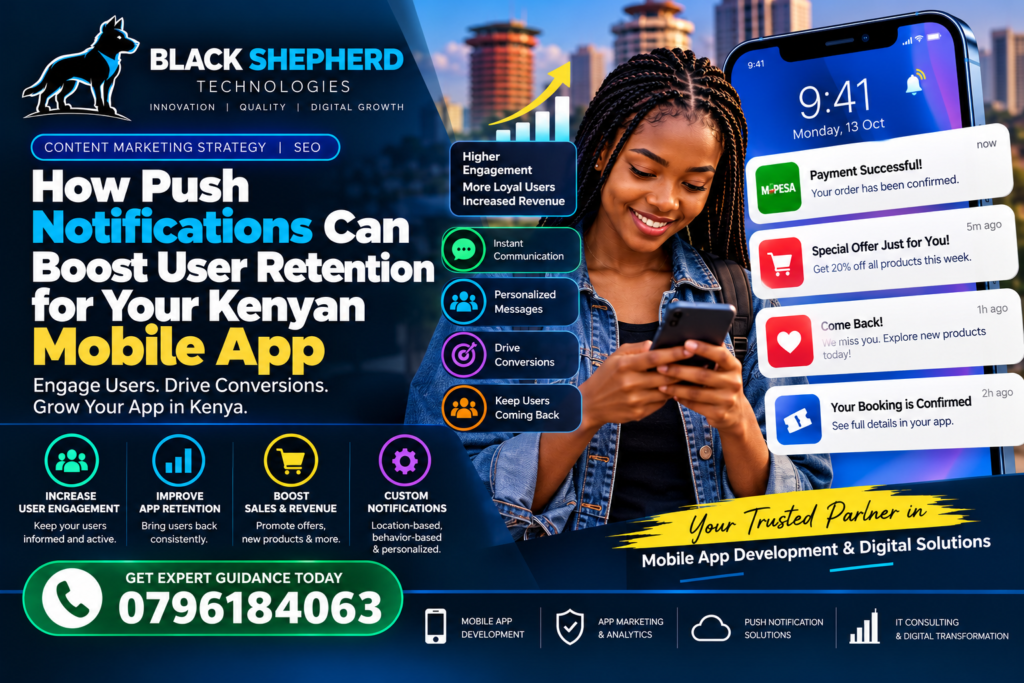
In the rapidly expanding mobile application ecosystem of East Africa, acquiring a new user download is only the prologue to the real business challenge. With thousands of competing applications vying for space on the home screens of smartphone users in Nairobi, Mombasa, Kisumu, and Nakuru, the initial excitement of a new install frequently fades within days. Industry benchmarks consistently reveal a sobering reality: over 75% of users who download a mobile application abandon it within the first week never to return, unless proactive, intelligent re-engagement strategies are deployed.
For businesses operating in Kenya—spanning fintech utilities, e-commerce marketplaces, logistics platforms, educational portals, and on-demand service apps—user retention is the ultimate metric of sustainable growth. You can invest heavily in digital advertising, social media campaigns, and search engine optimization, but if your users churn out after a single session, your customer acquisition cost quickly eclipses your lifetime customer value.
One of the most potent, cost-effective, and direct channels for combating app abandonment and driving long-term retention is the strategic use of push notifications. When executed with precision, personalization, and respect for user attention, push notifications act as a direct lifeline between your brand and your customer’s pocket. However, in an era where users are bombarded by automated alerts from messaging apps, banking services, and news outlets, poorly timed or spammy push notifications will trigger immediate app uninstalls.
Mastering the art and science of push notification architecture requires an intimate understanding of local consumer psychology, behavioral timing, data-driven segmentation, and seamless technical integration. At Black Shepherd Technologies, we engineer high-performance mobile applications and digital platforms tailored specifically for the East African economic ecosystem. If you are scaling your digital infrastructure or require expert custom engineering, explore our professional engineering portfolio and projects (https://blackshepherd.co.ke/portifolios-projects/) to see our work in action.
In this exhaustive, 3,000-word guide, we will break down the end-to-end strategies, technical frameworks, behavioral psychology principles, and localization tactics required to leverage push notifications to skyrocket user retention for your Kenyan mobile app.
-
The User Retention Crisis in East African Mobile Apps
To understand why push notifications are indispensable, we must first analyze why users abandon mobile applications in the Kenyan market and how retention curves behave over time.
The 7-Day Churn Cliff
When a user downloads an app from the Google Play Store or Apple App Store, their intent is high. However, friction during onboarding, lack of immediate utility, or simply forgetting that the app exists leads to a dramatic drop-off in activity between day one and day seven. By day thirty, organic retention for un-optimized apps often plummets below 5%.
The Kenyan Context: Attention and Data Sensitivity
Kenyan smartphone users are discerning and pragmatic. They manage limited phone storage, carefully monitor their mobile data bundles, and maintain high standards for digital utility. An app that sends irrelevant, noisy alerts will be silenced or uninstalled without hesitation. Conversely, an app that sends timely, high-value reminders—such as a delivery update, a flash sale alert, an M-Pesa transaction confirmation, or a personalized study reminder—becomes an indispensable daily habit.
Whether your mobile app serves retail shoppers, logistics dispatchers, financial borrowers, or enterprise corporate clients, aligning your engagement strategy with your specific audience is critical. Explore our specialized industries we serve (https://blackshepherd.co.ke/best-web-designer-seo-services-in-nairobi-kenya/industries-we-serve/) page to see how we build bespoke engagement workflows tailored to diverse commercial sectors.
-
Understanding Push Notification Architecture and Types
Before crafting your messaging campaigns, you must understand the technical architecture that powers push notifications across Android and iOS platforms, as well as the distinct notification categories available to product managers.
The Technical Infrastructure
Push notifications rely on cloud-to-device messaging services. For Android apps, developers integrate Firebase Cloud Messaging (FCM), while iOS applications utilize Apple Push Notification service (APNs). Your application backend coordinates with these gateway services to dispatch alerts to specific device tokens registered when users log in or grant notification permissions.
The Four Pillars of Push Notification Types
-
Promotional Notifications: Designed to drive conversions, announce flash sales, promote seasonal discounts (such as Madaraka Day or Black Friday offers), or introduce new product features. These must be used sparingly to avoid fatiguing your user base.
-
Transactional Notifications: The golden standard for retention. These are triggered by user actions, such as order confirmations, M-Pesa payment receipts, shipping updates, account security alerts, or password resets. Transactional notifications boast the highest open rates because users actively anticipate them.
-
Behavioral and Triggered Notifications: Automated alerts sent based on specific user actions or inactions within the app. For example, if a user adds items to their e-commerce cart but exits without checking out, a triggered notification after two hours offering free delivery can recover a lost sale.
-
Habit-Forming and Re-engagement Notifications: Designed to bring dormant users back into the app. These include daily streaks, weekly summary reports, personalized content recommendations, or gentle reminders for utility apps.
-
The Psychology of High-Converting Notification Copy
Writing effective push notification copy is an exercise in extreme conciseness and psychological impact. You have less than three seconds to capture a user’s attention while their phone screen lights up.
The Anatomy of a Perfect Push Notification
-
The Hook: A compelling opening word or personalized name that grabs attention instantly.
-
The Value Proposition: Clear articulation of why the user should care or what benefit they gain by tapping the notification.
-
The Call to Action (CTA): A subtle or explicit prompt that encourages immediate action (e.g., Claim Now, Track Order, View Deal).
Personalization Beyond First Names
Simply inserting a user’s first name (“Hi John, check out our new shoes”) is no longer enough; it is table stakes. True behavioral personalization leverages user data, past purchase history, geographic location, and active app sessions.
-
Example for an E-Commerce App: “Hi Mary, your favorite running shoes from Nike are back in stock in Nairobi with free next-day delivery. Tap to claim yours!”
-
Example for a Fintech App: “Hi Brian, your automated savings goal of KES 5,000 for this week is just KES 1,000 away. Tap to top up via M-Pesa.”
Creating Urgency Without Causing Anxiety
Urgency drives action, but manufactured panic causes app uninstalls. Use time-sensitive hooks responsibly:
-
Poor: “URGENT! Open app now or lose your account!”
-
Effective: “Flash Sale Alert: 50% off electronics in Westlands for the next 2 hours only. Tap to shop!”
-
Timing, Frequency Capping, and Localization in Kenya
Timing is everything in mobile engagement. Sending a promotional push notification at 3:00 AM will annoy users and drive uninstalls, while sending a lunch-delivery reminder at 11:30 AM in Nairobi captures peak intent.
Optimizing for the East African Daily Rhythm
Kenyan urban professionals and students experience distinct daily routines influenced by traffic patterns, work schedules, and connectivity cycles:
-
Morning Rush (6:30 AM – 8:30 AM): Users check news, transit apps, and weather updates while commuting on matatus or driving into Nairobi’s CBD.
-
Midday Lull (1:00 PM – 2:00 PM): High engagement windows for food delivery, social media, and quick e-commerce browsing during lunch breaks.
-
Evening Wind-Down (6:30 PM – 9:30 PM): Prime time for relaxed shopping, entertainment streaming, financial budgeting, and catching up on lifestyle apps after arriving home.
The Danger of Notification Fatigue (Frequency Capping)
Nothing destroys user retention faster than notification fatigue. If an app pings a user four times a day with generic promotional spam, the user will either disable notifications entirely in their phone settings or delete the app.
-
Best Practice: Implement strict frequency capping on your backend server. Limit promotional notifications to a maximum of two per week per user, while allowing real-time transactional and security alerts as needed.
Localization and Cultural Nuances
Kenya is a vibrant, culturally rich nation characterized by warmth, humor, and linguistic versatility (including Sheng, Swahili, and English). Tailoring your push notification tone to reflect local culture dramatically boosts engagement.
-
Incorporating local slang or Swahili greetings (“Habari ya leo?”, “Freshi Barida”) creates an instant emotional connection that sterile, corporate messaging cannot replicate.
-
Ensure your pricing is always displayed in Kenyan Shillings (KES) rather than foreign currencies to eliminate cognitive friction.
-
Step-by-Step Strategy to Implement Push Notifications for Retention
To build a robust push notification retention engine, product managers and developers must follow a structured implementation framework.
Step 1: Perfect the Permission Opt-In Prompt
The most critical moment in your push notification lifecycle is the exact second you ask the user for permission to send notifications. If you trigger the native iOS or Android permission prompt immediately upon the user’s very first app launch, over 60% of users will tap “Don’t Allow.” Once denied, reversing that decision requires users to dive deep into their phone settings.
-
Solution: Implement a two-step pre-permission dialog (soft prompt). Explain the tangible value of enabling notifications first (“Enable notifications to track your M-Pesa delivery in real-time and receive exclusive flash sale codes”). Only trigger the native system prompt after the user taps “Turn On Notifications” in your custom in-app modal.
Step 2: Segment Your Audience for Hyper-Relevance
Never broadcast the exact same generic message to your entire user database. Segment your users based on actionable criteria:
-
Activity Status: Active daily users vs. dormant users who haven’t opened the app in 14 days.
-
Purchase Behavior: High-value frequent buyers vs. window shoppers who have never completed a transaction.
-
Geographic Location: Users in Nairobi vs. Mombasa or Kisumu, ensuring location-specific offers are targeted correctly.
Step 3: Automate Behavioral Triggers
Set up automated marketing automation workflows and event-driven triggers on your backend server:
-
Abandoned Cart Triggers: Send a gentle reminder 2 hours after a user leaves items in their shopping cart.
-
Onboarding Drip Campaigns: For new users, send a 3-part educational sequence over their first three days explaining how to navigate the app and complete their first transaction.
-
Milestone Celebrations: Send a celebratory push notification when a user completes their 10th order or reaches a savings milestone.
Step 4: A/B Testing and Continuous Optimization
Never assume you know what copy or timing will perform best. Use A/B testing frameworks to experiment with different headlines, emojis, call-to-action buttons, and delivery times. Track key metrics rigorously:
-
Opt-In Rate: Percentage of users who grant notification permissions.
-
Delivery Rate: Percentage of successfully delivered notifications.
-
Open/Click-Through Rate (CTR): Percentage of recipients who tap the notification.
-
Retention Lift: Measure the 30-day retention rate of users who receive targeted push notifications compared to a control group that does not.
-
Scaling Your Mobile App Growth with Enterprise Expertise
Implementing an advanced push notification and user retention engine requires robust technical architecture, clean database event tracking, and intelligent marketing automation workflows. Whether you are building a new application from scratch or optimizing an existing mobile product, having an experienced engineering partner ensures your infrastructure scales seamlessly.
If your organization requires comprehensive technical architecture, custom mobile app development, or enterprise-grade SEO services in Kenya (https://blackshepherd.co.ke/kenya/seo-services-kenya) to drive high-intent organic downloads to your app store listings, Black Shepherd Technologies is your trusted partner.
Get in touch with our engineering team today to discuss how we can accelerate your digital roadmap, boost user retention, and maximize your mobile app’s commercial ROI.
