Artificial Intelligence and Machine Learning have fundamentally reshaped paid advertising. The era of manual bid adjustments, hyper-fragmented audience targeting, and routine optimization checklists has evolved.
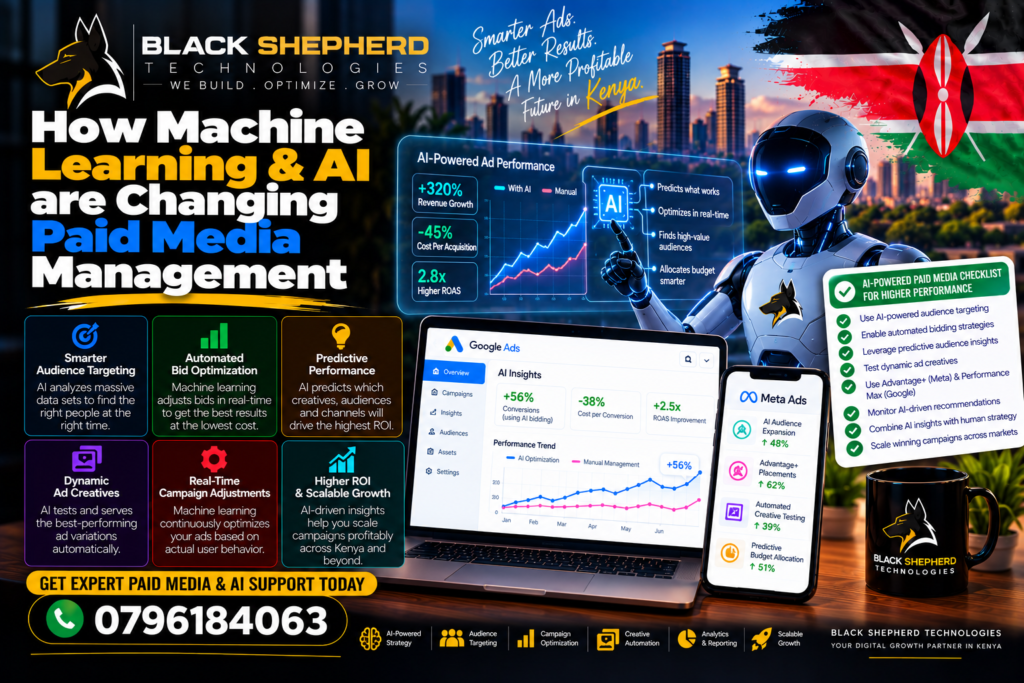
Today, major advertising platforms (Google Ads, Meta Ads, TikTok Ads) rely heavily on automated systems. Success in paid media management is no longer about managing settings within ad accounts; it is about managing inputs, directing creative strategy, and maintaining strict data guardrails.
Below is an overview of how machine learning and AI are changing paid media execution—and what media buyers must focus on to stay competitive.
1. The Death of Manual Targeting: “Creative Is Your Targeting”
Historically, PPC managers spent hours building granular interest groups, hand-picking placement exclusions, and building long keyword lists. Modern machine learning has largely automated these steps.
Traditional Media Management               AI-Driven Paid Media
├── Micro-managed interest ad sets         ├── Broad / Advantage+ / Open Targeting
├── Manual keyword bidding & match types   ├── Broad match + Smart Bidding / PMax / AI Max
└── Manual daily bid tweaks                └── Dynamic Creative optimization & AI asset assembly
-
Broad & Algorithmic Delivery: Tools like Meta’s Advantage+ Shopping Campaigns (ASC) and Google’s Performance Max (PMax) deploy automated algorithms to map user behavior.
-
Creative-Led Audience Match: AI systems analyze visual hooks, video audio, and ad copy in real time. The machine reads the context of your creative and matches it directly to users who are most likely to respond.
2. Real-Time Smart Bidding & Predictive Signals
Manual bidding models (such as Manual CPC) are generally less efficient than automated systems. Modern machine learning systems evaluate thousands of contextual parameters simultaneously during every auction.
-
Auction-Time Signals: Smart Bidding algorithms adjust bids in milliseconds using dynamic real-time parameters—including user device, precise geographic location, local time, browser language, operating system, and historical search or browsing intent.
-
Predictive Lifetime Value (LTV): Advanced AI models go beyond predicting a single form fill or sale. They analyze immediate signals to estimate long-term customer value, enabling Value-Based Bidding (tROAS) that directs ad budgets toward higher-value buyers.
3. Generative AI in Creative Production & Rapid Testing
Producing sufficient creative variations was once a key operational bottleneck. AI content generation tools have shifted creative testing into an automated workflow.
Creative Automation Pipeline
 [ Product URL / Brief ] ──► [ AI Creative Assistant ] ──► [ Dynamic Asset Swaps ]
                                                                   │
 [ Algorithmic Testing Engine ] ◄── [ Multi-Variant Ad Assembly ] ─┘
-
Dynamic Asset Generation: Platforms natively integrate generative models (such as Google’s Gemini integration in Google Ads) to write search headlines, compose description variations, compress images, and automatically adjust video ratios.
-
Creative Fatigue Detection: Predictive models track performance decay across visual ad sets. When an ad shows signs of creative fatigue (such as declining Click-Through Rates or rising Cost Per Acquisition), AI systems automatically adjust delivery and alert teams to introduce new concepts.
4. Cookieless Tracking & Modeled Conversions
With the rise of ad blockers, strict privacy regulations, and third-party tracking limits, data fragmentation presents a persistent challenge. Machine learning bridges these gaps using statistical modeling.
Conversion Recovery Pipeline
 [ Signal Loss / Ad Blockers ] ──► [ Server-Side CAPI / First-Party Data ]
                                                     │
 [ Smart Bidding Optimization ] ◄── [ Machine Learning Conversion Modeling ]
-
Modeled Conversions: When browser tracking is blocked, platform algorithms analyze historical conversion patterns to probabilistically attribute missing sales.
-
First-Party Data Integration: AI tools rely on clean first-party inputs. Uploading Customer Match lists and routing data via Server-Side Tagging (CAPI) gives platform algorithms the structured signals needed to optimize campaign delivery.
5. The Evolving Role of Media Buyers: Strategic Oversight
The transition to automated ad buying does not make human strategists obsolete; it elevates their responsibilities. The role has shifted from executing routine campaign mechanics to managing strategic inputs and system guardrails.
The New Paid Media Checklist
To leverage machine learning effectively, media buyers should focus on four core priorities:
-
Provide High-Signal First-Party Data: Connect CRMs to ad platforms using Conversions API (CAPI) and Enhanced Conversions so automated bidding models optimize for real business revenue.
-
Prioritize Creative Variety: Build ads with distinct messaging angles, hooks, and visual formats rather than testing minor color tweaks.
-
Establish Automation Guardrails: Set cost caps, bid bounds, and audience exclusions to prevent algorithms from spending budget on non-converting traffic.
-
Evaluate Holistically: Move away from relying solely on platform-reported metrics and evaluate success using overall business revenue and Blended CAC.
Are you looking to implement automated guardrails on a specific ad platform (like Google Ads or Meta Ads), or do you want to set up first-party conversion tracking to feed AI bidding engines better data?