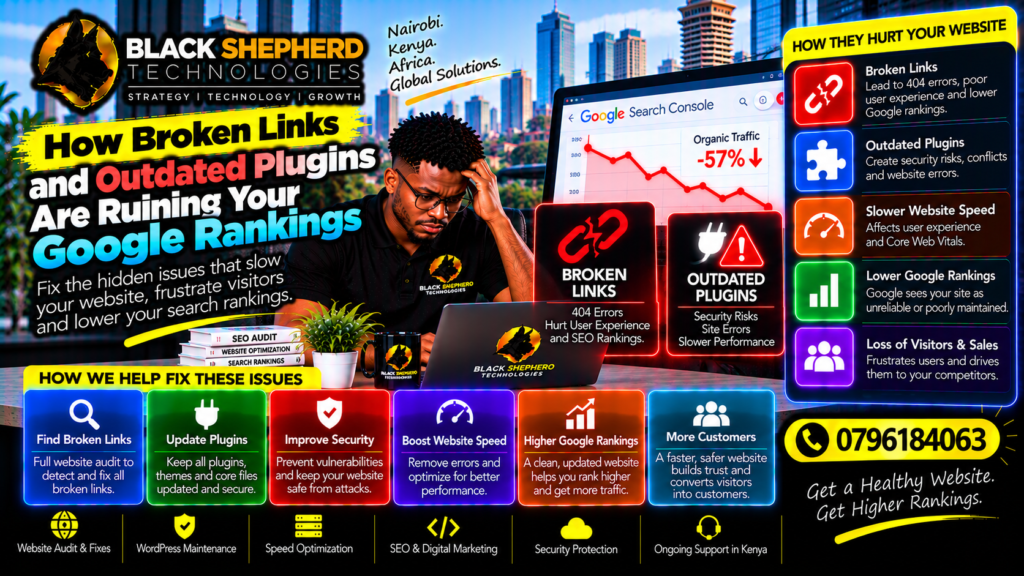
When business owners invest in web design and digital marketing, they often focus on publishable assets—fresh blog posts, new landing pages, and eye-catching social campaigns. However, beneath the surface of your website, technical friction can quietly dismantle your search engine visibility.
Among the various technical errors that degrade a site’s performance, two silent revenue killers stand out: broken links (404 errors) and outdated plugins.
While these might seem like minor backend inconveniences, search engines view them as indicators of a neglected, insecure, or poor-quality user experience. Left unchecked, they destroy your Core Web Vitals, burn your search crawl budget, and send your hard-earned Google rankings tumbling.
In this comprehensive guide, we explore how broken links and outdated software harm your SEO performance and provide actionable steps to clean up your technical infrastructure.
1. How Broken Links (404 Errors) Sabotage Your SEO
A broken link—whether pointing to an internal page on your site or an external resource—occurs when a web browser requests a URL that no longer exists, returning a 404 Page Not Found server error.
How Broken Links Drain Crawl Budget
 [ Search Engine Crawler ]
        │
        ├── Enters Your Website
        ├── Hits Broken Link (404 Error) ──► Crawl Budget Wasted
        └── Abandons Unindexed Pages    ──► Organic Rankings Drop
A. Waste of Search Engine “Crawl Budget”
Google allocates a finite amount of time and resources (known as a crawl budget) to discover, scan, and index the pages on your website. When Googlebot encounters broken internal links, it wastes valuable crawl budget navigating dead ends rather than indexing your new, revenue-generating landing pages or blog posts.
B. Destruction of Link Equity (PageRank)
Internal linking distributes PageRank (“link juice”) across your site, helping search algorithms understand which pages hold the highest priority. When a link breaks, that flow of authority stops dead in its tracks, diluting the SEO value of your entire domain.
C. Poor User Experience and Elevated Bounce Rates
When a user in Nairobi clicks on a link expecting product information or a service guide and lands on a broken 404 page, they instantly hit the back button. Search engines track this behavior (“pogo-sticking”). High bounce rates signal to Google that your website provides a frustrating user experience, leading to lower rankings across related keywords.
To align your technical site architecture with aggressive search visibility, combine routine link auditing with expert SEO services in Kenya.
To explore how resilient, well-maintained web architecture elevates digital execution across various commercial sectors, review the diverse industries we serve.
2. Why Outdated Plugins Directly Impact Search Rankings
Plugins expand the functionality of your Content Management System (like WordPress), powering everything from contact forms to M-Pesa checkouts. However, when plugins are left unpatched, they create severe technical debt that search engines penalize.
The Outdated Plugin Ranking Penalty
 Outdated Plugins ──► Code Bloat / Sluggish PHP ──► High TTFB & LCP (Bad Core Web Vitals) ──► Lower Google Rankings
A. Severe Degradation of Page Speed and Core Web Vitals
Outdated or unoptimized plugins execute inefficient code, generate excessive database queries, and load uncompressed CSS and JavaScript files across pages where they aren’t needed.
This inflates your server’s Time to First Byte (TTFB) and delays your Largest Contentful Paint (LCP). Because Google uses Core Web Vitals as direct ranking signals, slow page load speeds directly degrade your position on Search Engine Results Pages (SERPs).
B. Malware Infections and Search Engine Blacklisting
Outdated plugins represent the #1 entry point for hackers. When an unpatched vulnerability is exploited, attackers inject malicious scripts, pharma hacks, or hidden SEO spam links ( redirecting your traffic to sketchy third-party domains).
When Google detects malware or spam redirects on your domain, it takes immediate action:
-
Displays explicit “This site may be hacked” warnings in search results.
-
Completely removes (de-indexes) compromised pages from Google search results.
-
Places your domain on security blacklists, instantly killing organic lead generation.
To inspect real-world examples of secure, high-performing corporate platforms actively maintained for Kenyan businesses, browse through our portfolios and projects.
3. Step-by-Step Cleanup Plan to Reclaim Your Rankings
Fixing these technical errors requires a proactive, systematic maintenance approach:
4. Final Thoughts: Technical Health Is the Foundation of SEO
Search Engine Optimization is not just about keywords and backlinks—it relies fundamentally on technical health. By eliminating broken links, keeping your software stack updated, and maintaining a fast, secure user experience, you ensure search engines reward your site with top positions.
Whether you are looking to fix technical SEO errors on an existing website, audit your server health, or scale your online business with professional SEO services in Kenya, expert support ensures long-term growth. Explore our specialized industries we serve and examine our proven track record across portfolios and projects to secure your search performance today.