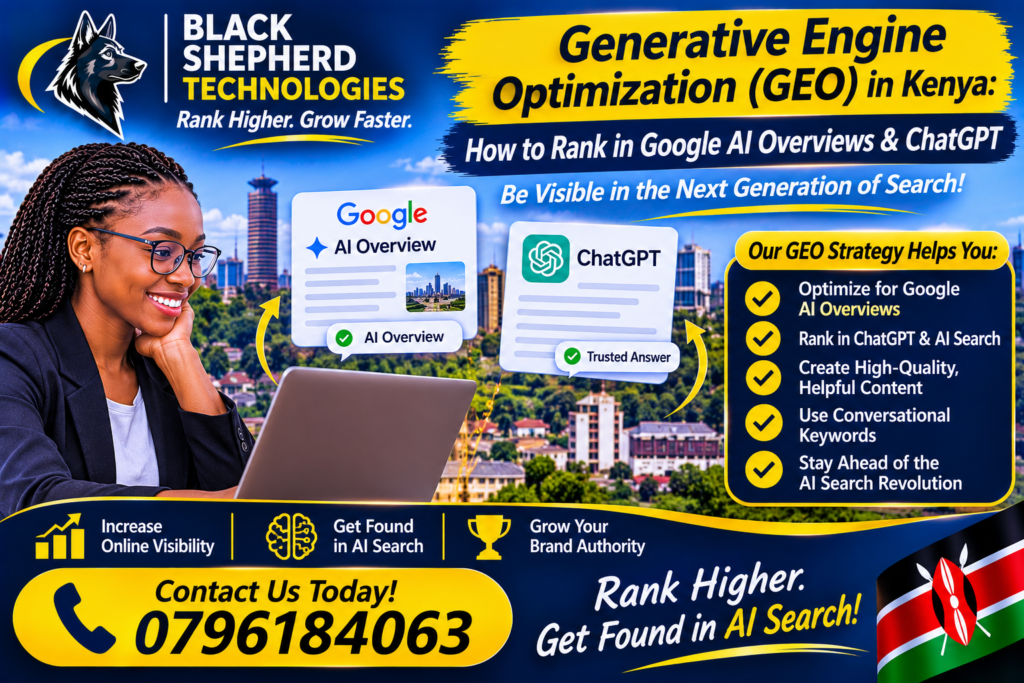
Generative Engine Optimization (GEO) is the practice of structuring your website content, technical access, and brand authority so AI search tools—including Google AI Overviews, ChatGPT, Gemini, and Perplexity—cite, quote, and recommend your business inside synthesized answers rather than just listing a traditional blue link. In Kenya, where AI Overviews are active on Google Search and conversational AI tools are increasingly used to compare local providers, GEO builds directly on strong SEO foundations while shifting focus toward citability, entity trust, and direct answer extraction.
Why GEO Matters for Kenyan Businesses
Traditional search results ask users to click through multiple pages to piece together an answer, whereas AI Overviews and conversational assistants synthesize answers directly on the screen. Users who do click through from AI answers often arrive further along in their decision process.
-
Zero-Click Summaries Change Discovery: When an AI Overview answers a query like “how much does solar installation cost in Nairobi” or “best way to register a company in Kenya”, buyers may read the summary first and only click cited sources for deeper detail or quotes.
-
Conversational Multi-Turn Queries: Buyers in Kenya increasingly ask detailed follow-up questions in ChatGPT or Gemini—comparing pricing structures, service areas, licensing requirements, and trade-offs before contacting a vendor.
-
Strong SEO Remains the Bedrock: AI search systems still rely on crawlable, trustworthy, well-structured web content rather than keyword tricks.
1. Make Sure AI Crawlers Can Access and Read Your Site
Before an AI model can cite your brand, its retrieval bots must be allowed to fetch your pages and read the text cleanly.
-
Audit
robots.txtand Firewall Rules: Check that your server or CDN (such as Cloudflare) is not accidentally blocking search and retrieval crawlers used by Google, OpenAI, Perplexity, or Anthropic. Be mindful of the difference between training crawlers and live search/retrieval crawlers so your site remains eligible to be cited in answers. -
Serve Key Content in Clean HTML: Avoid hiding core service descriptions, pricing rules, or FAQs behind unrendered JavaScript or gated tabs that lightweight crawlers struggle to parse.
2. Write “Answer-First” Passages That LLMs Can Extract
AI engines extract self-contained passages that directly answer a specific question or sub-question. Long, winding introductions bury the takeaway and reduce your chances of being quoted.
-
Lead Every Section with a Clear Answer: Open major headings with a concise, factual summary (roughly 30–60 words) that makes sense on its own without requiring surrounding context.
-
Use Clear Question-Based Headings and Tables: Structure pages around real buyer questions, comparison tables, and step-by-step lists so AI systems can easily match a passage to a user prompt.
-
Include Local Kenyan Specifics: Generic definitions get summarized away. Ground answers in Kenyan realities—such as KES pricing logic, local regulations, county/neighborhood coverage, payment habits like M-Pesa, and practical trade-offs.
3. Boost Citability with Data, Specifics, and Clear Attribution
Vague marketing claims like “we offer the best service in Nairobi” give AI engines nothing reliable to cite. Models favor clear facts, concrete examples, defined criteria, and verifiable references.
-
State Concrete Numbers and Conditions: Specify timelines, eligibility conditions, pricing ranges, capacities, or turnaround windows—and clearly state when figures vary by scope.
-
Cite Credible Primary Sources: Reference official bodies, standards, or original research where relevant rather than repeating unverified claims.
-
Keep Content Fresh: Regularly update dates, current rules, and practical examples so AI systems do not treat your guidance as stale.
4. Build Strong Entity Signals Across Kenya
AI models evaluate entities—your business, founders or specialists, locations, and offerings—across the broader web, not just on your own domain.
-
Keep Brand Facts Consistent Everywhere: Ensure your business name, physical address in Kenya, phone number, core services, and leadership/specialist credentials match across your website, Google Business Profile, LinkedIn, and reputable directories.
-
Use Structured Data (
JSON-LD): Implement accurate schema markup (Organization,LocalBusinessor industry subtype,ProductorService,Person, andFAQPage) matching visible page content. -
Earn Mentions on Trusted Third-Party Sites: AI answers draw heavily from third-party validation—such as local news coverage, industry associations, reputable directories, reviews, and community discussions—alongside your own site.
5. Track AI Visibility Alongside Leads and Revenue
Measuring GEO requires tracking both visibility and real business outcomes, since AI answers can influence buyers even without a click.
-
Monitor AI Referral Traffic in GA4: Segment referral visits from AI search and chat domains in Google Analytics 4 to see which pages attract AI-referred visitors and how they convert.
-
Run Monthly Prompt Audits: Test 15–25 high-intent Kenyan buyer prompts across Google Search, ChatGPT, Gemini, and Perplexity to record when your brand is mentioned or cited—and which competitors appear instead.
-
Track Branded Search and Direct Inquiries: Watch for growth in branded searches, direct calls, WhatsApp inquiries, and form submissions as your brand becomes a recognized entity across search and AI surfaces.