
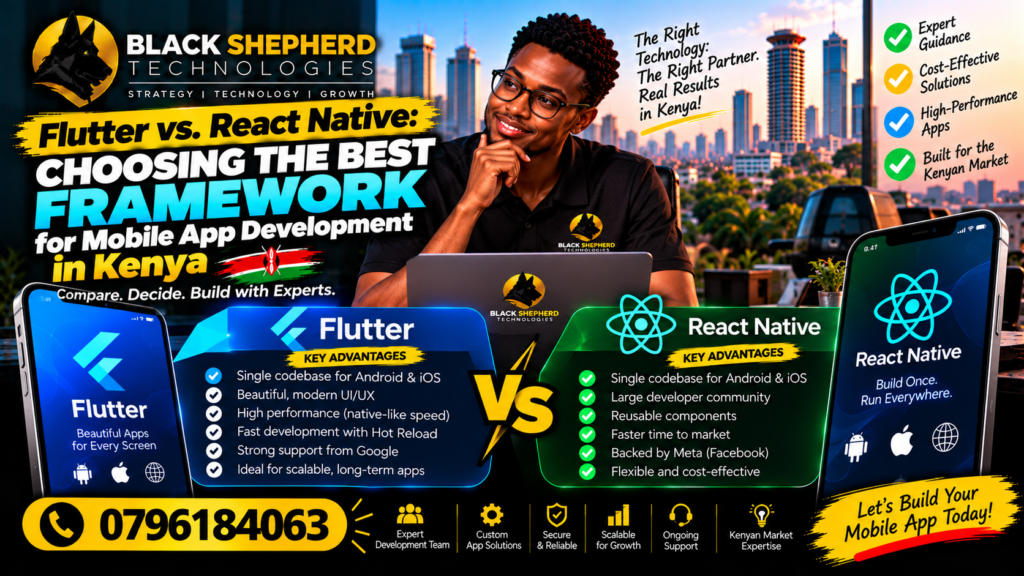
When embarking on a mobile app development journey in Kenya’s thriving tech ecosystem—the Silicon Savannah—one of the earliest and most consequential architectural decisions you and your development team will face is choosing the right cross-platform framework.
In the early days of mobile computing, building an application meant writing entirely separate codebases: native Swift or Objective-C for Apple’s iOS and native Java or Kotlin for Google’s Android. While native development delivered peak performance and hardware access, it carried a massive financial and time cost. Maintaining two distinct teams and codebases doubled development budgets, lengthened time-to-market, and made feature synchronization an ongoing operational headache.
Today, cross-platform frameworks have revolutionized mobile development. Instead of writing two separate applications, engineers can write a single codebase that compiles natively for both Android and iOS. This slashes development time by 30% to 50% and dramatically reduces maintenance overhead.
Among cross-platform technologies, two heavyweights dominate the global and Kenyan markets: Flutter (backed by Google) and React Native (backed by Meta/Facebook).
For startups in Kilimani, enterprises in Upper Hill, and digital agencies across Nairobi, choosing between Flutter and React Native can make or break a product’s efficiency, performance, and long-term scalability. Which framework is better suited for the unique realities of the Kenyan market? How do they handle local payment integrations like M-Pesa, network constraints, performance on budget devices, and talent availability?
This comprehensive guide breaks down Flutter and React Native across every critical dimension, providing you with a definitive decision-making framework.
Part 1: Understanding the Contenders
Before comparing their strengths and weaknesses in the context of Kenya, let us examine what Flutter and React Native are under the hood.
1. Flutter: Google’s UI Toolkit
- Language: Dart (developed by Google)
- Core Philosophy: “Write once, run anywhere with pixel-perfect consistency.”
- How It Works: Flutter does not rely on native OEM (Original Equipment Manufacturer) widgets. Instead, it uses its own high-performance rendering engine—Skia (and increasingly Impeller)—to draw every pixel on the screen directly onto a canvas.
2. React Native: Meta’s JavaScript Powerhouse
- Language: JavaScript / TypeScript (powered by React)
- Core Philosophy: “Learn once, write anywhere.”
- How It Works: React Native uses JavaScript to bridge communication with native UI components. When a user interacts with a React Native app, the JavaScript code communicates via a “bridge” (or the modern architectural overhaul known as the New Architecture / Fabric) to render native Android and iOS components.
Part 2: Evaluating Flutter vs. React Native for the Kenyan Market
While global benchmark articles debate these frameworks based on western developer preferences, building apps for Kenya introduces unique local variables. Let us evaluate Flutter and React Native against the realities of the Kenyan tech landscape.
1. Performance and Device Fragmentation
In mature tech markets, flagship devices dominate. In Kenya, while high-end iPhones have a strong urban footprint, the vast majority of mobile users rely on a wide spectrum of Android devices—ranging from mid-range Samsung models to budget-friendly Infinix, Tecno, and Oppo smartphones.
- Flutter in Kenya: Because Flutter compiles directly to machine code (ARM/x64) and bypasses native widget bridges using its own rendering engine, it delivers exceptionally smooth, butter-like 60fps or 120fps animations. Even on modest budget hardware, Flutter apps maintain consistent visual performance because the UI rendering is self-contained.
- React Native in Kenya: React Native performs admirably, but its reliance on native UI components via a bridge (or its newer Bridgeless architecture) can occasionally introduce slight overhead on lower-end processors if not carefully optimized. However, with the rollout of React Native’s New Architecture, performance gaps have narrowed significantly.
2. Integration with Local Payment Gateways (M-Pesa / Daraja API)
Financial transactions form the beating heart of mobile applications in Kenya. Whether you are building an e-commerce platform, a micro-lending app, or a delivery service, seamless integration with Safaricom’s M-Pesa (via the Daraja API), Flutterwave, or Paystack is non-negotiable.
- Flutter: Flutter boasts a rich ecosystem of community-maintained and official packages on
pub.dev. Integrating HTTP REST APIs for M-Pesa STK push callbacks, local database encryption, and secure storage is straightforward. Because Dart is strongly typed, debugging API request models is clean and predictable. - React Native: React Native benefits from JavaScript’s massive npm ecosystem. If you need a specific wrapper for local payment SDKs, biometric authentication, or geolocation, chances are an npm package already exists. However, managing native dependencies during major React Native upgrades can occasionally cause version conflicts.
3. Talent Availability and Developer Ecosystem in Nairobi
When building or scaling an app, you must consider the local talent pool. If your lead developer leaves, how easy is it to hire a replacement in Nairobi?
- React Native (JavaScript/TypeScript): JavaScript is the undisputed king of web development. Many web developers in Nairobi transitioning into mobile development find React Native incredibly natural to pick up because they already know JavaScript and React.
- Flutter (Dart): Dart is a specialized language created by Google. While it is easy to learn for developers familiar with Java, C#, or TypeScript, developers coming strictly from web frontend backgrounds (HTML/CSS/JS) may face a minor learning curve. Nonetheless, Flutter has gained massive traction in Nairobi’s developer meetups and bootcamps due to its rapid UI productivity.
Part 3: Head-to-Head Comparison Metrics
To make an informed choice, let us examine how Flutter and React Native stack up across core technical and business metrics.
| Metric | Flutter | React Native | Winner |
| Language | Dart (Statically typed) | JavaScript / TypeScript | Tie (Depends on team background) |
| Performance | High (Direct compilation, Skia/Impeller engine) | High (Native components via bridge/New Architecture) | Flutter (Slight edge on animations & budget devices) |
| UI Consistency | Identical UI across Android & iOS out of the box | Uses native widgets (can look slightly different per OS) | Flutter (For strict brand uniformity) / React Native (For native feel) |
| Ecosystem & Packages | pub.dev (Rich, well-maintained official packages) |
npm (Massive ecosystem, but varying package quality) | React Native (Volume) / Flutter (Quality/Consistency) |
| Hot Reload / Developer Experience | Outstanding (Stateful hot reload is exceptionally fast) | Excellent (Fast refresh, though native bridges can occasionally crash) | Flutter |
| App Binary Size | Slightly heavier base binary size | Generally lighter base binary size | React Native |
Part 4: When to Choose Flutter for Your Kenyan Project
Flutter is the ideal choice for your mobile app development project if:
- You Need Pixel-Perfect Brand Consistency: If your app features heavy custom branding, intricate illustrations, unique animations, or a proprietary design system that must look identical down to the single pixel on both a Tecno Android phone and an iPhone, Flutter is unmatched.
- Your Team Wants Rapid MVP Development: Flutter’s widget library is exceptionally comprehensive. You can build complex layouts with pre-built Material Design and Cupertino widgets in a fraction of the time, accelerating your time-to-market.
- You Target Budget Android Hardware: Because Flutter controls every pixel rendered on the screen, it performs remarkably well on the mid-to-low-end Android devices that dominate emerging markets like Kenya.
Part 5: When to Choose React Native for Your Kenyan Project
React Native is the ideal choice for your mobile app development project if:
- Your Team Already Knows JavaScript/React: If you have an existing web application built in React and want your frontend web developers to transition smoothly into mobile app development without learning a new language, React Native minimizes the learning curve.
- You Require Native-Looking UI Components: If your app’s primary goal is to blend seamlessly into the native operating system guidelines (such as native navigation bars, native scrolling physics, and native gesture handling), React Native’s reliance on native components shines.
- You Rely Heavily on Existing JavaScript Libraries: If your backend or shared codebase is deeply entrenched in the Node.js/npm ecosystem, React Native integrates smoothly into existing JavaScript toolchains.
Conclusion: Which Framework Wins in Kenya?
There is no single “silver bullet” framework that is universally superior. Both Flutter and React Native are world-class, production-proven technologies capable of powering multi-million-user applications.
In the Kenyan context, Flutter has earned immense popularity among startups and digital agencies in Nairobi due to its buttery-smooth performance on budget Android hardware, rapid UI development speed, and rock-solid cross-platform consistency. Meanwhile, React Native remains a powerhouse for teams leveraging existing JavaScript expertise and web engineering talent.
Ultimately, your choice should be guided by your team’s existing skill set, your project’s UI complexity, and your long-term business goals. Partnering with an experienced digital agency or software development firm in Nairobi ensures your technical architecture is tailored for maximum performance, seamless M-Pesa integration, and long-term scalability.
Looking to build or scale a cross-platform mobile application in Kenya? Connect with industry-leading digital agencies and mobile app developers in Nairobi to choose the right framework and bring your vision to life.
