
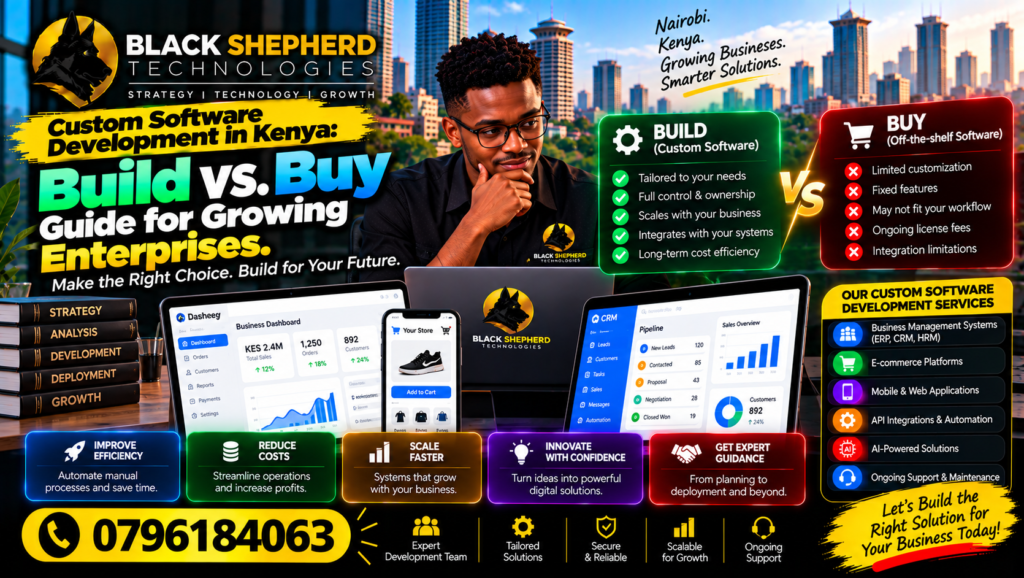
In the rapidly evolving digital landscape of East Africa, Kenyan enterprises are transitioning from basic digitization to sophisticated, software-driven operational models. Nairobi has earned its reputation as the “Silicon Savannah,” boasting a vibrant tech ecosystem, a highly skilled talent pool, and an appetite for innovation that rivals established global hubs. As local businesses scale—spanning fintech, agritech, logistics, manufacturing, retail, and professional services—they reach a critical strategic crossroads: Should they build custom software tailored precisely to their operations, or should they buy off-the-shelf software solutions?
This decision is far more than a simple IT preference; it is a fundamental business strategy that impacts capital expenditure, operational agility, competitive differentiation, and long-term scalability. Choosing incorrectly can lead to bloated budgets, crippled workflows, locked-in vendor constraints, or missed market opportunities.
This comprehensive guide explores the nuances of the build vs. buy dilemma within the Kenyan market. We will dissect the total cost of ownership, operational realities, scalability challenges, security compliance considerations, and strategic frameworks needed to make an informed choice. Furthermore, we will examine how modern enterprises leverage digital visibility through expert SEO services in Kenya and robust execution across diverse industries we serve by partnering with experienced technical teams visible in our portfolios and projects.
1. The Kenyan Digital Economy Context: Why Software Strategy Matters Now
Kenya’s economic environment is characterized by high mobile-money penetration (led by M-Pesa), progressive regulatory frameworks (such as the Data Protection Act), and an increasingly tech-savvy consumer base. Businesses operating in this ecosystem face unique dynamics:
-
Rapid Urbanization and Regional Integration: Companies based in Nairobi often scale operations into regional markets like Uganda, Tanzania, Rwanda, and the broader COMESA trade bloc. Software must accommodate multi-currency transactions, cross-border logistics, and varied regulatory regimes.
-
Leapfrogging Legacy Systems: Unlike Western enterprises burdened by decades of mainframe and legacy codebases, many Kenyan enterprises are young and agile. They have the opportunity to build modern cloud-native architectures from the ground up.
-
The Cost of Inefficiency: In competitive sectors like fintech, supply chain, and e-commerce, operational bottlenecks directly translate to customer churn. Manual reconciliations, fragmented spreadsheets, and disconnected software silos stunt growth.
To capture market share, enterprises need software that acts as an accelerator rather than an anchor. This makes the evaluation between custom software development and off-the-shelf procurement one of the most critical decisions a CEO or CTO will make.
2. Defining the Options: Custom Software vs. Off-the-Shelf Solutions
What is Custom Software Development?
Custom software development involves designing, building, testing, and deploying applications specifically for a defined set of users, functions, or organizations. It is engineered from scratch (or built upon flexible open-source frameworks) to map directly onto existing or envisioned business processes.
In Kenya, custom software is typically commissioned through internal engineering teams or specialized local development agencies. It covers everything from bespoke enterprise resource planning (ERP) extensions and proprietary mobile apps to specialized core-banking systems and logistics management platforms.
What is “Buy” (Off-the-Shelf / SaaS / Enterprise Software)?
Buying software involves licensing or subscribing to pre-built, standardized applications developed by third-party vendors. These range from generic productivity tools (Microsoft 365, Slack) to industry-standard enterprise software (SAP, Salesforce, HubSpot, or specialized vertical SaaS products).
While off-the-shelf software requires little to no upfront coding, it often demands configuration, workflow adjustments, and recurring subscription fees (SaaS model).
3. Deep Dive: The Case for “Buying” (Off-the-Shelf Software)
For many growing businesses, buying off-the-shelf software is the logical starting point. It offers distinct advantages, particularly in the early stages of enterprise evolution.
A. Speed to Market and Immediate Deployment
Time is often more valuable than capital. If an enterprise needs a standard customer relationship management (CRM) tool or accounting software, purchasing an established SaaS product allows deployment within days or weeks. There is no requirement to draft detailed software requirements specifications (SRS), wait for UI/UX wireframes, or undergo months of QA testing.
B. Lower Initial Upfront Costs
Off-the-shelf software operates primarily on operational expenditure (OpEx) models—monthly or annual subscriptions. This spares growing enterprises from sinking heavy capital expenditure (CapEx) into extensive software engineering hours, infrastructure setup, and long-term maintenance contracts.
C. Built-in Industry Best Practices
Established software vendors invest heavily in researching industry standards. When you buy a mature ERP or HR management system, you inherit decades of collective best practices baked into the software architecture. Features like tax calculations compliant with KRA (Kenya Revenue Authority) guidelines, automated payroll deductions (NSSF, NHIF/SHIF, PAYE), and standard financial reporting are often pre-configured.
D. Vendor-Managed Maintenance and Updates
Security patches, feature updates, bug fixes, and infrastructure scaling are handled entirely by the vendor. Your internal team does not need to worry about server downtimes, database migrations, or patching zero-day vulnerabilities.
Limitations of Off-the-Shelf Software in Kenya
Despite its benefits, buying off-the-shelf software frequently introduces friction for scaling Kenyan enterprises:
-
The “Square Peg in a Round Hole” Dilemma: Standard software forces your business processes to adapt to the software’s limitations rather than the other way around.
-
Hidden Long-Term Costs: As user counts grow or premium feature tiers are unlocked, subscription fees escalate drastically. Per-user pricing models can become prohibitively expensive for growing teams.
-
Integration Nightmares: Off-the-shelf products may not natively integrate with local payment gateways (e.g., Daraja API for M-Pesa, Pesapal, Flutterwave), local SMS aggregators, or specialized regional logistics APIs.
-
Vendor Lock-in: Migrating data away from a proprietary SaaS platform can be complex, costly, and legally restrictive.
4. Deep Dive: The Case for “Building” (Custom Software Development)
When a growing enterprise reaches a stage where generic software inhibits differentiation or operational scale, custom software development becomes essential. Reviewing successful digital implementations across our portfolios and projects highlights how tailored digital assets unlock distinct competitive advantages.
A. 100% Alignment with Business Logic and Workflow
Your business has unique intellectual property, secret sauces, and specific operational workflows that give you an edge over competitors. Custom software is sculpted around these exact processes. If your logistics enterprise in Mombasa requires a unique multi-tier tracking algorithm combined with regional customs clearance documentation workflows, custom software accommodates this effortlessly without forcing workarounds.
B. True Scalability and Cost Efficiency at Scale
While custom software requires a higher upfront investment (CapEx), it does not penalize you with punishing per-user licensing fees as your headcount grows. Once built, the software belongs to you. Scaling from 50 users to 500 users incurs negligible marginal software costs beyond standard cloud infrastructure scaling.
C. Seamless Integration with Local and Global Ecosystems
In Kenya, seamless integration with local financial and operational infrastructure is non-negotiable. Custom software allows developers to build direct API integrations with:
-
M-Pesa STK Push and C2B/B2C APIs for instant mobile money collections and disbursements.
-
Kenya Revenue Authority (KRA) eTIMS systems for automated tax compliance and electronic invoicing.
-
Regional banking switches and localized logistics tracking networks.
D. Competitive Advantage and IP Ownership
When you build custom software, you own the source code and the intellectual property. This asset adds tangible valuation to your enterprise, acts as a defensible moat against competitors, and can eventually be productized and commercialized as a secondary revenue stream.
Limitations of Custom Software Development
Building custom software is not without its hurdles:
-
Higher Upfront Capital Requirement: Initial design, development, testing, and deployment require significant financial outlay and resource allocation.
-
Extended Timelines: Building robust software takes time—typically ranging from 3 to 9 months depending on complexity.
-
Management Overhead: Managing development teams, defining technical scopes, and overseeing quality assurance requires competent internal technical leadership or a trusted development partner.
5. The Comprehensive Comparison Framework: Build vs. Buy
To assist executive boards, founders, and IT directors in making an objective choice, let us evaluate both approaches across key enterprise dimensions:
6. The Hybrid Strategy: Best of Both Worlds
Discerning enterprises in Kenya increasingly adopt a hybrid approach to balance speed, cost, and customization.
Leveraging Open-Source Foundations and SaaS Building Blocks
Instead of writing every single line of code from scratch, modern custom software development often utilizes mature open-source frameworks, component libraries, and cloud services (AWS, Google Cloud, Azure).
-
Example: For an e-commerce or retail enterprise across industries we serve, core authentication and database management can leverage secure cloud infrastructure, while the front-end user experience, checkout workflows, and inventory reconciliation engine are custom-built to match specific operational rules.
-
Enterprise SaaS + Custom Middleware: An enterprise might buy Salesforce for core sales pipeline tracking, but build a custom integration middleware layer that connects Salesforce to local inventory management systems, M-Pesa billing APIs, and custom reporting dashboards.
This pragmatic methodology minimizes development time while preserving absolute control over core business differentiators.
7. Evaluating Total Cost of Ownership (TCO) Over 5 Years
A common pitfall in the build vs. buy decision is evaluating only the initial sticker price. To make an accurate financial projection, enterprises must calculate the Total Cost of Ownership (TCO) over a 3- to 5-year horizon.
Calculating Off-the-Shelf TCO
-
Subscription Fees: Monthly/Annual user licenses ×\times Number of users ×\times 5 years. (Factor in potential annual price hikes of 5–10%).
-
Tier Upgrades: Costs incurred when outgrowing basic tiers and needing enterprise-grade features (advanced security, dedicated support, API access).
-
Customization & Consultancy Fees: Paying certified third-party consultants to bend the SaaS tool to your workflows.
-
Integration Maintenance: Costs when SaaS API updates break your legacy connections.
-
Inefficiency Costs: Productivity losses due to employees working around software limitations.
Calculating Custom Software TCO
-
Initial Development Cost: Discovery, UI/UX design, engineering sprints, QA testing, and initial deployment.
-
Infrastructure & Hosting: Cloud server hosting (AWS/Azure/Google Cloud), SSL certificates, and domain management.
-
Ongoing Maintenance & Updates: Allocating 15–20% of initial development cost annually for security patches, OS updates, and minor feature iterations.
-
Internal Staffing / Partner Retainer: Retaining internal developers or partnering with an external software development agency.
The Inflection Point: For small teams with standard needs, buying is perpetually cheaper. However, as an enterprise scales past 50–100 users with complex workflows, the cumulative recurring subscription fees of off-the-shelf software frequently eclipse the one-time development and maintenance cost of custom software.
8. Regulatory Compliance and Data Security in Kenya
Operating an enterprise in Kenya means strict adherence to legal frameworks. Your software strategy must align with national laws, particularly regarding data sovereignty and consumer privacy.
The Data Protection Act, 2019
Enforced by the Office of the Data Protection Commissioner (ODPC), Kenya’s Data Protection Act places strict mandates on how personal data is collected, processed, stored, and transferred.
-
Off-the-Shelf Risks: Many global SaaS providers store data on overseas servers (e.g., US or European data centers). While major global clouds comply with GDPR, transferring sensitive citizen data across borders requires careful legal compliance, and certain government or financial institutions may face outright bans on foreign data storage.
-
Custom Software Advantage: Custom software development gives enterprises absolute control over data residency. You can choose to host your databases locally within carrier-neutral data centers in Nairobi (such as IXAfrica, iccolo, or PAIX) or on secure regional cloud regions, ensuring 100% compliance with local regulatory directives.
KRA Compliance and eTIMS Integration
Tax administration in Kenya has tightened significantly with the introduction of electronic Tax Invoice Management System (eTIMS).
-
Off-the-shelf global accounting software often lacks native eTIMS integration, requiring cumbersome manual exports or expensive custom plugins.
-
Custom software can be engineered with direct eTIMS API connectivity, automatically generating compliant electronic tax invoices upon every transaction, shielding the enterprise from punitive KRA penalties.
9. Technical Talent, Partnerships, and Execution in Nairobi
Having a brilliant software blueprint means little without elite execution. Kenya boasts one of the most vibrant developer ecosystems in Africa, nurtured by hubs like iHub, Moringa School, and robust university computer science programs. However, hiring, vetting, and retaining full-time senior software engineers in Nairobi is fiercely competitive and expensive.
In-House Development vs. Outsourced Development Partners
-
Building an In-House Team: Ideal for mature tech enterprises where software is the core product. However, recruitment overhead, salaries, benefits, and employee churn can slow down project delivery.
-
Partnering with Specialized Development Agencies: For growing enterprises in manufacturing, logistics, retail, or professional services, partnering with an established digital agency provides immediate access to multidisciplinary teams—product managers, UI/UX designers, full-stack engineers, DevOps specialists, and QA testers—without the friction of permanent recruitment.
10. Driving Digital Growth: Beyond the Code
Building or buying software is only half the battle. Once your digital platform or enterprise portal is live, ensuring it reaches your target audience, stakeholders, or customers is vital for commercial success.
Technical excellence must be paired with dominant digital visibility. Whether you operate in B2B enterprise tech, e-commerce, hospitality, or professional services across the industries we serve, organic search positioning determines market leadership. Integrating targeted SEO services in Kenya ensures that your software products, web platforms, and enterprise solutions rank prominently on search engines, capturing high-intent local and regional traffic.
To witness practical applications of high-performance digital architecture, UI/UX design, and custom web engineering, explore our comprehensive portfolios and projects. Seeing successful deployments provides tangible benchmarks for what your enterprise can achieve.
11. Step-by-Step Decision Framework for Kenyan Enterprises
To crystallize your decision, walk through this sequential decision-making matrix:
[Start: Identify Business Problem/Opportunity]
         │
         ▼
[Is this function core to your competitive advantage/IP?]
         ├── YES ──► [BUILD: Custom Software]
         │
         └── NO
              │
              ▼
[Does an off-the-shelf tool meet >80% of your workflow needs?]
              ├── YES ──► [BUY: Off-the-Shelf / SaaS]
              │
              └── NO
                   │
                   ▼
[Does buying require heavy custom integration and high user fees?]
                   ├── YES ──► [HYBRID: Open-source base + Custom Middleware]
                   │
                   └── NO  ──► [BUY with configuration]
-
Audit Your Core Processes: Is the process in question generic (e.g., payroll processing, email communication) or core to your unique value proposition (e.g., proprietary credit-scoring algorithm, specialized agricultural supply-chain tracking)? Generic = Buy. Core = Build.
-
Analyze User Projections: Estimate your user headcount growth over the next 36 months. Calculate cumulative SaaS license fees versus upfront custom development costs.
-
Assess Integration Complexities: List all internal and external systems the software must talk to (M-Pesa, KRA eTIMS, legacy databases). If integration friction is high, custom development or hybrid middleware is required.
-
Review Compliance Mandates: Evaluate data privacy laws, sector-specific regulations (CBK, CMA, ODPC), and data residency requirements.
-
Consult Technical Experts: Before committing capital, engage with experienced software architects and digital strategists to validate your technical scope, feasibility, and risk assessment.
Conclusion
The choice between building custom software and buying off-the-shelf solutions is a defining moment for growing enterprises in Kenya. There is no universal correct answer; rather, the optimal choice depends on your strategic maturity, financial capacity, operational complexity, and long-term vision.
Buying off-the-shelf software provides speed and low initial costs, making it ideal for standard administrative and operational functions. Conversely, custom software development empowers ambitious enterprises to eliminate workflow bottlenecks, achieve true scalability, maintain absolute data sovereignty, and secure a lasting competitive moat in the dynamic East African market.
By pairing meticulous strategic planning with expert execution—backed by robust digital marketing, search visibility like SEO services in Kenya, and proven technical competence demonstrated across our portfolios and projects tailored to the diverse industries we serve—your enterprise can navigate the build vs. buy dilemma with confidence, positioning itself for sustainable, technology-driven growth.
