In the competitive digital economy of Kenya, many business owners measure success by a single metric: traffic. Whether through organic search engine optimization, social media campaigns, or paid digital advertising, hundreds of thousands of shillings are continually invested to drive clicks, views, and visitors to corporate websites.
However, a harsh commercial reality quickly sets in for many organizations: high traffic numbers do not automatically translate into healthy revenue. If your website attracts thousands of visitors every month but your phone lines remain quiet and your inquiry forms stay empty, your digital strategy has a critical leak at the conversion finish line.
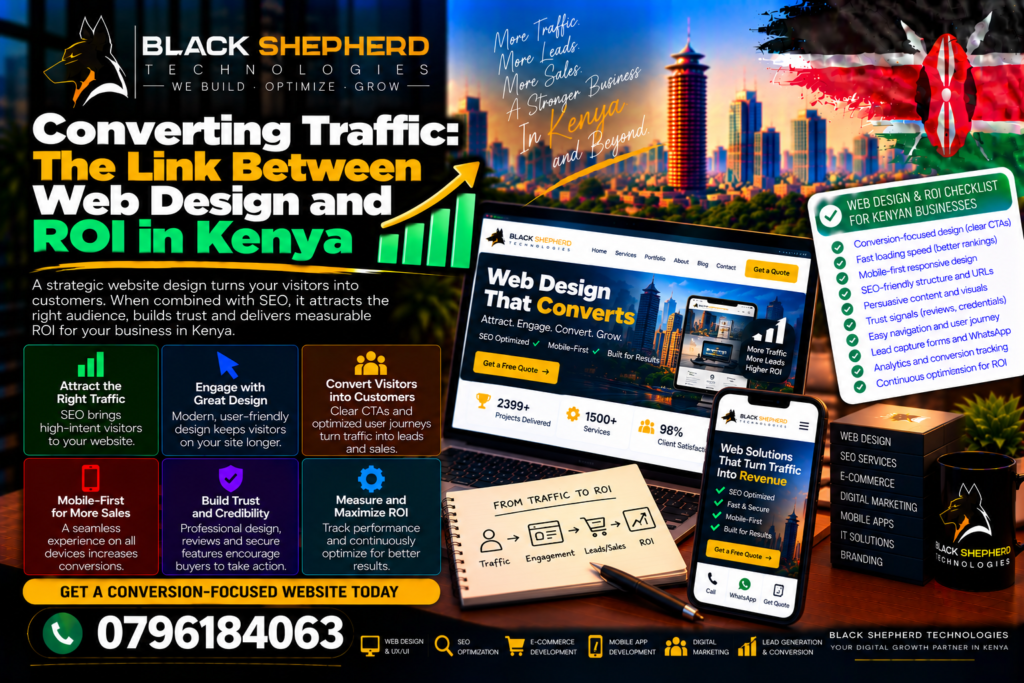
Return on Investment (ROI) in digital marketing is not determined by how many people visit your site—it is determined by how many of those visitors take profitable action. In this comprehensive guide, we will explore why web design is the primary driver of conversion rates, how user experience directly impacts your bottom line, and how Kenyan businesses can transform traffic into sustainable revenue.
1. The Traffic vs. Conversion Paradox
Imagine investing heavily in a brilliant marketing campaign that drives a surge of prospective clients to your website. A user lands on your homepage from a smartphone while navigating traffic in Nairobi’s CBD. Within three seconds, they encounter a sluggish loading screen, a confusing menu layout, and a dense wall of corporate text with no clear way to contact your sales team. Frustrated, they hit the back button and buy from your competitor instead.
The traffic was successfully acquired, but the design failed to convert it.
Why Web Design Dictates ROI
Your website is your 24/7 digital storefront. In traditional retail, a poorly organized physical shop with blocked walkways, unpriced items, and a hidden checkout counter will suffer low sales regardless of how many people walk through the door. Online, web design serves as your digital shopkeeper. Clean architecture, intuitive navigation, and persuasive layouts guide visitors seamlessly from curiosity to commitment.
For organizations looking to bridge the gap between search visibility and commercial revenue, integrating high-performance web architecture with professional SEO Services Kenya ensures that the traffic you attract is met with an environment engineered specifically for conversion.
2. Key Web Design Elements That Drive Conversion Rates
Converting traffic requires intentional psychological and structural design choices. When visitors land on your site, they subconsciously evaluate your credibility within milliseconds. Here are the core design pillars that maximize ROI:
A. Above-the-Fold Clarity and Value Proposition
The area of your web page visible immediately upon loading—without requiring the user to scroll—is your digital billboard. Within three seconds, a visitor must understand three things:
-
What you do or sell.
-
Who you do it for.
-
Why they should choose you over competitors.
Cluttering this prime real estate with generic stock imagery or dense jargon destroys conversion potential. A high-ROI design features a concise headline, a powerful subheadline, and a prominent, unmissable Call-to-Action (CTA) button.
B. Frictionless Mobile User Journeys
With the vast majority of web traffic in Kenya originating from mobile devices, conversion design must prioritize smartphone ergonomics. Lengthy contact forms asking for excessive personal details cause immediate drop-offs. High-converting mobile design replaces friction with convenience:
-
Streamlined form fields that only request essential information (Name, Phone Number, Inquiry).
-
Persistent, thumb-friendly CTA buttons that remain visible as the user scrolls.
-
Instant communication triggers like floating WhatsApp integration.
3. Building Local Trust: The Secret Catalyst for ROI
In the Kenyan market, trust is the single most influential currency in consumer decision-making. Online shoppers and B2B corporate buyers alike are naturally cautious about transferring funds or sharing personal contact details with unverified digital brands.
Your web design must actively incorporate trust signals to reassure prospective clients:
-
Transparent Local Proof: Prominently displaying physical addresses in recognized commercial zones (such as Westlands, Upper Hill, or Mombasa Road), verified local telephone numbers, and real customer reviews.
-
Local Payment Integrations: For e-commerce and service providers, clear visual integration of trusted regional payment methods—such as M-Pesa STK push and secure banking gateways—removes hesitation at checkout.
-
Professional Branding and Typography: Clean visual hierarchy, consistent color palettes, and professional imagery signal operational stability and competence.
To examine how high-converting layouts, robust trust frameworks, and custom digital architectures are successfully deployed across complex commercial projects, exploring verified case studies via Portfolios and Projects offers clear visual and structural insights.
4. Sector-Specific Conversion Strategies
Different business models require unique conversion pathways to maximize return on investment.
| Industry Sector | Primary Conversion Goal | High-ROI Design Elements |
| B2B & Professional Services | Inbound leads, consultation bookings, RFQs. | Gated case studies, clear service breakdowns, click-to-call consultation forms. |
| E-Commerce & Retail | Completed online orders, repeat checkouts. | Fast guest checkout, transparent KES pricing, mobile-optimized product filters. |
| Hospitality & Tourism | Direct room/safari bookings, reservation inquiries. | Instant booking widgets, immersive visual galleries, click-to-chat concierge. |
To explore how specialized conversion systems are tailored to diverse commercial landscapes and unique business models, you can examine our customized frameworks via Industries We Serve.
5. A Step-by-Step Blueprint to Optimize Your Website ROI
Transforming your website from a passive digital brochure into a high-converting revenue engine requires a structured, data-driven optimization process:
Step 1: Install Robust Analytics and Tracking
Before changing any design elements, ensure Google Analytics 4 and conversion tracking tools are properly configured. You cannot optimize what you do not measure. Track form submissions, phone link clicks, WhatsApp button taps, and checkout completions.
Step 2: Identify Conversion Bottlenecks
Analyze your user behavior reports to see where visitors are dropping off. Are users abandoning their carts at the payment page? Are they leaving contact forms halfway through? Identifying these friction points highlights what needs immediate redesigning.
Step 3: Simplify and Streamline Layouts
Remove distracting elements, decluttered navigation menus, and slow-loading scripts. Direct the user’s eye naturally down the page toward a single, compelling primary action.
Step 4: Test and Iterate Continuously
Digital marketing is an ongoing refinement process. Test different CTA button colors, headline variations, and form lengths to see what resonates best with your Kenyan audience, continuously compounding your return on investment.
Conclusion
Traffic is only the beginning of the customer journey. Without a strategic web design framework engineered to build trust, eliminate friction, and guide users toward conversion, your marketing budget is leaking potential revenue.
By aligning mobile-first user experience, localized trust signals, and clear conversion paths with your search optimization efforts, you transform your website into a powerful asset that consistently generates qualified leads and sustainable sales.
Evaluate your website’s conversion architecture today, remove the barriers standing between your visitors and your products, and turn your digital traffic into maximum return on investment.