
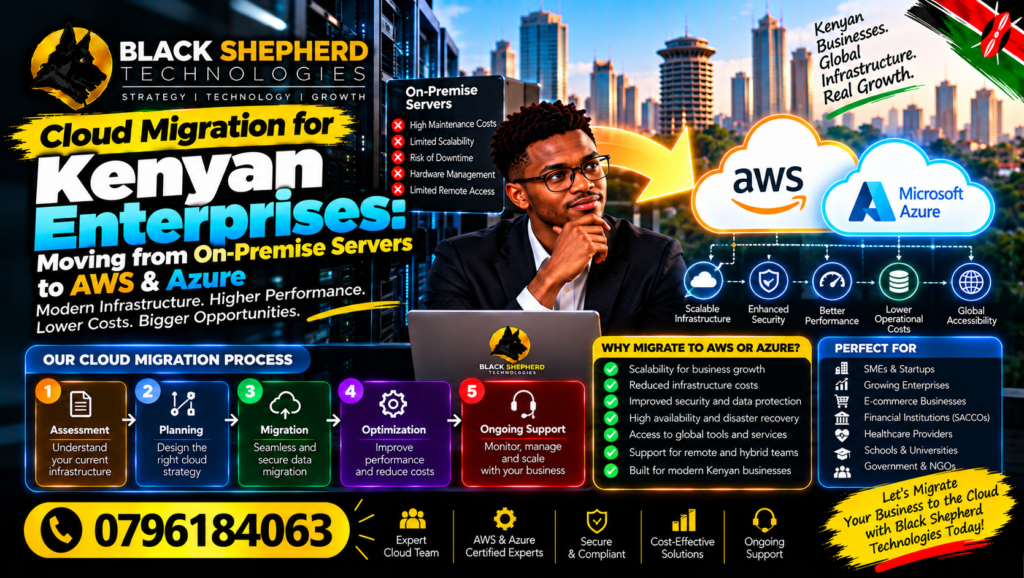
For decades, running an enterprise technology infrastructure in Kenya meant maintaining physical control in a very literal sense. IT departments housed bulky server racks, UPS units, and noisy cooling systems in cramped office backrooms or rented data center cages. Management viewed physical hardware as a secure asset because they could walk down the hall, touch the blinking server lights, and lock the room door.
Today, that traditional physical model is rapidly giving way to cloud computing. As growing enterprises across Nairobi, Mombasa, Kisumu, and the wider East African region scale their operations, relying on on-premise servers creates a dangerous bottleneck. Physical hardware lacks elasticity, requires heavy upfront capital expenditure (CapEx), is vulnerable to local power and environmental outages, and struggles to support modern, high-concurrency digital workflows.
The strategic migration from on-premise infrastructure to global hyperscalers like Amazon Web Services (AWS) and Microsoft Azure has become the defining technological shift for modern East African enterprises. This comprehensive guide explores why Kenyan businesses are moving to the cloud, how to choose between AWS and Azure, how to navigate local data sovereignty and connectivity realities, and how to execute a zero-downtime migration strategy. We will also examine how to pair your cloud infrastructure with world-class digital visibility through expert SEO services in Kenya across the diverse industries we serve, drawing inspiration from proven engineering blueprints featured in our portfolios and projects.
1. The On-Premise Bottleneck: Why Kenyan Businesses Are Outgrowing Physical Hardware
To understand why cloud migration is surging, one must examine the operational frustrations of managing physical data centers within the East African context:
-
Unpredictable Power and Environmental Realities: Despite major improvements in national grid stability and the proliferation of carrier-neutral data facilities in Nairobi (such as IXAfrica, iccolo, and PAIX), localized power surges, brownouts, and generator failures still threaten on-premise server rooms. A single cooling failure in an unmonitored office server closet can fry expensive server hardware and cripple business operations.
-
The Hardware Procurement Trap: Buying physical servers requires a lengthy capital expenditure approval cycle, heavy upfront cash outlays, and long procurement shipping lead times (often 6 to 12 weeks for enterprise-grade server units to clear customs in Kenya). By the time the hardware arrives, business requirements may have already shifted.
-
The Scalability Wall: If your e-commerce platform or fintech app experiences a sudden traffic surge—such as a flash sale or a payday weekend rush—your physical server resources (CPU and RAM) max out. You cannot instantly “rent” more physical capacity on a whim; your system slows down, transactions time out, and customers abandon your platform.
-
Maintenance and Disaster Recovery Overhead: On-premise servers demand specialized internal IT staff to handle manual OS patches, hardware disk replacements, firmware updates, and physical backups. If an office experiences a physical disaster, fire, or theft, unbacked-up local data can be lost forever.
2. AWS vs. Microsoft Azure: Choosing the Right Hyperscaler for East African Enterprises
When migrating to the cloud, enterprises face a primary choice between the two dominant global hyperscalers: Amazon Web Services (AWS) and Microsoft Azure. Both maintain massive global footprints and serve African customers primarily through regional data centers in South Africa (Cape Town for AWS; Johannesburg and Cape Town for Azure), supplemented by edge caching nodes and connectivity hubs in Nairobi. However, their core philosophies differ significantly.
A. Amazon Web Services (AWS): The Pioneer of Agility and Developer Freedom
AWS is the global market leader and is renowned for its vast, deep catalog of over 200 fully featured cloud services.
-
Strengths: Unmatched breadth of compute, serverless architectures, machine learning pipelines, and data analytics tools. AWS is the default ecosystem for high-growth tech startups, SaaS providers, and engineering-heavy fintech platforms.
-
Proximity in Africa: AWS operates the
af-south-1region in Cape Town, coupled with edge POPs and Direct Connect infrastructure linking into Nairobi, minimizing latency for regional users. -
Considerations: Its sheer scale and hundreds of granular services can introduce configuration complexity. Without rigorous FinOps and cost governance, AWS bills can spiral unexpectedly.
B. Microsoft Azure: The Enterprise Corporate Standard
Azure is built from the ground up to integrate seamlessly with existing enterprise IT ecosystems, particularly those running Windows-heavy environments.
-
Strengths: If your organization relies heavily on Windows Server, SQL Server, Active Directory, and Microsoft 365, Azure offers the path of least resistance. Through the Azure Hybrid Benefit, existing Microsoft software licenses can be leveraged to significantly reduce cloud costs.
-
Proximity in Africa: Azure operates two robust regions in South Africa (South Africa North in Johannesburg and South Africa West in Cape Town).
-
Considerations: While Azure has evolved tremendously in supporting open-source stacks (Linux, Kubernetes, PostgreSQL), its heritage remains deeply anchored in enterprise Microsoft licensing and governance structures.
Comparison Framework: AWS vs. Azure for Kenyan Enterprises
| Evaluation Criteria | Amazon Web Services (AWS) | Microsoft Azure |
| Ecosystem Heritage | Born-in-the-cloud, developer-first, open-source native | Enterprise corporate IT, deep Microsoft integration |
| African Region Footprint | Africa (Cape Town) region + Nairobi edge POPs | South Africa North & South Africa West regions |
| Best Suited For | Fintechs, SaaS builders, high-scale web apps, container-first teams | Banks, insurance firms, NGOs, and corporates running Windows/SQL estates |
| Licensing Advantages | Flexible pay-as-you-go, Reserved Instances, Savings Plans | Azure Hybrid Benefit for existing Windows/SQL licenses |
3. Navigating Local Realities: Connectivity, Latency, and Data Sovereignty
Migrating to AWS or Azure from Kenya requires careful technical planning around local infrastructure dynamics.
A. Managing Latency via Edge Locations and CDNs
Because the nearest full hyperscale cloud regions are hosted in South Africa, network round-trip times (latency) to server instances must be optimized.
-
Content Delivery Networks (CDNs): Utilizing Amazon CloudFront or Azure Front Door caches static assets (images, stylesheets, JavaScript bundles) at edge locations directly in Nairobi, ensuring lightning-fast load times for local end-users.
-
Database Optimization: Keeping dynamic database queries efficient and utilizing read replicas ensures that application response times remain well within acceptable thresholds.
B. Compliance with Kenya’s Data Protection Act
Operating in Kenya means strict compliance with the Data Protection Act, 2019, enforced by the Office of the Data Protection Commissioner (ODPC).
-
Both AWS and Azure offer enterprise-grade compliance frameworks, end-to-end encryption (at rest and in transit), and granular Identity and Access Management (IAM) controls.
-
For organizations handling highly sensitive citizen or financial data where regulatory guidelines or internal policies dictate specific data residency rules, cloud architects can design hybrid cloud architectures—keeping sensitive core databases on secure local bare-metal servers while leveraging AWS or Azure for scalable public-facing applications and disaster recovery backups.
4. The Phased Cloud Migration Roadmap
Moving an enterprise from physical on-premise servers to the cloud is not an overnight “lift-and-shift” gamble. A successful migration follows a disciplined, multi-phase engineering methodology.
[Phase 1: Assessment & Discovery]
               │
               ▼
[Phase 2: Target Architecture & Landing Zone Setup]
               │
               ▼
[Phase 3: Wave-Based Migration & Testing]
               │
               ▼
[Phase 4: Cutover & Parallel Run]
               │
               ▼
[Phase 5: Post-Migration Optimization & FinOps]
Phase 1: Assessment and Workload Discovery
Before moving a single byte, audit your entire on-premise estate. Catalog every server, application dependency, database size, and peak CPU/RAM utilization metric. Rank workloads by business impact and determine whether each application requires a simple “lift-and-shift” (rehosting) or a full cloud-native refactor.
Phase 2: Landing Zone Setup and Infrastructure-as-Code (IaC)
Establish your secure cloud foundation (Landing Zone) on AWS or Azure. Modern migrations avoid manual point-and-click console configurations; instead, teams use Infrastructure-as-Code (IaC) tools like Terraform or AWS CloudFormation. Every network VPC, security group, subnet, and IAM policy is written in code, ensuring reproducibility, version control, and auditable security guardrails from day one.
Phase 3: Wave-Based Migration and Testing
Group your applications into logical migration waves. Migrate non-critical internal staging environments first, followed by read-only workloads, and finally core transactional databases. Utilize secure VPN tunnels or dedicated direct-connect links to sync on-premise data repositories with cloud databases incrementally.
Phase 4: Cutover and Parallel Run
Execute the final data synchronization and switch DNS pointers during low-traffic windows (such as a Sunday morning). Maintain a 30-day parallel run where on-premise servers are kept on standby as a hot backup before being safely decommissioned.
Phase 5: FinOps and Ongoing Cost Optimization
Cloud environments are dynamic. Without intentional management, idle resources can cause cloud bills to swell. Post-migration governance involves implementing auto-scaling policies, right-sizing server instances, and purchasing Reserved Instances or Savings Plans. Organizations that practice diligent FinOps often see their initial cloud spend drop by 30% to 50% within the first year.
5. Modernizing Beyond Migration: Containers, Kubernetes, and AI
Moving to AWS or Azure is just the starting line. Once your enterprise workloads reside in the cloud, you unlock powerful modernization capabilities that are impossible with physical on-premise servers:
-
Containerization (Docker and Kubernetes): Packaging applications into lightweight containers managed via Amazon EKS (Elastic Kubernetes Service) or Azure AKS (Azure Kubernetes Service) ensures your software runs reliably across staging and production environments while scaling automatically based on live user traffic.
-
Managed Databases: Offloading database administration (patching, backups, replication) to managed services like Amazon RDS or Azure SQL Database frees your internal engineers from routine maintenance.
-
Artificial Intelligence and Machine Learning APIs: Integrating cloud-native AI engines—such as Amazon Bedrock or Azure OpenAI services—allows enterprises to build intelligent automation, customer support chatbots, and predictive data analytics directly on top of their proprietary cloud data repositories.
6. Driving Business Growth: Visibility and Market Reach
Migrating to the cloud provides your enterprise with the raw performance, high availability (99.99% uptime SLAs), and infinite scalability needed to handle surging user demand. However, technical excellence must be matched by commercial visibility.
Whether you operate in retail, fintech, logistics, manufacturing, or professional services across the diverse industries we serve, your digital assets must be easily discovered by target customers online. Partnering with digital marketing experts to execute targeted SEO services in Kenya ensures that your cloud-hosted web portals, SaaS platforms, and enterprise solutions rank prominently on search engines, capturing high-intent search traffic from across East Africa.
To review practical examples of robust cloud architectures, high-performance web applications, and seamless system integrations, explore our comprehensive portfolios and projects. Witnessing successful deployments offers clear benchmarks for what your enterprise can achieve.
Conclusion
Migrating from fragile, rigid on-premise servers to AWS or Azure is no longer an experiment reserved for Silicon Valley startups; it is a vital strategic evolution for growing East African enterprises. By embracing cloud elasticity, eliminating hardware procurement bottlenecks, automating disaster recovery, and establishing rigorous FinOps cost discipline, businesses can future-proof their operations against local power and scaling challenges.
Backed by expert technical execution, robust cloud landing zones, and strategic digital marketing like SEO services in Kenya, your enterprise will be fully equipped to scale without limits, transforming IT infrastructure from a persistent operational headache into a powerful engine for market leadership.
