
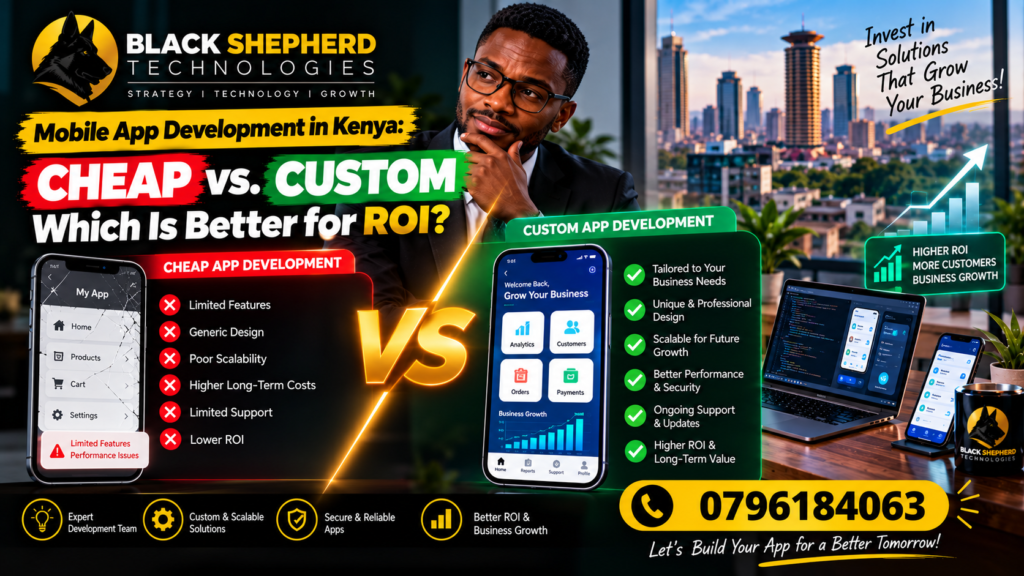
The digital transformation sweeping across East Africa has turned mobile applications from luxury corporate assets into absolute operational necessities. From Nairobi’s bustling fintech hub in Kilimani and Westlands to retail powerhouses in Mombasa, Kisumu, and Eldoret, businesses are racing to capture mobile-first consumers. With Kenya boasting smartphone penetration rates soaring past 60% and mobile money transactions via M-Pesa driving trillions of shillings annually, having a mobile app feels like an open door to endless market share.
Yet, as business owners, founders, and Chief Technology Officers sit down to budget for their digital expansion, a monumental crossroad emerges: Do we opt for a cheap, template-based, or off-the-shelf mobile application, or do we invest in a bespoke, custom-built mobile app tailored specifically to our business ecosystem?
At first glance, the balance sheet seems to dictate the answer. A cheap mobile app—often built using rigid templates, cookie-cutter drag-and-drop builders, or sourced from low-cost overseas freelance arbitrage—promises a quick launch for a fraction of the cost. Meanwhile, custom mobile app development requires a heavier upfront capital commitment, detailed discovery phases, and a dedicated development team.
However, looking strictly at the initial price tag is the quickest way to destroy long-term Return on Investment (ROI). In the vibrant, highly competitive Kenyan and broader African digital landscape, software is not merely an expense; it is a revenue-generating engine.
In this comprehensive guide, we will dissect the financial realities, technical nuances, hidden costs, and ultimate ROI outcomes of choosing between cheap and custom mobile app development in Kenya. Whether you are scaling an enterprise, launching a high-potential startup, or expanding your digital footprint across African markets, understanding these mechanics will protect your capital and secure your competitive edge.
1. The Kenyan Mobile Ecosystem: A High-Stakes Playground
Before evaluating development strategies, we must understand the unique environment in which Kenyan applications operate. Kenya is not Silicon Valley, nor is it Western Europe. The digital infrastructure, consumer behaviors, and economic realities present unique challenges and opportunities that dictate how software must perform.
Connectivity and Data Costs
While Kenya boasts impressive 4G coverage and expanding 5G networks in major urban centers like Nairobi, Mombasa, and Kisumu, mobile data remains a precious commodity for the average consumer. Applications that are heavy, unoptimized, or bloated with unnecessary background scripts will consume a user’s data bundle within days. When a Kenyan consumer realizes an app is burning through their Safaricom or Airtel data bundle, they delete it immediately. Cheap template apps are notoriously bloated, whereas custom apps can be engineered for data efficiency, offline-first caching, and lightning-fast load speeds.
The M-Pesa Imperative
You cannot talk about mobile applications in Kenya without integrating mobile money. M-Pesa is the financial circulatory system of the country. A successful mobile application—whether in e-commerce, logistics, agribusiness, or healthcare—must seamlessly integrate with local payment gateways, Daraja APIs (Lipa Na M-Pesa STK push), bank transfers, and alternative digital wallets.
- Cheap Apps: Often rely on generic, plugin-based payment integrations that frequently fail, break during API updates, or lack secure error-handling, leading to abandoned carts and lost revenue.
- Custom Apps: Built with native or robust hybrid integrations that guarantee secure, instant, and frictionless M-Pesa STK pushes, drastically reducing transaction drop-off rates and boosting conversion efficiency.
Multi-Device Fragmentation
In Kenya, mobile users run everything from high-end Apple iPhones and Samsung Galaxy flagships to budget-friendly Infinix, Tecno, Itel, and Xiaomi Android devices running various OS versions and screen sizes. A cheap template app tested only on a modern iPhone will frequently crash, distort layouts, or fail entirely on a budget Android device popular among the mass market. Custom development ensures comprehensive cross-platform optimization, rigorous local QA testing, and seamless performance across the exact hardware your target demographic uses.
2. Defining the Contenders
To make an objective comparison, let us clearly define what we mean by “Cheap” versus “Custom” mobile app development in the Kenyan context.
The “Cheap” Mobile App
A cheap mobile app typically costs anywhere from KES 30,000 to KES 150,000 (roughly $250 to $1,100 USD). These are characterized by:
- Pre-made Templates: Reused codebases where your logo and brand colors are slapped onto a generic framework.
- No-Code / Low-Code Builders: Drag-and-drop app creators that limit feature sets, customization, and scalability.
- Offshore Freelance Arbitrage: Sourced through overseas platforms where developers have zero understanding of the Kenyan market, local regulations (like the Data Protection Act, 2019), or consumer psychology.
- Zero Post-Launch Support: Once the app is handed over, you are on your own when bugs emerge or app stores (Google Play and Apple App Store) update their compliance policies.
The Custom Mobile App
A custom mobile app is a bespoke digital product engineered from scratch to solve specific business problems and capture precise market opportunities. Characterized by:
- Tailored Architecture: Built specifically for your business logic, workflow, and user journey.
- Scalable Tech Stack: Utilizing modern frameworks (Flutter, React Native, Native Swift/Kotlin) capable of handling millions of users.
- Deep Local & Regional Integration: Custom APIs connecting your app to local ERPs, CRMs, logistics tracking, and financial systems like M-Pesa.
- Comprehensive Lifecycle Partnering: Managed by professional digital agencies (such as those offering specialized SEO and digital growth services in Kenya) that handle ongoing maintenance, security updates, and performance optimization.
3. The True Cost Breakdown: Upfront vs. Total Cost of Ownership (TCO)
When evaluating ROI, business leaders frequently commit the cardinal sin of looking only at the initial development cost. Let us analyze the financial lifecycle of both approaches over a 3-year period.
Scenario A: The Cheap App Financial Model
- Upfront Cost: KES 80,000
- Hidden Costs & Maintenance:
- Month 2: The app crashes every time an Android system update occurs. Cost to fix: KES 40,000 (finding a new developer because the original disappeared).
- Month 6: You need to add a new product category or integrate a new payment method. The template cannot support it. Cost to rebuild from scratch: KES 150,000.
- Month 12: Users leave 1-star reviews due to slow load times and UI glitches. Customer acquisition spend is wasted because retention is near zero. Estimated lost revenue: KES 500,000+.
- Total 3-Year Spend: Over KES 670,000+ in patchwork fixes, rebuilds, and lost opportunities, with zero sustainable business value.
Scenario B: The Custom App Financial Model
- Upfront Investment: KES 500,000 to KES 2,000,000+ (depending on complexity).
- Value & Maintenance:
- Scalability: Built modularly. Adding new features requires minor updates rather than a complete rewrite.
- High Conversion & Retention: Intuitive UI/UX designed specifically for Kenyan consumer behavior results in high engagement.
- Robust Security: Fully compliant with the Office of the Data Protection Commissioner (ODPC) guidelines, avoiding crippling regulatory fines and loss of consumer trust.
- Total 3-Year Spend: Higher initial capital outlay, but generates steady, compounding revenue, low maintenance overhead, and high asset valuation.
When you calculate Total Cost of Ownership (TCO), cheap apps are invariably more expensive because they must be repeatedly replaced, whereas custom apps become revenue-generating corporate assets.
4. How ROI is Calculated in Mobile App Development
Return on Investment (ROI) in software is not an abstract concept; it is a hard financial metric calculated using the following formula:
$$\text{ROI} = \frac{\text{Net Gain from App} – \text{Total Cost of Development \& Maintenance}}{\text{Total Cost of Development \& Maintenance}} \times 100$$
To maximize this formula, you must either drive up the “Net Gain” or optimize the “Total Cost” over time. Let us examine how cheap versus custom development impacts each variable of this equation.
A. Driving Net Gain (Revenue & Efficiency)
- Conversion Rate Optimization (CRO): A custom app guides the user effortlessly from download to checkout. In e-commerce or service booking, shaving even two seconds off the checkout flow or simplifying M-Pesa payment confirmation can spike conversion rates by 30%. Cheap apps force users through clunky, generic checkout funnels, tanking conversion rates.
- User Retention & Lifetime Value (LTV): Acquisition costs in Kenya (through digital marketing, social media ads, and influencer partnerships) are rising. If a cheap app frustrates users and they churn within 48 hours, your customer acquisition cost (CAC) destroys your margins. Custom apps use personalized notifications, smooth UI/UX, and reliable performance to keep users engaged for years, maximizing LTV.
- Operational Automation: Custom apps often double as internal efficiency tools. By integrating directly with inventory management, dispatch systems, and accounting software, they eliminate manual data entry, reduce human error, and save hundreds of operational hours monthly.
B. Protecting the Investment (Mitigating Risk)
Risk is a negative multiplier on ROI. Cheap apps introduce massive operational, security, and reputational risks:
- Data Breaches: Cheap apps often lack robust encryption, leaving customer phone numbers, transaction histories, and personal data vulnerable to cybercriminals. In Kenya, a data breach reported to the ODPC can result in fines up to KES 5 million or 1% of annual turnover, alongside devastating PR damage.
- Vendor Lock-in and Abandonment: Cheap developers rarely document their code. If they abandon the project, no other developer can untangle the mess, forcing you to start over.
- App Store Rejections: Apple and Google have strict quality and security guidelines. Template apps frequently fail automated app store reviews, leaving your marketing campaigns stranded with no app to download.
5. Case Studies & Industry Applications in Kenya
To ground these insights in reality, let us examine how different sectors in Kenya experience ROI across various app development strategies.
Fintech and Micro-Lending
- The Context: Kenya is a global fintech powerhouse. Loan apps, savings platforms, and payment aggregators operate in a hyper-competitive space.
- Cheap App Route: A startup uses a cheap template to launch a lending app. Security vulnerabilities allow fraudulent loan applications and data leaks. The app crashes under heavy concurrent traffic during end-of-month salary disbursement cycles. The business collapses within six months.
- Custom App Route: A scalable custom fintech app built with secure cloud architecture, automated credit scoring APIs, and instant M-Pesa disbursement handles thousands of concurrent requests seamlessly, building investor confidence and capturing substantial market share.
E-Commerce and Retail
- The Context: Online shopping is booming across Nairobi estates (Kilimani, Kileleshwa, Roysambu) and regional hubs.
- Cheap App Route: A rigid template e-commerce app cannot sync with the retailer’s physical POS system or physical inventory warehouse. Customers order items that are out of stock, leading to furious reviews and cancelled orders.
- Custom App Route: A bespoke e-commerce application syncs real-time inventory across physical retail outlets and the digital storefront, featuring push notifications for flash sales and instant M-Pesa STK push. The resulting efficiency drives repeat purchases and high customer satisfaction.
Agribusiness and Logistics
- The Context: Connecting farmers in rural production hubs (like Naivasha, Meru, or Kitale) with urban markets in Nairobi requires specialized supply chain tracking.
- Cheap App Route: Fails due to lack of offline data synchronization when drivers enter low-connectivity zones.
- Custom App Route: Features offline-first data caching where transactions and delivery updates sync automatically the moment network connection is re-established, safeguarding supply chain integrity.
To explore how robust digital infrastructure, professional portfolio execution, and strategic web and mobile design integrate seamlessly, review our portfolio projects and discover the industries we serve.
6. Strategic Decision Framework: Which Should You Choose?
Not every business needs a multi-million-shilling custom enterprise application right out of the gate. Resource allocation requires strategic wisdom. Use this decision framework to determine your optimal path:
Choose a Simple/Low-Cost Approach IF:
- You are validating a raw concept: You want to run a quick proof-of-concept (PoC) or MVP (Minimum Viable Product) over a 2-week period to test if target users even care about your idea.
- Internal utility only: The app is intended for internal use by a tiny team of 5 employees where bugs can be communicated and fixed verbally.
- Zero financial risk: Failure of the app will result in zero financial or reputational loss.
Choose Custom App Development IF:
- Your core business model relies on the app: If the app is your product or primary sales channel, compromising on its quality is commercial suicide.
- You handle sensitive user data & payments: Any app processing M-Pesa transactions, personal identities, or financial records demands enterprise-grade custom security.
- You plan to scale across East Africa: If you intend to expand from Kenya into Uganda, Tanzania, Rwanda, and beyond, your app architecture must be scalable, localized, and modular.
- You value long-term asset creation: You want a digital product that holds intrinsic valuation, attracts venture capital, and appreciates as a corporate asset.
7. Partnering for Success: What to Look for in a Kenyan Development Agency
If you decide that custom mobile app development is the correct catalyst for your ROI, your choice of development partner will make or break the venture. The Kenyan tech scene is vibrant, but it features a wide spectrum of talent quality. When selecting a digital agency, evaluate them against these core criteria:
- Demonstrated Portfolio: Look beyond flashy promises. Inspect their past projects. Do their apps perform smoothly? Are they live on the Google Play and Apple App Stores? Explore established portfolios such as our portfolio and completed projects showcase.
- Comprehensive Digital Ecosystem Understanding: Building an app in isolation is a mistake. Your app must connect with your website, search engine visibility, and digital marketing funnels. Partner with agencies that understand holistic digital growth, including professional SEO services in Kenya to ensure your app and web assets rank and acquire organic traffic.
- Transparent Discovery and Scoping Phase: A professional agency will never throw a random price at you before understanding your business logic. They will take you through a rigorous discovery workshop to map out wireframes, user personas, technical requirements, and milestone roadmaps.
- Post-Launch SLA (Service Level Agreement): Software is never “finished.” Operating systems update, security patches drop, and user feedback requires iterative feature tweaks. Ensure your partner offers reliable maintenance agreements.
Conclusion: Investing for Maximum ROI
The debate between cheap and custom mobile app development in Kenya ultimately boils down to a fundamental business philosophy: Are you looking for a short-term expense or a long-term investment?
Cheap mobile apps offer the sweet siren song of immediate savings, but they consistently deliver broken user experiences, severe security vulnerabilities, unscalable codebases, and ultimately, a negative ROI driven by wasted marketing budgets and lost customer trust.
Custom mobile app development, while requiring a more deliberate upfront investment of capital and strategic planning, builds a secure, high-performing, scalable commercial asset. In a dynamic, mobile-first market like Kenya, a custom app aligns perfectly with local consumer habits, integrates flawlessly with M-Pesa and regional financial systems, and positions your business for sustainable, compounding profitability.
Make the choice that respects your capital, protects your brand, and secures your competitive advantage across Africa’s digital frontier.
Ready to build a mobile app engineered for exceptional ROI and tailored specifically to the African market? Explore our industries we serve or review our proven portfolio projects to see how we bring digital visions to life.
