
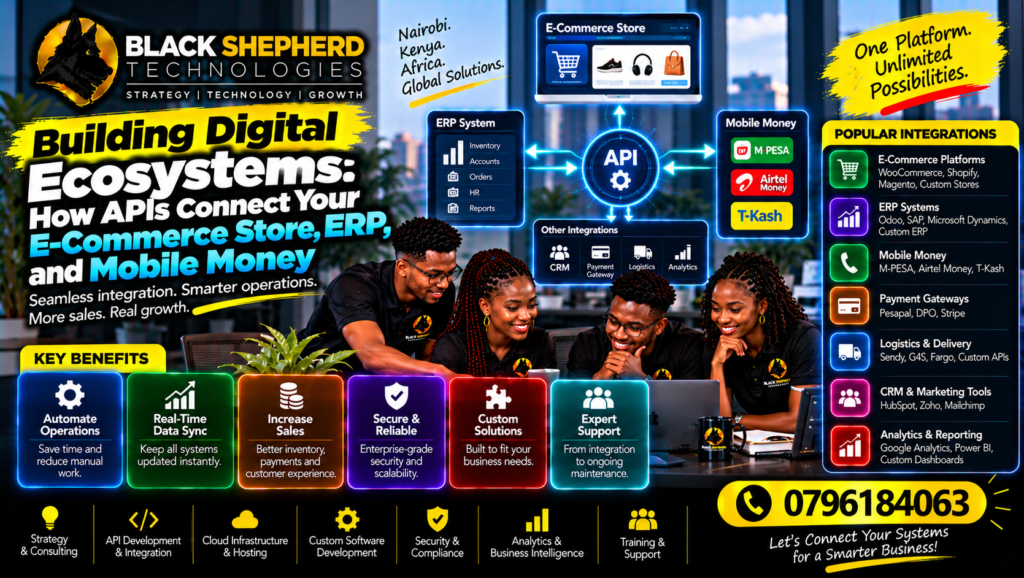
In the fast-moving commercial landscape of East Africa, growing businesses in Nairobi, Mombasa, Kisumu, and across the regional economic corridor face a defining operational reality: isolation is the enemy of efficiency. Whether running a multi-branch retail network, an expanding online marketplace, an FMCG distribution operation, or a B2B wholesale platform, modern enterprises rely on multiple software applications to execute daily operations.
A typical growing enterprise operates a customer-facing e-commerce storefront or mobile app, an internal Enterprise Resource Planning (ERP) or accounting database to track inventory and financial ledgers, and local payment gateways—most notably Safaricom’s M-Pesa—to settle transactions.
However, when these critical digital components exist as disconnected software silos, severe operational friction ensues. Employees spend hundreds of hours manually copy-pasting customer details, typing M-Pesa transaction reference codes into accounting spreadsheets, updating stock levels across separate dashboards, and chasing order fulfillment delays. This manual lag leads directly to human error, stockouts, delayed dispatches, frustrated customers, and bloated labor overheads.
The solution to this operational bottleneck lies in building an integrated Digital Ecosystem connected through Application Programming Interfaces (APIs). APIs act as secure digital bridges, allowing your e-commerce storefront, backend ERP database, mobile money channels, logistics carriers, and communication tools to converse, share data, and trigger automated workflows in real time without human intervention.
At Black Shepherd Technologies, we engineer high-performance custom software, enterprise platforms, and seamless API integration architectures tailored specifically for the East African economic environment. If you are auditing your enterprise digital stack or planning to integrate your core systems, explore our professional engineering portfolio and projects to see how we build market-leading technology solutions.
In this exhaustive, 3,000-word architectural guide, we will examine how APIs power modern digital ecosystems, detail the technical mechanics of connecting your e-commerce store, ERP, and mobile money rails, explore event-driven webhooks, address data security and compliance, and outline an implementation roadmap for enterprise growth.
-
The Anatomy of a Fragmented Business vs. an API-Connected Ecosystem
To understand the transformative power of API integration, business leaders must contrast the operational realities of a fragmented software environment with an API-driven digital ecosystem.
The Fragmented Business (Operational Silos)
In an un-integrated business, each software tool operates on its own isolated island:
-
The E-Commerce Storefront: Captures customer orders and shipping details, but has no live visibility into actual warehouse stock levels.
-
The ERP / Accounting System: Tracks financial ledgers, purchasing, and stock levels, but relies on manual data entry to record online sales.
-
The Mobile Money Gateway: Receives payments, but notifications remain trapped on merchant phone screens or raw bank dashboards until staff manually cross-reference payment codes with open order numbers.
                  THE FRAGMENTED BUSINESS (MANUAL SILOS)

  [ E-Commerce Store ] --(Manual Entry)--> [ Excel / ERP ]
            |                                    ^
            |                                    |
    (Manual Check)                         (Manual Reconcile)
            v                                    |
  [ Customer / WhatsApp ] <--------------- [ M-Pesa / Bank ]
The Cost: Delayed order processing, stock overselling, accounting reconciliation errors, high support ticket volumes, and an unsustainable dependence on manual administrative labor.
The API-Connected Digital Ecosystem
In an API-connected ecosystem, software platforms communicate continuously over secure REST or GraphQL protocols:
-
A customer places an order on your e-commerce website or mobile app.
-
The storefront pings the ERP API in real time to verify exact warehouse stock availability.
-
The system triggers an automated M-Pesa STK Push prompt directly to the customer’s mobile phone screen.
-
The moment the user enters their PIN, Safaricom’s server dispatches an API callback (webhook) confirming payment.
-
The API instantly updates the ERP ledger, deducts the purchased item from central inventory, generates a digital tax receipt, and alerts the warehouse dispatch team—completing the entire transaction in under three seconds without a single human keystroke.
                 THE API-CONNECTED ECOSYSTEM (AUTOMATED)

  [ E-Commerce Store ] <==== (REST API) ====> [ Central ERP / DB ]
           ||                                       ||
     (STK Push API)                           (API Webhook)
           ||                                       ||
           v                                         v
  [ Safaricom M-Pesa ] <==== (API Callback) ====> [ Fulfillment / Logistics ]
Whether your organization operates in retail e-commerce, wholesale distribution, financial services, or manufacturing, building a connected digital foundation is essential. Explore our specialized industries we serve page to see how we construct custom software integration architectures tailored to diverse commercial sectors.
-
What Is an API and How Does It Work in Enterprise Software?
For non-technical executives, understanding the core concepts of API architecture clarifies why bespoke integration is superior to generic, off-the-shelf software plugins.
The Restaurant Metaphor
Think of an API as a waiter in a restaurant.
-
You (the user on the E-Commerce Storefront) sit at the table looking at a menu of choices.
-
The kitchen (the ERP Database or M-Pesa Payment Server) holds the raw data and ingredients required to fulfill your order.
-
You cannot walk directly into the kitchen to grab food yourself; that would cause chaos and security risks.
-
Instead, the waiter (the API) takes your request, delivers it securely to the kitchen, retrieves the prepared response (data or payment confirmation), and brings it back to your table instantly.
Core API Protocols & Data Formats
Modern enterprise ecosystems rely primarily on two architectural standards:
-
REST (Representational State Transfer) APIs: The industry standard for web services. REST APIs use standard HTTP methods (
GETto fetch data,POSTto send data,PUTto update data,DELETEto remove data) to exchange structured information. -
JSON (JavaScript Object Notation): The lightweight, human-readable data format used by REST APIs to pass information between systems. For instance, an M-Pesa payment API callback delivers transaction data in a clean JSON payload:
{
  "TransactionType": "Pay Bill",
  "TransID": "QKH789XYZ10",
  "TransTime": "20261015111500",
  "TransAmount": 4500.00,
  "BusinessShortCode": "600100",
  "BillRefNumber": "ORD-10482",
  "MSISDN": "254712345678",
  "FirstName": "Brian"
}
By parsing this standardized payload automatically, your ERP or e-commerce software reads the exact transaction reference (TransID), matching amount (TransAmount), and order reference (BillRefNumber) in milliseconds.
-
The Three Pillars of East African E-Commerce Integration
Building an end-to-end digital ecosystem requires orchestrating data flows across three primary technology pillars: the customer-facing storefront, the backend operations engine, and the regional payment infrastructure.
                   THE THREE PILLARS OF INTEGRATION

  PILLAR 1: FRONTEND      --->   PILLAR 2: MIDDLEWARE/APIs   --->   PILLAR 3: BACKEND
  - Web Storefront               - REST / GraphQL Endpoints          - Enterprise ERP
  - Mobile App (Android/iOS)      - Asynchronous Webhooks             - Financial Ledgers
  - WhatsApp Business Chat       - Security & Encryption             - Central Warehouse DB
Pillar 1: The E-Commerce Storefront (Web & Mobile)
The storefront is your primary customer interaction layer—whether built on Shopify, WooCommerce, custom React/Node.js web applications, or native Android/iOS mobile apps.
Key API Requirements:
-
Real-Time Catalog Sync: Pings the ERP API to display live, accurate product pricing, variant options, and stock levels.
-
Cart & Checkout Logic: Captures delivery addresses, calculates shipping fees based on location APIs, and passes cart metadata securely to the payment gateway.
-
Customer Account Management: Syncs user purchase history, loyalty reward points, and saved delivery addresses with the central CRM.
Pillar 2: The Enterprise Resource Planning (ERP) System
The ERP (such as SAP, Microsoft Dynamics 365, Odoo, Sage, or a custom-engineered enterprise database) serves as the single source of truth for your corporate data.
Key API Requirements:
-
Inventory Management: Automatically decrements physical stock upon confirmed payment and reserves stock for pending orders to prevent overselling.
-
Financial Ledger Sync: Automatically credits appropriate accounts receivable ledgers, categorizes sales channels, and generates KRA eTIMS tax compliance documentation via API.
-
Order Status Updates: Pushes live fulfillment status changes (
Processing,Dispatched,Out for Delivery,Delivered) to the e-commerce storefront and customer notification channels.
Pillar 3: Mobile Money & Payment Rails (Safaricom M-Pesa Daraja)
In East Africa, seamless payment processing is the lifeblood of commerce. Integrating Safaricom’s Daraja API directly into your software stack unlocks frictionless digital transactions.
Key API Capabilities:
-
Lipa Na M-Pesa Online (STK Push): Triggers an instant, automated payment dialog directly onto the customer’s phone screen, prompting them to enter their M-Pesa PIN without navigating manual paybill menus.
-
C2B (Customer to Business) Validation & Confirmation: Automatically captures manual paybill or till payments made directly from mobile phones, validating transaction amounts before finalizing orders.
-
B2C (Business to Customer) Disbursements: Automates instant outbound payments—such as merchant supplier payouts, customer refunds, field agent commissions, or loan disbursements—directly from your ERP to recipient mobile wallets.
-
Webhooks: The Secret to Real-Time Event-Driven Automation
A common architectural flaw in early software integrations was reliance on “polling.” Polling means your e-commerce store or ERP constantly sends API requests every few seconds asking the payment server: “Has the customer paid yet? Has the customer paid yet?” This creates massive server strain, high network traffic, and unnecessary API rate-limit penalties.
Modern digital ecosystems utilize Event-Driven Architecture powered by Webhooks.
                    POLLING VS. WEBHOOK ARCHITECTURE

  POLLING (Inefficient):
  [ ERP ] --(Is it ready?)--> [ Payment Server ]  (Repeated every 5 sec)
  [ ERP ] --(Is it ready?)--> [ Payment Server ]  (Wasted bandwidth)
  [ ERP ] --(Is it ready?)--> [ Payment Server ]

  WEBHOOKS (Event-Driven & Instant):
  [ ERP ] <================== [ Payment Server ]  (Sends data ONLY when
                                                   event occurs!)
How Webhooks Work
A webhook is an HTTP callback—an automated message sent from one server to another the exact millisecond a specific event happens.
-
A customer enters their PIN on an M-Pesa STK push prompt.
-
The moment Safaricom authorizes the transaction, Safaricom’s server dispatches an asynchronous HTTP POST payload (the webhook) to your backend application server endpoint (
[https://api.yourbusiness.co.ke/v1/payments/mpesa-callback](https://api.yourbusiness.co.ke/v1/payments/mpesa-callback)). -
Your application server receives the webhook payload, verifies its cryptographic signature, updates the order status to “Paid,” and sends a response back (
200 OK) in less than 200 milliseconds.
Webhooks eliminate server polling, conserve bandwidth, and guarantee instant, real-time transaction processing.
-
Overcoming Key Technical Challenges in API Integrations
Building a production-grade API ecosystem requires addressing critical technical challenges to guarantee reliability, security, and data integrity under high transaction volumes.
Challenge 1: Asynchronous Network Delays and Retry Logic
Cellular networks across East Africa occasionally experience transient network hiccups, causing delayed payment callbacks or temporary API timeouts.
Engineering Solution: Implement an Idempotent Queue & Retry Engine:
-
Idempotency Keys: Ensure that if an M-Pesa webhook callback is delivered twice due to a network retry, your ERP processes the payment only once, preventing double-crediting or duplicate stock deductions.
-
Message Queues (RabbitMQ / Redis / Kafka): Place incoming webhooks into an asynchronous processing queue. If your backend ERP is temporarily undergoing maintenance, the queue holds the transaction safely and retries delivery automatically until confirmed.
Challenge 2: Security, Encryption, and Token Authentication
Exposing API endpoints to the public internet without ironclad security invites malicious attacks, data breaches, and unauthorized transaction injection.
Engineering Solution: Implement Enterprise Security Protocols:
-
OAuth 2.0 & Bearer Tokens: Require strict token-based authentication for all internal and external API endpoints.
-
IP Whitelisting & HTTPS Encryption: Enforce TLS 1.3 encryption for all data in transit and restrict payment callback listener endpoints to verified IP address ranges owned by payment providers.
-
API Key Rotation & HMAC Signatures: Validate payload integrity using HMAC (Hash-based Message Authentication Code) signatures to guarantee that incoming callback data was generated by the legitimate payment gateway and has not been tampered with in transit.
Challenge 3: Regulatory Compliance and Data Governance
In Kenya, processing customer personal records, payment data, and financial transactions falls under the jurisdiction of the Data Protection Act and KRA tax mandates.
Engineering Solution:
-
Data Anonymization & Role-Based Access Control (RBAC): Ensure sensitive payment records and personal identifiable information (PII) are stored with end-to-end encryption and accessible strictly to authorized personnel.
-
Automated eTIMS Integration: Utilize KRA eTIMS API connectors to generate compliant Electronic Tax Invoices automatically at the moment of payment clearance.
-
Step-by-Step Roadmap: How to Build Your API Ecosystem
Transitioning from fragmented software tools to an API-connected digital ecosystem requires a structured engineering roadmap:
               ENTERPRISE API IMPLEMENTATION ROADMAP

  [ PHASE 1 ]  --->  [ PHASE 2 ]  --->  [ PHASE 3 ]  --->  [ PHASE 4 ]
  System Audit       API Architecture   Sandbox Testing    Live Deployment
  & Mapping          & Middleware       & Error Handling   & Monitoring
Phase 1: Comprehensive System & Process Audit
-
Map every software application, database, and payment tool currently used across departments.
-
Document precise data flows: What data needs to move? Where does it originate? How frequently must it update?
-
Audit existing software for native REST/GraphQL API support and webhook capabilities.
Phase 2: API Architecture & Custom Middleware Development
-
Design clean, standardized API schemas for product catalogs, customer profiles, inventory metrics, and payment transactions.
-
Develop custom middleware or integration microservices (using high-performance frameworks like Node.js, Python FastAPI, or Go) to handle data transformation between systems that use different data formats.
Phase 3: Rigorous Sandbox Testing & Edge-Case Validation
-
Test all API endpoints and webhook listeners in developer sandbox environments.
-
Simulate failure scenarios: What happens if M-Pesa times out? What if a product goes out of stock simultaneously on two channels? What if network connectivity drops mid-transaction?
-
Validate error-handling routines, automated retry queues, and idempotency logic.
Phase 4: Production Cutover, Monitoring, and Logging
-
Deploy the integration architecture to live enterprise cloud infrastructure.
-
Set up real-time API monitoring tools (Datadog, Prometheus, or ELK Stack) to track endpoint latency, success rates, error spikes, and server load.
-
Maintain comprehensive application logs for financial auditing and troubleshooting.
-
Driving Enterprise Growth with Advanced SEO
Engineering an API-connected digital ecosystem ensures that when customers buy from your business, they experience unmatched speed, instant payment verification, and reliable order fulfillment. However, internal operational excellence and seamless system integration represent only one side of the commercial equation; your enterprise must also capture continuous market demand.
If prospective corporate clients, B2B buyers, or retail consumers searching for your products and services online cannot discover your digital platform on Google, your competitors will capture that market share. Implementing technical SEO, structured schema markup, fast page speed optimization, and targeted local content strategies is essential for dominating search engine results pages. Partnering with professionals providing expert SEO services in Kenya is the most sustainable way to drive high-value organic traffic directly to your digital ecosystem.
Conclusion: Build Your Digital Ecosystem for 2026 and Beyond
Building a connected digital ecosystem by integrating your e-commerce store, backend ERP database, and local mobile money channels is no longer a luxury for forward-thinking businesses; it is essential operational infrastructure for scaling in East Africa.
By eliminating manual administrative drag, eradicating payment reconciliation errors, preventing inventory stockouts, and processing transactions in real time via APIs and webhooks, your enterprise transforms routine operations into a distinct competitive advantage.
At Black Shepherd Technologies, we empower corporate enterprises, retail networks, logistics operators, and growing businesses across East Africa with elite custom software engineering, robust API architectures, and seamless digital integrations. Get in touch with our engineering team today to audit your technology stack, connect your core business platforms, and build a digital ecosystem engineered for sustainable, profitable growth.
