
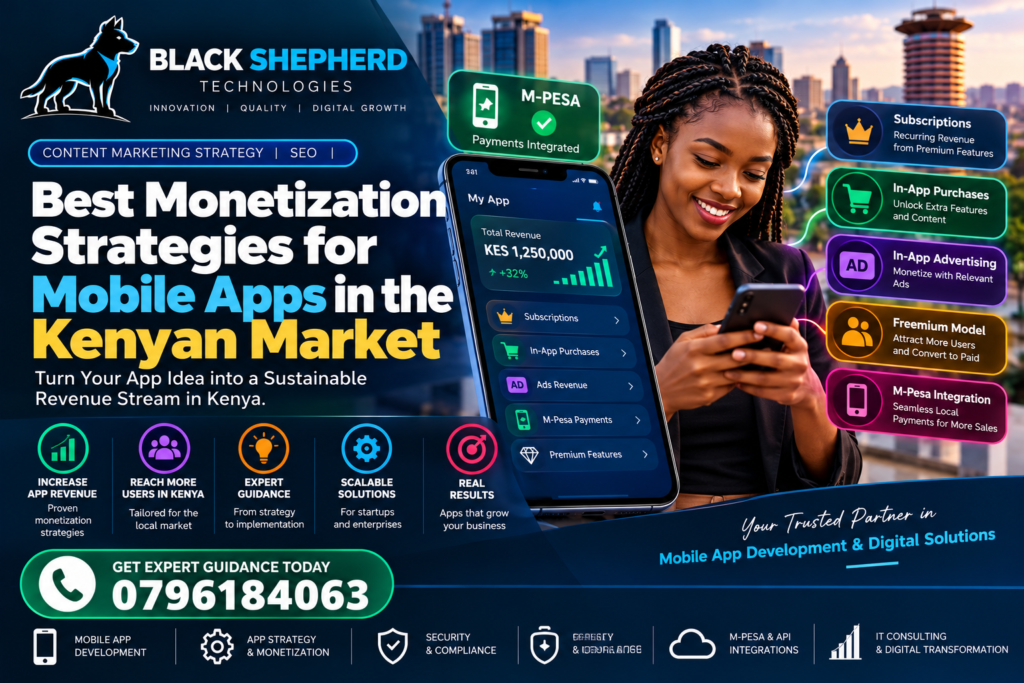
The mobile application ecosystem in East Africa is experiencing unprecedented acceleration. With widespread smartphone penetration, affordable 4G and 5G data bundles from carriers like Safaricom and Airtel, and an increasingly tech-savvy urban demographic in Nairobi, Mombasa, Kisumu, and Nakuru, building a mobile app is no longer just a vanity project for corporate brands—it is a powerful commercial engine.
However, a common pitfall that haunts software startups and established enterprises alike is building a magnificent app with thousands of downloads on the Google Play Store and Apple App Store, only to watch it fail commercially. Getting users to download your application is only half the battle; the ultimate test is converting that digital engagement into sustainable, recurring revenue.
Monetizing an application in the Kenyan and broader East African market requires a nuanced understanding of local consumer behavior, purchasing psychology, digital infrastructure, and payment habits. Western monetization models—such as credit card-backed subscriptions or high-volume display advertising—often fall flat in a market where mobile money reigns supreme and consumer disposable income requires clear, undeniable value justification.
At Black Shepherd Technologies, we engineer high-performance mobile applications and digital platforms tailored specifically for the East African economic landscape. If you are planning your next digital product or looking to optimize your software architecture, explore our professional engineering portfolio and projects to see how we bring innovative software to life.
In this exhaustive, 3,000-word guide, we will break down the top monetization strategies for mobile apps in Kenya, analyzing how to leverage M-Pesa integrations, freemium models, in-app purchases, targeted advertising, and localized corporate partnerships to maximize your mobile app’s return on investment (ROI).
1. The Kenyan Mobile Economy: Consumer Behavior and Payment Realities
Before selecting a monetization model for your mobile app, you must analyze the unique characteristics of the Kenyan digital consumer. Failing to align your pricing and payment mechanisms with local realities is the fastest route to high churn rates and abandoned carts.
The Mobile-First and Mobile-Money Dominance
Kenya is globally renowned as a pioneer of mobile money. Safaricom’s M-Pesa commands over 90% of the mobile money market, complemented by Airtel Money and T-Kash. For the average Kenyan smartphone user:
-
Bank accounts are secondary to mobile wallets: While traditional banking is growing through apps like Equity’s Equitel and KCB Mobile, millions of citizens transact daily entirely via mobile money wallets linked to their phone numbers.
-
Frictionless payments drive conversion: Requiring a user to input a 16-digit Visa or Mastercard number, expiry date, and CVV creates massive friction. Conversely, triggering an M-Pesa STK Push that prompts a user for their PIN in seconds drastically increases conversion rates.
The Value-Sensitivity Factor
Kenyan consumers are notoriously value-conscious. Because disposable income is hard-earned, users evaluate apps through a strict utility lens: “What problem does this app solve for me today, and is it worth sacrificing hard-earned money?”
To monetize successfully, your app must deliver immediate utility—whether it saves time, reduces transport costs, provides essential education, streamlines business operations, or offers unbeatable convenience.
For businesses operating across diverse sectors—including retail, logistics, hospitality, agriculture, and fintech—tailoring your monetization strategy to fit your specific market segment is critical. Discover how we design custom monetization and operational workflows across the various industries we serve.
2. Strategy 1: The Freemium Model with M-Pesa Premium Tier Upgrades
The Freemium model is arguably the most effective monetization strategy for consumer-facing apps in Kenya. Under this model, the core application is downloaded and used completely free of charge, but advanced features, higher transaction limits, exclusive content, or ad-free experiences are locked behind a paid subscription or one-time upgrade.
Why Freemium Works in Kenya
The psychological barrier to downloading an app drops to zero when there is no upfront purchase cost. In a market where users are cautious about unverified software, a free download allows them to test your UI/UX, verify your app’s reliability, and build trust.
Implementing Localized Paywalls
When a free user hits a feature limit and decides to upgrade, your payment gateway must support local instruments. Instead of asking for international credit cards, your app should seamlessly integrate an M-Pesa STK Push API call.
For example, a fitness coaching app or an educational revision app can offer free basic content, but charge KES 250 per month or KES 2,500 per year for premium access. When the user taps “Upgrade to Pro,” a prompt appears on their phone screen: “Pay KES 250 to Black Shepherd Premium. Enter M-Pesa PIN.” The transaction clears in under five seconds, and the user’s account is instantly upgraded via webhook confirmation.
3. Strategy 2: In-App Purchases (IAP) and Consumable Credits
If your app relies on transactional interactions—such as digital marketplaces, classifieds, delivery services, ticketing platforms, or gaming—In-App Purchases (IAP) and consumable digital credits represent a lucrative revenue stream.
Consumable vs. Non-Consumable IAPs
-
Consumable Credits: Users purchase virtual tokens, credits, or coins that deplete as they use services within the app. For instance, a B2B logistics app might sell “load-posting credits” to transporters, or a real estate listing app might sell “boost tokens” to landlords wanting to pin their properties to the top of search results.
-
Non-Consumable Features: Permanent unlocks purchased once, such as removing advertisements forever or unlocking a specific offline map pack for navigating Nairobi traffic without data connection.
Case Study: B2B Marketplace Monetization
Consider a specialized B2B wholesale app connecting hardware manufacturers with hardware shop owners across East Africa. While browsing product catalogs is free, securing a direct verified supplier contact or placing bulk orders triggers a small transaction facilitation fee or subscription tier. By integrating flexible payment rails, businesses can fund their virtual app wallets via bank transfer or M-Pesa paybill, ensuring uninterrupted trade.
4. Strategy 3: Direct Subscription Models (SaaS and Content Services)
For software-as-a-service (SaaS) applications, productivity tools, enterprise resource planning (ERP) mobile companions, and specialized news or research portals, the recurring subscription model provides predictable, compounding monthly recurring revenue (MRR).
Structuring Subscription Tiers for the East African Market
Subscription pricing in Kenya must account for local cash flow cycles. Many professionals and small business owners operate on monthly budgeting cycles aligned with salary disbursements at the end of the month.
-
Daily and Weekly Micro-Subscriptions: Recognizing that cash flow can fluctuate, offering micro-subscriptions (e.g., KES 50 per day or KES 200 per week) can dramatically outperform annual subscriptions for lower-income or gig-economy users who cannot commit to large upfront sums.
-
Monthly Enterprise Tiers: For B2B applications targeting corporate firms in Upper Hill or Westlands, monthly or annual invoicing backed by automated M-Pesa recurring billing or corporate bank integration ensures steady cash flow.
5. Strategy 4: Transaction-Based Commissions and Marketplace Take Rates
If your mobile application acts as a two-sided marketplace connecting service providers with consumers (e.g., ride-hailing, home cleaning, freelance carpentry, food delivery, or digital tutoring), taking a commission percentage on every transaction processed through the platform is the most natural monetization vector.
Building Trust in Marketplace Payments
In Kenya, peer-to-peer scams have made users wary of paying service providers directly before service delivery. Your mobile app can act as a trusted escrow intermediary:
-
The customer pays for the service via the app (funds are held in a secure merchant account).
-
The service provider completes the delivery or ride.
-
Upon customer confirmation (or automatic timeout), the app releases the payout to the service provider’s mobile wallet via an M-Pesa B2C (Business-to-Consumer) API call, retaining your platform’s take rate (e.g., 10% to 15%).
This model aligns your revenue directly with the economic value flowing through your platform: the more successful transactions your app facilitates, the higher your earnings.
6. Strategy 5: Targeted In-App Advertising and Sponsored Placements
For apps with massive user acquisition and high daily active user (DAU) counts—such as news aggregators, entertainment apps, utility tools, and casual games—advertising remains a viable monetization pillar. However, running generic, low-paying banner ads from global ad networks often yields disappointing returns in the African market due to lower eCPMs (effective cost per mille).
Maximizing Ad Revenue Locally
To make advertising profitable in Kenya, consider these advanced tactics:
-
Sponsored Content and Native Placements: Instead of annoying pop-up ads, partner with local brands for native sponsored placements. For example, a recipe app can feature branded cooking oil or flour in its featured weekly meal plans.
-
Geo-Targeted Local Advertisements: Local SMEs (restaurants, car dealerships, fashion boutiques) are eager to reach hyper-targeted local audiences. Building an in-house ad-serving module allows you to sell direct banner space to Nairobi businesses, charging them directly in Kenyan Shillings (KES) rather than relying solely on programmatic ad networks.
-
Rewarded Video Ads: In gaming and utility apps, reward users with virtual currency or premium features in exchange for watching a 30-second promotional video. User engagement with rewarded ads is significantly higher than traditional display banners.
7. Strategy 6: Corporate Sponsorships and B2B White-Labeling
Many successful mobile apps in Kenya achieve profitability not through millions of retail consumers, but through high-value B2B contracts and corporate sponsorships.
White-Labeling Your Technology
If you have built a stellar mobile app architecture—such as an event ticketing app, a sacco management portal, or an inventory tracking tool—you can license your source code as a white-label product to other organizations, Saccos, or county governments. Charging a hefty initial setup fee plus ongoing maintenance and hosting retainers generates substantial enterprise revenue.
Strategic Brand Partnerships
Non-profits, financial institutions, and telecommunication giants frequently look for innovative digital channels to reach grassroots communities. Partnering with a bank like KCB or Co-operative Bank to sponsor specific features within your app can completely cover your development and operational costs while providing free utility to your user base.
8. Overcoming Common Monetization Pitfalls in Kenya
Even with a brilliant app and a solid monetization strategy, execution errors can derail your revenue goals. Avoid these common traps:
1. Ignoring Offline Functionality
Internet connectivity in Kenya, while vastly improved, can still experience drops in remote areas or deep indoors. An app that refuses to open or crashes when offline will quickly be uninstalled. Ensure critical cached data and graceful offline states are built into your architecture.
2. Over-Monetizing Too Early
Aggressive paywalls that pop up before the user experiences any core value will destroy your retention metrics. Let users experience the “aha moment” of your app before introducing subscription prompts or payment gates.
3. Poor Error Handling in Payment Gateways
If an M-Pesa STK push fails because the user entered the wrong PIN or had insufficient funds, your app must provide a crystal-clear error message and a retry button. Vague error codes like
Error 500: Internal Server Error will cause users to panic and assume their money was stolen.9. Driving Growth with Enterprise SEO and Digital Marketing
Monetizing an app successfully starts long before the user opens the app store—it starts with high-intent user acquisition. If potential customers cannot find your app or landing page when searching for solutions on Google, your monetization funnel starves.
Implementing rigorous search engine optimization ensures that your mobile app landing pages rank at the top of search engine results pages for lucrative local queries. Whether you need technical keyword optimization, programmatic SEO, or authoritative link-building, investing in professional SEO services in Kenya is the most effective way to drive organic, high-value downloads at scale.
Conclusion: Building a Profitable Digital Future
Monetizing a mobile app in Kenya is an art and a science. It demands an intimate understanding of local payment rails like M-Pesa, a deep respect for consumer value-sensitivity, and a robust technical architecture that ensures frictionless transactions.
Whether you choose a freemium model, in-app purchases, marketplace commissions, or corporate sponsorships, success belongs to those who combine flawless software engineering with intelligent business strategy.
At Black Shepherd Technologies, we help businesses transform visionary app concepts into market-leading, revenue-generating digital products. Get in touch with our engineering team today, and let’s build a high-performing mobile app engineered for sustainable growth and profitability in East Africa.
