
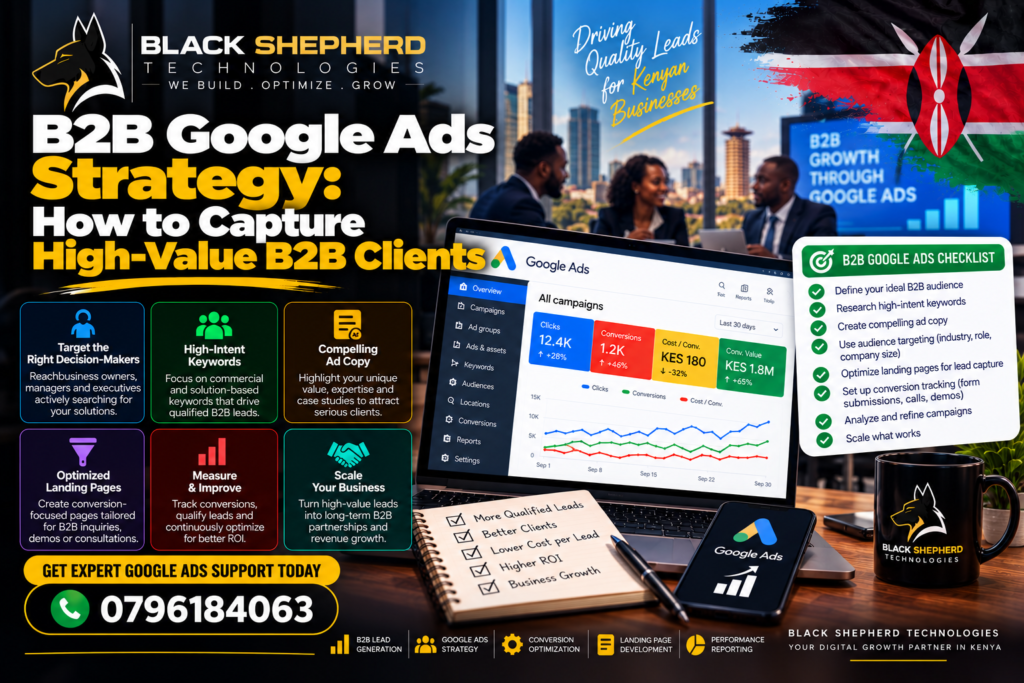
Capturing high-value B2B clients—such as enterprise software deals, corporate advisory contracts, or large-scale industrial accounts—requires a fundamentally different Google Ads strategy than standard B2C campaigns. B2B buying journeys involve long sales cycles, multiple C-suite decision-makers, high contract values, and strict procurement compliance.
If your Google Ads campaigns are optimized purely for “cheap lead volume,” your sales team will end up chasing low-budget inquiries, job seekers, and students while wasting advertising spend.
To capture true enterprise decision-makers, deploy this high-value B2B Google Ads framework.
1. High-Intent Keyword Targeting (Quality Over Volume)
In B2B advertising, high search volume is often a trap. Broad informational queries like “cloud security” or “ERP software” attract casual researchers, students, and low-budget startups. To reach C-suite and procurement teams, target low-volume, hyper-specific commercial intent queries:
The High-Value B2B Intent Spectrum
 Low Intent (Avoid/Examine) ──► High Commercial Intent (Target)
 "what is cloud security"          "enterprise cloud security provider for financial institutions"
-
Competitor Alternative Queries: Target buyers actively evaluating replacements for established vendors (e.g.,
"[Competitor] alternative for enterprise"or"[Competitor] vs [Our Platform]"). These searchers are already at the bottom of the buying funnel with allocated budgets. -
Feature & Integration Modifiers: Include technical requirements in your keywords (e.g.,
"ISO 27001 compliant CRM"or"ERP integration for SAP"). -
Enterprise & Role Modifiers: Add high-value qualifiers such as
"enterprise,""managed,""consulting,""for financial institutions,"or"for healthcare."
2. Advanced Audience Layering & Account-Based Marketing (ABM)
Search keywords reveal what is being searched, but audience layers ensure who is searching aligns with your Ideal Customer Profile (ICP).
High-Value B2B Targeting Layer
 [ High-Intent Keyword Query ] + [ Customer Match First-Party Data ] + [ In-Market & Company Size Signals ]
-
Customer Match & ABM Account Lists: Upload first-party CRM email lists of target accounts, existing high-ticket clients, and key decision-makers. Use Google’s AI to build targeted lookalike segments.
-
In-Market B2B Audiences: Layer Google’s built-in In-Market B2B segments (e.g., Business Technology, Enterprise Software Solutions, or Corporate Financial Services) over your Search campaigns.
-
Demographic & Geographic Exclusions: Exclude non-target locations and adjust bid multipliers based on corporate geographic hubs.
3. Account-Level Negative Keyword Protection
Stopping wasted ad spend on irrelevant traffic is critical when B2B Cost-Per-Clicks (CPCs) range between $15 and $50+. Build robust, account-level Negative Keyword Lists to filter out non-buyers immediately:
4. B2B Ad Copy: Empathy, Specific Metrics & Qualification
High-converting B2B ad copy does two things simultaneously: it attracts the target decision-maker and discourages irrelevant clicks.
B2B Responsive Search Ad (RSA) Structure
 [ Exact Match Headline ] ──► [ Specific Outcome Metric ] ──► [ Enterprise Qualification & Low-Friction CTA ]
-
Lead with Specific Outcomes (Not Superlatives): Replace generic claims like “Leading Software Company” with verifiable metrics (“Reduce Procurement Cycle Times by 35%”).
-
Qualify in the Ad Copy: Explicitly state who your solution is built for (e.g., “Built for Mid-Market & Enterprise Teams” or “Min. 50+ User Licenses”).
-
Address C-Suite Objections: Highlight compliance, security, and risk-mitigation credentials directly in your descriptions (e.g., “ISO Certified | SOC 2 Type II Compliant | Dedicated SLA Support”).
5. High-Converting Landing Page Framework for Enterprise Leads
Sending expensive B2B ad traffic to a generic homepage is the fastest way to burn your budget. Every ad group must point to a dedicated landing page designed specifically for corporate procurement.
Enterprise Landing Page Architecture
 [ Query-Matched Headline ] ──► [ Corporate Logos & Compliance Trust Badges ]
                                            │
 [ Low-Friction Offer (Demo/Audit) ] ◄── [ Short Form + Frictionless CRM Capture ] ◄──┘
-
Immediate Trust Signals: Place client logos, ISO/SOC badges, and industry awards above the fold.
-
Role-Specific Value Propositions: Match the hero headline to the exact search query and pain point.
-
Balanced Form Friction: Ask for enough information to qualify the lead (e.g., Work Email, Company Name, Team Size) without making the form so long that it tanks conversion rates. Enforce validation to block free email providers (
@gmail.com,@yahoo.com).
6. Closed-Loop CRM Attribution & Value-Based Bidding
The fundamental reason B2B campaigns fail is that ad platforms optimize for lead form completions rather than closed pipeline revenue. A $10,000 contract and a spam form fill look identical to an unlinked Google Ads pixel.
Closed-Loop Data Pipeline
 [ User Fills Lead Form ] ──► [ Lead Recorded in CRM (HubSpot / Salesforce) ]
                                            │
 [ Conversion Value Pushed Back to Google Ads ] ◄── [ Sales Qualification (SQL / Closed Won) ] ◄──┘
-
Implement Enhanced Conversions for Leads: Pass hashed customer data alongside the Google Click ID (GCLID) into your CRM.
-
Track Pipeline Milestones: Send conversion signals back into Google Ads when a lead transitions from MQL (Marketing Qualified) →\rightarrow SQL (Sales Qualified) →\rightarrow Closed Deal.
-
Deploy Value-Based Bidding (tROAS): Assign higher conversion values to downstream sales milestones, training Google’s AI to bid aggressively on keywords and profiles that generate real pipeline revenue.
High-Value B2B Action Checklist
Final Thoughts
Winning enterprise B2B accounts on Google Ads requires treating paid search as a high-precision pipeline engine rather than a mass-market lead generator. By focusing on commercial intent keywords, filtering out non-buyers with account-level negatives, providing enterprise proof on landing pages, and looping CRM revenue data back into your ad account, you consistently capture high-value corporate clients.
