
Ask any business owner or marketing manager in Nairobi, Mombasa, or Kisumu how their website is performing, and you will almost always hear a familiar phrase: “We are on Google, so people can find us.”
When pressed for specifics, they open Google.co.ke, type in their company name or a hyper-specific brand phrase, see their logo pop up at position number one, and feel a reassuring sense of accomplishment.
Then comes the harsh commercial reality check: Zero inquiries, zero inbound phone calls, and stagnant sales.
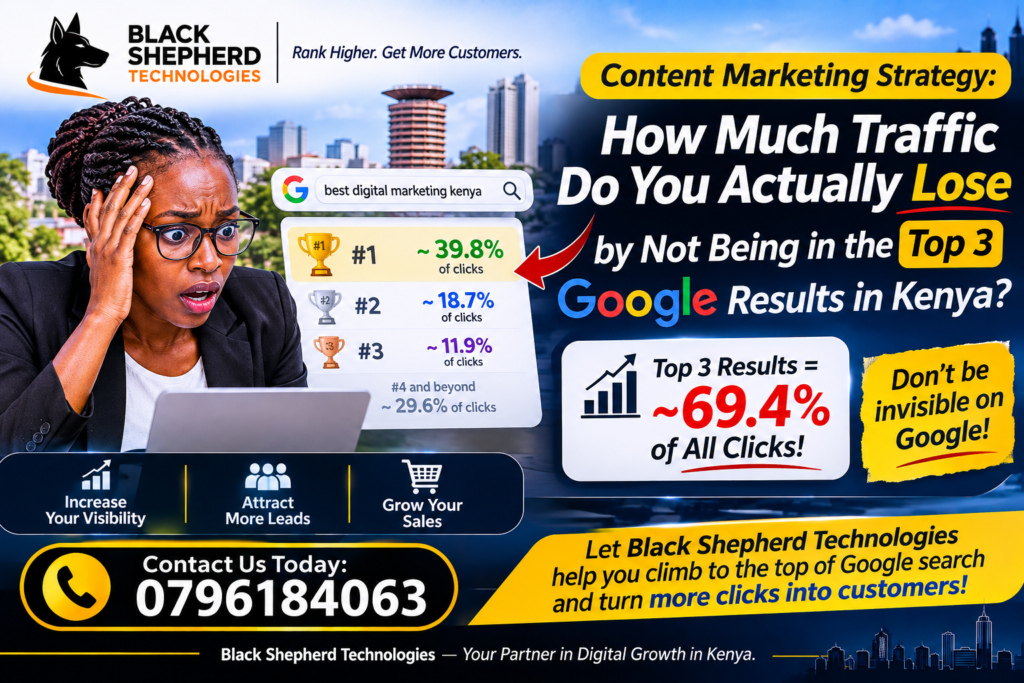
The reason why most Kenyan business websites fail to generate predictable revenue through search engines comes down to a brutal mathematical cliff known as the SERP Click-Through Rate (CTR) Curve. In digital marketing, ranking on page one is not an achievement—it is merely being invited to the stadium. Winning the match requires securing one of the top three organic positions.
When your service pages, e-commerce categories, or B2B landing pages languish at positions #4, #7, or #12 on Google.co.ke, you are not just missing out on a few clicks; you are forfeiting up to 90% of the active buyer traffic searching for what you sell. Partnering with data-driven SEO services in Kenya helps businesses bridge the costly gap between appearing on page one and capturing the lion’s share of high-intent clicks.
The Brutal Math of the SERP: Understanding Click-Through Rate (CTR) Curves
For over a decade, SEO researchers and data scientists at Advanced Web Ranking, Backlinko, and Sistrix have analyzed billions of search queries across desktop and mobile devices to map how human eyes and fingers interact with search engine results pages (SERPs).
While exact CTR percentages fluctuate slightly depending on whether Google displays an AI Overview, a Local Map Pack, or paid search ads at the top, the fundamental hierarchy remains absolute: The top three organic positions capture the vast majority of all human traffic.
The Global & Local SERP CTR Breakdown
The Real-World Cost of Ranking #7 Instead of #2
Imagine you operate an industrial solar installation company in Nairobi, and a high-value commercial query like “commercial solar panel installation cost Kenya” receives 3,000 exact searches every month from business owners and procurement managers.
-
If you rank at Position #2: You capture roughly 15% of those searches. That equals 450 targeted website visits per month from active buyers with budgets.
-
If you rank at Position #7: You capture roughly 2% of those searches. That equals 60 website visits per month—most of whom will bounce before reading your pricing or filling out a contact form.
By slipping from position #2 to position #7, you lose 390 potential high-intent corporate visitors every single month—nearly 4,700 missed buyer opportunities a year. Reviewing proven SEO portfolios and digital case studies in Kenya demonstrates how pushing high-intent commercial keywords from the bottom of page one into the top three positions routinely doubles or triples inbound lead volume within 60 to 90 days.
Why the Top 3 Dominate Even More on Mobile Phones in Kenya
If the desktop CTR curve is unforgiving, the mobile SERP curve is ruthless.
Over 80% of all web traffic in Kenya originates on smartphones—primarily Android devices connected to Safaricom, Airtel, or Telkom cellular networks. When a Kenyan searches for a service while commuting along Thika Superhighway, walking through Westlands, or sitting in an office in Upper Hill, their viewport is exceptionally small.
1. The Mobile Screen Real Estate Crisis
On a standard 6-inch mobile screen, Google’s Paid Search Ads (PPC) and Google Business Profile Local Map Packs occupy 100% of the above-the-fold space.
-
By the time a mobile user scrolls past the ads and the local map pack, Position #1 organic blue link is often pushed below the fold.
-
Positions #4, #5, and #6 require aggressive thumb scrolling.
-
By position #7 and below, users have to swipe multiple times through interstitial images and “People Also Ask” accordions. In mobile browsing, out of sight truly means out of mind.
2. The Rise of AI Overviews and Zero-Click Searches
In 2026, Google’s AI Overviews and conversational search summaries answer millions of informational queries directly at the top of the mobile screen.
-
If your website ranks at position #6 for a question like “how much does it cost to drill a borehole in Karen,” Google’s AI Overview will extract an answer from the #1 or #2 ranking site and display it instantly.
-
The searcher gets their answer without ever clicking a link.
-
To win traffic in an AI-dominated SERP, your brand must either power the AI summary or occupy the top three organic links cited as supporting references.
The Psychology of the Searcher: Why Users Never Scroll Past Page 1
Why do human beings exhibit such extreme laziness on search engines? Why won’t a procurement manager or retail shopper click to Page 2 or Page 3 to find your business?
1. The Implicit Trust in Google’s Algorithm
Users implicitly trust that Google’s multi-billion-dollar ranking algorithm knows best. When a Kenyan types “best digital marketing agency in Nairobi” or “top real estate developers Kilimani”, they assume the websites appearing at positions #1, #2, and #3 are the most reputable, established, and authoritative companies in the country.
-
If your website sits at position #14 on Page 2, the subconscious consumer bias assumes: “If these guys were any good, they’d be at the top.”
2. Fatigue and Instant Gratification
Modern digital consumers have zero patience. If the top three results do not instantly answer their question, solve their problem, or display transparent pricing, they rarely scroll to the bottom of the page. Instead, they simply rewrite their search query (“cheaper options for…” or “top rated…”) and let Google serve a new set of top-three contenders.
The Hidden Revenue Loss: What Not Being in the Top 3 Costs Your Business
Traffic numbers are important, but revenue is what keeps your business doors open. When you fail to crack the top three organic results in Kenya, you suffer three distinct financial losses:
1. Higher Customer Acquisition Costs (CAC) Through Paid Ads
When organic search visibility fails to deliver inbound leads, marketing managers are forced to compensate by pouring money into Google Ads (PPC) and Meta Ads.
-
In competitive Kenyan niches—such as insurance, software, real estate, and corporate services—cost-per-click (CPC) rates on Google Ads have skyrocketed.
-
When you stop paying for ads, your leads drop to zero.
-
Ranking in the top three organically creates a compounding flywheel: once you occupy those spots, you capture high-intent traffic 24 hours a day without paying per click.
2. Handing High-Intent Buyers Directly to Competitors
If a buyer in Mombasa searches “cold storage room installation coastal region” and your company is buried at position #9, they will click your competitor at position #1, #2, or #3.
-
That competitor gets the opportunity to pitch their proposal, build rapport, and close the deal.
-
You never even knew the opportunity existed.
3. Suppressed Brand Authority in B2B and Enterprise Sales
In B2B sectors, senior executives and procurement committees vet potential vendors online.
-
If an enterprise buyer in Nairobi searches for your industry keywords and your brand is nowhere to be found in the top results, your perceived market authority evaporates.
-
Conversely, dominating the top three spots signals market leadership—making it significantly easier for your sales team to close deals once initial contact is made.
Why Most Kenyan Websites Fail to Reach the Top 3
If ranking in the top three is so lucrative, why are thousands of Kenyan websites stuck on page two and three? Reviewing hundreds of local web audits reveals four recurring operational and technical failures:
1. Treating SEO as a One-Time “Setup” Task
Many business owners believe that hiring a freelancer once to “do SEO” when launching a website is enough to secure top rankings forever.
-
Google’s algorithms update thousands of times a year, and your competitors are actively publishing new content, earning backlinks, and improving their site speed.
-
SEO is not a static project; it is an ongoing operational channel like accounting or customer service.
2. Targeting Broad, Unrealistic Head Terms
Trying to rank for ultra-broad keywords like “Insurance Kenya” or “Phones Nairobi” against multinational corporations and dominant market aggregators (like Jumia or Booking.com) is a waste of capital.
-
Success in Kenyan SEO requires mastering long-tail, high-intent commercial modifiers (“comprehensive car insurance for commercial matatus Nairobi” or “buy 5G smartphones under 30k Kenya”).
3. Ignoring Technical Foundations and Mobile Speed
A website can have brilliant copywriting, but if it takes 8 seconds to load on a 4G mobile connection in Nakuru, or if it lacks mobile responsiveness and SSL security, Google will never rank it in the top three.
4. Thin, Unhelpful Content That Lacks Local Nuance
Generic AI-generated fluff pasted from American marketing blogs fails to resonate with Kenyan buyers. To rank in the top three on Google.co.ke, your content must reflect lived local reality—incorporating Kenyan pricing benchmarks in KES, local regulatory bodies (KRA, CBK, EPRA, NCA, ODPC), neighborhood landmarks, and first-hand expertise.
How to Climb From Page 2 Into the Coveted Top 3
Moving from the wilderness of Page 2 (positions #11–#20) into the high-traffic zone of Positions #1, #2, or #3 requires a surgical, data-backed optimization strategy. Follow this proven four-step escalation framework:
Step 1: Mine Google Search Console for “Striking-Distance” Keywords
Do not guess what needs fixing. Open your free Google Search Console account, filter by Country: Kenya, and look for queries where your pages currently rank between Position #6 and Position #20 with high impressions.
-
These are your “striking-distance” keywords.
-
Google already considers your page relevant; it just needs an authority and depth boost to break into the top three.
Step 2: Upgrade Content Depth and Information Gain
Compare your ranking page against the current occupants of positions #1, #2, and #3 for that keyword. Ask yourself:
-
Do they have comprehensive pricing tables, step-by-step instructions, or original case studies that your page is missing?
-
Does your page answer all the follow-up questions found in Google’s People Also Ask box?
-
Have you included local Kenyan context, regulatory guidelines, and expert quotes? Expand your content to provide superior information gain—giving the searcher a better answer than anything else currently on the web.
Step 3: Optimize CTR Elements (Titles, Meta Descriptions, and Schema)
If you are already sitting at position #4 or #5, sometimes the barrier to entering the top three isn’t your rank—it’s your Click-Through Rate.
-
Rewrite your
<title>tag to include compelling hooks: current year freshness (2026), KES pricing signals, or fast turnaround times. -
Implement structured
FAQPage,Product,Review, orLocalBusinessSchema markup so your listing commands visual real estate with rich snippets on mobile screens.
Step 4: Build Authoritative, In-Country Backlinks and Digital PR
Google evaluates authority through the quality and geographic relevance of websites linking to you.
-
Earning editorial links from respected Kenyan platforms (such as Business Daily, Techweez, industry associations like KAM or KEPSA, and regional partner sites) signals to Google.co.ke that your business is a trusted local entity.
Industry-Specific Impact: What the Top 3 Mean Across Kenyan Sectors
Different industries experience different economic stakes when missing out on top-three rankings. Aligning your SEO roadmap with the specific industries served by top Nairobi web design and SEO agencies ensures your digital investment targets maximum commercial return:
1. E-Commerce & Retail
-
The Stakes: E-commerce thrives on volume and immediate transaction intent. If your online store sells electronics, fashion, or cosmetics and sits at position #8 for “buy smart TV Nairobi”, your conversion rate drops to near zero while competitors at positions #1–#3 capture daily checkout revenue.
2. B2B Services, SaaS & Enterprise Software
-
The Stakes: A single B2B contract for enterprise resource planning (ERP), HR software, or cybersecurity auditing can be worth millions of shillings. Ranking in the top three for commercial B2B queries ensures your firm is shortlisted by procurement teams during active tender research.
3. Hospitality, Tourism & Airbnbs
-
The Stakes: High-spending international tourists researching safari lodges or coastal villas use Google to plan itineraries months in advance. Securing top-three rankings allows hotels and vacation rentals to capture direct bookings commission-free, bypassing high OTA commissions charged by Booking.com and Airbnb.
4. Real Estate, Construction & Solar EPC
-
The Stakes: High-ticket capital expenditures require immense trust. Ranking at the top of Google for terms like “commercial solar installation cost Kenya” or “gated community townhouses Karen” establishes immediate market credibility and feeds qualified buyer inquiries directly to your sales team.
Frequently Asked Questions (FAQ)
How much traffic do you lose by ranking #4 instead of #1 on Google?
Ranking at position #4 typically results in an organic click-through rate (CTR) between 5.8% and 7.1%, whereas position #1 captures between 28.5% and 32.2%. This means moving from #1 to #4 causes an immediate 75% to 80% drop in organic traffic for the exact same search query.
Can a Kenyan business survive on Page 1 without being in the Top 3?
While ranking anywhere on Page 1 provides some baseline visibility, positions #6 through #10 receive less than 3% of total clicks. Surviving purely on bottom-page-one rankings usually results in anemic lead flow, forcing businesses to overspend on paid ads to make up for lost organic volume.
How long does it take to move a keyword from Page 2 into the Top 3 in Kenya?
For “striking-distance” keywords already ranking between positions #6 and #20, implementing targeted on-page content enhancements, fixing technical speed issues, adding schema markup, and earning authoritative local backlinks typically yields top-three ranking improvements within 60 to 120 days.
Is mobile SEO more important than desktop SEO in Kenya?
Yes. With over 80% of digital traffic originating on mobile smartphones across Kenya, mobile user experience, lightning-fast page speed, and mobile SERP layout dominance dictate the vast majority of organic lead generation.
Stop Settling for Page One: Claim Your Spot at the Top
Appearing on page one of Google.co.ke is an important milestone, but treating it as the finish line leaves massive amounts of revenue on the table. The mathematical reality of search behavior is unforgiving: Position #1, #2, and #3 capture the overwhelming majority of clicks, trust, and conversions.
By identifying your striking-distance keywords, upgrading your content with genuine local expertise, optimizing for mobile user intent, and building authoritative in-country backlinks, you can transform your website from a passive digital brochure into a dominant industry leader. If you are ready to stop losing traffic to competitors and secure top-three rankings that drive predictable revenue, explore specialized SEO services in Kenya to build a results-driven search strategy tailored to the East African market.