
If you run a business or manage a marketing budget in Kenya right now, you have likely felt the squeeze of rising digital advertising costs. Five years ago, running Google Search Ads or sponsored social media campaigns in Nairobi, Mombasa, or Kisumu was an inexpensive shortcut to immediate leads. Today, the auction landscape looks drastically different. With more local enterprises, regional startups, and international brands bidding on the exact same pool of high-intent Kenyan searchers, Cost-Per-Click (CPC) rates across competitive sectors—from real estate and legal services to healthcare, insurance, and B2B software—have climbed relentlessly.
Many Kenyan business owners find themselves trapped on a paid advertising treadmill: the moment you fund your Google Ads account or boost a campaign, inquiries trickle in; the second your budget runs out or your card hits its monthly limit, your phone stops ringing and your WhatsApp goes quiet. You are essentially renting your visibility from tech giants, paying a rising toll for every single visitor who clicks your link—whether they convert into a paying customer or bounce after three seconds.
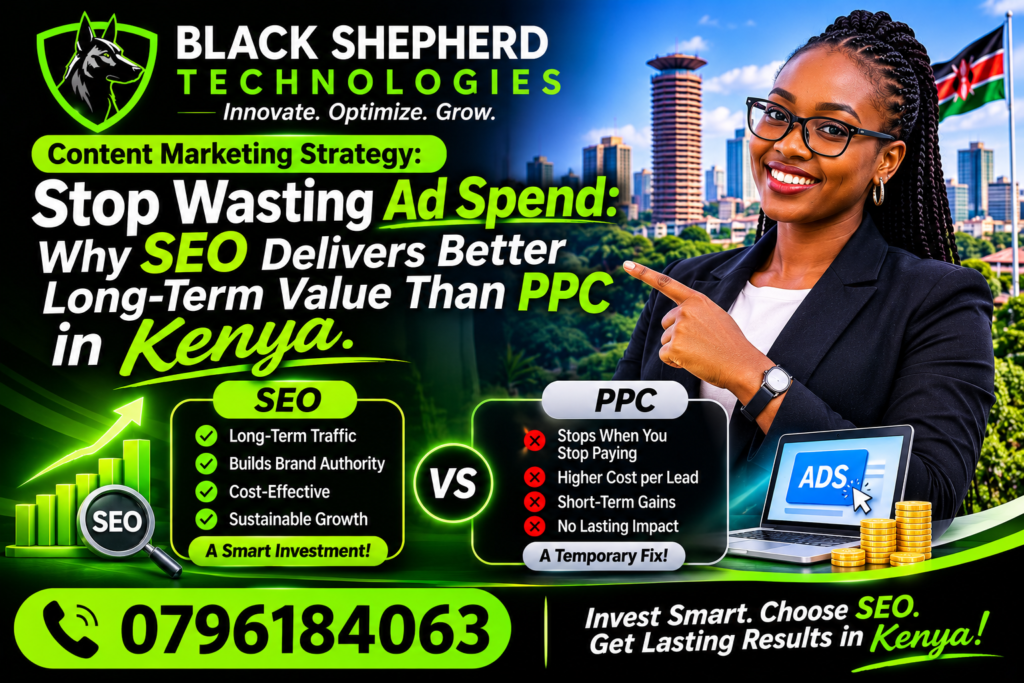
This is precisely why smart Kenyan brands are shifting their capital from short-term ad spend into sustainable SEO services in Kenya. While Pay-Per-Click (PPC) advertising has its place for short-term promotions and product launches, Search Engine Optimization (SEO) builds an owned digital asset that compounds in value, lowers your customer acquisition cost over time, and commands far higher trust among Kenyan buyers.
In this comprehensive guide, we break down the real economics of SEO versus PPC in the Kenyan market, expose why over-reliance on paid ads drains long-term profitability, and show how investing in organic search delivers superior return on investment (ROI) year after year.
Understanding the Core Difference: Renting Traffic vs. Owning Real Estate
To understand why SEO outperforms PPC over the long run, compare the two channels to commercial property in Nairobi.
-
Pay-Per-Click (PPC) is like renting an office space in Westlands or Upper Hill: You can move in tomorrow, put up your signage immediately, and start welcoming clients on day one. However, you never build equity. Every month, your landlord can raise the rent based on market demand. The moment you miss a payment, the locks are changed, and you are back on the street with zero assets to show for all the money you spent.
-
Search Engine Optimization (SEO) is like buying land and constructing your own commercial building: It requires upfront planning, solid architectural foundations, quality materials, and patience while construction takes place. You will not open your doors on day one. Once built and established, however, you own the property outright. Visitors walk through your doors every day without you paying a per-visitor toll, and the asset appreciates in value every year.
When you invest in professional search engine optimization in Kenya, every technical improvement, authoritative article, and local citation becomes a permanent fixture of your brand’s digital footprint.
The Hidden Drain of PPC in the Kenyan Market
PPC is frequently sold to business owners as a predictable, risk-free growth lever. In practice, Kenyan marketers running ad-heavy strategies encounter five structural problems that quietly erode profit margins:
1. Rising Auction Competition and Dollar-Denominated Ad Costs
Google Ads and Meta Ads are billed in US Dollars (or converted from USD at prevailing exchange rates), which immediately exposes Kenyan businesses to currency fluctuations on top of auction inflation. As more Kenyan SMEs digitize and compete for high-intent queries like “corporate lawyers in Nairobi,” “solar installation Kenya,” or “apartments for sale in Kilimani,” bid prices escalate. You end up paying significantly more this year just to maintain the exact same lead volume you achieved last year.
2. Zero Residual Value Once Spend Stops
Suppose you spend KES 150,000 per month on Google Ads over 24 months—a total outlay of KES 3,600,000. During those two years, you generate clicks and leads. However, on the first day of month 25, if you pause your campaigns to reallocate cash flow, your search traffic drops to zero instantly. Every shilling spent on PPC evaporates the moment the campaign ends.
3. Banner Blindness and Ad Skepticism Among Kenyan Consumers
Modern Kenyan internet users are digitally savvy. When they type a query into Google.co.ke, they immediately recognize the “Sponsored” tag sitting above paid search listings. Many users intentionally scroll past paid advertisements to click on the top organic results because they perceive organic rankings as earned through credibility, relevance, and authority rather than bought with an ad budget. Research consistently shows that organic search results capture over 70% to 85% of all search clicks, leaving paid ads to fight over the remaining fraction.
4. Click Fraud, Competitor Clicking, and Accidental Mobile Taps
Over 90% of search traffic in Kenya originates from mobile devices. On smaller smartphone screens, accidental taps on top-of-page ads happen frequently—costing you hundreds of shillings for a visitor who immediately hits the back button. Worse still, in hyper-competitive local industries, unscrupulous competitors or automated bots frequently click on rival ads simply to exhaust their daily budgets before noon. While Google filters out some invalid traffic, subtle manual competitor clicks still slip through and drain marketing budgets.
5. Unqualified Traffic From Broad Match Leakage
Without constant, expert bid management and aggressive negative keyword lists, PPC platforms routinely match your ads to loosely related searches. A B2B logistics company bidding on “freight forwarding Kenya” might end up paying for clicks from students researching supply chain definitions or job seekers looking for “freight forwarding vacancies in Mombasa.”
7 Reasons Why SEO Delivers Superior Long-Term Value in Kenya
Shifting focus toward organic search addresses every single weakness of paid advertising while unlocking compounding advantages tailored to how Kenyans actually search, evaluate, and buy.
1. Compounding Return on Investment (ROI) Over Time
The financial curve of SEO is the exact inverse of PPC. In the first 3 to 4 months of an SEO campaign, your investment goes toward technical audits, website speed optimization, content architecture, and foundational authority building. During this phase, your cost per lead looks higher than PPC.
By months 6 to 12, however, your service pages and educational guides begin claiming top-3 positions on Google.co.ke. Now, those pages attract hundreds or thousands of targeted visitors every single month without any incremental cost per click. In year two and year three, your monthly organic traffic continues to climb while your baseline maintenance spend remains steady—driving your effective Customer Acquisition Cost (CAC) down to a fraction of paid advertising.
2. Higher Trust, Credibility, and Brand Authority
In Kenya, trust is the single biggest currency in business. Buyers are cautious about online scams, briefcase companies, and unreliable vendors. When your business consistently appears in the top organic results and the Google Local Map Pack across dozens of industry-related searches, it sends a powerful psychological signal: this company is an established market leader.
Reviewing real-world web design and SEO case studies demonstrates how brands that pair a fast, professionally engineered website with top-ranking organic content convert visitors at substantially higher rates than brands relying solely on cold paid ads.
3. Capturing the Entire Kenyan Buyer Journey (Not Just Bottom-Funnel Clicks)
PPC forces you to bid almost exclusively on high-cost, bottom-of-funnel transactional keywords (e.g., “buy accounting software Kenya”), because paying KES 300 per click for top-of-funnel educational searches is financially unsustainable.
SEO allows you to profitably capture buyers at every stage of their decision-making journey:
-
Awareness Stage: A founder searches “how to register a limited company in Kenya and KRA PIN requirements.” Your comprehensive guide ranks #1, introduces your brand, and builds immediate goodwill.
-
Consideration Stage: Two weeks later, that same founder searches “best tax compliance and bookkeeping services in Nairobi.” Your detailed service comparison page appears at the top of Google, reinforcing your authority.
-
Decision Stage: Ready to hire, the founder searches your brand name or “affordable accounting firm Westlands” and clicks straight through to book a consultation via WhatsApp or phone.
By owning informational, comparative, and transactional search queries simultaneously, SEO builds an ecosystem that nurtures prospects long before they ever enter a competitor’s ad auction.
4. Dominating Local Search and Google Maps Across Kenyan Cities
Nearly half of all Google searches carry local intent. When someone in Karen searches for “emergency dental clinic near me,” a fleet manager in Industrial Area looks for “heavy commercial truck spare parts,” or a tourist searches “best boutique hotel in Diani,” Google prioritizes its Local Map Pack and localized organic results.
Through dedicated Local SEO—optimizing your Google Business Profile, building consistent Kenyan directory citations, generating authentic customer reviews, and creating city- or neighborhood-specific landing pages—your business captures high-converting local leads who are ready to call, request directions, or visit your premises immediately. Unlike Local Services Ads, organic Map Pack visibility costs nothing per phone call or direction request.
5. Better Alignment With Kenya’s Mobile-First and WhatsApp Conversion Culture
Kenyan consumers rarely fill out 12-field enterprise lead forms on a smartphone. They browse on mobile data, scan key information quickly, and tap a floating WhatsApp button or direct tel: link to ask a quick question before buying.
A holistic SEO strategy doesn’t just chase rankings—it optimizes your website’s mobile Core Web Vitals, trims bloated page sizes so pages load in under 2.5 seconds on 4G/3G connections, and streamlines mobile conversion pathways. When organic visitors land on a fast, mobile-first page tailored to their exact query, engagement rates soar and inbound WhatsApp and phone inquiries multiply organically.
6. Future-Proofing Against AI Search and Generative Engines
Search is undergoing its biggest transformation in two decades. In 2026, Google AI Overviews, ChatGPT Search, and Perplexity routinely answer complex user questions directly on the results page before a user clicks any link. Paid search ads cannot buy placement inside organic AI-generated recommendations.
Instead, AI search engines pull their citations and brand recommendations from websites with strong technical SEO, authoritative topical depth, structured schema markup, and credible third-party brand mentions. Investing in SEO today simultaneously positions your business to be the recommended answer inside AI search platforms tomorrow.
7. Sustainable Competitive Moat
Anyone with a credit card can copy your Google Ads headlines, clone your landing page, and outbid you in an afternoon. Nobody can replicate years of accumulated domain authority, high-quality Kenyan backlinks, deep topical content hubs, and hundreds of 5-star Google reviews overnight. SEO creates a defensible competitive moat that protects your market share even when aggressive, VC-backed newcomers enter your sector.
Side-by-Side Comparison: SEO vs. PPC in Kenya (24-Month Outlook)
To visualize the financial and operational differences between both channels, examine how a typical mid-sized Kenyan B2B or high-value B2C company fares over a two-year horizon with a comparable budget:
Illustrative Financial Breakdown: A 2-Year Kenyan Business Scenario
Let us look at the numbers behind a realistic Kenyan SME—for example, a commercial interior design and office fit-out company in Nairobi—investing KES 100,000 per month over 24 months (a total 2-year investment of KES 2,400,000 in either channel).
Scenario A: Pure PPC Strategy (KES 100,000/month)
-
Average Cost-Per-Click (CPC): Starts at KES 180 in Year 1 and rises to KES 230 in Year 2 due to auction competition (2-year average: ~KES 205/click).
-
Total Clicks Over 24 Months: KES 2,400,000÷205≈11,707 visits\text{KES } 2,400,000 \div 205 \approx \mathbf{11,707\text{ visits}}.
-
Average Conversion Rate (3.5%): ~410 leads over 24 months.
-
Average Cost Per Lead (CPL): KES 5,854 per lead.
-
Asset Value at Month 25: KES 0. If the company stops paying KES 100,000/month, inbound leads drop to zero immediately.
Scenario B: Strategic SEO Investment (KES 100,000/month)
-
Months 1–4 (Foundation & Content Buildout): Traffic ramps gradually from 200 to 600 organic visits/month (~1,600 visits total; ~56 leads).
-
Months 5–12 (Page-One Rankings Kick In): Traffic grows from 800 to 2,200 organic visits/month (~12,000 visits total; ~480 leads at a 4.0% conversion rate).
-
Months 13–24 (Compounding Authority & Long-Tail Dominance): Traffic scales from 2,500 to 4,500+ organic visits/month (~42,000 visits total; ~1,890 leads at a 4.5% conversion rate).
-
Total Visits Over 24 Months: ~55,600 targeted visits.
-
Total Leads Over 24 Months: ~2,426 leads.
-
Average Cost Per Lead (CPL): KES 989 per lead (nearly 6x cheaper than PPC).
-
Asset Value at Month 25: The website now ranks on page one for dozens of commercial keywords, generating 4,500+ monthly visitors and 180+ monthly leads on autopilot—even if the company reduces its ongoing SEO spend to maintenance mode.
Whether you operate in real estate, healthcare, hospitality, manufacturing, fintech, e-commerce, or professional services, examining how different Kenyan industries scale with digital marketing proves the exact same mathematical reality: paid ads buy temporary speed, while SEO builds permanent profitability.
When Should Kenyan Businesses Still Use PPC?
Advocating for SEO over PPC does not mean paid advertising should never be used. The sharpest Kenyan marketing teams treat PPC as a tactical scalpel rather than a permanent life-support machine. PPC makes strategic sense in four specific scenarios:
-
Brand-New Websites Needing Immediate Cash Flow: If you just launched a new business or domain this month, organic rankings will take 3 to 6 months to mature. Running targeted Google Search Ads during your first quarter bridges the revenue gap while your SEO foundation builds momentum in the background.
-
Time-Sensitive Promotions, Events, and Seasonal Sales: Promoting a Black Friday sale, a Jamhuri Day travel package, a conference registration deadline, or a limited-time property launch requires immediate visibility within a strict 2-to-4-week window—a job purpose-built for PPC.
-
Validating Keyword Conversion Rates Before Creating Content: Before investing in a 10-page SEO content cluster around a new service line, you can run a small KES 30,000 PPC test campaign for two weeks to verify which search phrases actually generate qualified WhatsApp inquiries and closed sales.
-
Retargeting Warm Organic Visitors: One of the highest-ROI ways to combine both channels is using SEO to bring thousands of qualified visitors to your website for free, and then running low-cost Meta or Google Display retargeting ads exclusively to visitors who viewed your pricing or service pages without converting.
How to Transition From Ad Dependency to an SEO-First Growth Engine
If your business is currently spending 80% to 100% of its digital marketing budget on paid ads and feeling the pinch of diminishing returns, follow this practical 5-step transition roadmap:
Step 1: Audit Your Paid Search Data to Uncover Proven “Money Keywords”
Log into your Google Ads account and open the Search Terms Report for the past 12 months. Export every search query that actually generated a phone call, WhatsApp chat, form submission, or sale. These proven queries are your top-priority SEO targets—you already know with 100% certainty that Kenyan buyers use these exact phrases and convert when they find the right offer.
Step 2: Reallocate 30% to 50% of Wasted Ad Spend Into Foundational SEO
You do not need to shut off your PPC campaigns overnight and risk a sudden dip in leads. Instead, trim underperforming, high-CPC ad groups with poor conversion rates and redirect 30% to 50% of your monthly ad budget into a structured SEO program. As your organic leads begin rising in months 4 through 8, you can gradually taper down paid search spend further while maintaining or increasing total lead volume.
Step 3: Fix Your Website’s Technical Foundation and Mobile Speed
Before publishing new content, ensure your website is engineered to convert the traffic you attract. Eliminate bloated themes, compress oversized images into WebP format, secure an SSL certificate, fix broken links, and ensure your site loads in under 2.5 seconds on Kenyan 4G mobile networks. Place clear, tap-friendly WhatsApp and Call Now triggers prominently above the fold on every mobile page.
Step 4: Build Dedicated, High-Converting Service and Location Pages
A common mistake among Kenyan businesses is lumping ten different services onto a single generic “Our Services” page. Google ranks specific pages for specific queries. Create individual, comprehensive landing pages for every core service you offer—and if you serve multiple locations (such as Nairobi, Mombasa, Kisumu, Nakuru, and Eldoret), build dedicated location pages tailored to each market’s unique needs, testimonials, and local contact details.
Step 5: Invest in Authoritative Content and Local Kenyan Backlinks
Publish in-depth guides, pricing breakdowns, comparison articles, and local case studies that answer the exact questions your prospects ask during sales calls. Pair that content with targeted digital PR and link-building outreach—securing mentions and backlinks from credible Kenyan business directories, industry associations, news portals, and partner websites to accelerate your domain authority.
Stop Renting Your Growth—Start Building an Asset That Pays You Back
Every shilling you spend on unoptimized PPC campaigns is a shilling that vanishes the moment a user closes their browser tab. In an increasingly competitive Kenyan digital economy, businesses that rely exclusively on paid ads face a losing battle against rising CPCs, shrinking margins, and algorithm volatility.
By contrast, investing in SEO transforms your website from a passive digital brochure into a 24/7 customer acquisition engine that grows stronger, more authoritative, and more profitable with every passing month.
If you are ready to break free from the paid ad treadmill and build lasting search visibility across Google.co.ke, explore our results-driven SEO services in Kenya, inspect our client portfolio and web projects, or discover tailored organic growth strategies across the Kenyan industries we serve.