When building an e-commerce store, many founders and web designers focus heavily on front-end aesthetics, product photography, and checkout buttons while ignoring the underlying foundation of their site: website architecture.
If your digital storefront is structured like a chaotic warehouse—where product pages link haphazardly to one another with no clear hierarchy—search engine crawlers will struggle to understand your inventory. This lack of structure leads to wasted crawl budget, diluted keyword authority, and lower rankings on Google.
To maximize search visibility and guide high-intent shoppers smoothly toward an M-Pesa checkout, you must implement a rigorous siloed architecture (also known as thematic siloing).
In this guide, we explore how organizing your category and product pages into clean, hierarchical silos boosts your SEO authority and skyrockets your conversion rates.
1. What Is Website Siloing and Why Does It Matter?
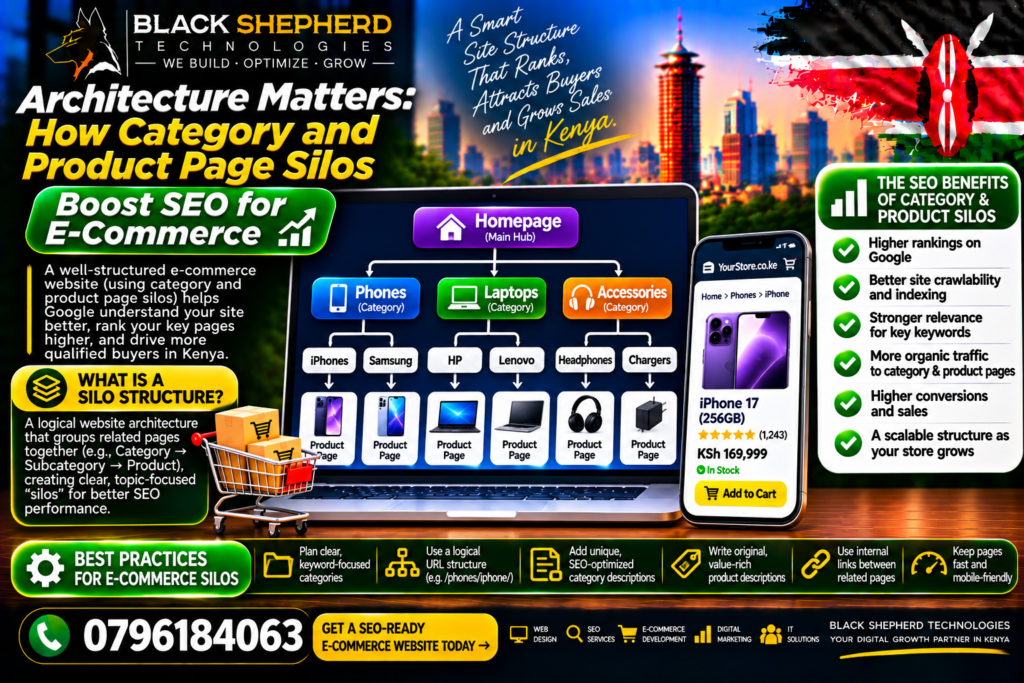
Website siloing is the practice of organizing your site’s content into distinct, logically related thematic groups (silos). In e-commerce, this means grouping your products into strict category and subcategory hierarchies so that search engines and users can immediately understand the relationship between pages.
The Two Types of Siloing:
-
Physical Siloing (URL Structure): Organizing your directory paths so that URLs clearly reflect the hierarchy.
-
Example:
[https://www.yourstore.com/electronics/smartphones/samsung](https://www.yourstore.com/electronics/smartphones/samsung)
-
-
Logical Siloing (Internal Linking): Linking pages within the same silo together (e.g., linking a smartphone blog post to a specific Samsung product page) while strictly avoiding cross-contamination between unrelated silos (e.g., linking a footwear page to a kitchen blender page).
When search engine crawlers spider your site, they rely on these clear pathways to evaluate topical relevance. A well-siloed site signals to Google that your brand is an authority in specific product categories.
For businesses looking to build a rock-solid technical foundation from scratch, expert architectural planning is available through Black Shepherd’s SEO Services in Kenya.
2. The Power of Category vs. Product Page Hierarchies
An optimized e-commerce architecture relies on a top-down flow of “link equity” (SEO authority). Authority flows from your homepage down to high-level category pages, then splits into subcategories, and finally reaches individual product pages.
A. Category Pages (The Authority Hubs)
Category pages are your heavy hitters. They typically target broader, high-volume commercial keywords (e.g., “Smart TVs in Kenya”). Because they capture high-level search intent, your category pages must be supported by clean internal linking from subcategories and product listings within that specific silo.
B. Product Pages (The Conversion Closers)
Product pages target specific long-tail keywords (e.g., “Buy 43-inch Samsung Smart TV Nairobi”). By nesting these product pages strictly inside their parent category silos, they inherit topical authority from the category page above them, helping them rank faster and higher on competitive Search Engine Results Pages (SERPs).
To see how custom web structures and clean category hierarchies are deployed across diverse retail sectors, explore the case studies in Black Shepherd’s Portfolios and Projects and Black Shepherd’s Industry Solutions.
3. Step-by-Step Blueprint: Building SEO-Optimized Silos
Implementing a siloing strategy requires careful planning before you write a single line of code or upload products to your content management system.
-
Map Your Inventory Taxonomy: Group your products logically. If you sell home appliances, do not dump everything into a generic “Shop” page. Create distinct silos for Kitchen Appliances, Laundry, and Climate Control, each with its own subcategories.
-
Enforce Strict Internal Linking Rules:
-
Downward: Link from the homepage to category pages, and from category pages to product pages.
-
Sideways: Link related products within the same silo (e.g., suggesting a phone case on a smartphone product page).
-
Upward: Use breadcrumb navigation (
Home > Electronics > Smartphones > Samsung) to allow users and crawlers to step back up smoothly.
-
-
Avoid Cannibalization: Ensure that similar products don’t compete for the exact same keywords by keeping variations cleanly nested under a single parent product or distinct subcategory.
4. How Siloed Architecture Boosts M-Pesa Conversions
A clean, logical site architecture doesn’t just satisfy Google’s web crawlers; it drastically improves the human user experience (UX).
When a shopper lands on your site via a targeted Google search, a well-siloed architecture ensures they land directly on the exact product or category page they were looking for. By surrounding them with related, relevant items and a lightning-fast mobile interface, you reduce bounce rates, build brand trust, and guide them effortlessly toward a frictionless M-Pesa STK push checkout.
Summary Table: Unstructured vs. Siloed E-Commerce Architecture
| Architectural Dimension | Unstructured / Flat Store | Siloed E-Commerce Store |
| URL Hierarchy | Random URLs (/product-1284/) with no clear path. |
Logical directory paths (/category/subcategory/product). |
| Crawl Efficiency | Search bots waste crawl budget navigating dead ends. | Search crawlers index pages rapidly following clear thematic paths. |
| Keyword Authority | Link equity is diluted across unrelated pages. | Topical authority is concentrated and amplified within specific categories. |
| User Experience & Conversion | Confusing navigation leads to high bounce rates and cart abandonment. | Intuitive paths guide shoppers smoothly from search to M-Pesa checkout. |
Conclusion: Structure Your Way to the Top of Google
Architecture matters. If you want your e-commerce store to outrank competitors and convert organic traffic into predictable revenue, you cannot afford a messy, unstructured website. By implementing rigorous category and product page silos, you satisfy search engine algorithms and deliver a seamless shopping experience.
Ready to overhaul your site architecture and dominate search results? Partner with experts through Black Shepherd’s SEO Services in Kenya, explore successful project builds at Black Shepherd’s Portfolios and Projects, or discover tailored retail strategies via Black Shepherd’s Industry Solutions.