In Kenya’s rapidly digitalizing marketplace, launching a website is no longer enough to guarantee business growth. Whether you operate a tech startup in Westlands, a retail boutique in Mombasa, or a professional consultancy in Upper Hill, the internet is flooded with digital noise. To rise above it, your website needs more than good looks—it needs a high-powered engine driven by a strategic content-led SEO framework.
Without a deliberate content strategy, even the most beautifully designed website risks becoming a digital ghost town, hidden away on page five of Google search results where no prospective customer will ever find it.
1. The Core Anatomy of a Kenyan SEO Content Strategy
A successful SEO content strategy bridges the gap between what your target audience is searching for and what your business offers. In Kenya, consumer search behavior is heavily tied to mobile-first interactions, local intent, and immediate problem-solving.
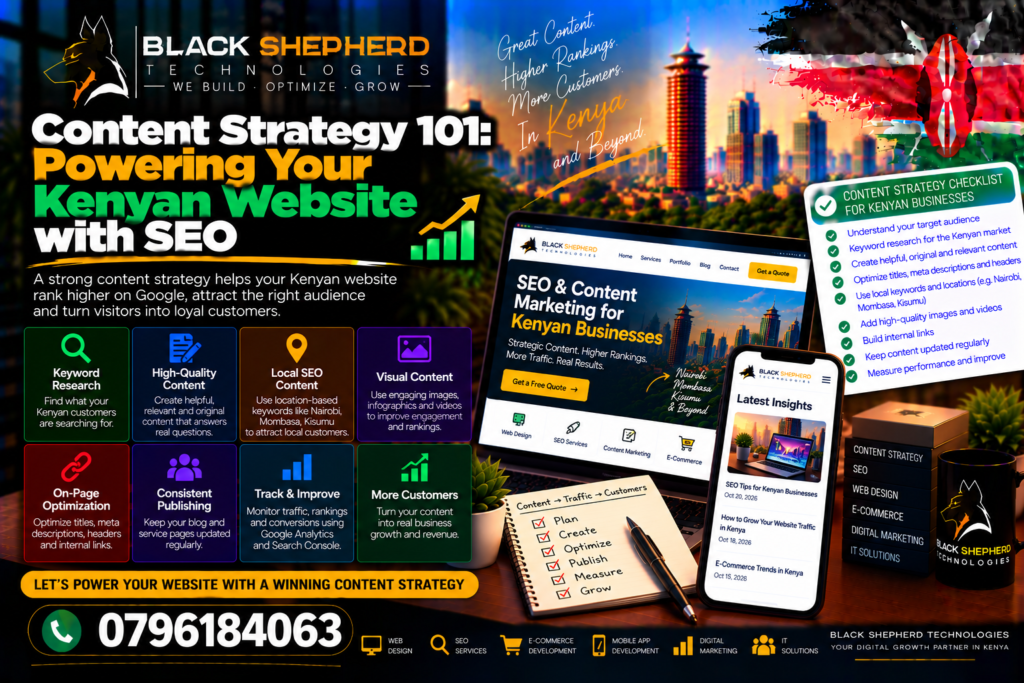
To power your website effectively, your content framework must address four critical pillars:
-
Audience Intent & Local Context: Understanding how Kenyans search is vital. Search queries are often localized (e.g., “best web design agency in Nairobi” or “affordable digital marketing packages”) or phrased conversationally on mobile devices. Your content must mirror this natural language.
-
Keyword Mapping: Aligning primary and secondary keywords strategically to specific pages. Rather than stuffing keywords randomly, each piece of content must answer a specific user query.
-
Topical Authority: Search engines reward websites that demonstrate deep expertise across an entire subject area. Publishing cluster content around your core offerings builds trust with both algorithms and human readers.
-
Conversion Architecture: Every blog post, service page, and landing page should guide the reader seamlessly toward a desired action—whether that is filling out an inquiry form, calling via phone, or initiating a chat.
2. Bridging Design, Content, and Search Performance
Content does not exist in a vacuum; its effectiveness is heavily dictated by how well your website is structured and optimized. When search engine crawlers and AI algorithms scan your site, they evaluate text layout, readability, technical speed, and overall user experience.
For businesses looking to scale their digital footprint, combining clean web design with professional optimization is paramount. You can explore how structured layouts and modern user journeys come together by reviewing diverse case studies across specialized portfolios and projects.
Furthermore, different commercial sectors require customized content frameworks. For instance, an e-commerce platform requires product-led SEO content, whereas a B2B corporate firm relies on thought leadership whitepapers and case studies. To see how specialized content and optimization strategies apply to your specific field, explore the tailored insights under industries we serve.
3. Step-by-Step Blueprint to Execute Your Content Strategy
Building a high-performing SEO content machine requires consistency, technical precision, and an ongoing commitment to quality. Follow these core steps to jumpstart your strategy:
Step 1: Conduct Deep Keyword & Competitor Research
Identify what terms your target customers are typing into Google. Look at what your top competitors in Kenya are ranking for and find the content gaps they are missing. Use tools like Google Keyword Planner, Ahrefs, or local search insights to build a targeted keyword roadmap.
Step 2: Build a Content Calendar and Publish Consistently
Search engines favor active websites. Commit to a realistic publishing schedule—such as two or four high-value, SEO-optimized blog posts or resource articles per month. Consistency signals to search crawlers that your business is active and authoritative.
Step 3: Prioritize On-Page Technical Optimization
Every piece of content must be structured correctly:
-
Use a clear, single H1 tag for your main title.
-
Organize sections logically using H2 and H3 subheadings.
-
Integrate target keywords naturally into the introduction, subheadings, and conclusion.
-
Optimize images with descriptive alt text to improve accessibility and image search rankings.
Step 4: Promote and Track Performance
Publishing content is only half the battle. Distribute your articles across your social media channels, email newsletters, and professional networks. Use Google Analytics and Search Console to monitor keyword rankings, click-through rates, and user engagement metrics, refining your approach over time.
4. Supercharge Your Digital Growth with Professional Expertise
Mastering content strategy and technical SEO takes time, deep technical insight, and continuous monitoring. If you want to bypass the steep learning curve and secure top-ranking positions on Google rapidly, partnering with industry specialists can accelerate your revenue growth.
To transform your digital presence, increase qualified inbound leads, and dominate your niche in the local market, explore comprehensive SEO services in Kenya built specifically to deliver measurable, data-driven results for your business.