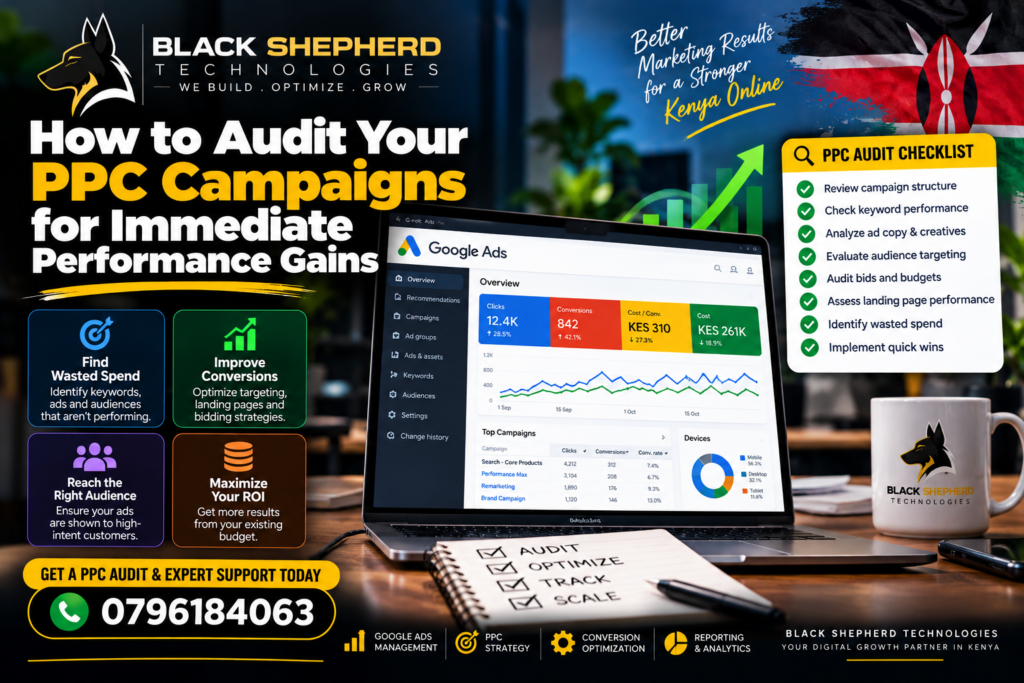
Running Pay-Per-Click (PPC) advertising campaigns on Google Ads or Social Ads (Meta, LinkedIn, TikTok) can be one of the fastest ways to drive traffic, leads, and sales for your business in Kenya. However, without regular, structured audits, PPC campaigns often develop unseen inefficiencies—wasting valuable advertising budget on irrelevant search queries, underperforming ad copy, broken landing pages, or misconfigured conversion tracking.
Whether you are managing campaigns for a corporate B2B firm in Nairobi, an e-commerce platform handling M-Pesa checkouts, or a local service business, executing a thorough PPC audit allows you to identify budget leaks, refine targeting, and unlock immediate ROI improvements.
In this comprehensive, step-by-step guide, we walk you through the essential checklist for auditing your PPC campaigns to stop wasted ad spend and maximize conversions.
1. What Is a PPC Campaign Audit and Why Is It Necessary?
A PPC audit is a systematic review of your advertising account’s health, structure, targeting settings, creative assets, and conversion pipelines. Over time, as campaigns run, “account drift” naturally occurs—bids become outdated, new irrelevantly matched search terms bleed into your budget, and audience behaviors shift.
The PPC Audit Performance Flywheel
 [ 1. Account Structure & Tracking Audit ] ──► [ 2. Search Term & Negative Keyword Pruning ]
                                                                   │
 [ 5. Scalable High-ROI Campaign Growth ] ◄── [ 3. Ad Copy & Quality Score Optimization ] ◄─┘
Key Benefits of a PPC Audit:
-
Eliminate Wasted Budget: Identify negative search queries that consume budget without delivering conversions.
-
Lower Cost-Per-Acquisition (CPA): Optimize Quality Scores and ad relevance to pay less per click and acquire leads more efficiently.
-
Improve Quality Score & Impression Share: Ensure your ads win top positions on Google over competitors without blindly raising bids.
-
Fix Tracking Discrepancies: Ensure every M-Pesa transaction, lead form fill, or phone call is accurately attributed.
2. Step 1: Verify Conversion Tracking and Data Integrity
Before touching keywords or ad copy, you must verify that your conversion tracking is 100% accurate. Optimization decisions made on flawed data will destroy campaign performance.
Conversion Tracking Validation Stack
 [ User Clicks PPC Ad ] ──► [ Interacts with Page / Initiates Checkout ]
                                          │
 [ GA4 / Google Ads Conversion Tag Fires ] ──► [ Accurate ROI Attribution ]
Action Items for Tracking Verification:
-
Audit Primary vs. Secondary Conversion Actions: Ensure macro-conversions (e.g., completed lead forms, phone calls over 60 seconds, M-Pesa checkouts) are set as Primary actions for bidding. Micro-conversions (e.g., button clicks, video views) should be set to Secondary so automated smart bidding algorithms do not optimize for low-value actions.
-
Check Conversion Tag Firing: Use Google Tag Assistant or browser inspector tools to confirm tags fire correctly on thank-you pages without double-counting reloads.
-
Verify GA4 & Google Ads Integration: Cross-reference conversion numbers in Google Analytics 4 (GA4) with Google Ads to catch attribution discrepancies or missing UTM tags.
To ensure your PPC traffic arrives on a fast, search-optimized web infrastructure, pair your campaign audits with professional SEO services in Kenya.
To explore how high-performing digital marketing and web solutions support diverse commercial sectors, review the various industries we serve.
3. Step 2: Audit Search Terms and Negative Keywords
The Search Terms Report reveals the exact words and phrases real users typed into Google before clicking your ad. This is where the largest amount of wasted ad spend is typically discovered.
A. Add High-Intent Negative Keywords
If you use Phrase Match or Broad Match keywords, Google will match your ads to queries that have zero commercial intent.
-
Common Wasted Spend Patterns: Terms like “free”, “cheap”, “jobs”, “internship”, “PDF download”, or “definition” often eat up 20% to 40% of campaign budgets.
-
Action: Build account-level Negative Keyword Lists to block irrelevant traffic immediately.
B. Identify Match Type Bleed
Verify if broad match keywords are pulling in completely unrelated queries. If a broad match keyword like office furniture triggers ads for used home furniture repair in Nakuru, refine match types to Exact ([office furniture]) or Phrase ("office furniture") to regain control over traffic quality.
4. Step 3: Evaluate Account Structure and Campaign Settings
A messy account structure makes performance tracking difficult and prevents Google’s bidding algorithms from optimizing effectively.
Optimal Account Architecture
                     [ Google Ads Account ]
                               │
         ┌─────────────────────┴─────────────────────┐
  [ Search Campaign: Office Chairs ]        [ Search Campaign: Executive Desks ]
         │                                           │
  [ Ad Group: Ergonomic Mesh Chairs ]       [ Ad Group: L-Shaped Executive Desks ]
Critical Settings to Review:
-
Networks Separation: Never combine Google Search and Google Display Network inside the same campaign. Display network clicks dilute your click-through rate (CTR) and waste budget on low-intent placements. Keep them in separate campaigns.
-
Geographic Location Targeting: Ensure location settings are explicitly set to “Presence: People in or regularly in your targeted locations” rather than “Presence or Interest.” The default setting can trigger ads for users located outside Kenya who are merely browsing related topics.
-
Device Bidding Adjustments: Analyze performance split across Mobile vs. Desktop. If mobile traffic yields high clicks but poor conversion rates due to a complex checkout flow, adjust bid multipliers accordingly.
To inspect real-world examples of high-converting landing pages and digital lead funnels built for local brands, browse through our portfolios and projects.
5. Step 4: Optimize Quality Score, Ad Copy, and Extensions
Google Ads calculates a Quality Score (1 to 10) for every keyword based on Expected Click-Through Rate (CTR), Ad Relevance, and Landing Page Experience. Higher Quality Scores lower your actual Cost-Per-Click (CPC) and improve ad positioning.
Upgrade Assets (Formerly Ad Extensions):
Ensure every search campaign utilizes all relevant ad assets:
-
Sitelink Assets: Direct users to specific sub-pages (e.g., “View Pricing”, “Read Case Studies”, “Contact Sales”).
-
Call Assets: Display clickable phone numbers for immediate call generation on mobile devices.
-
Structured Snippets & Callouts: Highlight specific brands, service features, payment options (e.g., “M-Pesa Accepted”, “Same-Day Nairobi Delivery”), and certifications.
6. PPC Campaign Audit Checklist Summary
7. Final Thoughts: Turn Wasted Spend into Profit
A systematic PPC audit is the single fastest way to improve digital marketing ROI. By auditing conversion tracking, eliminating negative search query bleed, refining location settings, and raising Quality Scores, you transform underperforming ad accounts into efficient, reliable lead generation engines.
Whether you need a complete audit of your Google Ads account, assistance optimizing landing page conversion rates, or professional SEO services in Kenya to complement your paid campaigns, expert digital execution ensures long-term business growth. Explore our specialized industries we serve and examine our proven track record across portfolios and projects to maximize your campaign performance today.


For expert PPC audits, high-converting digital ad strategies, and technical search campaigns, delivers comprehensive digital growth solutions tailored to businesses across Nairobi and East Africa.