For years, search engine optimization (SEO) in the Kenyan digital market operated on simple tactics. You could spin a few articles, submit your website URL to hundreds of low-tier web directories, buy a cheap link package, and watch your website climb to page one of Google.
That era is over.
Google’s search algorithms have evolved dramatically. Search engines penalize low-quality, unnatural link patterns while prioritizing topical relevance, brand signals, and authentic regional authority. If you are running an e-commerce platform in Nairobi, offering specialized corporate consulting, or scaling a tech startup in East Africa, securing off-page visibility requires a intentional, high-authority backlink strategy tailored specifically to the Kenyan search landscape.
A backlink is a vote of confidence from one site to another. When a high Domain Authority (DA) digital publication, top news outlet, or established industry platform links to your site, search engines recognize your domain as a trustworthy source. However, getting backlinks that actually move the needle—links that boost your organic search engine rankings, drive qualified referral traffic, and generate revenue—is a complex process.
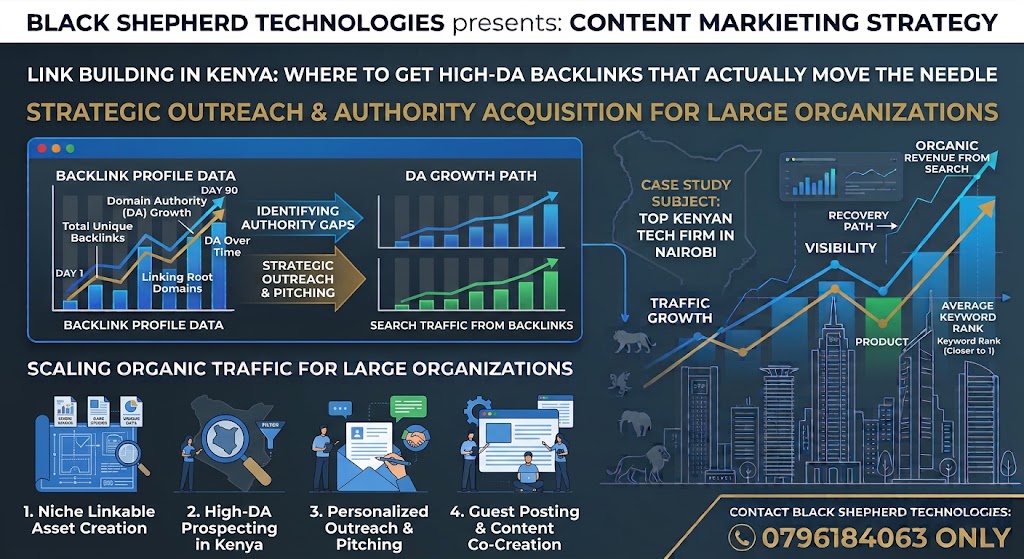
This guide breaks down the mechanics of link building in Kenya. You will learn how the Kenyan backlink ecosystem operates, where to acquire high-DA links safely, how to execute outreach strategies that work locally, and how to build an SEO engine that outperforms your competition.
1. The Reality of Link Building in Kenya
What Makes Kenya’s Digital Landscape Unique?
The Kenyan internet ecosystem is distinct. It is mobile-first, heavily influenced by fintech (such as M-Pesa integrations and local payment gateways), and dominated by a handful of established media conglomerates, online directories, tech publications, and niche blogs.
Because the digital economy in Nairobi and major Kenyan urban centers is growing rapidly, search competition for commercial keywords is intensifying daily. For instance, ranking for terms like “best insurance provider in Nairobi” or “top web design agency in Kenya” requires a combination of technical perfection, contextual content, and strong off-page signals.
Domain Authority (DA) vs. Relevance vs. Organic Traffic
When evaluating potential backlink sources in Kenya, many business owners fall into the metric trap, focusing solely on Domain Authority (DA) or Domain Rating (DR). While Moz’s DA and Ahrefs’ DR are useful proxy metrics, they do not tell the whole story.
In Kenya, an effective backlink must meet three distinct criteria:
        High-Impact Backlink
               / \
              /   \
             /     \
  Contextual  <-----> Real Regional
  Relevance           Search Traffic
-
Topical & Geographic Relevance: A link from a niche Kenyan business platform (DA 35) that actively serves your target audience carries far more search engine equity than a link from a generic, high-DA tech blog hosted overseas with zero local audience footprint.
-
Real Organic Traffic: If a website boasts a DA of 70 but receives less than 100 organic visits a month, search engine crawlers recognize it as a dormant or manipulated site. A valuable backlink comes from a site actively indexed, crawled, and visited by real users.
-
Editorial Placement: Links buried in low-quality footers, automated comment sections, or sitewide sidebars carry far less weight than contextual links embedded directly within the main body of a high-quality article.
The Danger of the “Fiverr Trap” & Automated PBNs
Many Kenyan entrepreneurs and marketing teams fall prey to cheap overseas link packages. Promos offering “10,000 High-DA Backlinks for $20” generate links from Private Blog Networks (PBNs), automated forum signatures, and link farm directories.
In the modern search environment, applying these low-tier links to your primary commercial domain triggers algorithmic penalties. Once Google marks your domain as spam, recovering your search rankings and trust scores requires extensive disavow campaigns and manual audits. Achieving sustainable top-tier search results requires working alongside experienced professionals who implement clean, white-hat outreach practices. To see how sustainable search strategies are built from the ground up, explore professional SEO services in Kenya that focus on long-term organic growth.
2. High-DA Backlink Tier Breakdown in Kenya
To build a balanced, resilient backlink profile, you must understand where different types of links fit into your overall digital marketing budget and authority model. The Kenyan web space can be split into three core link tiers:
3. Top Sources for High-DA Backlinks in Kenya
Tier 1: National Media & Major News Publications
Securing links from major news houses is the fastest way to signal site trust to search crawlers. These platforms receive millions of organic monthly visits, meaning a single contextual link from their main publication sections passes significant page rank and authority.
-
Nation Africa (
nation.africa): The largest digital publisher in the region. Features high domain authority and massive local traffic. -
The Standard (
standardmedia.co.ke): High-authority platform suitable for press coverage, business news, and thought leadership features. -
The Star Kenya (
the-star.co.ke): A high-DA news engine that indexes quickly, making it ideal for brand launches and industry data reports. -
Citizen Digital (
citizen.digital): Offers widespread reach and strong local relevance signals across general news, business, and tech sectors. -
Business Daily Africa (
businessdailyafrica.com): The primary target for B2B brands, enterprise services, and corporate executive profiles.
How to Acquire Tier 1 Links
Getting featured on these sites requires moving away from standard guest posts. You need to run Digital PR campaigns, pitch proprietary local data studies, publish major company announcements, or leverage paid sponsored press distribution services.
Tier 2: Niche-Specific Kenyan Publications & Tech Portals
While tier 1 news sites build high broad authority, tier 2 industry publications build topical authority. Search engines look for links coming from websites within your industry ecosystem to verify your relevance.
┌─────────────────────────────────────────────────────────────┐
│               Topical Relevance Mapping                     │
├──────────────────────────┬──────────────────────────────────┤
│ Your Business Focus      │ Targeted Kenyan Publications     │
├──────────────────────────┼──────────────────────────────────┤
│ Technology / Apps / B2B  │ Techweez, TechMoran, TechTrends  │
│ Finance / Real Estate    │ Kenyan Wallstreet, Soko Directory│
│ SMEs / Enterprise Growth │ Bizna Kenya, Khusoko             │
│ Travel / Hospitality     │ Victor Matara, Local Travel Blogs│
└──────────────────────────┴──────────────────────────────────┘
-
Technology & Telecom: Sites like Techweez (DA 60+), TechMoran (DA 50+), and Gadgets Africa provide high-value, do-follow link opportunities for software platforms, digital agencies, IT companies, and startups.
-
Business, Finance & Markets: Kenyan Wallstreet, Bizna Kenya, Soko Directory, and Khusoko cover local market shifts, economic trends, corporate news, and personal finance. These are prime targets for B2B guest posts, financial commentary, and thought leadership pieces.
-
Lifestyle, Tourism & Culture: Broad consumer platforms such as Victor Matara and regional culture blogs serve consumer-facing brands, events, hospitality providers, and real estate developments.
Tier 3: High-Trust Local Citations and Directories
Local citations form the structural foundation of off-page SEO. They confirm your business’s physical presence, legitimacy, and operational contact details (Name, Address, Phone Number – NAP).
-
Yellow Pages Kenya (
yellowpageskenya.com): The established local business directory. -
Kenya Business Directory (
businesslist.co.ke): High indexation rate with direct category-level business listings. -
Google Business Profile (GBP): While technically an ecosystem entity, a fully verified and optimized GBP profile acts as your most crucial local authority anchor.
-
Hotfrog Kenya & Cybo Kenya: Secondary local directories that help establish a natural baseline link profile.
When submitting to local directories, keep your business name, physical street address, local telephone numbers, and primary URL strictly identical across every platform. Inconsistencies confuse search crawlers and dilute your local search rankings.
4. White-Hat Backlink Acquisition Strategies for Kenyan Brands
Knowing where high-DA links exist is only half the battle. The core challenge lies in acquiring those links naturally without violating Google’s Webmaster Guidelines.
                             ┌────────────────────────┐
                             │  Digital PR & Data     │
                             │  (High DA + Traffic)   │
                             └───────────┬────────────┘
                                         │
                             ┌───────────▼────────────┐
                             │ Value-First Guest Post │
                             │  (Topical Relevance)   │
                             └───────────┬────────────┘
                                         │
                             ┌───────────▼────────────┐
                             │ Strategic Unlinked     │
                             │   Brand Mentions       │
                             └───────────┬────────────┘
                                         │
                             ┌───────────▼────────────┐
                             │ Local Citations & GBP  │
                             │   (Foundational Layer) │
                             └────────────────────────┘
Strategy 1: Digital PR & Data-Driven Journalism
Journalists at media houses like Business Daily, The Star, or Techweez are always looking for fresh, accurate data. They rarely write articles to promote a business directly, but they frequently cover industry statistics, market trends, and economic reports.
How to Execute This Strategy:
-
Gather Local Proprietary Data: Analyze internal customer insights or run a targeted survey on local consumer habits (e.g., “How M-Pesa Usage Patterns Shifted for Nairobi Retailers” or “The Average Cost of Web Design in Kenya”).
-
Package into an Interactive Report: Design an accessible, data-dense resource page on your site featuring clear charts, summary key takeaways, and downloadable graphics.
-
Draft a Targeted Pitch: Reach out directly to business and technology reporters.
Pitch Template for Local PR Outreach:
Subject: NEW DATA: 68% of Nairobi SMEs changed payment gateways in 2026
Hi [Journalist Name],
I’ve been following your recent coverage on Kenya’s fintech landscape in [Publication Name].
Our team just finalized a data report analyzing payment behaviors across 450 verified businesses in Nairobi over the last 12 months. A few key findings:
M-Pesa API integration rates grew by 42% among mid-sized retail brands.
Card processing drop-off rates remain high at 31%.
We published the complete dataset, along with high-res infographics, here: [Link to Your Data Asset].
Feel free to use these figures, charts, or quotes for your upcoming stories. Let me know if you need any additional breakdown or commentary!
Best regards,
[Your Name/Brand]
When journalists reference your dataset as their source, they naturally include a contextual do-follow link back to your data asset.
Strategy 2: Value-First Guest Blogging
Guest posting remains one of the most reliable ways to secure relevant contextual links, provided you create genuinely useful content.
Avoid sending generic 500-word articles filled with sales pitches. Instead, offer editors high-value, comprehensive guides that solve specific problems for their readers.
The Guest Post Outreach Checklist:
-
Target Site Vetting: Ensure the host site publishes fresh content, has real organic search traffic from East Africa, and maintains clean editorial standards.
-
Content Gap Identification: Read through their existing blog posts to find logical missing angles. For instance, if they have an article on “Digital Marketing Trends,” offer a deep dive into “How Localized Schema Markup Drives Conversions in Nairobi.”
-
Natural Link Placement: Insert your backlink within the body of the article where it naturally supports the topic. Ensure it points to an informative sub-page or deep resource rather than just your homepage.
Executing successful, multi-tier outreach campaigns requires seasoned technical execution and a clear portfolio of proven results. To review real-world case studies and off-page campaign structures, examine these verified digital projects and portfolios that illustrate how sustainable ranking gains are achieved.
Strategy 3: Unlinked Brand Mention Reclaim
As your business grows, local media outlets, corporate blogs, event organizers, and partners may mention your brand name without adding a hyperlink. Converting these existing text mentions into active backlinks is a high-yield tactic.
-
Set Up Brand Monitoring: Use tools like Google Alerts, Brand24, or Ahrefs Alerts to monitor references to your brand, product names, or executive leadership.
-
Identify Unlinked Mentions: When a website publishes an article mentioning your business without a link, find the author’s or editor’s contact email.
-
Send a Friendly Request: Thank them for the mention and politely ask if they would mind adding a link so readers can navigate directly to your website.
Unlinked Mention Email Template:
Subject: Thanks for mentioning [Brand Name] in your article!
Hi [Name],
I came across your recent article on [Article Title] on [Website Name]—great insights on the local market!
I noticed you mentioned [Brand Name] in the section discussing [Topic]. First off, thanks for the shout-out! I was wondering if you could add a link to our main site ([Your URL]) on our brand name? It would help your readers easily navigate to us if they want to explore our services further.
Thanks again for the coverage, and keep up the great work!
Best regards,
[Your Name]
Strategy 4: Localized Linkable Assets & Calculators
One of the most effective ways to earn high-DA backlinks automatically is by building Linkable Assets. These are free online tools, comprehensive industry benchmarks, or interactive calculators that address a recurring need in your market.
For example, a real estate agency in Nairobi could create a “Kenya Stamp Duty & Mortgage Calculator,” or a commercial agency could publish an interactive “PAYE, NHIF, & NSSF Salary Tax Estimator.” When financial bloggers, HR portals, and news outlets write articles discussing employment laws or property purchases, they regularly link to these dynamic utility tools as helpful reference points for their readers.
5. Technical Off-Page Factors: Anchors, Velocity, and Profiling
Acquiring links from high-DA websites is only part of the equation. How those links are structured and delivered to your domain determines how search engine algorithms process them.
Anchor Text Optimization
Anchor text is the clickable visible text in a hyperlink. Using unnatural anchor text patterns is one of the quickest ways to trigger search engine spam filters.
                     Recommended Anchor Text Profile

              ┌────────────────────────────────────────┐
              │  Brand Name / Naked URLs (60-70%)      │
              ├────────────────────────────────────────┤
              │  Partial-Match / LSI Terms (20-25%)    │
              ├────────────────────────────────────────┤
              │  Exact-Match Commercial Keywords (<10%)│
              └────────────────────────────────────────┘
-
Branded & Naked Anchors (60% – 70%): Uses your exact company name or direct web address (e.g., “Black Shepherd,” “blackshepherd.co.ke”). This creates a natural baseline backlink profile.
-
Partial-Match & Topic Anchors (20% – 25%): Integrates target keywords naturally into descriptive phrases (e.g., “this guide to SEO strategies in Kenya,” “view their Nairobi Web Design portfolio”).
-
Exact-Match Anchors (< 10%): Uses exact commercial targets (e.g., “best web designer in Nairobi”). Keep these sparse to prevent over-optimization penalties.
Link Velocity & Building Cadence
Link velocity refers to the rate at which your domain acquires backlinks over time.
If a fresh domain with no prior history suddenly acquires 500 high-DA links in two days, search engine algorithms flag this spike as artificial link manipulation. Safe link building focuses on a steady, compounding acquisition curve. Aim for consistent, sustainable monthly link growth through regular content publishing, Digital PR outreach, and continuous local citation management.
6. Industry-Specific Link Building Scenarios in Kenya
Link building is not a one-size-fits-all process. Every industry operating within Kenya requires a custom approach to attract relevant off-page signals.
B2B Enterprise & Professional Services
-
Primary Objective: High domain trust, executive authority, lead generation.
-
Best Link Sources: Guest contributions on corporate financial magazines (Business Daily, Kenyan Wallstreet, Khusoko), corporate press releases, and co-authored industry whitepapers with partner organizations.
-
Core Tactic: Publish original market surveys and host specialized business roundtables to generate executive press coverage.
E-Commerce & Retail Outlets
-
Primary Objective: High product page authority, local buyer trust, transactional referral traffic.
-
Best Link Sources: Consumer review blogs (Victor Matara, tech review channels), lifestyle hubs, influencer product features, and coupon/directory platforms.
-
Core Tactic: Send product samples to established Kenyan tech, fashion, or lifestyle bloggers for honest reviews that include contextual links to product category pages.
Local Services & Regional Agencies
-
Primary Objective: Dominating localized searches, map pack rankings, target neighborhood visibility.
-
Best Link Sources: Geo-targeted local directories, regional news hubs, community sponsorships, and industry partner citations.
-
Core Tactic: Sponsor local tech meetups, business awards, or community initiatives in Nairobi, Mombasa, or Kisumu to earn localized high-trust backlinks from partner sites.
Customizing off-page strategies to match specific sector requirements is essential for building sustainable digital authority. If your organization operates in specialized verticals—such as healthcare, real estate, manufacturing, professional services, or fintech—you can learn how customized strategies are tailored across different market segments by visiting industry-specific web and SEO solutions.
7. How to Audit, Clean, and Protect Your Backlink Profile
Acquiring high-DA backlinks is continuous work, but protecting your existing domain equity is equally important. Over time, your site can accumulate toxic backlinks from scraped web directories, spam bots, or automated negative SEO attempts.
                 Link Profile Health Monitoring

  Step 1: Run Monthly Link Audits (Ahrefs, Semrush, Moz)
                         │
                         ▼
  Step 2: Identify Toxic Signals (Spam Score > 30%, PBNs)
                         │
                         ▼
  Step 3: Manual Removal Outreach to Webmasters
                         │
                         ▼
  Step 4: Submit Disavow File via Google Search Console
Step 1: Run Regular Backlink Audits
Use tools like Ahrefs, Semrush, Moz, or Google Search Console to monitor your backlink profile every 30 to 60 days. Look for sudden spikes in backlink volume, unfamiliar referring domains, or irrelevant top-level domains (.xyz, .top, .rf) with unnatural foreign anchor texts.
Step 2: Identify Toxic Link Indicators
A link is toxic if it exhibits any of the following characteristics:
-
It originates from an unindexed site or a known PBN network.
-
The host site publishes auto-generated content packed with out-of-context outbound links.
-
The domain has an extremely high Moz Spam Score (above 30%).
-
The link uses irrelevant adult, casino, or commercial anchor text totally unrelated to your industry.
Step 3: Use the Google Disavow Tool Responsibly
If you discover toxic backlinks pointing to your domain, first reach out directly to the webmaster of the referring site and request link removal. If the webmaster is unresponsive or unreachable, compile a list of the spam URLs/domains and submit a formal disavow file through Google Search Console. This instructs search engines to disregard those toxic links when evaluating your website’s authority and rankings.
8. Summary Checklist: Building a High-Impact Kenyan Backlink Campaign
Building a high-authority backlink profile in Kenya requires systematic, long-term effort. Use this checklist to keep your strategy focused, safe, and effective:
-
[ ] Audit Your Current Baseline: Analyze your domain’s existing backlink profile, Domain Authority/Rating, and anchor text distribution using toolsuites like Ahrefs or Moz.
-
[ ] Fix Foundation & Citations: Ensure your business is accurately listed across key local directories (Google Business Profile, Yellow Pages Kenya, Business List) with identical NAP details.
-
[ ] Identify Tier 1 & Tier 2 Media Outlets: Map out target publications within your industry, such as national media (Nation, Standard, The Star) or niche platforms (Techweez, Bizna Kenya, Kenyan Wallstreet).
-
[ ] Develop Linkable Content Assets: Build data-driven studies, downloadable industry guides, or free online calculators tailored to the East African market.
-
[ ] Pitch Personal, Value-First Emails: Contact local editors and journalists with original data pitches, content gap solutions, or expert quotes.
-
[ ] Monitor Anchor Text & Link Velocity: Maintain a natural anchor profile dominated by branded/naked URLs and ensure steady, long-term link acquisition.
-
[ ] Clean Toxic Links Regularly: Perform quarterly backlink audits to disavow spam links and keep your domain trust signals clean.
By focusing on genuine relationships, creating original regional resources, and targeting publications with real organic traffic, you can build an off-page SEO strategy that strengthens your domain authority, protects your search rankings, and drives qualified leads to your business for years to come.