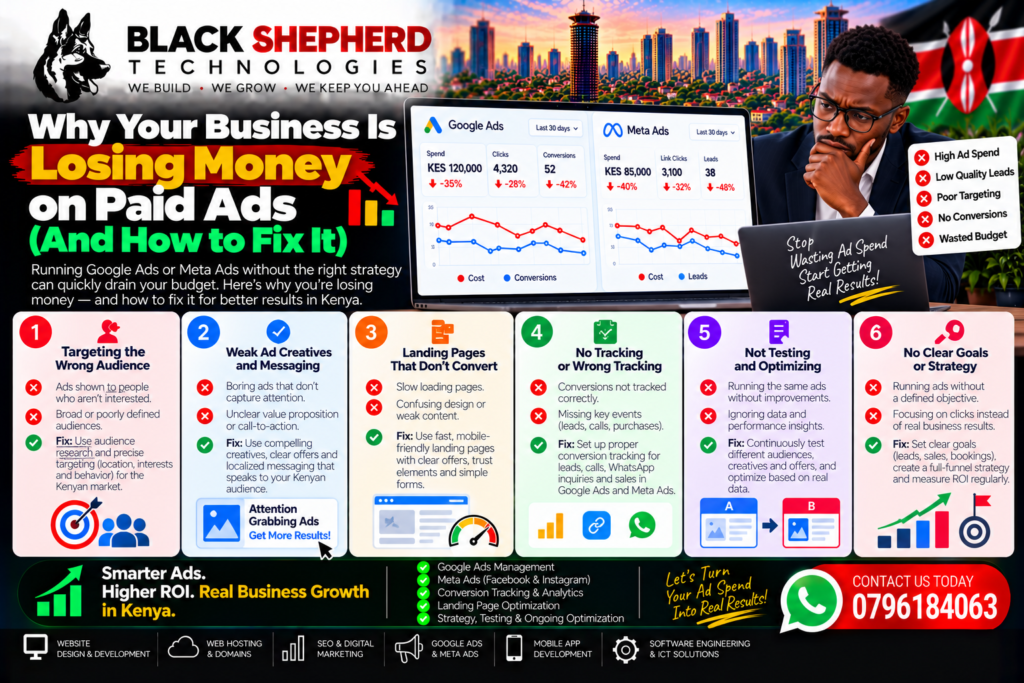
Why Your Business Is Losing Money on Paid Ads (And How to Fix It)
Paid advertising on platforms like Google Ads, Meta (Facebook & Instagram), TikTok, and LinkedIn is one of the fastest, most scalable channels for driving predictable revenue. However, for a vast majority of businesses, launching a paid ad campaign feels less like a strategic investment and more like a high-speed burn rate.
When campaigns fail to generate profitable returns, business leaders often blame the platform: “Google Ads are too expensive,” “Facebook ads don’t work for B2B,” or “TikTok traffic is too low-quality.”
In reality, digital advertising platforms are hyper-efficient auction ecosystems. When your campaigns bleed money, the cause is almost never the ad network itself. Instead, it stems from structural leaks across your advertising architecture—from tracking misconfigurations and poor bid management to broken funnel mechanics and misaligned landing pages.
This detailed guide outlines the 10 major reasons your business is losing money on paid ads, alongside step-by-step frameworks to fix each leak, maximize your return on ad spend (ROAS), and turn your advertising budget into a reliable growth engine.
1. You Are Optimizing for Clicks Instead of Business Conversions
One of the most frequent structural mistakes in digital advertising is choosing an ad campaign objective that incentivizes the platform’s algorithm to deliver low-value user actions instead of real revenue.
+-----------------------------------------------------------------------+
|                         CAMPAIGN OBJECTIVES                           |
+------------------------------------+----------------------------------+
|          TRAFFIC OBJECTIVE         |        CONVERSION OBJECTIVES     |
|       (Generates Low-Intent)       |       (Generates High-Intent)    |
+------------------------------------+----------------------------------+
| • High Volume Clickers             | • Lead Form Submissions          |
| • Accidental Tap Traps             | • E-Commerce Checkout Orders     |
| • High Bounce Rates (80%+)         | • Direct WhatsApp / Phone Calls  |
| • Bots & Cheap Inventory           | • Qualified CRM Pipeline Leads   |
+------------------------------------+----------------------------------+
The Problem
When you set your campaign objective to Traffic, Link Clicks, or Brand Awareness, you explicitly instruct the ad engine (e.g., Meta’s Delivery System or Google’s Smart Bidding) to find the cheapest possible users who are most likely to click a link.
Platforms know precisely which users click ads out of curiosity or by accident versus which users actually make purchases or fill out contact forms. By optimizing for traffic, you receive thousands of visits from low-intent users, automated bots, or accidental mobile taps. The result is high traffic volumes, high bounce rates, and zero pipeline impact.
The Fix
-
Align Objectives with Revenue: Rebuild your campaigns using Conversions, Leads, or Sales as the primary optimization goal.
-
Implement Event Thresholds: If you lack the weekly conversion volume (typically 30–50 conversions per ad set per week) required for algorithm learning, optimize for a higher-volume micro-conversion that strongly correlates with a sale—such as
Add to Cart,Begin Checkout, or spending over 2 minutes on a high-intent page. -
Incentivize High-Intent Actions: Direct social ad traffic to actionable conversion endpoints, such as embedded lead forms, interactive dynamic quote calculators, or direct messaging channels (like WhatsApp API integrations).
2. Broken, Incomplete, or Unvalidated Conversion Tracking
An ad algorithm is only as intelligent as the data feedback loop you feed into it. If your conversion tracking is incomplete, misconfigured, or broken, your ad platform operates in the dark, optimizing toward incorrect metrics.
                   +--------------------------------+
                   |    UNVALIDATED DATA FEEDBACK   |
                   +---------------+----------------+
                                   |
           +-----------------------+-----------------------+
           v                                               v
+---------------------+                         +---------------------+
|   Under-Reporting   |                         |    Over-Reporting   |
| (Algorithm deprives |                         | (Algorithm optimizes|
|  winning ad sets)   |                         | toward false signals|
+---------------------+                         +---------------------+
The Problem
Tracking errors manifest in two destructive ways:
-
Under-reporting: The ad platform records only a fraction of actual sales due to iOS privacy restrictions, ad-blockers, browser Cookie blocks, or missing post-purchase conversion tags. Believing the campaign is underperforming, the algorithm starves your best-performing targeting segments of impressions.
-
Over-reporting: A conversion pixel triggers every time a user refreshes a confirmation page, views a page without submitting a form, or opens a cart modal. The algorithm interprets these non-converting actions as success signals, continually serving ads to similar low-value audiences.
The Fix
-
Deploy Server-Side Tracking: Transition beyond simple client-side browser pixels by implementing server-side tracking, such as Meta Conversions API (CAPI) or Google Ads Server-Side Tagging via Google Tag Manager (GTM). Server-side tracking routes event data directly from your host server to the ad network, bypassing browser ad-blockers and cookie restrictions.
-
Deduplicate Client & Server Events: Ensure every conversion event carries a unique
event_idattribute so ad networks properly deduplicate instances where both the browser pixel and server API record the same action. -
Enforce Strictly Defined Trigger Conditions: Verify that conversion tags trigger exclusively upon explicit completion events—such as redirecting to a unique
/thank-you/page or firing a dynamic Webhook signal upon database entry.
3. Ignoring Negative Keywords in Google Ads
Google Search Ads put your business in front of users actively searching for your solutions. However, using broad keyword match types without maintaining aggressive negative keyword lists will drain your daily budget on irrelevant queries.
+-----------------------------------------------------------------------------------+
|                            SEARCH QUERY MATCH ENGINE                              |
+------------------------+---------------------------------+------------------------+
| Target Keyword (Broad) | Triggered User Search Query     | Intent / Result        |
+------------------------+---------------------------------+------------------------+
| "paid ad agency"       | best paid ad agency in Kenya    | HIGH INTENT (Target)   |
| "paid ad agency"       | free paid ad agency course pdf  | NO INTENT (Waste)      |
| "paid ad agency"       | paid ad agency jobs remote entry| NO INTENT (Waste)      |
+------------------------+---------------------------------+------------------------+
The Problem
Google incentivizes advertisers to adopt Broad Match keywords combined with Smart Bidding. While Broad Match expands your potential reach, it opens your campaign to search queries that bear zero commercial intent.
If you target
"web development company", broad match might trigger your ad for queries like:-
“free web development tutorial for beginners”
-
“web development company jobs in Nairobi”
-
“what is a web development company definition”
Every dollar spent on job seekers, students, DIY tutorial hunters, or consumers looking for free services is budget taken away from actual buyers.
The Fix
-
Audit Search Terms Regularly: Navigate to your Google Ads Insights & Reports > Search Terms report weekly. Filter search terms by spend and identify non-converting, low-intent terms.
-
Build Global Negative Keyword Lists: Maintain account-level negative keyword lists containing common non-buyer terms:
[Negative Keyword Grouping]
• Informational: free, cheap, DIY, how to, course, PDF, tutorial, example, template
• Employment: jobs, vacancies, salaries, career, internship, hiring, resume
• Software/DIY: open source, github, crack, download, nulled, script
-
Leverage Exact & Phrase Match Layers: Maintain granular control over core high-intent queries by isolating exact match
[keyword]and phrase match"keyword"ad groups with specific landing page copy and tailored bids.
4. Driving Paid Traffic to Generic Homepages
Sending paid traffic directly to a website homepage is one of the most reliable ways to burn an ad budget.
                             TRAFFIC FLOW COMPARISON

  POOR ARCHITECTURE (High Churn)            OPTIMIZED ARCHITECTURE (High Conversion)
  +-------------------------------+         +-------------------------------+
  |           Paid Ad             |         |           Paid Ad             |
  +---------------+---------------+         +---------------+---------------+
                  |                                         |
                  v                                         v
  +-------------------------------+         +-------------------------------+
  |        Generic Homepage       |         |   Dedicated Landing Page      |
  |  - Multiple Navigation Links  |         |  - Single Clear Value Prop    |
  |  - Unrelated Offers           |         |  - Direct Form / Checkout CTA |
  |  - High Visual Distractions   |         |  - Zero Exit Navigation Links |
  +---------------+---------------+         +---------------+---------------+
                  |                                         |
                  v                                         v
  +-------------------------------+         +-------------------------------+
  |     User Leaves (Bounce)      |         |     Qualified Lead / Sale     |
  +-------------------------------+         +-------------------------------+
The Problem
Homepages are designed to serve as broad directory hubs for general visitors, existing clients, job applicants, and partners. They feature header navigation menus, social links, company announcements, team summaries, and multiple competing Calls to Action (CTAs).
When a user clicks an ad expecting a specific solution and lands on a busy homepage, they face high cognitive load. Forced to search for the specific offer mentioned in the ad, most users bounce within seconds.
The Fix
-
Build Campaign-Specific Landing Pages: Construct dedicated, fast-loading landing pages for every active ad campaign. Ensure absolute message match between the headline of the ad creative and the primary h1 headline on the landing page.
-
Eliminate Unnecessary Exit Points: Remove global site navigation headers, footers, external blog links, and non-essential outbound buttons. The landing page should give the visitor only two choices: complete the conversion action or leave the page.
-
Optimize Page Load Speed: Ensure your landing page loads in under 2 seconds. A 1-second delay in mobile page response can decrease conversion rates by up to 20%. Compress asset files, eliminate heavy scripts, and utilize lightweight HTML architectures or static site frameworks to maximize delivery speed.
5. Ad Fatigue, Audience Overlap, and Creative Stagnation
Running identical ad creatives to the same audience for extended periods inevitably causes performance degradation.
                           THE AD FATIGUE CURVE
     ROAS / CTR
         ^
    High |       /-----\
         |      /       \  <-- Creative Fatigue Threshold
         |     /         \
         |    /           \  <-- Rising Frequency & Fatigue Sets In
     Low +--------------------------------------------------> Time / Impressions
The Problem
Ad fatigue occurs when target audiences view your ad creative multiple times. Over time, click-through rates (CTR) plummet while cost-per-click (CPC) and cost-per-acquisition (CPA) rise as platforms penalize ads with declining user engagement.
Simultaneously, businesses operating multiple ad sets often target overlapping audiences without audience exclusions. When Ad Set A and Ad Set B target similar demographics, your campaigns bid against themselves in the platform’s auction, driving up CPMs (Cost Per Mille).
The Fix
-
Monitor Ad Frequency Metrics: Track the Frequency metric (average times a unique user sees your ad). On prospecting social campaigns, when frequency passes 2.5–3.0 and CTR drops, refresh the creative immediately.
-
Implement Systematic Creative Rotation: Establish a creative pipeline that tests diverse ad angles, formats, and structures:
+--------------------------------------------------------------------+
|                      CREATIVE TESTING MATRIX                       |
+--------------------+-----------------------------------------------+
| Ad Format          | Variations to Test                            |
+--------------------+-----------------------------------------------+
| Visual Format      | Motion Graphic, UGC Video, High-Contrast Image|
| Hook Strategy      | Problem-First, Data/Stat-First, Case Study    |
| Value Proposition  | Speed/Efficiency, Cost Reduction, High Quality|
| Copy Structure     | Short Punchy, Long-Form Story, Bullet Points  |
+--------------------+-----------------------------------------------+
-
Configure Audience Exclusions: Prevent audience overlap by explicitly excluding past converters, existing email contacts, and active retargeting pools from prospecting campaigns.
6. Poor Audience Segmentation & Broad-Match Trap
Targeting everyone means appealing to no one. Setting targeting criteria too broad—or too narrow without sufficient algorithm signals—results in misallocated spend.
                               TARGETING MATRIX
+--------------------------+---------------------------------------------------+
| TARGETING TYPE           | CHARACTERISTICS & PITFALLS                        |
+--------------------------+---------------------------------------------------+
| Unfiltered Broad          | Low CPM, but reaches non-buyers with low intent. |
| Hyper-Segmented Stacking | High CPMs, artificially restricts scale and leads |
|                          | to rapid audience exhaustion.                     |
| Value-Based Lookalikes   | Balanced scale and intent; targets profiles that  |
|                          | match high-LTV customers.                         |
+--------------------------+---------------------------------------------------+
The Problem
Unfiltered broad targeting relies entirely on the platform to identify potential customers. Without clear value signals or custom creative hooks, your ad spend gets spent showing impression inventory to non-buyers.
Conversely, hyper-segmenting audiences—stacking dozens of detailed interests or targeting tiny geographic radius circles—artificially inflates CPMs and restricts the platform’s ability to locate high-converting users outside those narrow constraints.
The Fix
-
Let Creative Drive Segmentation: Modern ad engines use ad copy and visual hooks to qualify viewers. Write copy that explicitly speaks to your ideal customer profile (ICP) so the algorithm naturally delivers impressions to relevant users.
-
Build First-Party Data Lookalikes: Upload segmented customer lists (such as high-lifetime-value customers or repeat buyers) to construct 1% to 3% Lookalike/Similar Audiences, providing the ad network with a clear target demographic profile.
-
Segment Campaigns by Customer Intent: Separate cold prospecting audiences, warm engaged users, and hot decision-stage leads into distinct campaigns with unique messaging for each stage:
[Funnel Segmentation Strategy]
• TOFU (Top of Funnel - Cold Prospecting): Focus on broad problems, education, and brand value.
• MOFU (Middle of Funnel - Solution Consideration): Feature product demos, comparison guides, and social proof.
• BOFU (Bottom of Funnel - Decision): Offer direct incentives, explicit quotes, and risk-reversal guarantees.
7. Bidding Strategy Misalignment
Automated Smart Bidding strategies (e.g., Target CPA, Target ROAS, Maximize Conversions) are powerful tools, but applying them prematurely can quickly stall campaign performance.
                       BIDDING STRATEGY ROADMAP
+--------------------------------------------------------------------+
| PHASE 1: Launch Phase (< 30 Conversions/Month)                     |
| Strategy: Maximize Conversions / Enhanced CPC                      |
| Goal: Gather baseline event volume and train tracking engines.     |
+--------------------------------------------------------------------+
                                  |
                                  v
+--------------------------------------------------------------------+
| PHASE 2: Optimization Phase (30-50 Conversions/Month)              |
| Strategy: Target CPA (Cost Per Acquisition)                        |
| Goal: Stabilize cost-per-lead at a profitable target threshold.    |
+--------------------------------------------------------------------+
                                  |
                                  v
+--------------------------------------------------------------------+
| PHASE 3: Scale Phase (50+ Conversions/Month with Value Data)       |
| Strategy: Target ROAS (Return on Ad Spend) / Value Bidding         |
| Goal: Maximize total profit margin and high-value orders.          |
+--------------------------------------------------------------------+
The Problem
Smart Bidding algorithms rely on historical conversion volume to accurately predict auction outcomes. If you launch a brand-new campaign with a restrictive Target ROAS or Target CPA before the account has logged significant conversion data (typically 30 to 50 conversions per month per campaign), the system will severely restrict ad delivery or over-bid on limited inventory, causing performance to drop.
The Fix
-
Start with Maximizing Conversions: Launch new campaigns using Maximize Conversions or Enhanced CPC to allow the platform to gather initial event data and build statistical baselines.
-
Introduce Target CPA Gradually: Once the campaign reaches steady conversion volume, apply a Target CPA constraint. Set your initial target CPA slightly higher than your account’s real historical average to prevent suppressing impressions.
-
Shift to Value-Based Bidding: Integrate actual revenue values into your pixel setup. Switch to Target ROAS bidding only after your account systematically collects accurate order and pipeline values over a continuous 30-day window.
8. Misaligned Offer and Lack of Value Proposition
The best technical ad setup cannot sell an offer that the market does not want, does not understand, or does not trust.
                           THE VALUE ALIGNMENT MESH
+-----------------------+-----------------------+-----------------------+
|    PAID AD HOOK       |   VALUE PROPOSITION   |      CALL TO ACTION   |
+-----------------------+-----------------------+-----------------------+
| Captures Attention    | Clearly Solves a Pain | Low Friction Step     |
| Addresses Core Pain   | Removes Buying Risk   | Aligned with User     |
| Builds Curiosity      | Offers Clear Proof    | Intent Level          |
+-----------------------+-----------------------+-----------------------+
The Problem
Businesses frequently run ads featuring high-friction, low-value conversion requests to cold audiences—such as “Book a 60-Minute Paid Consultation” or “Buy Our Premium Package Now.”
Cold audiences rarely commit significant time or money on a first interaction. If your ad fails to communicate a clear, differentiated value proposition—or asks for too much commitment upfront—your conversion rate will remain near zero regardless of how well your targeting is configured.
The Fix
-
Reduce Friction for Cold Traffic: Replace high-commitment offers at the top of the funnel with low-friction, high-value conversion steps:
-
B2B / Service Providers: Offer instant audit frameworks, free cost estimators, clear pricing calculators, or concise downloadable strategy guides.
-
E-Commerce: Use introductory product bundles, limited-time welcome discounts, or interactive product matching quizzes.
-
-
Add Trust and Risk Reversals: Incorporate social proof directly into the ad creative and landing page, including verified client testimonials, review badges, case study results, and money-back guarantees.
-
Highlight Your Unique Selling Proposition (USP): Clearly answer the primary question every buyer considers: “Why should I choose your solution over competing alternatives or doing nothing at all?”
9. Friction-Heavy User Experience (UX) & Checkout Flows
Winning an ad auction and securing a click is only half the battle. If your mobile user interface is slow, difficult to navigate, or confusing, visitors will drop off before completing their purchase or form submission.
                           CONVERSION FUNNEL DROPOFF
+--------------------------------------------------------------------+
| 1,000 Ad Clicks                                                    |
+--------------------------------------------------------------------+
    |
    v (30% dropoff due to 4-second page load speed)
+--------------------------------------------------------------------+
| 700 Landing Page Views                                             |
+--------------------------------------------------------------------+
    |
    v (50% dropoff due to complex 12-field lead form)
+--------------------------------------------------------------------+
| 350 Initiated Conversions                                          |
+--------------------------------------------------------------------+
    |
    v (70% dropoff due to limited payment options / unexpected fees)
+--------------------------------------------------------------------+
| 105 Final Completed Purchases / Leads                              |
+--------------------------------------------------------------------+
The Problem
Ad traffic is predominantly mobile. If your landing page includes clunky form fields, non-responsive popups blocking the screen, slow-loading assets, or missing local payment options, your checkout drop-off rate will remain high.
For example, e-commerce stores operating in East Africa that fail to integrate seamless local mobile payment gateways (such as M-Pesa STK Push or instant checkout links) lose a significant portion of buyers during the payment step.
The Fix
-
Simplify Lead Capture Forms: Limit form inputs to essential fields only (e.g., Name, Email, Phone Number/WhatsApp). Every additional field added to a lead form decreases conversion completion rates by an average of 10%.
-
Optimize Mobile Experience: Test landing pages across multiple mobile devices, screen sizes, and connection speeds. Ensure interactive buttons are large, tap targets are clear, and text remains easy to read without zooming.
-
Integrate Localized Payment Gateways: Provide friction-free payment methods relevant to your target demographic:
[Payment Integration Options]
• E-Commerce / Local Retail: M-Pesa STK Push, Pesapal, Card Payments, Instant Pay-on-Delivery
• B2B / High-Ticket Services: One-Click Deposit Scheduling, Instant Invoicing, Direct WhatsApp Consultation Links
10. Failing to Nurture and Retarget Unconverted Traffic
Approximately 95% to 98% of cold paid ad traffic will not convert on their initial visit. Treating paid ads as a single-step purchase funnel leaves the majority of your traffic value on the table.
                     COMPLETE RETARGETING RECOVERY LOOP
+--------------------------------------------------------------------+
| COLD PROSPECTING TRAFFIC (TOFU)                                    |
| Brings 100% visitor volume; 2%-5% convert immediately.            |
+--------------------------------------------------------------------+
                                  |
                                  v (95% Unconverted Visitors)
+--------------------------------------------------------------------+
| DYNAMIC RETARGETING ENGINE (MOFU / BOFU)                           |
| • Sequence 1 (Days 1–3): Testimonial Ads & Product Demos           |
| • Sequence 2 (Days 4–7): Handling Objections & FAQ Highlights      |
| • Sequence 3 (Days 8–14): Limited-Time Offer / Direct Discount     |
+--------------------------------------------------------------------+
                                  |
                                  v
+--------------------------------------------------------------------+
| AUTOMATED EMAIL / WHATSAPP NURTURE                                 |
| Converts additional visitors over 30-to-90-day pipeline cycles.    |
+--------------------------------------------------------------------+
The Problem
If your marketing strategy stops once a cold user leaves your website, your customer acquisition cost (CAC) will remain high. Most prospects need multiple touchpoints with a brand to build sufficient trust before making a buying decision.
Ignoring retargeting sequences, lead-nurturing email automation, and immediate sales follow-ups guarantees that competitors capture prospects who were initially introduced to the market by your ads.
The Fix
-
Implement Multi-Stage Retargeting Sequences: Create segmented retargeting campaigns built on user behavior depth:
+--------------------------------------------------------------------+
|                      RETARGETING SEQUENCE MATRIX                   |
+-------------------+--------------------+---------------------------+
| Segment           | Timeframe          | Message Strategy          |
+-------------------+--------------------+---------------------------+
| Page Visitors     | Retarget Days 1–7  | Client Case Studies &     |
|                   |                    | Social Proof              |
| Cart Abandoners  | Retarget Days 1–3  | Direct Reminder & Risk    |
|                   |                    | Reversal (Guarantee)      |
| Form Drop-offs    | Retarget Days 4–14 | FAQ Answers & Free Demo   |
|                   |                    | Offers                    |
+-------------------+--------------------+---------------------------+
-
Automate Instant Lead Follow-Up: Set up immediate automated email, SMS, or WhatsApp responses when a lead form is submitted. Contacting a lead within 5 minutes of submission increases conversion likelihood by over 21 times compared to waiting an hour.
-
Capture Email & Contact Assets Early: Use popups with exit-intent triggers, free resource downloads, or interactive tools to collect contact information before visitors leave, converting cold ad clicks into owned audience lists.
Master Paid Ad Performance Audit Checklist
Use this diagnostic framework to quickly evaluate your active ad campaigns, isolate leaking spend, and systematically restore account profitability.
| Audit Phase | Item to Inspect | Verification Criteria | Status |
| 1. Optimization Goals | Campaign Objectives | Set explicitly to Conversions, Leads, or Sales (Not Traffic or Clicks). | [ ] |
| 2. Event Tracking | Tracking setup | Server-Side CAPI / Tag Manager configured with deduplicated event_id attributes. |
[ ] |
| 3. Negative Keywords | Search Terms Report | Reviewed weekly; account-level negative keyword lists actively applied. | [ ] |
| 4. Destination Page | Landing Page Alignment | Dedicated landing pages with absolute headline message match and < 2s load time. | [ ] |
| 5. Ad Fatigue & Frequency | Frequency & CTR | Creative refreshed when prospecting frequency passes 2.5–3.0 with declining CTR. | [ ] |
| 6. Audience Overlap | Audience Exclusions | Converters, active customers, and retargeting pools excluded from cold campaigns. | [ ] |
| 7. Bidding Mechanics | Smart Bidding Settings | Smart Bidding active only on campaigns with at least 30–50 conversions/month. | [ ] |
| 8. Conversion Friction | Forms & Checkout UX | Form fields kept minimal (<= 4 fields); localized payment options enabled. | [ ] |
| 9. Lead Follow-Up | Automated Response | Automated instant email/SMS/WhatsApp outreach triggers within 5 minutes of lead capture. | [ ] |
| 10. Lifecycle Retargeting | Retargeting Pipeline | Segmented sequential retargeting active for 7–30 day non-converting traffic pools. | [ ] |
Summary: Turning Ad Spend into Predictable Revenue
Losing money on paid ads is rarely caused by platform limitations or market saturation. In almost every scenario, underperforming campaigns are caused by underlying mechanical issues: optimizing for low-intent clicks, operating with inaccurate tracking, failing to manage negative search queries, or sending traffic to unoptimized homepages.
By executing the fixes outlined in this guide—aligning campaign goals with actual business revenue, setting up robust server-side event tracking, building dedicated landing pages, and establishing automated follow-up sequences—you eliminate wasted budget and build a scalable, high-return paid acquisition channel.
Need Expert Assistance Optimizing Your Paid Media?
If you want an expert team to audit your ad accounts, build fast conversion engines, or manage high-ROI performance campaigns, explore our complete suite of solutions at blackshepherd.co.ke. Our team helps businesses optimize their digital advertising funnel, implement server-side tracking architectures, and maximize measurable revenue across search and social channels.