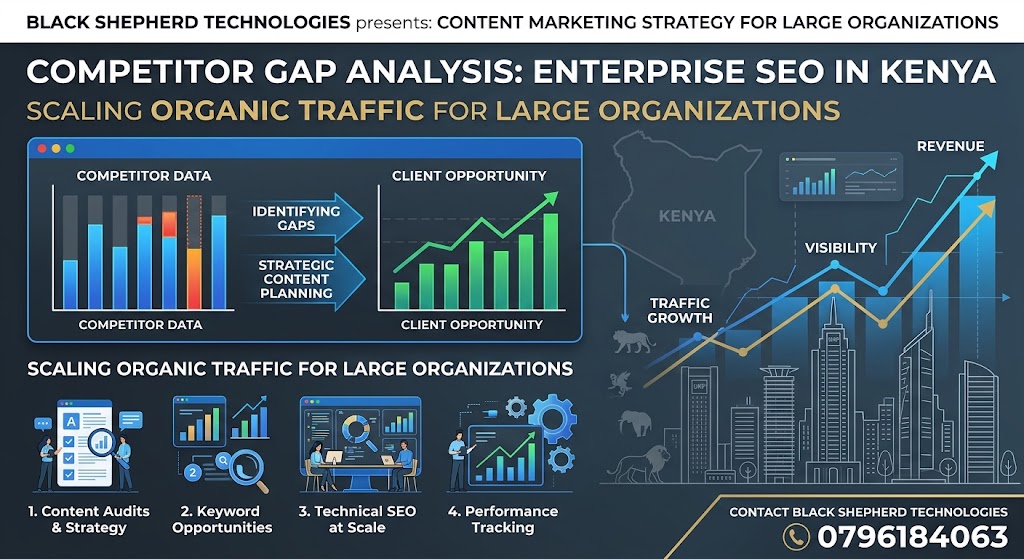
In today’s rapidly modernizing digital economy, Kenya has cemented its position as East Africa’s undisputed technological powerhouse. Driven by widespread smartphone adoption, robust high-speed internet infrastructure, and the pioneering spirit of fintech innovations like M-Pesa, consumer and business-to-business behaviors have permanently shifted online. From banking giants headquartered in Nairobi’s bustling Upper Hill financial district to multi-national FMCG brands distributing across East and Central Africa, large organizations face a common imperative: dominating search engine results pages (SERPs) to maintain market leadership.
However, scaling search visibility for large corporations is fundamentally different from optimizing a local business or a boutique ecommerce shop. When a website spans thousands—or hundreds of thousands—of pages, multiple subdomains, complex tech stacks, and various regional operational hubs, traditional SEO tactics simply fail to scale.
This comprehensive guide explores the strategic, technical, and organizational blueprint for executing successful enterprise search engine optimization in Kenya, driving sustainable growth, and ensuring your brand remains top-of-mind across digital touchpoints.
1. Defining Enterprise SEO in the Kenyan Business Context
Enterprise SEO refers to the practice of optimizing large-scale websites, complex site architectures, and broad digital footprints to increase organic visibility, user acquisition, and revenue growth. While traditional SEO often focuses on optimizing individual target keywords or resolving localized page-level technical bugs, enterprise SEO addresses structural challenges, cross-departmental workflows, and high-stakes market competition.
Small Business SEO vs. Enterprise SEO
To understand the scope of enterprise-level search optimization, it helps to contrast it with standard small-to-medium enterprise (SME) strategies:
| Dimension | SME / Local SEO | Enterprise SEO |
| Site Scale | Dozens to hundreds of pages. | Tens of thousands to millions of URLs across subdomains. |
| Tech Stack | Simple CMS (e.g., WordPress, Squarespace). | Custom headless CMS, legacy enterprise platforms (AEM, SAP Commerce), microservices. |
| Stakeholders | Single business owner or a small marketing team. | C-suite, IT/Engineering, Legal, Content, PR, and Procurement teams. |
| Execution | Quick implementation of site edits. | Complex governance, sprint cycles, staging environment testing, and sign-offs. |
| Keyword Scope | Targeted, low-to-medium volume local phrases. | Vast taxonomy covering broad commercial terms, intent clusters, and multi-region search terms. |
The Kenyan Enterprise Landscape
In Kenya, enterprise SEO challenges manifest uniquely across several thriving sectors:
- Financial Services & Banking: Institutions like KCB, Equity Bank, and NCBA manage complex digital portals featuring personal banking, corporate services, loan calculators, and international branch networks. They must rank for high-intent financial keywords while navigating strict regulatory compliance enforced by the Central Bank of Kenya (CBK).
- Telecommunications & Technology: Companies such as Safaricom and Airtel operate sprawling web platforms offering consumer subscriptions, enterprise cloud solutions, devices, and developer APIs. Managing technical crawl efficiency across millions of dynamic URLs is a constant operational focus.
- Retail & E-Commerce Aggregators: Large retail platforms and online marketplaces handle inventory across thousands of categories and product pages. Handling dynamic URL parameters, faceted search pagination, out-of-stock items, and local search queries (e.g., “smart TV delivery in Westlands”) requires specialized architectural oversight.
- Real Estate & Hospitality: Conglomerates and property management platforms managing multi-location developments and hotel chains across Nairobi, Mombasa, Naivasha, and Kisumu require precise local and structural SEO integration.
To successfully navigate these complexities, large organizations frequently partner with specialized agencies providing professional SEO services in Kenya to bridge the gap between technical strategy and execution.
2. Strategic Pillars of Enterprise SEO
Scaling organic search performance for complex Kenyan organizations relies on four foundational pillars: Technical Excellence, Scalable Content Architecture, High-Authority Link Acquisition, and Organizational Governance.
                  ┌─────────────────────────────────────────┐
                  │    ENTERPRISE ORGANIC GROWTH ENGINE     │
                  └────────────────────┬────────────────────┘
                                       │
         ┌──────────────────┬──────────┴───────────┬──────────────────┐
         │                  │                      │                  │
┌────────┴─────────┐ ┌──────┴──────────┐ ┌─────────┴────────┐ ┌────────┴─────────┐
│  Technical SEO   │ │ Content Strategy│ │ Digital Authority│ │  Governance &    │
│  & Architecture  │ │  & Governance   │ │ & Strategic PR   │ │ Cross-Functional │
└──────────────────┘ └─────────────────┘ └──────────────────┘ └──────────────────┘
3. Technical SEO at Scale: Taming Complex Architectures
For websites with massive page counts, technical issues compound exponentially. A minor canonical misconfiguration on an e-commerce platform can accidentally index 100,000 duplicate URLs, diluting search rankings and exhausting search engine crawl budgets.
Managing Crawl Budget Efficiency
Search engine bots (such as Googlebot) assign a finite “crawl budget” to every website based on its authority, speed, and update frequency. On enterprise websites, crawl waste is a primary blocker to organic visibility.
Common Sources of Crawl Waste
- Faceted Navigation & URL Parameters: Filter choices (price, color, size, location) generating infinite unique URLs.
- Duplicate Content Across Subdomains: Staging environments or regional subdomains accidentally left indexable by search bots.
- Broken Redirect Chains: Historical domain migrations resulting in multi-step 301 redirect chains.
- Soft 404 Errors: Out-of-stock product pages or expired listing URLs that return a status code of
200 OKdespite lacking relevant content.
Solution Architecture
- Robots.txt Optimization: Strategically block low-value parameter paths (e.g.,
Disallow: /*?sort=) without blocking access to critical visual scripts or CSS files. - Canonical Tag Enforcement: Implement strict self-referential canonical tags on master pages and direct parameter variations back to primary canonical URLs.
- Dynamic XML Sitemaps: Segment sitemaps logically by category, page count, or update frequency (e.g.,
sitemap-products-1.xml,sitemap-locations.xml), keeping entries under 50,000 URLs per file to facilitate rapid indexing.
JavaScript SEO and Rendering Pipelines
Modern enterprise websites increasingly rely on client-side JavaScript frameworks such as React, Angular, Vue.js, or Next.js to provide interactive, dynamic user interfaces. However, client-side rendering (CSR) introduces potential indexation delays because Google must execute JavaScript in a secondary rendering pass.
Client-Side Rendering (CSR):
[Fetch HTML (Empty Div)] ──> [Download JS] ──> [Execute Script] ──> [Render Content & Links]
                                                                        │
                                                                 (Delayed Indexing)

Server-Side / SSR / Hybrid:
[Fetch HTML (Pre-rendered HTML + Content)] ─────────────────────────> [Immediate Indexing]
To ensure instantaneous indexation of critical business content:
- Implement Server-Side Rendering (SSR) or Static Site Generation (SSG) using modern frameworks.
- Dynamic Rendering: Serve pre-rendered static HTML specifically to search crawlers while maintaining dynamic client-side interactions for human visitors when full SSR migration is technically constrained by legacy systems.
Page Speed Optimization & Core Web Vitals in East Africa
While Kenya boasts expanding 4G and 5G mobile network coverage, a substantial percentage of online traffic still accesses web properties via variable mobile network speeds across various regions. Google’s Core Web Vitals serve as explicit user experience and ranking signals:
- Largest Contentful Paint (LCP): Measures loading performance. Aim for $\le 2.5\text{ seconds}$.
- Interaction to Next Paint (INP): Measures responsiveness to user interactions. Aim for $\le 200\text{ milliseconds}$.
- Cumulative Layout Shift (CLS): Measures visual stability. Aim for a score of $\le 0.1$.
Technical Interventions for Enterprise Sites
- Edge Caching & Local CDNs: Utilize Content Delivery Networks (e.g., Cloudflare, Fastly, AWS CloudFront) with Points of Presence (PoPs) in Nairobi or Johannesburg to minimize latency for local users.
- Modern Image Formats: Convert legacy PNG/JPEG media to WebP or AVIF formats dynamically at the edge.
- DOM Node Reduction: Streamline nested elements generated by complex CMS frameworks to optimize browser parsing speeds.
4. Content Strategy & Topic Clustering for Kenyan Enterprises
Winning competitive search queries in enterprise environments requires moving beyond isolated keyword targeting toward building comprehensive topical authority. Search engines utilize advanced natural language processing models to evaluate whether a domain offers authoritative, end-to-end expertise within a given industry sector.
Building Strategic Hub-and-Spoke Topic Clusters
To establish category dominance, structure enterprise content using a clear Pillar and Cluster architecture:
                    ┌────────────────────────┐
                    │     PILLAR PAGE        │
                    │ Enterprise Cloud Banking│
                    └───────────┬────────────┘
                                │
       ┌────────────────────────┼────────────────────────┐
       │                        │                        │
┌──────┴──────────────┐  ┌──────┴──────────────┐  ┌──────┴──────────────┐
│    CLUSTER PAGE     │  │    CLUSTER PAGE     │  │    CLUSTER PAGE     │
│ CBK Cloud Compliance│  │ Migration Security  │  │ API Integration    │
└─────────────────────┘  └─────────────────────┘  └─────────────────────┘
1. Pillar Pages
Broad, overarching resources that cover a high-level subject comprehensively (e.g., “The Complete Guide to Enterprise Banking Solutions in Kenya”). These target high-volume, competitive head keywords.
2. Cluster Pages
In-depth sub-articles addressing specific sub-topics, long-tail search intents, and niche audience questions (e.g., “Navigating CBK Cloud Compliance Guidelines for Financial Institutions” or “API Integration Frameworks for Local Merchant Payment Gateways”).
3. Hyper-Contextual Internal Linking
Connect cluster pages back to the primary pillar page and horizontally to related sub-topics using descriptive, natural anchor text. This internal link equity flow signals clear semantic relationships to search engine crawlers.
Navigating Multi-Lingual and Cultural Nuances (Sheng, Swahili, and English)
Kenya’s business environment operates primarily in English for formal B2B transactions and corporate communications. However, consumer search behavior dynamically integrates English, Swahili, and colloquial Sheng.
Target Audience Strategy:
├── B2B / Corporate Decision Makers ──> Formal English Content
└── B2C / Consumer Retail Market     ──> Hybrid Strategy (English + Swahili / Contextual Nuance)
- Intent Matching: For consumer brands, evaluate whether users search using English terms (“apply for personal loan”), Swahili terms (“mkopo wa haraka”), or hybrid local phrasing.
- Localization over Direct Translation: Simply running content through automated translation tools creates unnatural language phrasing. Ensure local content creators write naturally tailored, culturally resonant copy.
- Hreflang Implementation: If your enterprise operates across multiple African jurisdictions (e.g., Kenya, Uganda, Tanzania, Rwanda), implement correct
hreflangannotations to prevent cross-border duplicate content conflicts:hreflang="en-ke"for English users in Kenyahreflang="sw-ke"for Swahili users in Kenyahreflang="en-ug"for English users in Uganda
Reviewing real-world implementations across various industries in our portfolios & projects offers concrete insights into how leading regional brands structure high-performing enterprise web properties.
5. Scalable Digital Authority & Strategic Link Acquisition
In enterprise search engine optimization, link building is not about buying low-quality blog outreach links. For large Kenyan corporations, acquiring authority involves transforming existing corporate initiatives, PR activities, and industry partnerships into high-equity backlinks that reinforce brand trust.
Enterprise Backlink Acquisition Strategy:
├── Brand-Driven PR (Press Releases, Industry Reports)
├── CSR & University Sponsorships (.ac.ke / .go.ke domains)
└── B2B Vendor & Channel Partner Ecosystem Alignment
Digital PR Strategies Tailored for the Kenyan Market
- Data-Driven Industry Insights: Large enterprises sit on vast proprietary data sets. Extracting anonymized data to produce quarterly market reports—such as “The State of Mobile Commerce Adoption in East Africa”—naturally earns coverage and editorial backlinks from authoritative Kenyan news portals (e.g., Business Daily Africa, The Standard, Nation Media Group, CIO Africa).
- Executive Thought Leadership: Position C-suite executives as industry experts on major business platforms. Authoring expert commentary on regulatory changes, economic trends, or technological advancements yields natural, high-authority brand mentions and links.
- CSR & Local Educational Partnerships: Major corporates frequently sponsor educational initiatives, university hackathons, or sustainable community programs. Securing mentions and links from educational domains (
.ac.ke) and government portals (.go.ke) provides high trust signals to search engine algorithms. - Vendor Ecosystem Alignment: Map out enterprise supply chain partners, technology vendors, and enterprise clients. Requesting mutual case studies or partner directory listings secures clean, relevant B2B backlinks.
6. Enterprise SEO Governance, Workflow, and Cross-Departmental Buy-In
The greatest barrier to enterprise SEO success in large Kenyan organizations is rarely technical knowledge—it is organizational friction. SEO initiatives often stall due to competing departmental priorities, technical backlogs, legal review delays, and lack of cross-functional understanding.
                              ┌─────────────────────────┐
                              │    SEO STEERING GROUP   │
                              └────────────┬────────────┘
                                           │
         ┌──────────────────┬──────────────┴──────────────┬──────────────────┐
         │                  │                             │                  │
┌────────┴─────────┐ ┌──────┴──────────────┐ ┌────────────┴───────────┐ ┌────────┴─────────┐
│ IT & Engineering │ │ Product Teams (UX) │ │ Marketing & Content    │ │ Legal & Corporate │
│ Integrates SEO   │ │ Embeds Organic     │ │ Executes Scaled        │ │ Ensures Quick    │
│ into Sprints     │ │ Requirements       │ │ Publishing             │ │ Compliance Checks│
└──────────────────┘ └────────────────────┘ └────────────────────────┘ └─────────────────┘
Breaking Down Organizational Silos
To scale search visibility, SEO must operate as a cross-functional discipline embedded throughout the business:
- Engineering & IT Teams: Work closely with software architects to integrate automated SEO linting checks into Continuous Integration/Continuous Deployment (CI/CD) pipelines. This prevents code deployments from accidentally dropping primary meta tags or blocking core page paths.
- Product Teams: Ensure organic search user experience (UX) requirements are integrated into the initial development stages of new digital features rather than treated as an afterthought post-launch.
- Legal & Compliance Teams: Create standardized content frameworks and pre-approved messaging guidelines for regulated sectors (such as banking, insurance, and healthcare). This accelerates sign-off timelines for newly published content.
- Corporate Communications: Educate PR teams to systematically request live context-rich hyper-links—not just plain-text brand mentions—in published digital media coverage.
Quantifying Business Impact for executive Leadership
C-suite executives rarely evaluate performance in terms of keyword rankings or organic traffic volume alone; they require clear business metrics:
$$\text{Organic ROI} = \frac{\text{Attributable Pipeline Revenue} – \text{SEO Program Investment}}{\text{SEO Program Investment}} \times 100$$
When reporting to boards and leadership teams in Nairobi, frame progress using commercial impact metrics:
- Organic Customer Acquisition Cost (CAC) vs. Paid CAC: Demonstrate how organic channel growth reduces reliance on paid media ad spend.
- Customer Lifetime Value (LTV) from Search: Track conversion performance and retained value from users acquired via search engines.
- Share of Voice (SoV) vs. Key Competitors: Benchmark digital SERP real estate ownership against top regional industry competitors.
7. Industry-Specific Enterprise SEO Playbooks in Kenya
Different enterprise sectors operate under distinct technical standards, search intents, and regulatory guidelines. tailored strategies are essential across the key industries we serve across Kenya and East Africa.
Sector-Specific Focus Areas:
├── Banking & Fintech     ──> YMYL Compliance, E-E-A-T, & Security Standards
├── Telecommunications    ──> Massive Scale Crawl Optimization & Subdomain Management
└── FMCG & Enterprise B2B ──> Category Dominance, Localized Search, & Thought Leadership
A. Financial Services & Fintech
- Primary Challenges: Strict regulations, complex security frameworks, legacy infrastructure, high competition on commercial keywords.
- Strategic Focus Areas:
- E-E-A-T (Experience, Expertise, Authoritativeness, Trustworthiness): Finance falls directly under Google’s “Your Money or Your Life” (YMYL) guidelines. Ensure all financial content is authored or thoroughly reviewed by certified industry professionals, featuring transparent author bios, credentials, and references to regulatory frameworks.
- Security Infrastructure: Ensure flawless HTTPS execution, robust SSL certificates, and zero security vulnerabilities across online banking subdomains.
B. Telecommunications & Internet Service Providers (ISPs)
- Primary Challenges: Extremely large site structures, high volume of promotional campaigns, dynamic service packages, overlapping content paths.
- Strategic Focus Areas:
- Campaign Lifecycle Management: Avoid creating disposable landing pages for seasonal promotions that are deleted after a few months. Instead, maintain permanent evergreen URL hubs (e.g.,
/fiber/home-internet) and update the underlying promotional content dynamically to retain accumulated link equity. - Geographic Hyper-Targeting: Build structured location hubs targeting specific business hubs, towns, and residential areas (e.g., “Fiber Internet for Businesses in Kilimani”, “Home Internet Coverage in Nakuru”).
- Campaign Lifecycle Management: Avoid creating disposable landing pages for seasonal promotions that are deleted after a few months. Instead, maintain permanent evergreen URL hubs (e.g.,
C. Fast-Moving Consumer Goods (FMCG) & Conglomerates
- Primary Challenges: Indirect consumer sales paths, brand awareness focus, managing multi-brand corporate portfolios.
- Strategic Focus Areas:
- Unbranded Intent Capture: Consumers rarely search directly for corporate parent entity names when looking for everyday solutions. Focus content on non-branded lifestyle, health, nutrition, or utility queries to capture early-funnel consumer intent.
- Structured Data Implementation: Implement detailed
Organization,Brand, andProductschema markup across regional portals to help search engine algorithms map multi-brand corporate relationships correctly.
8. Enterprise Technical & Architectural Audit Checklist
To ensure your digital platform is optimized for organic search performance at scale, perform regular technical audits against these core enterprise criteria:
Crawlability & Architecture
- [ ] Is
robots.txtoptimized to preserve crawl budget while allowing access to essential visual assets? - [ ] Are dynamic URL parameters managed via canonical tags or controlled in search engine webmaster tools?
- [ ] Is the site architecture structured logically so that important deep-level pages are accessible within 3 to 4 clicks from the homepage?
- [ ] Are dynamic XML sitemaps updated automatically and segmented logically by content type?
Technical Execution & Rendering
- [ ] Are JavaScript frameworks pre-rendered on the server side (SSR) or configured to serve crawlable static HTML to search bots?
- [ ] Are mobile Core Web Vitals (LCP, INP, CLS) passing recommended speed benchmarks across target regional markets?
- [ ] Are structural canonical tags implemented correctly across all page variations to prevent duplicate content issues?
- [ ] Is
hreflangmarkup configured accurately across multi-regional and multi-language subdomains?
Trust, Security, & E-E-A-T
- [ ] Is an enterprise-grade SSL certificate deployed seamlessly across all core domains and subdomains?
- [ ] Is JSON-LD structured schema markup (Organization, Article, Product, FAQ) deployed accurately across target page templates?
- [ ] Do YMYL pages clearly display verified author credentials, publication dates, and expert review disclosures?
Conclusion: Securing Long-Term Organic Leadership in Kenya
As Kenya’s digital ecosystem matures, enterprise search engine optimization is no longer merely a tactical marketing activity—it is a critical business driver that directly impacts market share, brand authority, and customer acquisition efficiency.
Successfully scaling organic traffic for large organizations demands a holistic approach: combining rigorous technical optimization and strategic, localized content production with cross-departmental governance and high-authority link acquisition. By building search best practices directly into your organization’s core operations, your brand can establish an enduring competitive advantage that grows in value over time.
Accelerate Your Enterprise Organic Growth
Navigating enterprise search optimization across complex systems requires strategic vision and technical expertise. Partner with our dedicated team of specialized engineers, search strategists, and digital architects to unlock long-term organic growth for your brand.
- Explore our full range of enterprise SEO services in Kenya.
- Discover real-world case studies in our portfolios & projects.
- Learn how we tailor our technical frameworks across the diverse industries we serve.