
The entrepreneurial spirit in Kenya is soaring to unprecedented heights. From the bustling tech hubs of Nairobi’s Kilimani, Westlands, and Ngong Road to vibrant business communities in Mombasa, Kisumu, Nakuru, and Eldoret, visionary founders are engineering digital solutions for Africa’s unique challenges. Whether in fintech, agritech, logistics, e-commerce, or healthcare, a brilliant business idea can spark anywhere.
However, a recurring nightmare haunts early-stage founders: The capital trap.
Many founders believe that bringing a mobile application to life requires millions of shillings, a dozen software engineers, and twelve months of development before anyone even sees the product. They empty their savings, borrow heavily from family, or pitch prematurely to investors with nothing more than a PowerPoint deck—only to watch their capital vanish on bloated feature sets, slow iterations, and products that target users ultimately ignore.
There is a smarter, leaner, and proven way to enter the market: The Minimum Viable Product (MVP) approach.
An MVP allows you to build the core version of your mobile app—featuring just enough functionality to solve your target user’s primary pain point—on a strict startup budget. It gets your product into the hands of real Kenyan consumers quickly, validates your business model with minimal financial risk, and preserves your precious capital for when traction demands it.
In this comprehensive, step-by-step guide, we will explore how you can conceptualize, budget for, design, and launch a high-impact MVP mobile app in Kenya without breaking the bank.
1. Deconstructing the MVP: What It Is (and What It Is Not)
Before writing a single line of code or allocating a single shilling, clarity is essential. The term Minimum Viable Product is frequently misunderstood.
What an MVP Is NOT:
- A buggy, half-finished application: An MVP should not crash every two minutes or feature broken buttons. It must work smoothly.
- A cheap prototype with no security: Even an MVP must protect user data and handle transactions securely.
- A massive “Super App”: It is not an app that tries to do twenty things at once.
What an MVP IS:
- Focused value: It delivers the single core value proposition that solves your customer’s most urgent problem.
- A learning vehicle: It is a strategic tool designed to test hypotheses about user behavior with minimal expenditure of time and money.
- A foundation for scale: Built on a clean, scalable codebase that can evolve as your user base and funding grow.
For example, if you are building an on-demand logistics and delivery startup in Nairobi, your MVP does not need in-app AI route optimization, multi-currency wallets, automated customer chat support bots, and advanced analytics dashboards. Your MVP simply needs:
- User registration and profile management.
- A simple pickup and drop-off location selector.
- A bulletproof M-Pesa STK push payment integration.
- A basic driver assignment and tracking notification.
Everything else is secondary noise that drains your startup budget.
2. Financial Realities: Budgeting for an MVP in Kenya
When bootstrapping a startup in East Africa, cash flow is oxygen. Understanding financial realities prevents founders from overspending before achieving product-market fit.
Estimating Realistic MVP Budgets in Kenya
While cheap template builders claim to build apps for KES 20,000, and bloated legacy agencies quote KES 3 million+, a realistic custom MVP development budget for a professional cross-platform mobile app in Kenya typically ranges from KES 150,000 to KES 600,000 (roughly $1,200 to $4,500 USD), depending on backend complexity and third-party integrations.
Where Your Budget Should Go:
- Discovery & Scoping (10%): Mapping out user personas, wireframes, and technical specifications. Do not skip this; building without a plan guarantees budget overruns.
- UI/UX Design (20%): Crafting clean, intuitive, high-converting interfaces optimized for local user habits and budget Android screens.
- Core Development (50%): Writing clean, cross-platform code (using frameworks like Flutter or React Native) and implementing essential API integrations (such as M-Pesa Daraja).
- QA Testing & Deployment (20%): Rigorous testing across local devices and networks, plus setting up Google Play Store and Apple App Store developer accounts.
Where NOT to Waste Your Budget:
- Custom server infrastructure: Use scalable cloud platforms (Firebase, AWS, Supabase) with pay-as-you-go pricing rather than buying physical servers.
- Premature branding campaigns: Do not spend millions on billboard advertising before your digital product is validated by actual users.
- Writing code from scratch for basic features: Leverage existing, secure authentication libraries, payment gateways, and cloud storage providers.
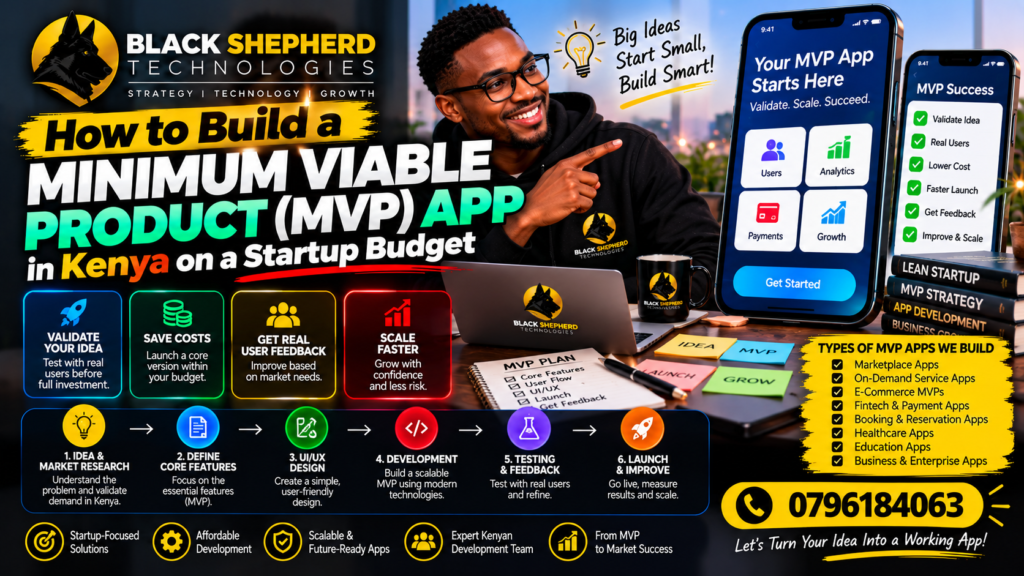
3. Step-by-Step Blueprint to Build Your MVP on a Startup Budget
Executing an MVP efficiently requires strict adherence to a lean product development lifecycle.
Step 1: Ruthless Feature Prioritization (The MoSCoW Method)
Sit down with your founding team and list every feature you want your app to have. Then, categorize them using the MoSCoW framework:
- Must Have: Features without which the app cannot function or solve the core problem (e.g., M-Pesa payment, core service listing).
- Should Have: Important but not vital for day-one launch (e.g., user reviews, rating systems).
- Could Have: Nice-to-have enhancements if time and budget permit (e.g., dark mode, social media sharing).
- Won’t Have (for now): Complex features parked for Version 2.0.
Slash everything except the “Must Haves.” That is your MVP scope.
Step 2: Design for the Kenyan Mobile Reality
Your UI/UX designer must understand local consumer psychology and hardware constraints:
- Data Conservation: Kenyan mobile users are conscious of data bundle consumption. Avoid bloated animations and heavy image resolutions.
- Device Fragmentation: Ensure your app is rigorously tested on popular mid-range Android devices (Tecno, Infinix, Samsung, Oppo) alongside iPhones. A design that looks stunning on an iPhone 15 Pro Max might break on a budget device popular in mass-market demographics.
- Instant Trust: Incorporate local trust signals—clear pricing in KES, verified badges, visible customer support contacts, and smooth M-Pesa checkout flows.
Step 3: Choose a Cost-Effective, Scalable Tech Stack
Choosing native development (separate codebases for iOS and Android) will instantly double your engineering costs.
- Cross-Platform Frameworks: Utilize Flutter (backed by Google) or React Native. A single codebase builds both iOS and Android apps simultaneously, cutting your front-end development costs and timelines by nearly 50%.
- Backend-as-a-Service (BaaS): Utilize Firebase or Supabase to handle user authentication, database management, and cloud storage without paying engineers to build server backends from scratch.
Step 4: Integrate Local Financial Gateways Seamlessly
In Kenya, if your app handles payments, it must integrate mobile money flawlessly. Partner with developers experienced in integrating Safaricom’s Daraja API (Lipa Na M-Pesa STK push). A failed payment gateway or a slow checkout confirmation will destroy user trust and kill your startup before it gains momentum.
4. Validating Your MVP Without Bleeding Capital
Building the MVP is only half the battle; validating it with real users on a bootstrap budget dictates your next moves.
1. Closed Beta Testing with Target Users
Before launching publicly on the app stores, deploy your MVP to a closed group of 50 to 100 beta testers. If you are building an agricultural marketplace, give it to farmers and traders in Meru or Nakuru. If you are building a student housing app, give it to university students in Nairobi or Eldoret. Watch how they use it without your guidance. Where do they get stuck? What features do they ignore?
2. Measuring Key Metrics
Do not rely on vanity metrics like total downloads. Focus on actionable retention metrics:
- DAU/MAU Ratio: Are users coming back day after day?
- Drop-off Funnel: At what exact screen do users abandon registration or checkout?
- Customer Feedback: Listen carefully to support messages and app reviews.
3. Iterating Lean
Use the feedback gathered from your MVP to make rapid, low-cost tweaks. Pivot if necessary before committing substantial capital to scaling marketing campaigns.
5. Integrating Your MVP into Your Broader Digital Ecosystem
An MVP app does not operate in a vacuum. To attract your first wave of users organically without spending a fortune on paid ads, your app must connect seamlessly with your digital footprint.
When potential users search for your solutions on search engines like Google, your web presence must capture their interest and guide them directly to app store download links. Partnering with a specialized digital agency ensures your website, search engine optimization (SEO), and mobile funnel work in perfect synchronization.
To explore how robust digital infrastructure, web design, and mobile execution align, examine our professional SEO and digital growth services in Kenya. Additionally, you can review our proven portfolio projects and explore the diverse industries we serve to discover how agile, cost-effective digital solutions drive commercial success across East Africa.
Conclusion: Build Smart, Launch Fast, Scale Wisely
Building a mobile app MVP on a startup budget in Kenya is entirely achievable when approached with strategic discipline, lean methodology, and a refusal to fall into the trap of feature bloat. By focusing strictly on core problem-solving, leveraging cross-platform frameworks, integrating M-Pesa seamlessly, and validating early with real users, you conserve capital while testing the waters of the digital economy.
Do not let financial intimidation keep your breakthrough idea locked in your head.
Ready to build and launch your startup’s MVP mobile app efficiently and affordably? Explore our industries we serve or inspect our portfolio projects to see how we help innovative founders turn bold visions into scalable digital realities.
How to Build a Minimum Viable Product (MVP) App in Kenya on a Startup Budget
The entrepreneurial spirit in Kenya is soaring to unprecedented heights. From the bustling tech hubs of Nairobi’s Kilimani, Westlands, and Ngong Road to vibrant business communities in Mombasa, Kisumu, Nakuru, and Eldoret, visionary founders are engineering digital solutions for Africa’s unique challenges. Whether in fintech, agritech, logistics, e-commerce, or healthcare, a brilliant business idea can spark anywhere.
However, a recurring nightmare haunts early-stage founders: The capital trap.
Many founders believe that bringing a mobile application to life requires millions of shillings, a dozen software engineers, and twelve months of development before anyone even sees the product. They empty their savings, borrow heavily from family, or pitch prematurely to investors with nothing more than a PowerPoint deck—only to watch their capital vanish on bloated feature sets, slow iterations, and products that target users ultimately ignore.
There is a smarter, leaner, and proven way to enter the market: The Minimum Viable Product (MVP) approach.
An MVP allows you to build the core version of your mobile app—featuring just enough functionality to solve your target user’s primary pain point—on a strict startup budget. It gets your product into the hands of real Kenyan consumers quickly, validates your business model with minimal financial risk, and preserves your precious capital for when traction demands it.
In this comprehensive, step-by-step guide, we will explore how you can conceptualize, budget for, design, and launch a high-impact MVP mobile app in Kenya without breaking the bank.
1. Deconstructing the MVP: What It Is (and What It Is Not)
Before writing a single line of code or allocating a single shilling, clarity is essential. The term Minimum Viable Product is frequently misunderstood.
What an MVP Is NOT:
- A buggy, half-finished application: An MVP should not crash every two minutes or feature broken buttons. It must work smoothly.
- A cheap prototype with no security: Even an MVP must protect user data and handle transactions securely.
- A massive “Super App”: It is not an app that tries to do twenty things at once.
What an MVP IS:
- Focused value: It delivers the single core value proposition that solves your customer’s most urgent problem.
- A learning vehicle: It is a strategic tool designed to test hypotheses about user behavior with minimal expenditure of time and money.
- A foundation for scale: Built on a clean, scalable codebase that can evolve as your user base and funding grow.
For example, if you are building an on-demand logistics and delivery startup in Nairobi, your MVP does not need in-app AI route optimization, multi-currency wallets, automated customer chat support bots, and advanced analytics dashboards. Your MVP simply needs:
- User registration and profile management.
- A simple pickup and drop-off location selector.
- A bulletproof M-Pesa STK push payment integration.
- A basic driver assignment and tracking notification.
Everything else is secondary noise that drains your startup budget.
2. Financial Realities: Budgeting for an MVP in Kenya
When bootstrapping a startup in East Africa, cash flow is oxygen. Understanding financial realities prevents founders from overspending before achieving product-market fit.
Estimating Realistic MVP Budgets in Kenya
While cheap template builders claim to build apps for KES 20,000, and bloated legacy agencies quote KES 3 million+, a realistic custom MVP development budget for a professional cross-platform mobile app in Kenya typically ranges from KES 150,000 to KES 600,000 (roughly $1,200 to $4,500 USD), depending on backend complexity and third-party integrations.
Where Your Budget Should Go:
- Discovery & Scoping (10%): Mapping out user personas, wireframes, and technical specifications. Do not skip this; building without a plan guarantees budget overruns.
- UI/UX Design (20%): Crafting clean, intuitive, high-converting interfaces optimized for local user habits and budget Android screens.
- Core Development (50%): Writing clean, cross-platform code (using frameworks like Flutter or React Native) and implementing essential API integrations (such as M-Pesa Daraja).
- QA Testing & Deployment (20%): Rigorous testing across local devices and networks, plus setting up Google Play Store and Apple App Store developer accounts.
Where NOT to Waste Your Budget:
- Custom server infrastructure: Use scalable cloud platforms (Firebase, AWS, Supabase) with pay-as-you-go pricing rather than buying physical servers.
- Premature branding campaigns: Do not spend millions on billboard advertising before your digital product is validated by actual users.
- Writing code from scratch for basic features: Leverage existing, secure authentication libraries, payment gateways, and cloud storage providers.
3. Step-by-Step Blueprint to Build Your MVP on a Startup Budget
Executing an MVP efficiently requires strict adherence to a lean product development lifecycle.
Step 1: Ruthless Feature Prioritization (The MoSCoW Method)
Sit down with your founding team and list every feature you want your app to have. Then, categorize them using the MoSCoW framework:
- Must Have: Features without which the app cannot function or solve the core problem (e.g., M-Pesa payment, core service listing).
- Should Have: Important but not vital for day-one launch (e.g., user reviews, rating systems).
- Could Have: Nice-to-have enhancements if time and budget permit (e.g., dark mode, social media sharing).
- Won’t Have (for now): Complex features parked for Version 2.0.
Slash everything except the “Must Haves.” That is your MVP scope.
Step 2: Design for the Kenyan Mobile Reality
Your UI/UX designer must understand local consumer psychology and hardware constraints:
- Data Conservation: Kenyan mobile users are conscious of data bundle consumption. Avoid bloated animations and heavy image resolutions.
- Device Fragmentation: Ensure your app is rigorously tested on popular mid-range Android devices (Tecno, Infinix, Samsung, Oppo) alongside iPhones. A design that looks stunning on an iPhone 15 Pro Max might break on a budget device popular in mass-market demographics.
- Instant Trust: Incorporate local trust signals—clear pricing in KES, verified badges, visible customer support contacts, and smooth M-Pesa checkout flows.
Step 3: Choose a Cost-Effective, Scalable Tech Stack
Choosing native development (separate codebases for iOS and Android) will instantly double your engineering costs.
- Cross-Platform Frameworks: Utilize Flutter (backed by Google) or React Native. A single codebase builds both iOS and Android apps simultaneously, cutting your front-end development costs and timelines by nearly 50%.
- Backend-as-a-Service (BaaS): Utilize Firebase or Supabase to handle user authentication, database management, and cloud storage without paying engineers to build server backends from scratch.
Step 4: Integrate Local Financial Gateways Seamlessly
In Kenya, if your app handles payments, it must integrate mobile money flawlessly. Partner with developers experienced in integrating Safaricom’s Daraja API (Lipa Na M-Pesa STK push). A failed payment gateway or a slow checkout confirmation will destroy user trust and kill your startup before it gains momentum.
4. Validating Your MVP Without Bleeding Capital
Building the MVP is only half the battle; validating it with real users on a bootstrap budget dictates your next moves.
1. Closed Beta Testing with Target Users
Before launching publicly on the app stores, deploy your MVP to a closed group of 50 to 100 beta testers. If you are building an agricultural marketplace, give it to farmers and traders in Meru or Nakuru. If you are building a student housing app, give it to university students in Nairobi or Eldoret. Watch how they use it without your guidance. Where do they get stuck? What features do they ignore?
2. Measuring Key Metrics
Do not rely on vanity metrics like total downloads. Focus on actionable retention metrics:
- DAU/MAU Ratio: Are users coming back day after day?
- Drop-off Funnel: At what exact screen do users abandon registration or checkout?
- Customer Feedback: Listen carefully to support messages and app reviews.
3. Iterating Lean
Use the feedback gathered from your MVP to make rapid, low-cost tweaks. Pivot if necessary before committing substantial capital to scaling marketing campaigns.
5. Integrating Your MVP into Your Broader Digital Ecosystem
An MVP app does not operate in a vacuum. To attract your first wave of users organically without spending a fortune on paid ads, your app must connect seamlessly with your digital footprint.
When potential users search for your solutions on search engines like Google, your web presence must capture their interest and guide them directly to app store download links. Partnering with a specialized digital agency ensures your website, search engine optimization (SEO), and mobile funnel work in perfect synchronization.
To explore how robust digital infrastructure, web design, and mobile execution align, examine our professional SEO and digital growth services in Kenya. Additionally, you can review our proven portfolio projects and explore the diverse industries we serve to discover how agile, cost-effective digital solutions drive commercial success across East Africa.
Conclusion: Build Smart, Launch Fast, Scale Wisely
Building a mobile app MVP on a startup budget in Kenya is entirely achievable when approached with strategic discipline, lean methodology, and a refusal to fall into the trap of feature bloat. By focusing strictly on core problem-solving, leveraging cross-platform frameworks, integrating M-Pesa seamlessly, and validating early with real users, you conserve capital while testing the waters of the digital economy.
Do not let financial intimidation keep your breakthrough idea locked in your head.
Ready to build and launch your startup’s MVP mobile app efficiently and affordably? Explore our industries we serve or inspect our portfolio projects to see how we help innovative founders turn bold visions into scalable digital realities.