
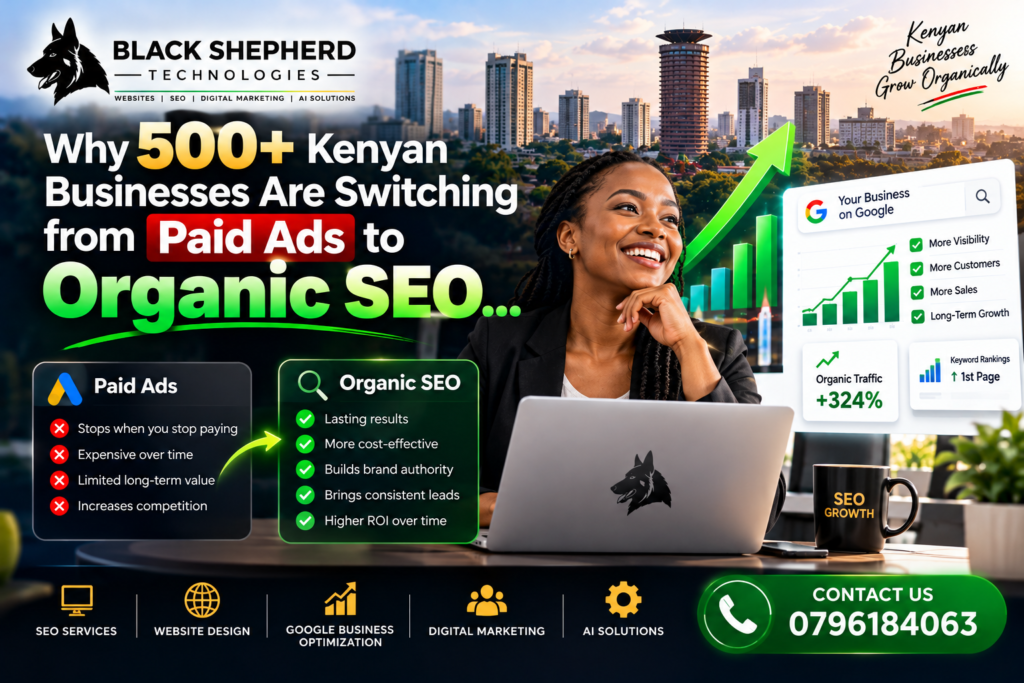
Walk into any boardroom or executive meeting across Nairobi’s commercial districts—from the towering corporate hubs of Upper Hill and Westlands to the bustling retail corridors of the CBD and Industrial Area—and you will hear a common frustration among business leaders: Digital advertising is becoming unsustainable.
For years, paid advertising on Google, Meta (Facebook and Instagram), and TikTok was the undisputed holy grail of digital customer acquisition. You loaded funds onto your virtual credit card or M-Pesa linked billing profile, set up your campaign targeting, and watched leads or sales roll in.
However, the digital economy in Kenya has matured rapidly. Over the last few years, more than 500 forward-thinking Kenyan enterprises—spanning e-commerce startups, logistics firms, hospitality brands, manufacturing companies, and professional service agencies—have undergone a strategic migration. They are actively shifting their primary marketing budgets away from perpetual paid ads and reallocating them toward organic Search Engine Optimization (SEO).
Why this mass migration? What do these businesses know that others are only just beginning to realize? Let’s dive deep into the economic, behavioral, and structural shifts driving Kenyan businesses to embrace organic search.
1. The Rising Cost of Digital Advertising in Kenya
The fundamental economic law of digital advertising is supply and demand. As more businesses enter the digital ecosystem in East Africa, the competition for digital real estate on search engine results pages and social feeds intensifies.
The CPC Inflation Trap
A few years ago, the Cost-Per-Click (CPC) for competitive commercial keywords in Kenya was remarkably low. Today, because every competitor in your niche is bidding on the exact same keywords, auction prices have soared.
-
E-Commerce and Retail: Retailers running Google Shopping or search ads find that profit margins are constantly squeezed by rising ad spend. When every shilling made is immediately funneled back into buying the next click, scaling profitability becomes an uphill battle.
-
B2B and Professional Services: Law firms, real estate developers, and software agencies bidding on high-intent keywords find themselves paying exorbitant fees per click, often with no guarantee that the click will convert into a qualified client.
The “Tap-To-Stop” Vulnerability
Paid ads operate like a utility bill: the moment you stop paying, the lights go out. If cash flow tightens—whether due to seasonal fluctuations, macro-economic shifts, or delayed client payments—and you pause your Google Ads or Meta campaigns, your lead flow drops to absolute zero overnight. You do not own your visibility; you rent it month-to-month.
2. Consumer Fatigue and Banner Blindness
Kenyan internet users are digitally savvy. With millions of active mobile devices accessing high-speed fiber and 4G/5G networks, consumers are constantly bombarded with sponsored posts, banner ads, pop-ups, and paid search results.
This over-saturation has given rise to banner blindness.
-
Modern buyers instinctively skip the top 2 to 4 “Sponsored” results on Google and scroll straight down to the organic listings.
-
Consumers perceive organic rankings as an endorsement of quality and authority. If Google’s algorithm places your business at the top of organic search results, users subconsciously view your brand as a trusted industry leader rather than a company simply paying for attention.
By shifting resources toward organic search optimization, businesses are meeting modern consumers where their trust actually resides.
3. The Power of Compounding Digital Assets
The defining financial argument for SEO—and the primary reason hundreds of Kenyan businesses are making the switch—is compounding economic return.
When you invest in comprehensive technical optimization, site speed improvements, mobile responsiveness, and high-intent content architecture, you are building a permanent digital asset.
Organizations that partner with specialists to execute targeted SEO services in Kenya quickly discover that unlike ad spend, which vanishes instantly, high-ranking organic pages continue to generate qualified leads month after month, year after year.
The 3-Year Trajectory Comparison
-
Year 1 (Paid Ads Model): You spend KES 1,500,000 on ads. You acquire a steady stream of traffic, but your Customer Acquisition Cost (CAC) remains flat or increases as competition rises. In Year 2, you must spend more to get the same results.
-
Year 1–3 (Organic SEO Model): You invest a comparable amount upfront into rigorous technical SEO, site architecture overhaul, and content creation. While results take a few months to compound, by Year 2 and Year 3, your organic rankings solidify. Your traffic surges, your reliance on paid ads drops dramatically, and your marginal cost of acquiring an extra customer approaches zero.
Reviewing a diverse portfolio of projects demonstrates how initial technical web investments transform raw corporate websites into automated, 24/7 lead-generation engines that operate independently of monthly advertising budgets.
4. Tailoring Strategy Across Diverse Kenyan Sectors
Every industry operates under different market dynamics. The migration from paid ads to SEO is not a one-size-fits-all approach; it is customized to fit the unique operational realities of different sectors. Exploring specialized industries we serve reveals how distinct the search landscape is across e-commerce retail, heavy manufacturing, logistics, corporate consultancy, and hospitality.
